eBook - ePub
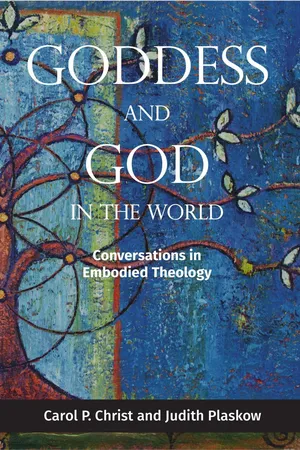
Goddess and God in the World
Conversations in Embodied Theology
- 364 pages
- English
- ePUB (mobile friendly)
- Available on iOS & Android
eBook - ePub
About this book
In Goddess and God in the World, leading theologians Carol P. Christ and Judith Plaskow propose a new method for thinking about theological questions: embodied theology rooted in experience and tested in dialogue. Their theological conversation begins from the premise that the transcendent, omnipotent male God of traditional theologies must be replaced with new understandings of divinity that can provide orientation and guidance as we face the social, political, and environmental challenges of our time. Situating divinity in the world and placing responsibility for the future firmly in human hands, they argue for an inclusive monotheism that affirms the unity of being through a plurality of images celebrating diversity and difference. Carol proposes that Goddess is the intelligent embodied love that is in all being, a personal presence that can inspire us to love the world more deeply. Judith counters that God is an impersonal power of creativity, the ground of being that includes both good and evil. Their probing of the autobiographical sources of their theologies combined with an intense questioning of each other's views offers both a new way of speaking about Goddess and God and a fruitful model of theological conversation across difference.
Information
Topic
Theology & ReligionSubtopic
Theology1
Embodied Theologies
1
For the Beauty of the Earth
Carol P. Christ
I was brought from the Huntington Hospital just before Christmas to my grandmother’s home on Old Ranch Road in Arcadia, California. Peacocks from the adjacent Los Angeles County Arboretum screeched on the roof. There was another baby in the house, my cousin Dee, born a few months earlier. My mother and her sister were living with their mother. The Second World War was over, and they were anticipating the return of their husbands from the Pacific Front. My earliest memory, recovered during a healing energy session, is visual and visceral. I am lying crossways in a crib next to the other baby. There is a soft breeze. The other baby is kicking its legs, and I am trying to do the same. I look up and see three faces looking down at us. Although the faces are blurry in the vision I see, I feel them as female and loving.
My parents had what was called a mixed marriage. My father’s family was Roman Catholic and my mother’s was Christian Science. This was at a time when Roman Catholics were viewed with suspicion in the United States. We were brought up in local Protestant churches in the postwar tract home suburbs of Southern California where my parents hoped we would all fit in. In church, I learned about the love of God without much mention of judgment. God was the one who made the ivy twine; He looked for the one lost sheep, and His love was divine, all loves excelling.[1] I knew what this meant, because I never doubted my grandmothers’ love for me. There was something about worship that attracted me, and I often begged my parents to get up to take me to church when they would have liked to stay in bed on a Sunday morning. I preferred the grown-ups’ service to Sunday school, and I enjoyed the uplifting feeling that enveloped me while singing hymns with the whole congregation. I loved thanking God “For the beauty of the earth, for the glory of the skies, for the love that from our birth, over and around us lies.”[2]
My grandmothers were more spiritual than my parents. When we stayed overnight with our grandmother Lena Marie Searing Bergman in Arcadia, we sat on the living room floor and played cards or dominoes while she listened to “The Christian Science Hour” on the radio or read from Mary Baker Eddy’s Science and Health. My mother didn’t discuss Christian Science with us except to say that she had felt embarrassed to have been seen as different in school. Our grandmother did not speak to us about her faith, but we knew that she did not believe in doctors or medicine and that she almost always had a positive attitude toward life. We listened with her to stories of miraculous faith healings, and we were quiet while she read and prayed. Although we got the measles, mumps, and chicken pox, my brother and I were rarely sick and often had perfect attendance records at school. We were raised with the assumption of health.
Grandmother Bergman had been raised on a farm in Michigan and was sturdy and tall—I got my height from her German, English, and Huguenot ancestors. Her garden was filled with roses and camellias that always graced her table at much-loved family meals. I can still picture her with a pitchfork in her hand turning over compost in the fruit orchard. Her pantry was filled with fruits and jellies she had preserved. When we were small, there was no fence separating her backyard from the arboretum, and she often took us on special walks through it. Even after the fence was put up, a hole emerged, and she showed us how to crawl through it with her. Grammy taught us that the world was a beautiful and magical place, and the peacocks that spread their tails for us in her garden and the peahens that brought their chicks to her back door convinced us that this was indeed true.
When I was six years old, I went to stay with my father’s parents in San Francisco. What was supposed to have been a short visit expanded into a whole summer. My grandparents adored me, and I was probably glad not to have to share the attention of adults with my younger, demanding brother. My grandmother Mary Rita Inglis Christ, who took the name Mae to avoid becoming Mary (the mother of Jesus) Christ, was delicate and tiny, much less than five feet tall. Though I would far surpass her in height, I inherited her Irish freckled skin, strawberry blonde hair, blue-green eyes, and facial structure. She and I would get up early to drive my grandfather Irv to the train he took to work in the mornings. Afterward, we sometimes went to Lake Merced to see the ducks. Other mornings we went to the Pacific Ocean beach where my little grandmother removed her shoes and stockings to run with me in the sand. Usually we also stopped at the local Catholic Church where my Nannie lit a candle in a blue glass vase for Uncle Bobby who was away in the Korean War. We sat together in the still dark church while she prayed the rosary on her lavender faceted beads. She spoke often of the Blessed Virgin. I delighted in her love of life and absorbed her faith without the need of many words.
Discord and Death
My childhood world was not all rosy. Our father was strict and sometimes angry, and I was an awkward, quiet, tall, smart child who didn’t always feel at home with the other kids, especially after we moved to a lower-middle-class neighborhood where being smart was not valued, but playing spin the bottle at the age of nine and ten out of the sight of parents was. In the church we joined after our move, I was not fully accepted by the other girls because we were newcomers in town and lived on the wrong side of the railroad tracks. Their mothers refused to let me join their daughters’ Girl Scout troop. My father’s family time was given to Little League and incessant baseball practice limited to my brother only. My mother had a baby when I was ten years old, and I threw myself into the role of second mother. I fed and diapered the new baby and treated him like he was my own. I started babysitting and prided myself on being able to put five kids under the age of five to bed all by myself.
When I was fourteen, my world fell apart. My father’s mother was diagnosed with cancer and kept alive on tubes much longer than she should have been. My mother vowed that this would never happen to her. Our maternal grandfather, who had been bedridden at home for a long time following a stroke, died the same year. Then the second baby my mother and I were planning to raise together died without even having been brought home from the hospital. The only time I saw him was in the open coffin. While he was dying, I promised God that I would never fight with my other brother again if the baby lived. God did not answer my prayer. My mother fell into a depression that lasted for years. Before I was nineteen, I had also lost my other grandfather in a fire, and one of my only two aunts to a tragic prescription drug overdose. While other students may have felt carefree in their college years, I was struggling to understand the meaning of a life that included so much death.
Entering into Western Culture
I went to Stanford because my high school guidance counselor told my parents that, with my grades and scores, I should not go to the local junior college, but somewhere that would challenge my mind. My parents would not let me apply out of state. I got into Stanford with a partial California State Scholarship, worked summers as a telephone solicitor, and my parents made personal sacrifices to pay the difference. When they sent me to college, my parents expected me to get a teaching credential, teach for a few years before I got married, and have a profession to fall back on if my husband died. I probably would have followed this path if I had started dating in my first year of college. I did not know any women who spoke about careers and had no ambition to have one. However, because I was over six feet tall, extremely shy, and quite overwhelmed by college, I did not start dating, much to my chagrin. I also was totally unprepared for Stanford, because I had never even heard of Plato and Aristotle or the Middle Ages. At some point, I looked around me and saw that most of the other girls were dating as well as getting better grades than I was. I did not know how to make the boys ask me out, but, I figured, at least I could improve my grades. Because of my lack of background, this meant studying pretty much night and day and during weekends and holidays.
I spent six months of my sophomore year at Stanford-in-Florence. There we read Augustine and Dante and visited Christian churches and immersed ourselves in Christian art. I think living in close connection to monuments of Christian history gave me an embodied sense that Christianity had a history and was much more than the social club it often seemed to be for my parents and their friends. I spent many hours in churches meditating on the frescoes and praying where so many others had prayed before me. I did not always know the questions I was asking, but I sensed that all the feelings of my heart were taken up into the shadowy darkness.
The book that most impressed me that year was Augustine’s Confessions.[3] I not only read it but reread it many times. I identified with Augustine’s search for God and his struggle to understand God’s presence in his daily life. His was a spiritual passion combined with intellectual acuity and persistence that I had never experienced before. Until that time, I had often been told that I was thinking too much or that my questions about God didn’t really matter. Reading Augustine, I began to see that there was a way to combine my grandmothers’ spiritual intensity with my own intellectual curiosity and desire to make sense of the questions that had arisen in my life. I wanted to know why my brother had died, and I wanted to understand why I so often felt alone with my questions. In Augustine, I felt a spiritual kinship that I did not find in church or among my contemporaries at Stanford. I would continue to read and reread Augustine during my undergraduate and graduate school years and use him as a model for bringing full engagement of mind and body, heart and head, to theological questions. In those days, I understood Augustine’s struggle with the flesh symbolically and did not identify with the woman he viewed as an impediment to his relationship with God.
Falling in Love with God
When I returned to Stanford, I enrolled in an Old Testament course for background. The professor presented the Bible as a book that raised more questions than it answered. I fell in love with the Old Testament and idolized the professor who taught it. During Christmas break, I learned enough Hebrew on my own to join the second quarter class. I suppose I thought that if I could read the Bible in God’s own language I would understand Him better. I was fascinated with a God who did not stay in the heavens but came down to earth to enter into a covenant with His own special people. The Hebrew people did not hold God in awe, but dared to converse and even disagree with Him. God’s people, our professor loved to point out, were a “stiff-necked people,” but God loved them anyway. God’s on-again off-again relationship with His people echoed my father’s stormy relationship with me and seemed to hold a clue to the relation of life and death. I needed to believe in a God whose “steadfast love” was overflowing with a compassion that stemmed his judgment and anger. I needed a God whose love conquered death. I was deeply moved by the prophets’ understanding that God cares about the widow at the gate and that the proper way to worship Him is to care for her. In my senior year, I chose to write my thesis on “Nature Imagery in Hosea and Second Isaiah” because the images of the trees of the field clapping their hands on the day of redemption resonated with my grandmothers’ and my spiritual feelings in nature. At my oral, I stumbled when I was asked if the prophets’ imagery was a pathetic fallacy. I did not know the meaning of the term, and it had never crossed my mind that the prophets did not intend to say that God loves and redeems trees as well as people. As in my reading of Augustine, I failed to recognize the significance for me as a woman of the fact that Hosea portrayed female sexuality as source and symbol of evil.
I studied theology with Roman Catholic Michael Novak, whose Belief and Unbelief[4] shaped my future study of religion. Novak defined a process of understanding he called “intelligent subjectivity” that incorporates mind, body, and feeling. I was extremely lucky to have been taught to question the widely accepted ideal of scholarly objectivity so early in my career. Through Novak, I was introduced to the idea that all thinking is situated in personal, cultural, and historical experience, long before standpoint theory became popular. Novak gave me the tools I would need to combine head and heart in my studies and to resist ideas and ways of thinking that did not make sense in my own life. He also taught me that theologies need to be open to the world, as advocated by Vatican II. In Belief and Unbelief, Novak asked existential theological questions—questions about the meaning of life. He entered into dialogue with Dr. Rieux of Albert Camus’s The Plague.[5] For Dr. Rieux the pervasiveness of death and undeserved suffering in the world argued against the existence of God. The questions raised in The Plague haunted me too, and I would introduce students to them when I began teaching. Novak came very close to agreeing with Camus, but in the end concluded that because we humans “sometimes love and understand,” there is reason to believe in a God who loves and understands.
My favorite theologian was Martin Buber, whose idea that the meaning of life was found in the I-Thou relationship w...
Table of contents
- Cover
- Additional Praise for Goddess and God in the World
- Title Page
- Copyright
- Table Of Contents
- Introduction: Goddess and God in Our Lives
- Embodied Theologies
- Theological Conversations
- List of Publications: Carol P. Christ
- List of Publications: Judith Plaskow
- Index
Trusted by 375,005 students
Access to over 1.5 million titles for a fair monthly price.
Study more efficiently using our study tools.
Frequently asked questions
Yes, you can cancel anytime from the Subscription tab in your account settings on the Perlego website. Your subscription will stay active until the end of your current billing period. Learn how to cancel your subscription
No, books cannot be downloaded as external files, such as PDFs, for use outside of Perlego. However, you can download books within the Perlego app for offline reading on mobile or tablet. Learn how to download books offline
Perlego offers two plans: Essential and Complete
- Essential is ideal for learners and professionals who enjoy exploring a wide range of subjects. Access the Essential Library with 800,000+ trusted titles and best-sellers across business, personal growth, and the humanities. Includes unlimited reading time and Standard Read Aloud voice.
- Complete: Perfect for advanced learners and researchers needing full, unrestricted access. Unlock 1.5M+ books across hundreds of subjects, including academic and specialized titles. The Complete Plan also includes advanced features like Premium Read Aloud and Research Assistant.
We are an online textbook subscription service, where you can get access to an entire online library for less than the price of a single book per month. With over 1.5 million books across 990+ topics, we’ve got you covered! Learn about our mission
Look out for the read-aloud symbol on your next book to see if you can listen to it. The read-aloud tool reads text aloud for you, highlighting the text as it is being read. You can pause it, speed it up and slow it down. Learn more about Read Aloud
Yes! You can use the Perlego app on both iOS and Android devices to read anytime, anywhere — even offline. Perfect for commutes or when you’re on the go.
Please note we cannot support devices running on iOS 13 and Android 7 or earlier. Learn more about using the app
Please note we cannot support devices running on iOS 13 and Android 7 or earlier. Learn more about using the app
Yes, you can access Goddess and God in the World by Carol P. Christ,Judith Plaskow in PDF and/or ePUB format, as well as other popular books in Theology & Religion & Theology. We have over 1.5 million books available in our catalogue for you to explore.