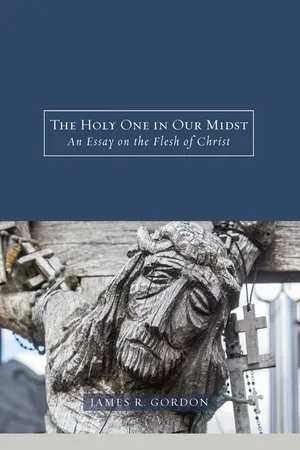
The Holy One in Our Midst: An Essay on the Flesh of Christ aims to defend the doctrine of the extra Calvinisticumthe doctrine that maintains the Son of God was not restricted to the flesh of Christ during the incarnationby arguing that it is logically coherent, biblically warranted, catholically orthodox, and theologically useful. It shows that none of the standard objections are devastating to the extra, that the doctrine is rooted in the claims of Christian Scripture and not merely a remnant of perfect being philosophical theology, and that the doctrine plays an important role in contemporary theological discussion. In this way, James Gordon revives an important Catholic doctrine that has fallen out of favor in contemporary theology. Also, this project aims to integrate biblical, philosophical, and systematic theology by showing that the tools and methods of each distinct discipline can contribute to the goals and aims of the others.
- 320 pages
- English
- ePUB (mobile friendly)
- Available on iOS & Android
eBook - ePub
About this book
Information
Topic
Theology & ReligionSubtopic
Christian Theology5
(De)Limiting the Flesh of Christ: The Proper Dogmatic Uses of the Extra Calvinisticum
This chapter offers an account of the proper and improper dogmatic uses of the extra Calvinisticum. In order to do so, we will refute the suggestion that the extra ought to function only in a small, christological capacity, examine two of the most significant positive uses of the extra in modern theology, suggest three specific theological loci the extra informs, and propose a way to discern what sorts of dogmatic uses of the extra are illegitimate.
Response to McGinnis: Extending and Expanding the Extra
As we discussed in chapter 1, the most recent study on the extra Calvinisticum, Andrew McGinnis’s The Son of God beyond the Flesh, traces several recent uses of the extra and argues that rather than expanding the uses of the doctrine beyond its historical-christological location, the extra ought to remain “significant and limited” and function only in a relatively limited manner in Christology proper.[1] McGinnis claims that “those authors who wish to extend the extra [beyond Christology] should justify their decision to do so by giving reasons why a doctrine about the incarnate Son ought to be extended.”[2] Here we will attempt to provide justification for our claim that the extra ought to be extended and expanded into other loci of theology.
McGinnis’s Argument
Let us begin by examining McGinnis’s reasoning for why the extra Calvinisticum ought to remain confined to the realm of Christology. In each of the authors whose employment of the extra he finds troublesome (Barth, Thielicke, Link, van der Kooi, and Gamberini), McGinnis sees a common trait: “Those who have sought to extend or expand the use of the extra . . . have typically located Christology, typically the doctrine of the incarnation, at the center or foundation of their theological method.”[3] He continues, “In this way, it was not so much the extra that has been relocated, but Christology itself. In cases where the incarnation is a theological principium—where a methodological christocentrism operates—there is an opening for expansive use of the extra that goes far beyond its traditional limited use in premodern theology.”[4] In other words, when Christology becomes the lens through which all other theological loci are viewed, then a seemingly small point of Christology (viz., the extra) morphs into something larger and more significant than it should have been and becomes a controlling feature of one’s theology. Unfortunately, McGinnis never offers significant argument for why such relocation—either of Christology in general or the extra in particular—is problematic; he merely asserts that it is.[5] Despite the lack of argument offered, however, one can detect in the critique a measure of continuity with other similar critiques of so-called Barthian christocentrism.
A Reformed Critique of Barth
While McGinnis does not acknowledge it, he is repeating two recent critiques of Barthianism common in a specific stream of the Reformed tradition, namely, those of Richard Muller and Paul Helm. Muller, for example, argues that “the Christocentric proclamation of Barth becomes a ‘principial’ Christocentrism, a use of Christ (instead of and prior to Scripture) as the principium cognoscendi theologiae . . . it becomes a Christological reductionism, a ‘Christomonism,’ as some have labelled it.”[6] Muller goes on to say that “the Barthianization of history,” in which authors find Barth’s christocentrism in writers who predate him, leads to a rejection of natural theology. Moreover, Muller claims that Barth “ultimately do[es] away with the extra-Calvinisticum,” expressing “a strong distaste for any notion of a Logos asarkos.”[7] Along similar lines, Helm claims that Barth’s negative comments regarding the extra Calvinisticum stem from his emphasis of God’s economic acts, such that there is no room for God’s hiddenness beyond what is revealed in Christ.[8]
We will not go to great lengths here to defend Barth’s christocentric methodology. In fact, we will note below how christocentrism in general creates tensions with an affirmation of the extra Calvinisticum. However, we must mention several things about the charge Muller and Helm level against Barth. Muller himself recognizes that the term christocentric is rather ambiguous and demands further qualification. As such, he distinguishes between soteriological, prototypical/teleological, and principial christocentrisms.[9] While soteriological christocentrism affirms “the absolute and necessary centrality of Christ to the work of salvation,” and while prototypical christocentrism focuses on “Adam-Christ typology and the priority of Christ over Adam,” principal christocentrism understands “Christ (rather than Scripture and God) as both principium essendi and principium cognescendi theologiae.”[10] Muller finds problematic in Barth the third type of christocentrism—principial christocentrism. First of all, in response, we must note that Muller’s flat reading of Barth is insufficient. The way in which, for Barth, Christ relates to “Scripture and God,” which he supposedly usurps as theology’s principle of being (ontology) and knowledge (epistemology), is much more complex than Muller allows. Recent treatments of Barth’s hermeneutics and exegesis have shown that a simple Christ-principle does not adequately account for the way Barth reads Scripture. Richard Burnett’s examination of Barth’s early hermeneutics, for example, shows that Barth’s reading of Scripture was motivated by an account of the being of God as well as a rejection of the hermeneutical tradition of Schleiermacher.[11] In addition, Donald Wood argues that Barth develops an entirely Trinitarian “Scripture principle” in his Church Dogmatics.[12] Paul Nimmo, further, has shown that Barth’s exegetical practice is bound up with his understanding of God’s grace, Trinitarian self-giving, and commitment to present Godself in the scriptural witness.[13] This is certainly not to suggest that Barth is not rightly labeled “christocentric.” However, in order to understand Barth’s theological methodology properly, one must note that a variety of theological themes and motifs are tied together in his thought in a way that complicates Muller’s overly simplistic critique.[14]
Second, it is not entirely clear just what constitutes christocentrism and who gets to define that in which it consists. Marc Cortez has attempted to state carefully what it means to call Barth “christocentric.” Rather than affirming, with Muller, that Barth “argues . . . speculatively, that the Christ-idea must be used as the interpretive key to understanding and elucidating all doctrinal topics,”[15] Cortez reads Barth much more carefully: “The consistency of Barth’s christocentrism is not based on systematic speculations but on a commitment to the reality-defining significance of the incarnation.”[16] It is not as if Barth rashly decided to turn the order of theology on its head for no good reason; rather, he was attentive to an area of tension in previous theologies that he felt demanded a prioritizing of Jesus Christ. Cortez’s reading of Barth takes into account the way Barth read Scripture and his concern for theological ontology. With this in mind, it is at least somewhat ironic that the sort of christocentrism that Muller sees as the gateway to speculation, Bruce McCormack sees as its solution. “Why,” McCormack asks, “should Christian theology be christocentric? Because . . . [it] puts an end to speculative treatments of the being and attributes of God. Barth’s christocentrism, by putting an end to metaphysics, also puts an end to speculation.”[17] For Muller, speculation consists in emphasizing the centrality of Christ, and for McCormack and Barth, speculation begins in failing to emphasize the centrality of Christ.
To state the tension more clearly, for Muller and Helm, Barth is speculative because he constructs a christological edifice incompatible with their account of God’s being and of...
Table of contents
- Cover
- Title Page
- Copyright
- Table Of Contents
- Acknowledgments
- Abbreviations
- Preface
- The Flesh of Christ and the Extra Calvinisticum
- The Flesh of Christ in Modern Theology: Objections to the Extra Calvinisticum
- The Logos and the Flesh of Christ: Responding to the Objections to the Extra Calvinisticum
- The Temple of God and the Flesh of Christ: A Constructive Argument for the Extra Calvinisticum
- (De)Limiting the Flesh of Christ: The Proper Dogmatic Uses of the Extra Calvinisticum
- Why One Ought to Embrace the Extra Calvinisticum
- Bibliography
- Index
Trusted by 375,005 students
Access to over 1.5 million titles for a fair monthly price.
Study more efficiently using our study tools.
Frequently asked questions
Yes, you can cancel anytime from the Subscription tab in your account settings on the Perlego website. Your subscription will stay active until the end of your current billing period. Learn how to cancel your subscription
No, books cannot be downloaded as external files, such as PDFs, for use outside of Perlego. However, you can download books within the Perlego app for offline reading on mobile or tablet. Learn how to download books offline
Perlego offers two plans: Essential and Complete
- Essential is ideal for learners and professionals who enjoy exploring a wide range of subjects. Access the Essential Library with 800,000+ trusted titles and best-sellers across business, personal growth, and the humanities. Includes unlimited reading time and Standard Read Aloud voice.
- Complete: Perfect for advanced learners and researchers needing full, unrestricted access. Unlock 1.5M+ books across hundreds of subjects, including academic and specialized titles. The Complete Plan also includes advanced features like Premium Read Aloud and Research Assistant.
We are an online textbook subscription service, where you can get access to an entire online library for less than the price of a single book per month. With over 1.5 million books across 990+ topics, we’ve got you covered! Learn about our mission
Look out for the read-aloud symbol on your next book to see if you can listen to it. The read-aloud tool reads text aloud for you, highlighting the text as it is being read. You can pause it, speed it up and slow it down. Learn more about Read Aloud
Yes! You can use the Perlego app on both iOS and Android devices to read anytime, anywhere — even offline. Perfect for commutes or when you’re on the go.
Please note we cannot support devices running on iOS 13 and Android 7 or earlier. Learn more about using the app
Please note we cannot support devices running on iOS 13 and Android 7 or earlier. Learn more about using the app
Yes, you can access The Holy One in Our Midst by James R. Gordon in PDF and/or ePUB format, as well as other popular books in Theology & Religion & Christian Theology. We have over 1.5 million books available in our catalogue for you to explore.