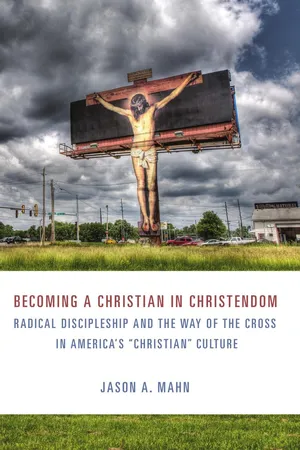
How might one live the Christian faith within a culture that idealizes and privileges Christianity while also relativizing it and making it redundant? Arguing for a reconceptualization of the theology of the cross and radical communal practices, the author explores some pervasive dangers of Americas new Christendom and provocatively imagines alternatives to conventional Christianityones whereby the church embodies an alternative politic, where it commits to cruciform non-violence, appreciates gifts by giving them away, and knows its boundaries well enough to learn from those on the other side.
eBook - ePub
Becoming a Christian In Christendom
Radical Discipleship and the Way of the Cross in America's "Christian" Culture
- 395 pages
- English
- ePUB (mobile friendly)
- Available on iOS & Android
eBook - ePub
Becoming a Christian In Christendom
Radical Discipleship and the Way of the Cross in America's "Christian" Culture
About this book
Information
Topic
Theology & ReligionSubtopic
Christian Theology3
CONTOURS
6
ECONOMY: Free Grace in a Culture of Cheap
In this chapter, we turn to the first of several concrete issues related to America’s new Christendom and the task of becoming Christian within it. In particular, we will explore the problem and possibility of realizing and valuing the free grace of God in a culture where almost anything and everything can be bought and sold.
The market has, in many ways, become America’s God. We decide what work to do, where to live, whether to marry, get a divorce, have children, or retire after consulting market forecasters. Religion is affected as well, as we “pick and choose religious moments as our schedules and checkbooks allow.”[1] The processes of commodification, commercialization, and monetization have crept into all areas of our lives. Public goods and services (parks, education, sidewalks, police protection, access to clean water, etc.) used to be shared and free for the user, and public obligations (waiting in line at the airport, jury duty, going to jail if you break a law) used to be (more) equitable, whether you had money or not. Now, almost everything can be bought and sold. Those who can purchase private education, neighborhood security, or fast passes through airports or gridlocked highways do so, leaving others stuck with shoddier goods and a good deal of resentment.
While this may not seem like a theological issue, this chapter will argue that both the problem and answer depend on theology—on how we think about God and creation and salvation, God’s gifts to us, or don’t. When Christians are able to understand grace and life as priceless gifts, they may be able to resist the encroachment of the market and temptations to worship it. They might also find themselves called to countercultural (counter-consumerist) discipleship, given that an incalculable gift calls forth an immeasurable response, and because “authentic expressions of peace, gratitude, and joy . . . tend to be found in dispositions and acts that define themselves in opposition to conventional economic goals.”[2] Alternatively, American Christians might mistake grace for something they deserve, either because they have earned it or (more commonly today) by virtue of being born in a prosperous country with a number of freedoms and advantages—grace being among them. The gifts of grace and of creation itself can quickly become privileges, while American Christianity becomes the invisible dispenser of such benefits.
I will try to show that one predominant stronghold of such acculturated and accommodated Christianity arises with subtle slippage from Martin Luther’s doctrine of “free grace” (read: immeasurable, priceless grace) to what Bonhoeffer calls “cheap grace”—grace as latitude and license, grace as privilege, grace as having the carefully calculated value of absolutely nothing. The trick will be to value grace, to appreciate it with gratitude and respond to it in discipleship, without that valuation quantifying, commodifying, and so, cheapening it. In what follows, I want to read the Christian “doctrine” of grace differently than the standard reception, showing that an understanding of free grace shared by Luther, Kierkegaard, and Bonhoeffer might help resist the economization and desacralization of creation, and so also the cultural entrapments of Christendom.[3] Before revisiting sixteenth-century Saxony, nineteenth-century Copenhagen, and early-twentieth-century Germany, I turn to appraise the economic-cultural milieu of twenty-first-century North America.
Cheapening Gifts and Giftedness
In his book, What Money Can’t Buy: The Moral Limits of Markets, American political philosopher Michael Sandel points to hundreds of cases where encroachments of “the market” on goods that used to be priceless corrode civic values and cohesion in the United States. Some of the market’s expansions are irksome but perhaps morally inconsequential: the trend toward monetizing gifts through those once-tacky gift cards, the scalping of campsite tickets for Yosemite National Park, or the corporate renaming of professional baseball parks. Others are ethically alarming: the sale of the right to immigrate, cash to female drug addicts if they undergo sterilization, or the rise of the viatical industry, through which a terminally ill person sells his or her life insurance to a third party who then makes money when the terminal person dies—the sooner the death, the bigger the profit.[4] One of Sandel’s primary objections to the expansion of market forces into the civic realm is that putting a price on public goods or “incentivizing” consumers to choose the right thing to do (lose weight, stop smoking, give blood, care about the environment) does not simply add external motivations to internal ones, but actually corrodes the latter. We no longer do what is good because it is good or right or helpful to those in need. We do it because we are paid. And when those payments cease to be worth our effort, we stop doing it altogether.[5]
While shared goods presently sell off at surprising rates, Sandel’s concerns are not new. Some twenty years ago, Larry Rasmussen foresaw how the market beguiles us into believing that obligation to others is fulfilled through calculated self-interest.[6] Some two centuries before that, Adam Smith, the very person who first surmised that purely self-serving desires could lead to social benefits,[7] also insisted that capitalism could help humans flourish only so long as nonmarket civic virtues restricted the domain and curbed the temperament of economic exchange.[8] If Sandel and Rasmussen are right, that time is passing or has passed. According to Wendell Berry, “a state of virtually total economy” has been imposed upon us, “in which it is the destiny of every creature (humans not excepted) to have a price and to be sold.”[9]
A similar trend hits closer to home for those of us involved in teaching and learning. In her book, Not for Profit: Why Democracy Needs the Humanities, Martha Nussbaum documents the particular corrosion that worldwide pursuits of profitability have on humanistic education and its promise to educate for citizenship and democracy.[10] When education becomes primarily for economic growth, we lose the dispositions that are at the center of humanistic education and that are necessary for human flourishing.[11]
According to Sandel, Rasmussen, and Nussbaum, the expanding encroachment of the market cheapens our ability to give gifts to one another, whether that be through our participation in civic life, in democracy, or by ethical action in general. But there is more. The economization or marketization of nearly every sector of life also cheapens our sense of giftedness—what makes human individuals peculiar, special, and capable of offering such gifts in the first place. In “The Case Against Perfection,” Sandel inquires into Americans’ shared ill ease with breakthroughs in genetic engineering (think “designer babies”) and performance-enhancing drugs (“doping”). The two most common explanations revolve around issues of autonomy and fairness. Yet, autonomy and fairness turn out for Sandel to be almost the exact opposite of why he thinks we are—or should be—concerned with the drive to engineer the perfect person. For Sandel, the problem with doping and biotechnology and even helicopter parenting is not the loss of agency, but the drive toward hyperagency; we are becoming too autonomous, too responsible for our own fates, and so, are losing our “openness to the unbidden.”[12] We are losing our ability to mourn tragedy and honor good luck, in short, our appreciation for life’s giftedness. It is at this point that Sandel almost gets theological, as his allusion to “gift” suggests. Asking, “What would be lost if biotechnology dissolved our sense of giftedness?” Sandel responds:
From a religious standpoint the answer is clear: To believe that our talents and powers are wholly our own doing is to misunderstand our place in creation, to confuse our role with God’s. Religion is not the only source of reasons to care about giftedness, however. The moral stakes can also be described in secular terms. If bioengineering made the myth of the “self-made man” come true, it would be difficult to view our talents as gifts for which we are indebted, rather than as achievements for which we are responsible.[13]
Even the nonreligious should view their talents as gifts for which they are grateful and responsive, even if they remain agnostic about any Giver of those gifts and the Recipient of their thanksgiving.
Leaving theological overtones aside for the moment, Sandel critiques what others have called our meritocratic society—the prevailing assumption that we should form culture and a political economy in such a way that each person gets recognized and compensated according to her or his “output”—no more and no less. Meritocracies seem fairer and more egalitarian than the traditionalist cultures they replace, where a queen or man of genteel status, for example, was owed honor simply by nature of her or his standing at birth. If Sandel is right, however, meritocracies slowly corrode capabilities to mourn the simple bad luck of tragedy, to experience awe over a sense of unbidden giftedness, or to be radically grateful for all that we did not and cannot earn. Others critics suggest that meritocratic cultures necessarily develop economies that maximize opportunities for the talented at the expense of devaluing and exploiting those seemingly stuck in the places the upwardly mobile so readily abandon.[14] Political economies that are devoted to maximizing opportunities and democratizing access to those opportunities can help level unjust privilege, but they almost always do so by purchasing deracinated ways of life at the expense of farmers, craftsmen, family businesses, and fidelity to extended families and home communities— not to mention the well-being of the land and its nonhuman creatures.[15]
Here, the fairness argument returns, but now the inequity is between the whole system that promotes access to “opportunities” and the people and places that suffer from it. Meritocracies and the free market economies that sustain them often stockpile national wealth at the cost of its health. They free many for mobility by indenturing others (human and nonhuman) to increasingly meaningless, piecemeal, and unsustainable work.
But gifts, giftedness, gratitude, and being gracious are not cheapened by virtue of any and every economy. Particular trends in particular economic systems cheapen the gifts and tasks of...
Table of contents
- Cover
- Title Page
- Copyright
- Table Of Contents
- Preface and Acknowledgments
- Introduction: Life in a “Christian” Culture
- PROBLEMS
- RESOURCES
- CONTOURS
- RE-FORMATION
- For Further Reading
- Index
Trusted by 375,005 students
Access to over 1.5 million titles for a fair monthly price.
Study more efficiently using our study tools.
Frequently asked questions
Yes, you can cancel anytime from the Subscription tab in your account settings on the Perlego website. Your subscription will stay active until the end of your current billing period. Learn how to cancel your subscription
No, books cannot be downloaded as external files, such as PDFs, for use outside of Perlego. However, you can download books within the Perlego app for offline reading on mobile or tablet. Learn how to download books offline
Perlego offers two plans: Essential and Complete
- Essential is ideal for learners and professionals who enjoy exploring a wide range of subjects. Access the Essential Library with 800,000+ trusted titles and best-sellers across business, personal growth, and the humanities. Includes unlimited reading time and Standard Read Aloud voice.
- Complete: Perfect for advanced learners and researchers needing full, unrestricted access. Unlock 1.5M+ books across hundreds of subjects, including academic and specialized titles. The Complete Plan also includes advanced features like Premium Read Aloud and Research Assistant.
We are an online textbook subscription service, where you can get access to an entire online library for less than the price of a single book per month. With over 1.5 million books across 990+ topics, we’ve got you covered! Learn about our mission
Look out for the read-aloud symbol on your next book to see if you can listen to it. The read-aloud tool reads text aloud for you, highlighting the text as it is being read. You can pause it, speed it up and slow it down. Learn more about Read Aloud
Yes! You can use the Perlego app on both iOS and Android devices to read anytime, anywhere — even offline. Perfect for commutes or when you’re on the go.
Please note we cannot support devices running on iOS 13 and Android 7 or earlier. Learn more about using the app
Please note we cannot support devices running on iOS 13 and Android 7 or earlier. Learn more about using the app
Yes, you can access Becoming a Christian In Christendom by Jason A. Mahn in PDF and/or ePUB format, as well as other popular books in Theology & Religion & Christian Theology. We have over 1.5 million books available in our catalogue for you to explore.