The Freedom of a Christian, 1520
eBook - ePub

The Freedom of a Christian, 1520

The Annotated Luther

  1. 94 pages
  2. English
  3. ePUB (mobile friendly)
  4. Available on iOS & Android
eBook - ePub

The Freedom of a Christian, 1520

The Annotated Luther

About this book

Timothy J. Wengert skillfully provides a clear understanding of the historical context from which the treatise The Freedom of a Christian and his accompanying Letter to Pope Leo X arose. As controvery concerning his writings grew, Luther was instructed to write a reconciliation-minded letter to Pope Leo X (1475–1521). To this letter he appended a nonpolemical tract describing the heart of his beliefs, The Freedom of a Christian. Luther's Latin version added an introduction and a lengthy appendix not found in the German edition. The two editions arose out of the different audiences for them: the one addressed to theologians, clerics, and church leaders (for whom Latin was the common language), and one addressed to the German-speaking public, which included the nobility, townsfolk, many from the lesser clergy, and others who could read (or have Luther's writings read to them).

This volume is excerpted from The Annotated Luther series, Volume 1. Each volume in the series contains new introductions, annotations, illustrations, and notes to help shed light on Luther's context and to interpret his writings for today. The translations of Luther's writings include updates of Luther's Works, American Edition, or new translations of Luther's German or Latin writings.

Frequently asked questions

Yes, you can cancel anytime from the Subscription tab in your account settings on the Perlego website. Your subscription will stay active until the end of your current billing period. Learn how to cancel your subscription.
No, books cannot be downloaded as external files, such as PDFs, for use outside of Perlego. However, you can download books within the Perlego app for offline reading on mobile or tablet. Learn more here.
Perlego offers two plans: Essential and Complete
  • Essential is ideal for learners and professionals who enjoy exploring a wide range of subjects. Access the Essential Library with 800,000+ trusted titles and best-sellers across business, personal growth, and the humanities. Includes unlimited reading time and Standard Read Aloud voice.
  • Complete: Perfect for advanced learners and researchers needing full, unrestricted access. Unlock 1.4M+ books across hundreds of subjects, including academic and specialized titles. The Complete Plan also includes advanced features like Premium Read Aloud and Research Assistant.
Both plans are available with monthly, semester, or annual billing cycles.
We are an online textbook subscription service, where you can get access to an entire online library for less than the price of a single book per month. With over 1 million books across 1000+ topics, we’ve got you covered! Learn more here.
Look out for the read-aloud symbol on your next book to see if you can listen to it. The read-aloud tool reads text aloud for you, highlighting the text as it is being read. You can pause it, speed it up and slow it down. Learn more here.
Yes! You can use the Perlego app on both iOS or Android devices to read anytime, anywhere — even offline. Perfect for commutes or when you’re on the go.
Please note we cannot support devices running on iOS 13 and Android 7 or earlier. Learn more about using the app.
Yes, you can access The Freedom of a Christian, 1520 by Martin Luther, Timothy J. Wengert in PDF and/or ePUB format, as well as other popular books in Theology & Religion & Christian Theology. We have over one million books available in our catalogue for you to explore.

Information

Image Credits
466, 479, 483, 509, 513, 517: Courtesy of the Digital Image Archive,
Pitts Theology Library, Candler School of Theology, Emory University.


The Freedom of a Christian, 1520 (Timothy J. Wengert)
a.See WA 7:40, “E”: Epistola Lutheriana ad Leonem Decimum summum pontificem. Liber de Christiana libertate, continens summam Christianae doctrinae, quo ad formandam mentem, & ad intelligendam Euangelii vim, nihil absolutius, nihil conducibilius neque a veteribus neque a recentioribus scriptoribus perditum est. Tu Christianae lector, relege iterum atque iterum, & Christum imbibe. Recognitus Wittembergae (Wittenberg: Melchior Lotter, 1521). English: A Lutheran Letter to Pope Leo X. A Book on Christian Freedom, Containing the Sum of Christian Teaching, Concerning Which Nothing More Absolute or More in Line with Either Ancient or More Recent Writers Has Been Produced for Forming the Mind and for Understanding the Power of the Gospel. You, Christian Reader, Reread This Again and Again and Drink in Christ. Reedited in Wittenberg. For the publication, authorships, and dating of these printings, see James Hirstein’s article in Revue d’histoire et de philosophie religieuses (forthcoming).
b.Birgit Stolt, Studien zu Luthers Freiheitstraktat mit besonderer Rücksicht auf das Verhältnis der lateinischen und der deutschen Fassung zu einander und die Stilmittel der Rhetorik (Stockholm: Almzvist & Wiksell, 1969).
c.Ibid.
d.Using marginal notes found in WA 7:40, “D”: Epistola Lutheriana ad Leonem Decimum summum pontificem. Dissertatio de libertate Christiana per autorem recognita Wittembergae (Basel: Adam Petri, 1521). See the Introduction above.
e.See above, p. 264, n. 11.
f.Throughout this letter, marginal notes on the letter’s structure follow the structural analysis made by Stolt.
g.The first time was the preface to the Explanations of the Ninety-Five Theses of 1518. See WA 1:527–29.
h.Matt. 7:3.
i.John 8:1–11.
j.See Matt. 23:33, 13, 17; and John 8:44, respectively.
k.Acts 13:10.
l.Phil. 3:2; 2 Cor. 11:13; 2:17 (following the Latin; NRSV: “peddlers”).
m.Classical Latin authors often compared salt (especial “black salt”) with sharpness (e.g., Pliny [the Elder] (23–79), Historia naturalis, 10, 72, 93, par. 198) and sarcasm (e.g., Catullus [c. 84–54 BCE], 13, 5). See also Matt. 5:13.
n.Jer. 48:10 (Vulgate).
o.Literally, “brothers.”
p.Matt. 10:16; Dan. 6:16; and Ezek. 2:6, respectively.
q.See John 6:9.
r.Jer. 51:9 (Vulgate).
s.Virgil (70–19 BCE), Georgics, 1, 514.
t.The family of Judas Iscariot, as he was labeled in John 17:12.
u.See above, p. 475.
v.See Jer. 3:8.
w.Rev. 22:11.
x.Luther is making a play on words: “Ecce … Eck” (Behold … Eck).
y.See Cicero, De Amicitia, 91 (25).
z.See, e.g., the reference to “Roman ignorance” in Maurus Servius Honoratus (4th–5th century), Commentary on the Aeneid of Virgil, 8, 597.
a.See, e.g., 1 Pet. 5:5 and James 4:6.
b.2 Tim. 2:9, an indirect reference to the tract, The Freedom of a Christian, to which this letter became attached.
c.Isa. 3:12 (Vulgate).
d.See Luther’s Address to the Christian Nobility (1520), above, pp. 387–89.
e.Luke 1:52.
f.See above, p. 479.
g.This subhead is not in sixteenth-century editions of the tract.
h.The same Latin word is translated here “virtues” or “power.”
i.With few exceptions recorded in footnotes, all subtitles come from ...
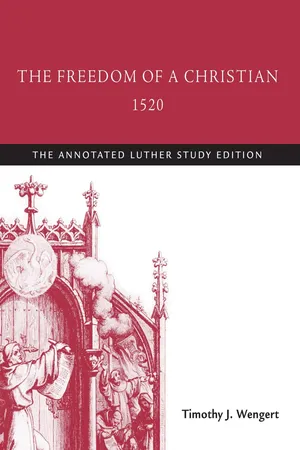
Table of contents

  1. Cover
  2. Title Page
  3. Title Page
  4. Copyright
  5. Contents
  6. Publisher's Note
  7. Series Introduction
  8. Abbreviations
  9. Introduction
  10. Image Credits