Sren Kierkegaard (18131855), the Danish theologian, philosopher, and preacher, in his last years issued a blistering attack on the established Christianity of the nineteenth century. That challenge was also a summons to an authentic life of Christian faith. With intensity and acumen, Kierkegaard diagnosed the spiritual and intellectual ills of modernity and Christendom and offered a constructive "upbuilding" for active, faithful Christian existence. One of Kierkegaard's key texts, The Sickness unto Death, outlines the problem of the human conditionsin/despairand draws the reader into the heart of the Christian faith: the infinite qualitative difference between God and creatures and the paradox of the God-man who came to bring abundant life in the form of authentic selfhood "grounded transparently" in the Creator.
In this volume, Paul R. Sponheim, introduces readers to Kierkegaard, unfolds this pivotal text and its connections to Kierkegaard's theological and ethical worldview, and traces the reception and significance of this text in the modern and contemporary theological tradition. In this, Existing Before God continues the contribution of the Mapping the Tradition series in providing compact yet salient maps of the theological, historical, social, and contextual impact of the most important minds and texts of Christian history.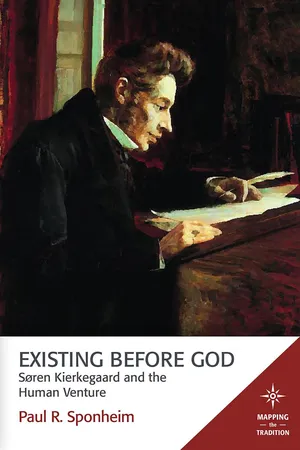
- 200 pages
- English
- ePUB (mobile friendly)
- Available on iOS & Android
eBook - ePub
About this book
Information
Topic
Theology & ReligionSubtopic
Christian Theology1
The Sickness unto Death: A Christian Psychological Exposition for Upbuilding and Awakening by Anti-Climacus: Analysis and Commentary
As we turn to this challenging and complex work, I offer a very brief overview of the journey ahead.
Anti-Climacus writes of what it is and how it is to exist “before God,” given that there is an “infinite qualitative difference” between the Creator and the creature. There’s no choice about being in some relationship with God, in the becoming self that is a given from/by the “Constituting Power.” But there is life-determining choosing to be done about how one relates to God, for there’s a calling in what’s given for the human self. To choose to be wrongly related to God is to be in despair, whether or not one acknowledges that openly or feels it inwardly. That is the sickness unto death. The first part of this “Christian psychological exposition” offers a detailed analysis of the various forms to be found in the variegated territory of despair. In being related to the eternal God, the creaturely self finds the proper measure for assessing life’s afflictions. All other problems and perils pale before despair, which, as ever present, is indeed the sickness “unto” death.
This becoming self is a relation as a duality of the temporal and the eternal, the finite and the infinite. But the self’s narrative is the story of a third element—a “positive third”—as the self relates itself to itself, choosing how the elements of the self will come together. Thus, despair can be analyzed in terms of an imbalance in the constituting elements: freedom and necessity, infinitude and finitude. Or the self’s despair can be analyzed in terms of the degree of consciousness to be found in the self’s relating to itself and to the Constituting Power. Varying degrees of consciousness characterize the self’s choosing either not to be the self it is being called to be or choosing to be a self other than that calling.
The second part, “Despair Is Sin,” advances the analysis through the explicit judgment that this “misrelation” to God is sin, which is always against God. Again, the growing consciousness of the self marks a despairing deepening of the sinful condition. Anti-Climacus depicts this development in terms of the Trinity. As constituted, one exists “before God,” and one is invited to live “on the most intimate terms with God.” But the self may find that news too good to be true and in weakness or in strength be offended and go its own way. That going astray is not a matter of ignorance, but is rooted in a willed choosing. Anti-Climacus offers a sharp critique of his beloved Socrates, who is here understood to fail to recognize that one can know the good and yet not choose it. Moreover, the pseudonym tightens the knot of judgment by an appeal to the doctrine of hereditary sin. The intensification in consciousness and sin continues before God, who came to be born, suffer, and die for this self. Finally, there is the sin against the Holy Spirit, as in dismissing Christianity or as in saying that one has no opinion about the gospel that has been truly preached to them.
Thus a grim account awaits us, but throughout Anti-Climacus’s message for “upbuilding and awakening,” there are pointed references to the saving action of God toward the despairing creatures. There too, one is before a God who is marked by an “infinite qualitative difference” from the creatures. For the creatures, this radical God is risking the possibility of offense. Yet all the same, in no way does God differ from the creature more than in forgiving sins. In that difference there lies the hope that one may come to be grounded transparently in God after all, which is the definition of faith.
Preface
Kierkegaard was on the verge of publishing this book under his own name, but at the last minute, Anti-Climacus appeared as the author.[1] As we have noted in the biographical sketch, Kierkegaard did not regard himself as “a Christian on an extraordinarily high level,”[2] the ranking Anti-Climacus receives from him. As Johannes Climacus in 1846, Kierkegaard had already made the point that while he did not claim to be a Christian, he could present Christian claims and use them as a measuring stick in relationship to what was going on in Danish Christendom.[3] Kierkegaard will not bind Anti-Climacus’s presentation of those claims to his own flawed example, though the pseudonym does identify the direction of his striving and S. Kierkegaard appears on the title page as “editor,” the one who “gives out” (udgivet) the message. There is a claim, a calling, in that message. Johannes Climacus offers his readers a “thought project,” but “Anti-Climacus is thetical.”[4] A truth claim is at stake in the pages of SUD.
The claim is presented in a “Christian psychological exposition.” This is not the first time that the word psychological appears in a pseudonym’s title. Back in 1844, in The Concept of Anxiety, Vigilius Haufniensis had offered “a simple psychologically orienting deliberation on the dogmatic issue of hereditary sin.” There we are told that when psychology deals with sin, the “mood becomes that of persistent observation, like the fearlessness of a secret agent.”[5] Thus Vigilius is “the watchman of Copenhagen.” He is fearless in his observance of Copenhagen, but he lacks “earnestness [Alvor] expressed in courageous resistance.”[6] Nonetheless, his book has a direction in mind. Its last sentence is, “As soon as psychology has finished with anxiety, it is to be delivered to dogmatics.”[7] In Anti-Climacus, the delivery has arrived. The first part of SUD is richly theological, but its category is despair as the sickness unto death. The second part completes the delivery already in its three-word title, “Despair Is Sin.” That’s unambiguously theological talk. It will be clear in the analysis to follow that each part speaks to the other in this “Christian psychological exposition.”
The title page for SUD employs varying font sizes and selective use of bold face. Now in a smaller (down two steps) font size but reclaiming the bold face of Sickness unto Death we find the words “for upbuilding and awakening.”[8] That gets us to a crucial point in Anti-Climacus’s preface. He writes:
Many may find the form of this “exposition” strange; it may seem to them too rigorous to be upbuilding and too upbuilding to be rigorously scholarly. . . . From the Christian point of view, everything, indeed everything, ought to serve for upbuilding. . . . It is precisely Christianity’s relation to life (in contrast to a scholarly distance from life) or the ethical aspect of Christianity that is upbuilding. . . . It is Christian heroism—a rarity, to be sure—to venture wholly to become oneself, an individual human being, this specific individual human being, alone before God.[9]
The “discourses,” signed by Kierkegaard, carry “upbuilding” in their titles. In each preface, Kierkegaard stresses that what he offers is “‘not sermons,’ because its author has no authority to preach.” But the discourses are located somewhere short of SUD in the progression of Kierkegaard’s authorship, for that sentence continues by saying the discourses are “‘upbuilding discourses,’ not discourses for upbuilding, because the speaker does not claim to be a teacher.”[10] In other...
Table of contents
- Cover
- Title Page
- Copyright
- Table Of Contents
- Mapping the Tradition Series
- Abbreviations
- Preface
- Introduction: A Biographical Sketch
- The Sickness unto Death: A Christian Psychological Exposition for Upbuilding and Awakening by Anti-Climacus: Analysis and Commentary
- The Theological Reception and Legacy
- Bibliography
- Index of Names
Trusted by 375,005 students
Access to over 1.5 million titles for a fair monthly price.
Study more efficiently using our study tools.
Frequently asked questions
Yes, you can cancel anytime from the Subscription tab in your account settings on the Perlego website. Your subscription will stay active until the end of your current billing period. Learn how to cancel your subscription
No, books cannot be downloaded as external files, such as PDFs, for use outside of Perlego. However, you can download books within the Perlego app for offline reading on mobile or tablet. Learn how to download books offline
Perlego offers two plans: Essential and Complete
- Essential is ideal for learners and professionals who enjoy exploring a wide range of subjects. Access the Essential Library with 800,000+ trusted titles and best-sellers across business, personal growth, and the humanities. Includes unlimited reading time and Standard Read Aloud voice.
- Complete: Perfect for advanced learners and researchers needing full, unrestricted access. Unlock 1.5M+ books across hundreds of subjects, including academic and specialized titles. The Complete Plan also includes advanced features like Premium Read Aloud and Research Assistant.
We are an online textbook subscription service, where you can get access to an entire online library for less than the price of a single book per month. With over 1.5 million books across 990+ topics, we’ve got you covered! Learn about our mission
Look out for the read-aloud symbol on your next book to see if you can listen to it. The read-aloud tool reads text aloud for you, highlighting the text as it is being read. You can pause it, speed it up and slow it down. Learn more about Read Aloud
Yes! You can use the Perlego app on both iOS and Android devices to read anytime, anywhere — even offline. Perfect for commutes or when you’re on the go.
Please note we cannot support devices running on iOS 13 and Android 7 or earlier. Learn more about using the app
Please note we cannot support devices running on iOS 13 and Android 7 or earlier. Learn more about using the app
Yes, you can access Existing Before God by Paul R. Sponheim in PDF and/or ePUB format, as well as other popular books in Theology & Religion & Christian Theology. We have over 1.5 million books available in our catalogue for you to explore.