eBook - ePub
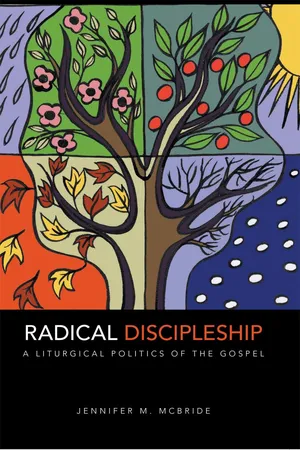
Radical Discipleship
A Liturgical Politics of the Gospel
- 290 pages
- English
- ePUB (mobile friendly)
- Available on iOS & Android
eBook - ePub
About this book
Reminiscent of Bonhoeffer's Discipleship, Jennifer McBride's Radical Discipleship utilizes the liturgical seasons as a framework for engaging the social evils of mass incarceration, capital punishment, and homelessness, arguing that to be faithful to the gospel, Christians must become disciples of, not simply believers in, Jesus. The book arises out of McBride's extensive experience teaching theology in a women's prison while participating in a residential Christian activist and worshipping community. Arguing that disciples must take responsibility for the social evils that bar "beloved community," Martin Luther King's term for a just social order, the promised kingdom of God, McBride calls for a dual commitment to the works of mercy and the struggle for justice. This work seeks to form readers into an understanding of the social and political character of the good news proclaimed in the Gospels. Organically connecting liturgy with activism and theological reflection, McBride argues that discipleship requires that privileged Christians place their bodies in spaces of social struggle and distress to reduce the distance between themselves and those who suffer injustice, and stand in solidarity with those whom society deems guilty, despises, and rejects—which makes discipleship radical as Christians take seriously the Jesus of the Gospels.
Information
Topic
Theology & ReligionSubtopic
Christian Rituals & Practice2
Advent
And Mary said,
“My soul magnifies the Lord,
and my spirit rejoices in God my Savior,
for he has looked with favor on the lowliness of his servant.
. . . . . . . . . . . . . . . . . . . . . . . . . . . . .
He has shown strength with his arm;
he has scattered the proud in the thoughts of their hearts.
He has brought down the powerful from their thrones,
and lifted up the lowly;
he has filled the hungry with good things,
and sent the rich away empty
. . . . . . . . . . . . . . . . . . . . . . . . . . . . .
according to the promise he made to our ancestors.”
—Luke 1:46–55
“My soul magnifies the Lord,
and my spirit rejoices in God my Savior,
for he has looked with favor on the lowliness of his servant.
. . . . . . . . . . . . . . . . . . . . . . . . . . . . .
He has shown strength with his arm;
he has scattered the proud in the thoughts of their hearts.
He has brought down the powerful from their thrones,
and lifted up the lowly;
he has filled the hungry with good things,
and sent the rich away empty
. . . . . . . . . . . . . . . . . . . . . . . . . . . . .
according to the promise he made to our ancestors.”
—Luke 1:46–55
In those days John the Baptist appeared
in the wilderness of Judea, proclaiming,
“Repent, for the kingdom of heaven has come near.”
—Matthew 3:1–2
in the wilderness of Judea, proclaiming,
“Repent, for the kingdom of heaven has come near.”
—Matthew 3:1–2
We live, from a liturgical standpoint, in between. We are positioned in between what classical Christianity has called the first and second Advent, the coming of Christ into the world, initially as a vulnerable babe born in a manger because there was no room in the inn, whose life on the margins eventually leads to the cross, and then finally, at the end of time, who comes again in visible triumph over the powers of sin and death. We also live after the resurrection, the sign and promise of that ultimate victory, the new creation glimpsed in the here and now that will eventually gather into itself all things (Eph 1:10; Rev 21:5). Thus, we enter the movement from Advent to Pentecost always from the middle, with the knowledge of Christ crucified and risen constantly before us.
This means that no liturgical season is whole in and of itself. The boundary lines are fluid indeed as each points forward and backward, often in surprising ways, to central themes emphasized in the other, to themes like hope and repentance. As a prelude to a merry Christmas, for example, Advent is rarely viewed as a penitential season even though early Christianity and the traditional lectionary texts recognize that Christ’s coming always leads to judgment—our judgment and redemption—for which we must prepare in hopeful and earnest expectation. Likewise, as the first season, Advent is rarely associated with eschatology, commonly defined as the doctrine of the last things (the second coming, final judgment, and consummation of the kingdom), yet as Jürgen Moltmann argues, because it concerns these realities, eschatology is essentially a doctrine of hope. Hope is no mere “epilogue” but “the key” in which Christian discipleship is set, “the glow” at “the dawn of an expected new day.”[1] Because hope ignites active expectation, it belongs not at the end of liturgical reflection but at its beginning.
The dynamism inherent to this liturgical telling serves to inspire Christians toward continual seeking, toward a “faith seeking understanding” that perhaps challenges our embedded theologies, divesting us of static knowledge and reminding us that as narrative, the gospel cannot be possessed, it must be performed and discovered anew in each embodied retelling. The dynamic quality of the liturgical narrative mirrors a dynamic God on the move who, in the midst of the between, is always coming, always surprising, always disrupting what we thought we knew and understood, provided, as Jesus cautioned, we have the eyes to see and the ears to hear. Disciples then are people who respond to God’s movement by courageously opening ourselves up to divine disruption, or, as Jesus says in the Beatitudes, by “hungering and thirsting” for the advent of God. We are to be a people who long.
As a season of expectant waiting, Advent trains Christians to be a people who yearn, but the vital question is: What are we longing for? What are we waiting for? Or better, how do we become people who long for the right things, those things that correspond with what God promises to bring?
As an adult, Advent has always been for me a time of longing, but the focus of this longing was my own personal need. Living through Advent at the Open Door, where the biblical texts are interpreted through the lens of homelessness or mass incarceration, expanded my longing and helped me see Advent more holistically, as a season with social and political significance. This chapter argues that the social and political character of Advent is made manifest through the great reversal Mary proclaims. For those of us who are privileged, this reversal involves the kind of repentance preached by John the Baptist, which inaugurates relational and social change. Relational change happens by building right relationships with those who are despised and oppressed and by taking responsibility for the social structures that cause them harm. Social change requires that we turn away from dominant attitudes about homelessness and mass incarceration, which overstate individual culpability, and recognize instead that these issues arise first and foremost from structural injustice—from decisions we have collectively made about how to order society. The chapter, therefore, concludes with a brief account of the structural nature of these realities and a call to overturn these social conditions that cause people harm.
Reading the Advent texts at the Open Door taught me that I will not know how to long for what is right unless I am alert, unless I acquire the eyes to see and the ears to hear, a development that comes only by walking through the Gospel narratives. In order to know where to direct our longing, we turn first to Mary. The promise of God that Mary proclaims is that God’s coming brings about the “great reversal,” an overturning of the established order, a disruption of unjust social arrangements and attitudes from which privileged people today effortlessly and often unwittingly benefit. Yet we who are privileged (perhaps because of our secure middle-class status in the wealthiest nation in history, our educational level, our gender and sexuality, or our white skin color) are ill equipped to think about our social location through the eyes of faith. We are ill equipped to think about the gospel—about Jesus’s person and work—in social, political, and economic terms, or to think about sin as a structural, and not only a personal, reality. While we may know how to ask Jesus to come to us personally, to us and those dear to us, in order to meet our needs or heal our wounds, many of our churches have not formed us into people who know how to yearn for this promised kingdom—God’s social order—in concrete ways “on earth as it is in heaven.” This is exactly what the Gospel lectionary texts lead us to do, through Mary and her Magnificat, through John and his proclamation to repent.
Mary and the Great Reversal
The Mary banner hangs in the Open Door’s dining room and worship space on the first Sunday in Advent, occupying the cross’s prominent position for the season. She is dark skinned, visibly pregnant, with her face turned toward Jerusalem, a city like most cities that manifests the dichotomies she sings about in her Magnificat: the place of the political, economic, and religious elites, the place of the powerless and destitute, the place where her yet-unborn son will die. “We welcome Mary into our hearts,” says Nelia Kimborough, Open Door partner and resident artist, “and we pray that she will be one of our guides during this time of preparation.”[2]
Although it may seem anachronistic to say, Mary is the first radical disciple. As Catholic Mariology has long observed, she is the first person to say “yes” to Jesus. What makes her an especially important guide for us in our search for a discipleship that faithfully embodies the gospel is that she says yes with her body—she literally embodies the good news—and she risks guilt in doing so. She takes her place among the guilty, for she was pregnant and unmarried, a crime punishable by death. Her name means “rebellion,” yet her rebellion stems not from the heroic zeal of a self-made revolutionary but from a pondering faith that, although “much perplexed” by what was unfolding before her, took seriously the reality of “a fulfillment” of God’s promises in time. She rebels against the world as it is—she stands as a living contradiction to its unjust arrangements—simply by saying yes to God, yes to this historical possibility. Her yes includes not only verbal assent but also bodily participation in the movement of God, who, as her Magnificat proclaims, scatters the proud, brings down the powerful, lifts up the lowly, fills the hungry with good things, and sends the rich away empty “according to the promise.”
Mary’s Magnificat is a foundational text for Advent because it teaches us how to align our longings and strivings with the promises of God, and faithful alignment means yearning for “the powerful” to be “brought down” and “the lowly” to be “lifted up”—a leveling reminiscent of the “straight path” to be prepared for the Lord that John the Baptist proclaims in which “every valley will be filled and every mountain and hill will be made low” (Luke 3:4–5). The Magnificat describes the powerful and lowly in economic terms, associating them respectively with the “rich” and “hungry,” yet economic realities and their inherent power relations—albeit integral to the Magnificat’s message—do not exhaust its meaning. In a 1933 sermon on the text, almost a year into the Nazi reign, Bonhoeffer suggests that we discover the content of God’s reversal by following the path of Christ’s coming. “God is not ashamed of human lowliness but goes right into the middle of it,” he declares; “God draws near . . . [to] the excluded, the powerless.”
What people say is lost, God says is found; what people say is “condemned,” God says is “saved.” Where people say No! God says Yes! Where people turn their eyes away in indifference or arrogance, God gazes with a love that glows warmer there than anywhere else. Where people say something is despicable, God calls it blessed.[3]
The lowly in this rendering are people who are shut out of mainstream existence, condemned, and despised. They are, in Howard Thurman’s famous phrase, “the disinherited,”[4] those who are up against a wall and see no way out, the people we dismiss or ignore, to whom we are cold and unresponsive, the people who are an affront to our values and moral sensibilities, the very people with whom the Open Door Community stands: those in prison and on death row, those who are homeless and hungry, most visible to us as beggars or even hustlers on the street, most threatening to us when their inebriation or mental illness bears striking resemblance to the demons Jesus cast out along his way. “There where our piety anxiously keeps its distance,” Bonhoeffer says, “that is exactly where God loves to be.”[5]
God’s great reversal includes, then, an overturning of any dominating power that condemns, excludes, or oppresses. God’s advent shatters any perspective, any conclusion drawn from distance that bolsters these powers, including, as we will see, an understanding of our own and others’ innocence and guilt. God’s advent overturns dominant social attitudes held by the religious and nonreligious alike—“he has scattered the proud in the thoughts of their hearts,” Mary sings—and leads us to confront the ways in which we are complicit in systems of oppression and injustice, in structures like mass incarceration and homelessness. If this great reversal is not my longing, if I hesitate or downright refuse to construe Christ’s coming in terms of systemic change and resistance to oppressive forces, Mary’s Magnificat presses me to ask if I am among the satiated and satisfied, “the rich” who are “sent away empty” from this Advent season because I am unable to hope for, and thus unable to receive, divine promise (Matt 7:7–8).
The Advent promise is addressed to people with concrete hopes that accord with God’s great reversal. It is addressed to people like Kelly Gissendaner, one of the prison theology students who, seeking a manifestation of God’s great reversal, the reversal of her sentence from death to life, shares the tangible hope of the psalmist, “I shall not die, but live, and declare the works of the Lord” (Ps 118:17), a verse that caught her attention in the testim...
Table of contents
- Cover
- Praise for Radical Discipleship
- Title Page
- Copyright
- Dedication
- Table Of Contents
- Introduction: The Space of Radical Discipleship
- Advent
- Christmas
- Ordinary Time
- Lent and Holy Week
- Good Friday
- Easter
- Pentecost: The Birth of the Discipleship Movement
- Acknowledgments
- Suggested Reading
- Index of Names and Subjects
- Index of Scripture
Trusted by 375,005 students
Access to over 1.5 million titles for a fair monthly price.
Study more efficiently using our study tools.
Frequently asked questions
Yes, you can cancel anytime from the Subscription tab in your account settings on the Perlego website. Your subscription will stay active until the end of your current billing period. Learn how to cancel your subscription
No, books cannot be downloaded as external files, such as PDFs, for use outside of Perlego. However, you can download books within the Perlego app for offline reading on mobile or tablet. Learn how to download books offline
Perlego offers two plans: Essential and Complete
- Essential is ideal for learners and professionals who enjoy exploring a wide range of subjects. Access the Essential Library with 800,000+ trusted titles and best-sellers across business, personal growth, and the humanities. Includes unlimited reading time and Standard Read Aloud voice.
- Complete: Perfect for advanced learners and researchers needing full, unrestricted access. Unlock 1.5M+ books across hundreds of subjects, including academic and specialized titles. The Complete Plan also includes advanced features like Premium Read Aloud and Research Assistant.
We are an online textbook subscription service, where you can get access to an entire online library for less than the price of a single book per month. With over 1.5 million books across 990+ topics, we’ve got you covered! Learn about our mission
Look out for the read-aloud symbol on your next book to see if you can listen to it. The read-aloud tool reads text aloud for you, highlighting the text as it is being read. You can pause it, speed it up and slow it down. Learn more about Read Aloud
Yes! You can use the Perlego app on both iOS and Android devices to read anytime, anywhere — even offline. Perfect for commutes or when you’re on the go.
Please note we cannot support devices running on iOS 13 and Android 7 or earlier. Learn more about using the app
Please note we cannot support devices running on iOS 13 and Android 7 or earlier. Learn more about using the app
Yes, you can access Radical Discipleship by Jennifer M. McBride,Jennifer M. McBride in PDF and/or ePUB format, as well as other popular books in Theology & Religion & Christian Rituals & Practice. We have over 1.5 million books available in our catalogue for you to explore.