- 220 pages
- English
- ePUB (mobile friendly)
- Available on iOS & Android
eBook - ePub
About this book
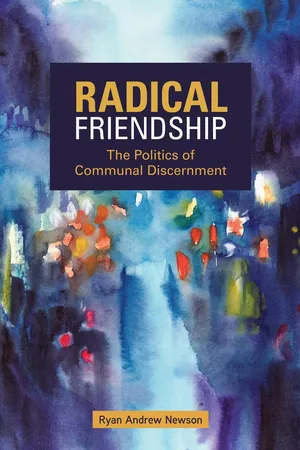
Radical Friendship explores the contours of communal discernment as a practice that is especially relevant to Christians seeking radical democratic alternatives to the predominance of political liberalism. Communal discernment is shown to be capable of generating conscientious participation in grassroots politics; additionally, this practice enables Christians to enjoy reciprocal, discerning relationships with people who hold convictions complete different from one’s own. Indeed, communal discernment turns out to be capable of preparing Christians to recognize and celebrate analogues to the practice in the world at large.
Information
Topic
Theology & ReligionSubtopic
Christian Theology2
Outline of the Promise of a Practice
Not finitude, but the denial of finitude, is the marker of tragedy.[1]
—Stanley Cavell
Those who lay claim, to whatever extent, to the heritage of the radical reformation in all its diversity have often found themselves marginalized from arguments in political theology, hastily labeled sectarians for failing to offer a morality that is of “public” import. Whether this marginalization is intentional or not, the sentiment is that such radicals may provide helpful explorations of character formation or gospel faithfulness, but their relevance ends at the borders of the church. I am uninterested in rehashing rebuttals to this charge, which successfully expose assumptions embedded within the accusation itself.[2] Rather, my interest is the sense in which this exclusion seems predicated on a picture of the political landscape that Sheldon Wolin and company have called into question—from a decidedly non-confessional stance. If it is true that the context itself as described by radical democrats calls for a reconsideration of criticisms that had given the sectarian charge its plausibility, then perhaps a way is opened for renewed interest in what those labeled “Anabaptist” have to contribute to the field of political theology, besides a decontextualized commitment to pacifism. In any case, I wish to go beyond mere throat clearing, and toward a description of what faithfulness looks like in the context described by Wolin.
At the end of the previous chapter, I noted Romand Coles’s remark that in struggling for radical democracy against the acids of liberalism with which it is intermixed, a central task must be naming the practices that might equip communities and individuals for that struggle. This is a task that previously disregarded Anabaptist theologians are now in a unique position to undertake, for if they have anything to teach the wider church, it is how to move discerningly within and among amorphous, hostile political forces. Indeed, Anabaptists have long specified certain practices that have proved helpful in this task. Searching for practices of this sort need not entail quietism; as ethicist Traci West writes, practices carry the potential for disrupting patterns of injustice, as well as stand in need of being continually “disrupted” from potentially reinscribing injustice.[3] Nor ought it entail isolationism: despite fears that a focus on practices in general and communal discernment in particular creates a deafness to others and a barrier to friendship, my goal is to show that when practiced well communal discernment helps achieve both openness to others and true friendship—both inside and outside the ekklesia.
To that stated end, my task in this chapter is to outline communal discernment as an important member of the “tensional ecology of practices that gradually work beyond the limits of the present toward a more generous and receptive justice”[4]—both its possibilities and liabilities as a practice that marks a distinctively “baptist” way of inhabiting the world. I begin with some orienting reflections on discernment, which introduce my approach to the descriptive task of this chapter. Next, I describe communal discernment itself as thickly as I can, including the socio-political context in which it was reclaimed by certain sixteenth-century Anabaptists. I conclude by correlating this description of discernment to the political context described in the previous chapter by Wolin and company. Because I will continue to do this in the chapters that follow, at this stage I limit my focus to an exploration of how communal discernment cultivates competence to name and resist some of liberalism’s acidic tendencies without sacrificing a respect for the finite, “relative” nature of this competence. This is an important reason communal discernment carries such promise for political theology: it fosters a way forward that is neither withdrawn nor acquiescent, neither formless nor rigid—and which values ongoing trust in a God on the move over certainty.
1 Communal Discernment as Promise
Of course, the task of moral discernment has been a perennial struggle for Christians. Whenever a community or any conscientious person faces a morally weighted situation, the skill of discernment will be exercised, however poorly. Classically, Aristotle devoted large portions of the Nicomachean Ethics to the virtue of phronesis or “prudence,” in which he describes the practical wisdom acquired in the midst of ordinary life. For Aristotle, phronesis is not only directed to “normative” questions, but is deeply relevant to who an agent is going to be; when mastered, in other words, phronesis is internalized, exercised “intuitively” and without deliberation, even in situations rife with ambiguity. Thus in political climates that breed moral incompetence, one may say that discernment is the first casualty, precisely because “inverted totalitarianism” does not simply control the behavior of a populace, but erodes its ability to even see that this is happening.
Over time, several approaches to moral discernment emerged among Christians to supplement this task: one ought to rationally follow certain rules, or exercise one’s “graced imagination,” or obey church tradition, and adequate discernment will thus occur.[5] As Christian theologians became increasingly indebted to Enlightenment patterns of thought, the question of discernment faded as the moral focus narrowed on the bare “moment of decision” faced by the autonomous individual. Ethics tended to be reduced to a kind of “decisionism” that ignored the character, community, and background narratives that made this hypothetical decider who he or she was,[6] and thus manifested a “modern generic individualism” whereby individuals were considered identical for “all relevant political and ethical purposes.”[7]
Fortunately, the inadequacy of such approaches was exposed by a diverse group of theological ethicists, some of whom were rediscovering virtue ethics and many of whom found ways to describe phronesis (discernment, prudence, practical wisdom) in new, helpful ways. James Gustafson, for instance, characterized discernment as analogous to the skill utilized in a variety of aesthetic arenas: with music, art, or even fine food, we naturally speak of people with “discerning” tastes, “who seem to be more perceptive, wiser, more discriminating than others are in judging, whether the object judged is a performance of a symphony, a person and his behavior, a political situation, or a novel.”[8] In particular, Gustafson compared discernment to aesthetic vision, in the sense that both skills are honed in their continued employment: as one judges art over time, for instance, “one’s own perceptions of the text or the painting are altered.”[9] Gustafson is drawing attention to the lack of any checklist that one could formulaically apply in order to achieve moral discernment. While such checklists may help the beginner avoid obvious error, they remain “external” to both observer and situation observed. “They do not in themselves have or require the qualities of empathy, appreciation, imagination, and sensitivity that seem to be involved in discerning perception and judgment.”[10] A host of theological ethicists have followed Gustafson in emphasizing the “fluid” nature of discernment, using conversation partners from Aristotle to Wittgenstein.[11] The point emphasized repeatedly is both that the goods of moral discernment are most clearly seen in its exercise, and that once mastered it leads to a moral virtuosity in which the discerning person can assess varying situations and tell a “fitting” response to what is going on: a skill that involves, at minimum, “a reading of the case at hand, an expression of what constitutes the character and perspective of the person, some appeals to reason and principles both to help one discern and to defend what one discerns. Excellence in moral discernment involves various combinations of these.”[12]
For Christians, discernment is vital as we attempt to live faithfully in the world without letting our particular witness become subsumed into obscurity, and as we go about the hard work of transforming the world (“by the renewing of [our] minds”; Rom 12:1–2). This “yes and no” quality is central to the Augustinian tradition, but it is not peculiar to it—it is a struggle for all Christians the moment there is a community that is distinctive in any way, to any degree, from the rest of society. Indeed, as Luke Timothy Johnson observes, the key element in decision making, viewed “as an articulation of the church’s faith in the Living God,” is discernment, which
enables humans to perceive their characteristically ambiguous experience as revelatory and to articulate such experiences in a narrative of faith. Discernment enables communities to listen to such gathering narratives for the word of God that they might express. Discernment enables communities, finally, to decide for God.[13]
Johnson unpacks several New Testament phrases used in relation to discernment (“judging,” “testing,” and “discerning the spirits”), and argues that the use to which these terms are put suggests “the capacity of judging, testing, or dis...
Table of contents
- Cover
- Title Page
- Copyright
- Table Of Contents
- Acknowledgments
- Introduction
- Incompetence, Liberalism, and Democracy
- Outline of the Promise of a Practice
- Power, Discernment, and the Politics of Binding and Loosing
- Practical Matters
- Radical Friendship
- Bibliography
- Index
Trusted by 375,005 students
Access to over 1.5 million titles for a fair monthly price.
Study more efficiently using our study tools.
Frequently asked questions
Yes, you can cancel anytime from the Subscription tab in your account settings on the Perlego website. Your subscription will stay active until the end of your current billing period. Learn how to cancel your subscription
No, books cannot be downloaded as external files, such as PDFs, for use outside of Perlego. However, you can download books within the Perlego app for offline reading on mobile or tablet. Learn how to download books offline
Perlego offers two plans: Essential and Complete
- Essential is ideal for learners and professionals who enjoy exploring a wide range of subjects. Access the Essential Library with 800,000+ trusted titles and best-sellers across business, personal growth, and the humanities. Includes unlimited reading time and Standard Read Aloud voice.
- Complete: Perfect for advanced learners and researchers needing full, unrestricted access. Unlock 1.5M+ books across hundreds of subjects, including academic and specialized titles. The Complete Plan also includes advanced features like Premium Read Aloud and Research Assistant.
We are an online textbook subscription service, where you can get access to an entire online library for less than the price of a single book per month. With over 1.5 million books across 990+ topics, we’ve got you covered! Learn about our mission
Look out for the read-aloud symbol on your next book to see if you can listen to it. The read-aloud tool reads text aloud for you, highlighting the text as it is being read. You can pause it, speed it up and slow it down. Learn more about Read Aloud
Yes! You can use the Perlego app on both iOS and Android devices to read anytime, anywhere — even offline. Perfect for commutes or when you’re on the go.
Please note we cannot support devices running on iOS 13 and Android 7 or earlier. Learn more about using the app
Please note we cannot support devices running on iOS 13 and Android 7 or earlier. Learn more about using the app
Yes, you can access Radical Friendship by Ryan Andrew Newson in PDF and/or ePUB format, as well as other popular books in Theology & Religion & Christian Theology. We have over 1.5 million books available in our catalogue for you to explore.