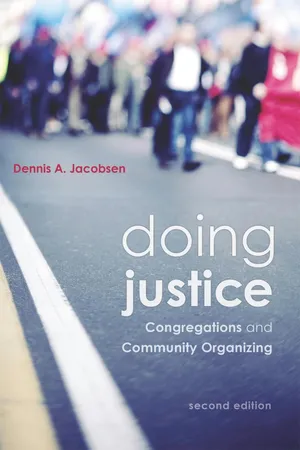
Doing Justice introduces people of faith to congregation-based community organizing rooted in the day-to- day struggles and hopes of urban ministry. Drawing from the authors decades of experience in community organizing ministry and skillfully illustrated with examples, Dennis A. Jacobsen weaves theological and biblical warrants for community organizing into concrete strategies for achieving justice in the public arena and discusses fundamental organizing principles like power, self-interest, and agitation. The second, updated edition includes a new preface and forewords, new sidebars by Grant Stevensen that draw the reader into conversation, an expanded list for further reading, and updated contact information on organizing networks and relevant websites.
eBook - ePub
Doing Justice
Congregations and Community Organizing
- 192 pages
- English
- ePUB (mobile friendly)
- Available on iOS & Android
eBook - ePub
About this book
Information
5
Power
“But you will receive power when the Holy Spirit has come upon you; and you will be my witnesses in Jerusalem, in all Judea and Samaria, and to the ends of the earth.” (Acts 1:8)
Then comes the end, when he [Christ] hands over the kingdom to God the Father, after he has destroyed every ruler and every authority and power. For he must reign until he has put all his enemies under his feet. The last enemy to be destroyed is death. For “God has put all things in subjection under his feet.” (1 Cor 15:24–27)
Organizers tend to have a rather straightforward approach to power. They want power. They want the people with whom they work to have power. And they want to build power organizations. They see power as essentially neutral. It can be used in the service of justice or abused in the service of evil. They point to the fact that in Spanish the word for power is poder, which literally means “the ability to act” or “to be able.” Organizers see power as what is needed to get things done. Power is needed to combat discrimination, to rebuild cities, to fight urban sprawl, to reduce drug trafficking, to improve school systems. If a person wants to make such changes in the public arena, then he or she must decide to become a power person connected with a power organization.
“They want power.” If we’re honest, we know the truth is that we want power. This chapter is all about what real power is.
Organizers are usually impatient with the ambivalence that most people of faith have with power. They think that this ambivalence serves the interests of politicians and the wealthy who want the rest of us to think of power as bad so that we will not threaten their status and position. Public officials call themselves “servants” in order to make us think that servanthood, not power, is the operative force for change. Organizers make note of Rollo May’s thesis in his book, Power and Innocence, which claims that most people seek innocence to avoid the responsibility of power. They contend that those who avoid power out of fear of being corrupted are probably doing so to avoid the high cost of having power: conflict, controversy, ridicule, defeat. Those exercising such avoidance in order to remain “innocent” are making a virtue out of their cowardice. According to organizers, power does not corrupt; power attracts the corruptible. Good people sit on the sidelines, wrap themselves in virtue, and allow other people’s values to dominate society.
Organizers know that power comes from essentially two sources: organized people and organized money. Political parties, unions, banks, corporations, and the media wield power because they have organized people and/or organized money. Congregation-based community organizations working in low-income neighborhoods may not be able to organize millions of dollars, but they can organize sufficient money to hire professional organizers and to be independent of governmental control. The greatest source of power for congrega-tion-based community organizations rests in the large numbers of people that can be organized around issues that meet their self-interest. Organizers say that moral suasion does not create social change. Social change is the product of power applied effectively in the public arena.
Such clarity and conclusions about power seem to come so easily to organizers but less so to most of the rest of us. Lord Acton’s statement that “power tends to corrupt, and absolute power corrupts absolutely” speaks to our experience. One does not need to point to Hitler or Stalin or other demagogues as examples of Acton’s maxim. We see in urban America the human destruction caused by power brokers and power systems, drug kings and gang leaders, greedy landlords and corrupted officials, principalities and powers. We know firsthand the way that power can crush whatever is in the way of its self-interest.
Power in the real world is often the tool of evil. And so Paul envisions the eschatological destruction of power: “Then comes the end, when he [Christ] hands over the kingdom to God the Father, after he has destroyed every ruler and every authority and power. For he must reign until he has put all his enemies under his feet” (1 Cor 15:24–25). William Stringfellow, always biblically wary of power, interprets Paul’s vision as total and unequivocal. For Stringfellow, the reiterated use of “every” and “all” in Paul’s reference to rebellious powers includes “all institutions, all ideologies, all images, all movements, all causes, all corporations, all bureaucracies, all traditions, all methods and routines, all conglomerates, all races, all nations, all idols.”[1] But powerlessness also corrupts. Powerlessness is also the tool of evil. The fruits of powerlessness are the loss of dignity and pride, the loss of hope, turning to drugs or alcohol or escapist religion, families in disarray—violent crimes as desperate reactions to life without the power to pursue dreams and aspirations. To the powerless, the Bible frequently promises power. The ascending Jesus promises his disciples that they will “receive power when the Holy Spirit has come upon you.” Hannah (echoed in Mary’s Magnificat) exults that her God “raises up the poor from the dust; he lifts the needy from the ash heap, to make them sit with princes and inherit a seat of honor” (1 Sam 2:8).
And so people of faith often find themselves with ambiguous and conflicting feelings about power. We see that Scripture has no single word about power. It is dishonest to focus only on those biblical passages about power that serve our interests. We disdain the corrupting influence of power. But we equally disdain the corrupting influence of powerlessness. We hate how evil uses power to destroy people. But we also know that it takes power to rise up against such evil.
We find that we cannot run away from power once we take the ethical teachings of Jesus seriously. These teachings draw us into a life of compassion and righteousness that seeks justice. On an interpersonal level, perhaps we find no tension. We visit the sick and imprisoned, shelter the homeless, and feed the hungry without conflict. But what happens when we begin to analyze why people are imprisoned, homeless, hungry, and poor in a society of immense wealth? We begin to thirst for justice. This thirst for justice leads us into the public arena. And there we learn rather quickly the truth of Frederick Douglass’s maxim: “Power yields nothing without a struggle. It never has and it never will.”[2]
We who try to live by the Golden Rule, by the mandate to love the enemy, by the perfect demands of the Beatitudes, now find ourselves in power struggles where we may act as a group in ways that we would not act as individuals. We experience the distinction that Niebuhr wrote about in his classic work Moral Man and Immoral Society. “As individuals, men believe that they ought to love and serve each other and establish justice between each other. As racial, economic and national groups they take for themselves whatever their power can command.”[3] Niebuhr was right. A sharp distinction can be drawn between the moral and social behavior of individuals and that of social groups, and this distinction often draws those seeking social justice into collective political actions that might seem offensive to an individualistic ethic.
The teachings of Jesus in the Sermon on the Mount clearly enjoin his disciples to nonviolence, and those who claim to follow Jesus deny him when they turn the cross into a sword. But given the systemic violence that daily demeans the lives of the poor, social justice must be pursued passionately and vigorously. Actions forcing politicians, bankers, or systems to act justly are often coercive. Whether it be as sweeping as sanctions against apartheid in South Africa or as basic as a public demonstration against the inaction of an elected official, nonviolent action to create social change that is powerful is usually coercive. While commitment to nonviolence must be unwavering, no one can make honest claim to moral purity in the public arena. The reality is that every action on behalf of justice creates an injustice.
We may feel “ambivalent” about power. How have you seen powerlessness corrode and undermine communities? How do you and your congregation shy away from acting powerfully in the world?
Amnesia must not be the cost of acting in the public arena. We remember who we are as Christians. And we act accordingly. I recall how Betty Smith, one of MICAH’s leaders, lived out her faith in the public arena on an issue of jobs for the unemployed. Her committee had worked for a year on a proposed piece of legislation that would set aside 14 percent of jobs on all Department of Public Works contracts for unemployed residents of Milwaukee’s inner city. After extensive negotiations with labor unions and with the Association of General Contractors, an inner-city alderman agreed to sponsor the legislation. But everything was moving intolerably slowly. Finally, at a public meeting of 1,200 members of MICAH congregations, at which the alderman and other public officials were present, Betty Smith gave a stirring speech calling for an end to stalling. She urged the alderman to act now. Feeling betrayed and publicly humiliated, the alderman stormed out of the meeting.
The next morning the alderman pushed the legislation through his committee while at the same time excoriating MICAH for attacking him. Betty Smith tried to reach him by phone all day to seek understanding and reconciliation. He refused to accept her phone calls. That evening, after work, Betty went to the alderman’s home, sat on his porch, and waited two hours for his arrival. Seeking him out in this way, she was able to press for an honest and open conversation. The emotional wounds took a while to heal for our good alderman (who is, by the way, a most decent and honest person).
Betty Smith was not seeking moral purity in the public arena. She was seeking jobs for hundreds of unemployed people. She acted nonviolently at the public meeting, but her action was also sufficiently coercive to force the alderman to move the legislation. She acted as a Christian. Her concern was not only for the unemployed but also for the alderman. Her relentless efforts to seek reconciliation reflected the depths of her Christian faith.
Small wonder that many people of faith prefer to turn away from power and the public arena. It feels safer, holier, and more comfortable to operate in the realm of the individual and interpersonal. Everyone speaks well of the Christian who serves soup to the homeless or volunteers at a shelter, unless of course that Christian begins to question why people are homeless. Dom Hélder Câmara said, “When I feed the hungry, they call me a saint. When I ask why people are hungry, they call me a Communist.”[4]
Moral purity can be a zone of comfort for the privileged and pious, where they—we?—can avoid responsibility. Our churches often revolve around themes of “reconciliation,” easy peace-making, and good feelings. What would it be like to live like Betty?
Jesus said, “Woe to you when the world speaks well of you.” Jesus had enemies. Jesus was controversial. Jesus turned tables upside down and confronted principalities and powers. Obedience to Jesus and to our conscience takes us where we may prefer not to go. The geography of faith is treacherous and difficult. It engages us in the public arena and in the formation and wielding of power. We are inclined to resist this summons of the Spirit.
Some fear the added responsibility that comes with power. Already exhausted by the burdens and demands of life, they simply want some peace and quiet. They do not want to be drawn into organizing efforts that will add meetings, commitments, relationships, and actions to their busy lives. Some do not enter the public arena because they lack confidence in their own gifts and abilities. They hide from power because they lack the self-confidence necessary to exercise it.
“Some fear the added responsibility that comes with power.” Isn’t that the truth we’d rather avoid?
Some pr...
Table of contents
- Cover
- Title Page
- Copyright
- Dedication
- Epigraph
- Table Of Contents
- Foreword
- Foreword and Introduction to the Conversation
- Preface to the Second Edition
- Preface to the 2001 Edition
- The World as It Is
- The World as It Should Be
- Engaging the Public Arena
- Congregation-Based Community Organizing
- Power
- Self-Interest
- One-on-Ones
- Agitation
- Metropolitan Organizing
- Building and Sustaining an Organization
- Community
- A Spirituality for the Long Haul
- Appendix
- Index
Trusted by 375,005 students
Access to over 1.5 million titles for a fair monthly price.
Study more efficiently using our study tools.
Frequently asked questions
Yes, you can cancel anytime from the Subscription tab in your account settings on the Perlego website. Your subscription will stay active until the end of your current billing period. Learn how to cancel your subscription
No, books cannot be downloaded as external files, such as PDFs, for use outside of Perlego. However, you can download books within the Perlego app for offline reading on mobile or tablet. Learn how to download books offline
Perlego offers two plans: Essential and Complete
- Essential is ideal for learners and professionals who enjoy exploring a wide range of subjects. Access the Essential Library with 800,000+ trusted titles and best-sellers across business, personal growth, and the humanities. Includes unlimited reading time and Standard Read Aloud voice.
- Complete: Perfect for advanced learners and researchers needing full, unrestricted access. Unlock 1.5M+ books across hundreds of subjects, including academic and specialized titles. The Complete Plan also includes advanced features like Premium Read Aloud and Research Assistant.
We are an online textbook subscription service, where you can get access to an entire online library for less than the price of a single book per month. With over 1.5 million books across 990+ topics, we’ve got you covered! Learn about our mission
Look out for the read-aloud symbol on your next book to see if you can listen to it. The read-aloud tool reads text aloud for you, highlighting the text as it is being read. You can pause it, speed it up and slow it down. Learn more about Read Aloud
Yes! You can use the Perlego app on both iOS and Android devices to read anytime, anywhere — even offline. Perfect for commutes or when you’re on the go.
Please note we cannot support devices running on iOS 13 and Android 7 or earlier. Learn more about using the app
Please note we cannot support devices running on iOS 13 and Android 7 or earlier. Learn more about using the app
Yes, you can access Doing Justice by Dennis R. Jacobsen,Dennis A. Jacobsen in PDF and/or ePUB format, as well as other popular books in Théologie et religion & Ministère chrétien. We have over 1.5 million books available in our catalogue for you to explore.