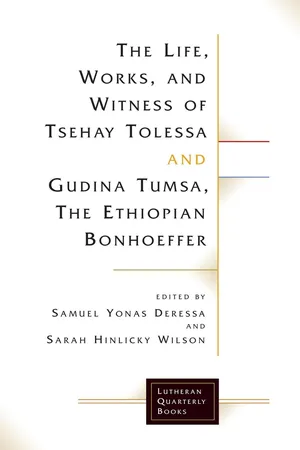
This book opens a window into the lives and extraordinary witness of a Christian couple whose faithful life of service has earned them the moniker of Ethiopias Bonhoeffer. Part One introduces the reader to the extant writings of Gudina Tumsa. Part Two is a highly personal account of Gudina and Tsehays life, witness, and sufferings. The collection concludes with an essay by Samuel Yonas Deressa on the impact of Gudinas vision. Gudina lives on in the many Ethiopian Christians who continue to be inspired by his life and witness.
eBook - ePub
The Life, Works, and Witness of Tsehay Tolessa and Gudina Tumsa, the Ethiopian Bonhoeffer
- 298 pages
- English
- ePUB (mobile friendly)
- Available on iOS & Android
eBook - ePub
The Life, Works, and Witness of Tsehay Tolessa and Gudina Tumsa, the Ethiopian Bonhoeffer
About this book
Trusted by 375,005 students
Access to over 1.5 million titles for a fair monthly price.
Study more efficiently using our study tools.
Information
Topic
Theology & ReligionSubtopic
Christian TheologyII
Tsehay Tolessa’s Story
Preface to In the Fiery Furnace
Lensa Gudina
For you, O God, have tested us;
you have tried us as silver is tried.
You brought us into the net;
you laid a crushing burden on our backs;
you let men ride over our heads;
we went through fire and through water;
yet you have brought us out to a place of abundance.
—Psalm 66:10–12
you have tried us as silver is tried.
You brought us into the net;
you laid a crushing burden on our backs;
you let men ride over our heads;
we went through fire and through water;
yet you have brought us out to a place of abundance.
—Psalm 66:10–12
It took me two decades to find the courage I needed to be able to read this book that Aud Sæverås wrote about my parents, In the Fiery Furnace. This phrase from the book of Daniel was used repeatedly by my mother during the interviews she had with the author—in a hiding place, for fear of military reprisal—to describe the sufferings she had to endure while in prison.
The book tells of atrocities committed against prisoners by the Ethiopian Military Regime, physical and mental torture committed on men and women, young and old indiscriminately. Ethiopia had become a testing ground for torture equipment, chemical weaponry, and strategies of war from the Soviet Union, Cuba, and the Eastern European countries.
The torturers were ruthless, merciless, brutal wild beasts, as my mother described them. It is impossible to make any sense out of their inhuman acts or why they did them. They considered torture sessions joyous occasions, a time to get drunk and mock victims as they hung them upside down on wooden bars and took turns beating them. They got pleasure from listening to the victims’ agonizing screams and seeing the blood dripping down from the beaten bodies. The guard who witnessed my father’s brutal assassination told how Mengistu Haile Mariam, the head of the Military Regime, and his officials came to the torture chambers to watch victims being slaughtered.
This is why it took me twenty years to bring myself to read this book. Each time I picked it up and tried to read a section of it, I cried uncontrollably and had to put it down. The book had been translated from its original Norwegian into other Scandinavian languages, German, Swahili, and even Mandarin. We heard that Aud had arranged for an English translation, but before it was finalized she passed away. This is how the English-speaking world has failed to hear the story of a courageous woman who unconditionally loved the Lord despite imprisonment, torture, the loss of a husband she loved dearly, and separation from her children for decades.
The brutal acts, inhumanity, and injustices described in the book may trigger anger, remorse, and outrage in the reader. At the same time, reading of how both my parents responded to the brutality inflicted upon them will demonstrate vividly the power of love, the cost of discipleship, determination, faithfulness, and victory in the way of Christ. My mother was once asked in an interview what she would like to see happen to her tormenters. Her response was: “That they may come to know Christ and through forgiveness inherit the kingdom of God.” This kind of response is beyond human understanding. Only through the grace of God can it be achieved.
While reading some sections of the book, I began to wonder whether Aud may have considered naming it “Born to Suffer.” My mother’s childhood, coinciding with the Italian occupation of Ethiopia, portrays fascism at its worst. Italian soldiers set fire to fields ready for harvest, annihilated innocent villagers, burned whole villages, and scattered families mercilessly, reducing them to poverty and homelessness. Mother managed to escape the wrath of the Italians, who killed her merchant father and made her mother a refugee, only to be kidnapped and abused by slave traders. A traumatic childhood! She was ill-treated, beaten, sick, and starved at the hands of vicious men. A similar kind of brutality recurred many decades later when she found herself in the hands of ferocious military men who took pleasure in shredding her flesh to pieces and breaking her bones as they tortured her.
As I was totally immersed in the thoughts of the indescribable atrocity committed against both of my parents, I was led to reflect on the words spoken to the church of Pergamum in Revelation: “I know where you dwell, where Satan’s throne is.” This, I thought to myself, could also have been a suitable title for this book: “Where Satan’s Throne Is.” Such an act of cruelty, savagery, mercilessness, and injustice against the innocent can only be expected in Satan’s kingdom. Throughout the different eras and regimes, Ethiopia suffered in this way. Underneath the superficial image that Ethiopia likes to show the rest of the world—as hospitable, never-colonized, biblical—lies inhumanity, injustice, and brutality indescribable in human words. The true stories told in this book expose the ancient Ethiopian camouflage, loaded with fairy tales and myths, while unveiling the true face of Ethiopia.
Heaven and earth will pass away, but my words will not pass away.
—Matthew 24:35
—Matthew 24:35
In that dungeon, where my mother was kept for the first thirteen months of her imprisonment, life had become unbearably bitter. She told me that open wounds all over her body were left untreated, her whole body was rotten, full of worms and stench, not to mention the creepy-crawly bugs and the throng of rats that invaded the prison cell every night. She had to lie on a bare cement floor night and day, unable to drink or eat, with nothing to cover her body. The worst of it all, she said, was that no sleep came to her eyes for the first twenty-one days after her first beating. On the twenty-first night, she couldn’t stop crying and murmured to herself that she was going to die there and no one would ever find out what had happened. As she uttered those words, she fell asleep and saw Jesus coming toward her, saying, “Do not be afraid. You shall not die here!” He took her by the hand to show her how he was going to bring her out of prison in due time. He said, “You shall pass through four gates to get out of prison, and afterward I will give you a spacious compound where you will reside.” After that encounter, she had no more sleepless nights. Her hopes were renewed.
Ten years passed before the promise came true. On the day of her release from prison, she thought of that dark and gloomy dungeon where she saw the extraordinary figure of Christ. As she walked out to freedom and new life, she began to count the gates. When she stepped out of the fourth, she said to herself, “Now I know I am finally free!”
Yet you have brought us out to a place of abundance.
—Psalm 66:12
—Psalm 66:12
The fulfillment of the second half of Christ’s words, spoken to Mother in that prison cell, took another fourteen years. When she entered the “promised compound,” she vowed to set up a church right there to serve and honor him who answered her in the day of her distress and who had been with her wherever she was taken, who never forsook her as she walked through the valley of the shadow of death.
Biftu Bole Mekane Yesus Congregation came as a reward for the long suffering and grief, wounds and bruises, widowhood and loneliness, loss and humiliation. Gudina Tumsa was in his eternal home; on October 12, 2014, Tsehay Tolessa joined him. The passion and selflessness with which God endowed them—passion to take the gospel to all peoples suffering under the bondage of the evil one, passion to reach out to the poor and downtrodden, passion to bring the message of hope to the despairing millions—continues to thrive through the Gudina Tumsa Foundation (GTF) and the Biftu Bole Congregation.
Holistic ministry, which has become synonymous in church circles with the name of Gudina Tumsa, has found a fertile ground among the underprivileged and marginalized persons that the GTF has been serving for the past two decades, addressing their physical and spiritual needs. Biftu Bole is actively engaged in spreading the good news and planting churches in remote areas. There in that “promised compound,” a new generation is rising to take the vision forward, a generation that, in the words of the prophet Joel, “march each on his way; they do not swerve from their paths. They do not jostle one another; each marches in his path. . . . The Lord utters his voice before his army, for his camp is exceedingly great; he who executes his word is powerful” (2:7–11).
The year is 2014. Three and a half decades have elapsed since Gudina Tumsa’s assassination and Tsehay Tolessa’s imprisonment. In the “promised compound” stands the Biftu Bole Congregation. It’s Sunday morning and people flock into the church by the hundreds. Tse...
Table of contents
- Cover
- Additional Praise for The Life, Works, and Witness of Tsehay Tolessa and Gudina Tumsa, the Ethiopian Bonhoeffer
- Title Page
- Copyright
- Table Of Contents
- Gudina Tumsa’s Life: An Overview
- Foreword: A Remarkable Man and a Remarkable Woman
- Introduction
- Gudina Tumsa’s Theological Writings
- Tsehay Tolessa’s Story
- Conclusion: The Reception and Expansion of Gudina Tumsa’s Legacy in Ethiopia, Africa, and Beyond
- Appendix: The Church and Ideologies
- Bibliography
- Subject Index
- Scripture Index
Frequently asked questions
Yes, you can cancel anytime from the Subscription tab in your account settings on the Perlego website. Your subscription will stay active until the end of your current billing period. Learn how to cancel your subscription
No, books cannot be downloaded as external files, such as PDFs, for use outside of Perlego. However, you can download books within the Perlego app for offline reading on mobile or tablet. Learn how to download books offline
Perlego offers two plans: Essential and Complete
- Essential is ideal for learners and professionals who enjoy exploring a wide range of subjects. Access the Essential Library with 800,000+ trusted titles and best-sellers across business, personal growth, and the humanities. Includes unlimited reading time and Standard Read Aloud voice.
- Complete: Perfect for advanced learners and researchers needing full, unrestricted access. Unlock 1.5M+ books across hundreds of subjects, including academic and specialized titles. The Complete Plan also includes advanced features like Premium Read Aloud and Research Assistant.
We are an online textbook subscription service, where you can get access to an entire online library for less than the price of a single book per month. With over 1.5 million books across 990+ topics, we’ve got you covered! Learn about our mission
Look out for the read-aloud symbol on your next book to see if you can listen to it. The read-aloud tool reads text aloud for you, highlighting the text as it is being read. You can pause it, speed it up and slow it down. Learn more about Read Aloud
Yes! You can use the Perlego app on both iOS and Android devices to read anytime, anywhere — even offline. Perfect for commutes or when you’re on the go.
Please note we cannot support devices running on iOS 13 and Android 7 or earlier. Learn more about using the app
Please note we cannot support devices running on iOS 13 and Android 7 or earlier. Learn more about using the app
Yes, you can access The Life, Works, and Witness of Tsehay Tolessa and Gudina Tumsa, the Ethiopian Bonhoeffer by Samuel Yonas Deressa, Sarah Hinlicky Wilson, Samuel Yonas Deressa,Sarah Hinlicky Wilson,Sarah Hinlicky Wison in PDF and/or ePUB format, as well as other popular books in Theology & Religion & Christian Theology. We have over 1.5 million books available in our catalogue for you to explore.