eBook - ePub
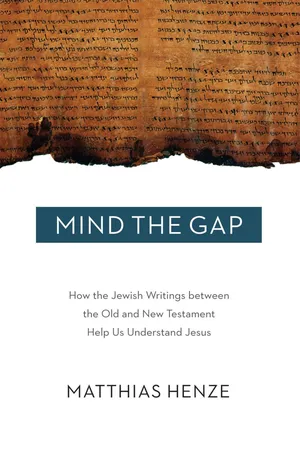
Mind the Gap
How the Jewish Writings between the Old and New Testament Help Us Understand Jesus
- 248 pages
- English
- ePUB (mobile friendly)
- Available on iOS & Android
eBook - ePub
Mind the Gap
How the Jewish Writings between the Old and New Testament Help Us Understand Jesus
About this book
Do you want to understand Jesus of Nazareth, his apostles, and the rise of early Christianity? Reading the Old Testament is not enough, writes Matthias Henze in this slender volume aimed at the student of the Bible. To understand the Jews of the Second Temple period, it’s essential to read what they wrote—and what Jesus and his followers might have read—beyond the Hebrew scriptures. Henze introduces the four-century gap between the Old and New Testaments and some of the writings produced during this period (different Old Testaments, the Apocrypha and Pseudepigrapha, the Dead Sea Scrolls); discusses how these texts have been read from the Reformation to the present, emphasizing the importance of the discovery of Qumran; guides the student’s encounter with select texts from each collection; and then introduces key ideas found in specific New Testament texts that simply can’t be understood without these early Jewish “intertestamental” writings—the Messiah, angels and demons, the law, and the resurrection of the dead. Finally, he discusses the role of these writings in the “parting of the ways” between Judaism and Christianity. Mind the Gap broadens curious students’ perspectives on early Judaism and early Christianity and welcomes them to deeper study.
Information
Topic
Theology & ReligionSubtopic
Biblical StudiesII
The Jewish Jesus
3
Jesus, the Messiah of Israel
The One Who Is to Come
The earliest followers of Jesus were united in their belief that Jesus of Nazareth, the son of Mary and Joseph, was the messiah for whom Israel had been waiting. Statements to this effect are found throughout the New Testament. In the opening scenes of the Gospel of John, for example, John tells the story of how Jesus meets his first disciples. One of them, Andrew, overhears John the Baptist bear witness about Jesus. He then looks for his brother Simon Peter and tells him excitedly, “We have found the Messiah.” Then both Andrew and Peter go to follow Jesus. A short moment later the scene is repeated, albeit this time with a different couple of disciples. Now it is Philip who tells Nathanael, “We have found him about whom Moses in the law and also the prophets wrote, Jesus son of Joseph from Nazareth.” When Nathanael meets Jesus shortly thereafter he says to him, “Rabbi, you are the Son of God! You are the King of Israel!” As early as the first chapter of his Gospel, John makes clear that it is a primary concern of his to demonstrate that Jesus is the Messiah of Israel, in whom the messianic promises have been fulfilled.
A few chapters later, in John 4, Jesus is deep in conversation with a Samaritan woman. The two meet at Jacob’s well in the city of Sychar and discuss the different places of worship of the Samaritans and the Jews. When Jesus tells the woman that soon all will worship God in spirit and truth, she responds with a reference to the Jewish hope for the messiah.
25 The woman said to him, “I know that the Messiah is coming” (who is called the Anointed). “When he comes, he will proclaim all things to us.” 26 Jesus said to her, “I am he, the one who is speaking to you.” (John 4:25–26; all translations from the Bible are taken from the New Revised Standard Version)
Andrew, Philip, and the Samaritan woman all speak of the Jewish belief in the coming of the messiah of Israel. Neither of them says very much about what exactly this belief entails, but a few things are clear: that the messiah will come to Israel, that the Advent of the messiah is thought to be imminent, that the Torah and the Prophets already announced the messiah, and that upon his arrival the messiah will reveal “all things.” John also works an impressive number of messianic titles into the opening scene of his Gospel. At some point or another, those who hear of Jesus and meet him call Jesus “Lamb of God,” “Son of God,” “King of Israel,” and “Son of Man”—all titles that are associated with the messiah and that are applied to Jesus in the first chapter of the Gospel of John.
Messianism, the belief in a divine agent whom God will send at the end of time to reign over a restored kingdom of Israel, was well established in first century Israel. The disciples of Jesus did not learn about the messiah from Jesus; they were already anticipating the coming of a messiah before they met Jesus. And they knew what to look out for. Likewise, the anonymous Samaritan woman, herself not an Israelite, also knew of the Jewish hope for a messiah who will come to reveal “all things.” The belief in a messiah, a future anointed agent of God, is thus not a Christian innovation, as the New Testament makes abundantly clear. It did not originate with Jesus. Rather, traditions about the messiah are already attested in Judaism centuries earlier. Messianism has deep roots in the Old Testament, but the idea of an awaited agent of God only developed gradually in Judaism in post-Old Testament times, during the last centuries before the Common Era. The evangelists of the New Testament knew of these traditions and were deeply influenced by them. They portray Jesus of Nazareth in their Gospels as God’s Messiah for whom Israel has been waiting, the One who is to come. Their aim is to show that Jesus of Nazareth is none other than the Messiah of Israel, who was already proclaimed in the Old Testament.
This chapter will trace the development of the messianic idea in ancient Judaism from its origins in the Old Testament to Jesus in the New Testament. The chapter begins with a selection of texts about the messiah in the Old Testament, then briefly examines some of the messianic expectations as they took shape in post–Old Testament Jewish writings, and finally compares these Jewish expectations with descriptions of Jesus in the New Testament. Not surprisingly, there are striking similarities between pre-Christian Jewish expectations of the messiah and the descriptions of Jesus we find in the Gospels.
The Messiahs of the Old Testament
The word “messiah” in English and its cognates in other Western languages come from the Greek word μεσσίας (pronounced messías). This explains why in English the word “messiah” is spelled with double “s.” In the New Testament, which was originally written in Greek, the word μεσσίας is found twice, in the two places we have already discussed. In John 1:41, Andrew says to Simon Peter, “We have found the Messiah,” and in John 4:25, the Samaritan woman says, “I know that the Messiah is coming.” The Greek word μεσσίας is a loan word, meaning that it is not originally a Greek word but is adopted from another language. It is a Greek version of the Hebrew word mashiakh (in Aramaic, a language closely related to Hebrew, the word is meshikha). The Hebrew noun mashiakh derives from the verb mashakh (to smear; anoint) and thus means “the anointed one.”
In addition to this Hebrew loan word, the Greek language has its own, native word for “anointed,” χριστός (pronounced christós), from which comes the English word “Christ.” It is related to the Greek verb chrío (to anoint). The words “Messiah” and “Christ” thus have the same meaning, “anointed one,” only the former derives from the Hebrew and the latter from the Greek. The New Testament often refers to Jesus as “Jesus Christ,” for example in the title of the Gospel of Mark in Mark 1:1, “The beginning of the good news of Jesus Christ.” The Greek phrase “Jesus Christ” thus simply means “Jesus, the Messiah,” or “Jesus, the Anointed.” It is likely that for Mark and other authors of the New Testament, the word “Christ” meant more than simply its literal meaning, “anointed one.” It had already become a messianic title.
The Hebrew noun mashiakh (anointed one) is found forty times in the Old Testament. There are three groups of people who are said to be “anointed”: kings, priests, and prophets. The group most often called “anointed” in the Bible are the kings. Saul, Israel’s first king, is called “the Lord’s anointed,” and so is King David, who reigned after Saul. Both carry this title because it was Samuel who anointed them and thus made them kings over Israel. In 1 Samuel 16, the Bible tells the story of how David is anointed as Israel’s new king. When God sends Samuel to David’s father Jesse to anoint the next king of Israel, Samuel has Jesse parade all of his sons before him. Only when David, the youngest of his brothers, is called to meet Samuel does God tell Samuel that this is the future king. This is when Samuel anoints David. “Then Samuel took the horn of oil, and anointed [Hebrew, mashakh] him in the presence of his brothers; and the Spirit of the Lord came mightily upon David from that day forward” (1 Samuel 16:13). This procedure of choosing the next king of Israel away from the public eye may seem a bit odd and somewhat underwhelming to the modern reader, who may well have expected a more impressive public coronation ceremony. And yet, in ancient Israel the act of anointing rather than public endorsement and celebration confers divine approval. The person is now set apart from the regular folk—and, in the case of David, against all odds endowed with the kind of authority that only God can bestow—regardless of how many people are present. The anointed individual now has a particular task with which God has entrusted him. The reasons for God’s choice are rarely self-evident.
In addition to Saul and David, there are other kings who are also labeled “anointed” or “messiah” in the Bible. A curious example is King Cyrus the Great, the founder of the Persian Empire, not an Israelite, whom the prophet Isaiah calls “[the Lord’s] anointed” (Isaiah 45:1). Cyrus was the Persian king who brought an end to the Babylonian captivity and allowed the Israelites to return home from exile. Calling Cyrus the Lord’s “anointed” is Isaiah’s way of saying that Cyrus, the only non-Israelite in the Old Testament who is called a “messiah,” did what he did because it was the God of Israel who anointed him, endowed him with the authority to reign, and who saw to it that Cyrus would allow Israel to return home from exile.
The second group of individuals who are called “anointed” in the Old Testament are the priests. Chapter 4 of the book of Leviticus explains the nature of a particular kind of offering that was brought to the temple in Jerusalem, the offering for sins and severe personal impurities. The first case to be discussed in Leviticus 4 considers such incidents in which it is the high priest himself who sinned. The text begins, “If it is the anointed priest [a more literal translation of the Hebrew would be “the priest, the messiah”] who sins . . .” The Hebrew verb “to anoint” is used sixty-nine times in the Hebrew text of the Old Testament. Just about half of these cases relate to the anointing of Aaron and his sons, of the high priests, and of the various cult objects used at the temple in Jerusalem. It is therefore not surprising that the high priest in Leviticus 4 is said to be “anointed.”
The third group, finally, are the prophets of Israel. Here the evidence is sparse. In 1 Kings 19, God tells Elijah to anoint two kings, Hazael of Aram and Jehu of Israel. God also commands Elijah to anoint Elisha “as prophet in your place,” but then the actual anointing of Elisha is never told. In Psalm 105:15, the psalmist recalls how God has always protected Israel since the time of Abraham, Isaac, and Jacob. The psalmist then notes how God rebuked the foreign kings, “Do not touch my anointed ones [or “my messiahs”]; do my prophets no harm.” The phrases “my anointed ones” and “my prophets” are used in parallel lines in the psalm. In biblical poetry, two expressions that are used in parallelism typically refer to the same subject. The “anointed ones” in Psalm 105 thus are God’s prophets. Apart from these short references in 1 Kings 19 and Psalm 105, there is no actual report in the Old Testament in which an individual is anointed to become a prophet. In brief, there are several people in the Bible who are said to be “anointed” —kings, priests, and, to a lesser extent, prophets. The act of anointing is part of their divine call and initiation rite. It bestows them with divine authority, even if they themselves do not become divine.
It is equally important to notice what we do not find in the Old Testament. While there are several individuals in the Bible who are said to be anointed, the word “messiah” or “anointed one” is never used in the Old Testament to designate a future anointed redeemer figure. In other words, there are no texts in the Old Testament that know of the concept of a messiah as an awaited agent of God, a descendant of David who will appear to reign over a restored kingdom of Israel at the end of time. That concept of a future messiah was only developed in later times, after the Old Testament. There are several “messiahs” in the Old Testament, to be sure, but they are not divine figures of the end of time. They are the kings, priests, and prophets of ancient Israel. And yet, when Andrew tells his brother Simon Peter, “We have found the Messiah,” or when the Samaritan woman declares, “I know that the Messiah is coming,” they are not referring to an earthly king, priest, or prophet. They are expressing the hope for a future redeemer figure, the messiah of the end time. We find that concept develop in the literature that was written during the gap years in between the Old and the New Testament.
The Scriptural Basis for the Messianic Expectations
in Ancient Judaism
There are no texts in the Old Testament that speak of a future messianic figure of the end time. There are, however, several biblical texts that provide the scriptural basis for messianic expectations in ancient Judaism. A few of these biblical passages mention an “anointed” figure, but most of them do not. In Second Temple times, these texts came to be interpreted as predictions of a future messiah.
A recurring theme in the texts from the Old Testament that came to be interpreted as messianic prophecies is the hope that the messiah will be a royal figure who will come from the line of King David. This hope is grounded not only in the sheer majesty of King David, who is unparalleled among the monarchs in ancient Israel. It is also based on a particular promise of God to David. The book of 2 Samuel tells the gripping story of David’s rise to power, tracing his rapid ascent step-by-step. First, David is made king over the entire kingdom of Israel. Then he conquers Jerusalem, a city that had not yet been taken by any of the tribes of Israel, and makes it the new political capital. Next, he brings the ark of the covenant to Jerusalem, so that the new political capital becomes the new religious capital as well. Then David builds himself a palace. And, finally, he offers to build God yet another structure, a temple that would serve as the new home for the ark. But this time David is rebutted. God sends Nathan to David to declare to him that the king should not build a house for God, but that it is God who will build a house for David. Nathan’s oracle is a play on the word “house,” which comes to mean both “temple” and “dynasty.”
11 Moreover the Lord declares to you that the Lord will make you a house. 12 When your days are fulfilled and you lie down with your ancestors, I will raise up your offspring after you, who shall come forth from your body, and I will establish his kingdom. 13 He shall build a house for my name, and I will establish the throne of his kingdom forever. 14 I will be a father to him, and he shall be a son to me. When he commits iniquity, I will punish him with a rod such as mortals use, with blows inflicted by human beings. 15 But I will not take my steadfast love from him, as I took it from Saul, whom I put away from before you. 16 Your house and your kingdom shall be made sure forever before me; your throne shall be established forever. (2 Samuel 7:11–16)
Nathan’s oracle does not fo...
Table of contents
- Cover
- Title Page
- Copyright
- Table Of Contents
- Introduction
- Mind the Gap! Reading between the Old and the New Testament
- The Jewish Jesus
- Acknowledgments
- Further Reading
- Glossary
- Index of Authors and Subjects
- Index of Ancient Names and Places
- Index of Ancient Text
Trusted by 375,005 students
Access to over 1.5 million titles for a fair monthly price.
Study more efficiently using our study tools.
Frequently asked questions
Yes, you can cancel anytime from the Subscription tab in your account settings on the Perlego website. Your subscription will stay active until the end of your current billing period. Learn how to cancel your subscription
No, books cannot be downloaded as external files, such as PDFs, for use outside of Perlego. However, you can download books within the Perlego app for offline reading on mobile or tablet. Learn how to download books offline
Perlego offers two plans: Essential and Complete
- Essential is ideal for learners and professionals who enjoy exploring a wide range of subjects. Access the Essential Library with 800,000+ trusted titles and best-sellers across business, personal growth, and the humanities. Includes unlimited reading time and Standard Read Aloud voice.
- Complete: Perfect for advanced learners and researchers needing full, unrestricted access. Unlock 1.5M+ books across hundreds of subjects, including academic and specialized titles. The Complete Plan also includes advanced features like Premium Read Aloud and Research Assistant.
We are an online textbook subscription service, where you can get access to an entire online library for less than the price of a single book per month. With over 1.5 million books across 990+ topics, we’ve got you covered! Learn about our mission
Look out for the read-aloud symbol on your next book to see if you can listen to it. The read-aloud tool reads text aloud for you, highlighting the text as it is being read. You can pause it, speed it up and slow it down. Learn more about Read Aloud
Yes! You can use the Perlego app on both iOS and Android devices to read anytime, anywhere — even offline. Perfect for commutes or when you’re on the go.
Please note we cannot support devices running on iOS 13 and Android 7 or earlier. Learn more about using the app
Please note we cannot support devices running on iOS 13 and Android 7 or earlier. Learn more about using the app
Yes, you can access Mind the Gap by Matthias Henze in PDF and/or ePUB format, as well as other popular books in Theology & Religion & Biblical Studies. We have over 1.5 million books available in our catalogue for you to explore.