Thomas Aquinas (1224-1274) is one of the most important thinkers in the history of western civilization. A philosopher and theologian, a priest and preacher, Aquinas bequeathed to the world an enduring synthesis of philosophy, theology, and Christian spirituality. Aquinas championed the integration of faith and action, sound doctrine and right living, orthodoxy and orthopraxy. From the thirteenth century through the present day, his legacy has served as a blessing for the church and beyond. In the nearly eight hundred years since Aquinas's death, his thought has been studied, interpreted, criticized, reinvigorated, and anointed as the exemplar of Catholic theology. Thomas and the Thomists, a new volume in the Mapping the Tradition series, serves as an introduction to the life of Aquinas, the major contours of his teaching, and the lasting contribution he made to Christian thought. Romanus Cessario and Cajetan Cuddy also outline the history of the Thomist tradition-the great school of Aquinas's interpreters-from the medieval era through the revival of the Thomist heritage in the nineteenth and twentieth centuries. This volume affords its readers a working guide to understanding the history of Aquinas and his expositors as well as to grasping their significance for us today.
eBook - ePub
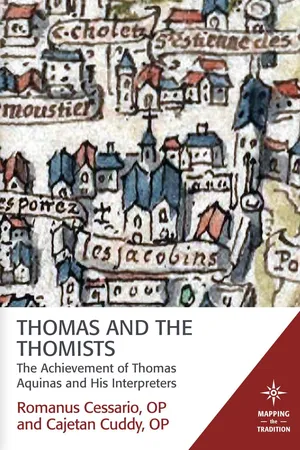
Thomas and the Thomists
The Achievement of Thomas Aquinas and his Interpreters
- 170 pages
- English
- ePUB (mobile friendly)
- Available on iOS & Android
eBook - ePub
Thomas and the Thomists
The Achievement of Thomas Aquinas and his Interpreters
About this book
Information
Topic
Theology & ReligionSubtopic
Christian DenominationsII
The Thomists, or “The Heritage of Truth”
4
Uneven Beginnings
Condemnation and “Correction”
Monumental aptly characterizes the academic achievement of Thomas Aquinas. Even early on, popes recognized this quality of his person and work. “Just as Saint Thomas shines among all the doctors by the beauty of his style and of his thought, likewise this church in Toulouse surpasses in beauty all the other churches of the Friars Preachers. I chose it for Saint Thomas and I wish that his body find its place there.”[1] Thus declaimed Pope Urban V (d. 1370), himself a Frenchman who had studied in the Rose City twained by the River Garonne. This sixth and penultimate of the Avignon popes resolved longstanding disputes over the final resting place of Saint Thomas’s earthly remains. The choice of Toulouse also honored Saint Dominic, who, with his first followers, took possession in 1216 of the city’s Saint-Romain chapel.[2] Except for an unhappy interlude after the French Revolution when they were moved for safekeeping to another church in Toulouse, the relics of Saint Thomas still reside in the church where Pope Urban V—who, it should be noted, had begun his clerical life as a Benedictine monk—ordered them transferred in 1369. Admittedly, Aquinas’s academic legacy provides historians with a more difficult challenge than that posed by his earthly remains. Nonetheless, his intellectual monument, or, as Josef Pieper calls it, “the heritage of truth,” that the interpreters of Aquinas, since his death in 1274, have constructed finds a fittingly symbolic representation in the Dominican church at Toulouse.[3] This imposing Gothic edifice, consecrated in 1385, goes under the name of the Église des Jacobins, a sobriquet used in France for the Order of Friars Preachers.
The heightened prominence that philosophy gained in the university settings of Europe from the start of the thirteenth century generated anxiety among certain theologians. In a word, the quarreling over substantial forms betrayed a sharp difference of opinion among Christian thinkers about how generously they should allow philosophy to throw light by analogy on the contents of faith.[4] Aquinas’s views were well-known. “If we resolve the problems posed by faith,” he once said, “exclusively by means of authority, we will of course possess the truth—but in empty heads!”[5] The debates that emerged revealed divided views on the broad methodological question of how philosophy and authority figure in to the development of Christian theology. Skittishness about just how much philosophy should play a role in theological discussions created a deep skepticism toward Aquinas’s characteristic “boldness” about human reason.[6]
The condemnation of certain theses both at Paris and Oxford in 1277, three years after the death of Aquinas in Italy, created a highly charged atmosphere in the intellectual centers of Europe. Although Aquinas’s name appeared in neither list of banned opinions, those persons who had not yet grown congenial to his innovations in the sacred sciences made the condemnations an occasion for advancing their unreconstructed views. This group mainly included local bishops and university professors, though even the reigning pope, John XXI, imposed disciplinary measures to support Bishop Tempier’s condemnations at Paris. This pope died shortly thereafter, on 20 May 1277; still, his mention of both philosophers and theologians who “dogmatize errors” seemed to implicate Aquinas.[7] The next pope, Nicholas III (d. 1280), proceeded to appoint a onetime opponent of Aquinas, John Pecham, a Franciscan theologian, to the archbishopric of Canterbury. Pecham continued his advocacy of the doctrine of plurality of substantial forms and insisted that Catholic orthodoxy depends on it. There followed, in the words of one scholar, “an active period of controversy in which the Franciscan prelate enjoyed a temporary advantage.”[8]
In order to put this controversy in perspective, one must remember the theological teaching that Aquinas’s opponents feared would be imperiled by their agreeing with those who upheld the Aristotelian position that no composite substance can have more than one substantial form. Bishops and some theologians worried about how to explain the divinity of the dead body of Christ. As events developed, Pecham’s conundrum led to his taking a less than generous view of Aquinas’s philosophical agility. One expert on the subject explains:
For Pecham this was not simply a philosophical issue, but one that touched the roots of Christian faith. If man has only one substantial form, he argued, then the living body of Christ on the cross cannot be the “same body” of Christ in the tomb. Pecham argued that there must be a “corporeal form” that is identical for both bodies. He and others even argued that if Mass had been celebrated while Christ was dead, it would not be true to say, “This is my Body,” or “This is my Blood.”[9]
Archbishop Pecham was persuaded that his opinion enjoyed the authority of Saint Augustine and that any other approach to the problem of the identity of Christ’s dead body would lead to heresy. Modern scholarship has determined otherwise about the antiquity of this philosophical analogy. The so-called doctrine of plurality of forms actually came into currency in the twelfth century.[10] Aquinas, as we have seen, advanced a different theory to explain the divine status of Christ’s dead body. His approach, however, did not entail heresy and, at the same time, avoided the metaphysical clumsiness that arises from postulating two substantial forms in one concrete, substantial being.[11] Aquinas was an innovator, however. In the late 1270s, partisans on each side of the question drew their battle lines around the philosophical question of the plurality of substantial forms.
Other confusions arose about how the new Aristotelian learning would affect the practice of Christian theology. Sixteen of the theses prohibited at Paris and three of those at Oxford reflected ideas found, though considerably qualified, in Aquinas’s writings.[12] Still, his critics tried to tar Aquinas with the same brush as the radical Aristotelians. Sometime between 1277 and 1279, the Franciscan theologian William de la Mare, who had succeeded John Pecham in the Franciscan chair at Paris, drew up a list of 118 topics from the works of Aquinas that required, in his view, emendation in light of the official condemnations that had been issued by the ecclesiastical authorities. The work, the Correctorium fratris Thomae, both gave its name to a controversy and earned for its author the—in hindsight—dubious title of the first systematic Neo-Augustinian. Because the debates were carried on mainly between members of the Dominican and Franciscan Orders, the Correctorium quarrels, as mentioned above, set each of these newly established mendicant orders at odds with the other.
As the motto of their Order, Veritas (Truth), might suggest, the Dominican scholars at Oxford, where the controversy initially flared up, did not remain supine in the face of opposition. The Yorkshire man William Hothum (d. 1298), who though a Dominican died archbishop of Dublin, followed the teaching of Aquinas and, what is more important, defended it. Hothum, whose career was spent largely attending to the diplomatic affairs of the English king, Edward I (d. 1307), came to the defense of those who tried to uphold Aquinas’s positions. That a man of Hothum’s standing took up the cause of one substantial form suggests that, even shortly after his death, an esprit de corps centered on Aquinas’s teaching had begun to develop among at least some of his Dominican confreres, including the superiors. Hothum served twice as provincial. The exact occasion that gave rise to Hothum’s defense of Thomist views involved another English Dominican, Richard Knapwell (d. ca. 1288), who produced one of the “Correctoria Corruptorii” writings. His composition comes down to us with the title “Quare,” or “Why do you disparage words of truth?” It was a question addressed to the Franciscan William de la Mare.
As already mentioned, the Dominicans were not willing to let William de la Mare get away with impunity. On the contrary, they accused the Franciscan of distorting Aquinas’s thought. Indeed, William’s Dominican interlocutors gibingly referred to his work as a “corruption” (corruptorium) instead of a correction (correctorium). Knapwell was the first to step into the ring. The plight of this staunch defender of the unicity of substantial form earned him rebuke and condemnation, including a temporary excommunication at London, which the pope eventually lifted. The papal reprieve, however, did not spell papal endorsement of Knapwell’s Thomist views. Instead, Pope Nicholas IV (d. 1292), the first pope drawn from the ranks of the Franciscans, imposed on the frazzled Knapwell a perpetual silence about the controversial theses. Knapwell returned to the Dominicans at Bologna, where he died, some say, having become unhinged as a result of the treatment he had received. Those teachers who raised questions such as, “Whether faith about the essence of human nature united to the Word requires us to posit plurality of forms,” were playing for high stakes. The uninitiated contemporary student of theology may be excused for thinking the brouhaha, well, odd. On the other hand, Catholic theology would have taken a different turn were the Augustinian theologians to have prevailed in their intransigence.[13]
The “Correctoria” literature continued to appear. At least five of these texts survive. A second comes from the pen of another English Dominican, Robert Orford, about whom little biographical information is available other than that he preached a sermon at Oxford on the second Sunday of Lent in 1293. He produced his “Sciendum” or “It Should be Known that Thomas . . . ,” which also took issue with each of the 118 corrections that William de la Mare thought necessary to make Aquinas safe for Augustinian theology. The third of the genre deals with only sixty of William’s complaints. The Correctorium “Circa,” or “About question XII, art., 20,” comes from the pen of the Parisian scholar Jean Quidort (d. 1306). Like the other Dominicans engaged in the “Correctoria” controversy, Quidort wrote on a wide variety of subjects. His straightforward defense of Aquinas’s work against false charges places this Frenchman within the burgeoning group of Dominicans one may describe, even if somewhat anachronistically, as Thomists. Given the high-profile politics of the times, Quidort himself fell under the suspicion of local ecclesiastical authorities. Like Knapwell, he ...
Table of contents
- Cover
- Title Page
- Copyright
- Dedication
- Table Of Contents
- Mapping the Tradition Series
- Introduction
- Thomas, or A Story of Divine Providence
- The Thomists, or “The Heritage of Truth”
- Select Bibliography
- Index
Trusted by 375,005 students
Access to over 1.5 million titles for a fair monthly price.
Study more efficiently using our study tools.
Frequently asked questions
Yes, you can cancel anytime from the Subscription tab in your account settings on the Perlego website. Your subscription will stay active until the end of your current billing period. Learn how to cancel your subscription
No, books cannot be downloaded as external files, such as PDFs, for use outside of Perlego. However, you can download books within the Perlego app for offline reading on mobile or tablet. Learn how to download books offline
Perlego offers two plans: Essential and Complete
- Essential is ideal for learners and professionals who enjoy exploring a wide range of subjects. Access the Essential Library with 800,000+ trusted titles and best-sellers across business, personal growth, and the humanities. Includes unlimited reading time and Standard Read Aloud voice.
- Complete: Perfect for advanced learners and researchers needing full, unrestricted access. Unlock 1.5M+ books across hundreds of subjects, including academic and specialized titles. The Complete Plan also includes advanced features like Premium Read Aloud and Research Assistant.
We are an online textbook subscription service, where you can get access to an entire online library for less than the price of a single book per month. With over 1.5 million books across 990+ topics, we’ve got you covered! Learn about our mission
Look out for the read-aloud symbol on your next book to see if you can listen to it. The read-aloud tool reads text aloud for you, highlighting the text as it is being read. You can pause it, speed it up and slow it down. Learn more about Read Aloud
Yes! You can use the Perlego app on both iOS and Android devices to read anytime, anywhere — even offline. Perfect for commutes or when you’re on the go.
Please note we cannot support devices running on iOS 13 and Android 7 or earlier. Learn more about using the app
Please note we cannot support devices running on iOS 13 and Android 7 or earlier. Learn more about using the app
Yes, you can access Thomas and the Thomists by OP Romanus Cessario,OP Cajetan Cuddy,Romanus Cessario,Cajetan Cuddy in PDF and/or ePUB format, as well as other popular books in Theology & Religion & Christian Denominations. We have over 1.5 million books available in our catalogue for you to explore.