In the last thirty years, books on the Trinity have abounded. There seems to be a fascination with this mysterious topic, especially among systematic theologians. The topic has been mined for many different interests, from liberation theology to feminist interpretations of the Christian heritage and from neo-Reformation theology to interreligious dialogue. This book has no intention of adding to the plethora of treatises on the Trinity. The main question with which it is concerned is what is really scripturally tenable with regard to the Trinity and what is unwarranted theological construction or even speculation. Through this question, Schwarz tries to discern whether the theological assertions made about the Trinity are in line with the biblical base from which they are derived, or whether they have veered off in a more or less questionable direction. What takes shape here is a story: how the doctrine of the Trinity developed over the subsequent centuries from the traces in Scripture to a centralized dogma at the heart of Christian teaching. We witness in this an evolution from proclamation to controversy to speculation. What are we to make of this doctrine? How do we articulate the biblical faith today?
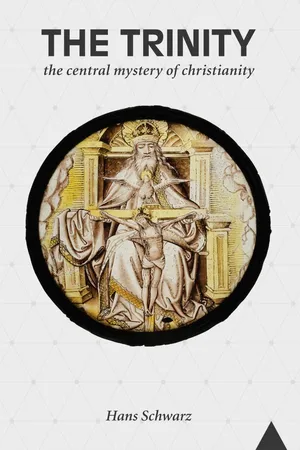
- 232 pages
- English
- ePUB (mobile friendly)
- Available on iOS & Android
eBook - ePub
About this book
Information
Topic
Theology & ReligionSubtopic
Christian Theology7
Perspectives of the Present Scene
Through the dominance of Karl Barth in twentieth-century Protestant theology, Trinitarian reflection received an immense boost. This is true for the Reformed side, as we will notice with Jürgen Moltmann and his followers, as well as for the Lutheran wing, as we gather from Wolfhart Pannenberg. Both Moltmann and Pannenberg were students of Karl Barth and were influenced by his Trinitarian theology. Yet, as we will detect, Trinitarian perspectives have been mined far beyond confessional considerations, from liberation theology to feminist concerns and even to orthodox considerations.
The Long Shadow of Karl Barth
Both Moltmann and Pannenberg were not just students of Karl Barth; they became theologians in their own right. Moreover, they were also influenced by Hegel in their appreciation of the doctrine of the Trinity. Yet they did not follow their mentors blindly.
Jürgen Moltmann
Jürgen Moltmann (1926–) readily admits: “Many people view the theological doctrine of the Trinity as a speculation for theological specialists, which has nothing to do with real life.”[1] Similar to Rahner, Moltmann observes that most Christians in the West are actually monotheists. That God is one and triune makes little difference to their doctrine of faith and to ethics. Most theological approaches do not begin with the Trinity. This means that this doctrine is of little importance. Since Moltmann senses that today it is important that we talk about the Triune God out of personal experience, he refers to Schleiermacher’s statement that God is indirectly experienced in our feeling of absolute dependence. Schleiermacher put the doctrine of the Trinity at the end of his Christian faith, since it was not a direct statement about the Christian self-consciousness. The feeling of absolute dependence refers us to God as one, and the doctrine of the three divine persons is then considered secondary. Moltmann concludes with regard to Schleiermacher: “The doctrine of the Trinity is superfluous.”[2]
Moltmann questions whether the experience of God can be adequately expressed in the concept of one God. The feeling of absolute dependence grasps only one side of the relationship with whom we call God. The other side remains unknown because the living relationship, which faith ought to be, considers only my dependence but not God’s relationship with me. If it is the relationship of covenant and love, as the biblical witness tells us, it cannot be one-sided; it must be reciprocal. “The expression ‘experience of God’ therefore does not only mean our experience of God; it also means God’s experience with us.”[3] The Bible witnesses to God’s history with us and also to God’s experiences with us. Here believers feel the infinite passion of God’s love; God suffers with us, God suffers from us, and God suffers for us. Moltmann concludes that today the discussion about the access to the doctrine of the Trinity is carried out in the context of the question about God’s capacity or incapacity to suffer.
Another objection to the doctrine of the Trinity comes from the present-day issue of practical application. There seems to be nothing in the doctrine of the Trinity that is useful. Yet Moltmann contends that this one-sided, pragmatic thinking must be overcome and refers here to the Greek philosophers and fathers of the church, who realized that knowing does not involve just practical application but also wonder. One does not just appropriate what one knows, but one is also transformed through what one perceives. Trinitarian thinking, Moltmann claims, “should prepare the way for a liberating and healing concern for the reality that has been destroyed.” The question, however, is how we should approach the doctrine of the Trinity. Neither the old idea of one substance and three persons nor the more modern version of one subject and three modes of being seems to suffice. Moltmann therefore attempts “to start with the special Christian tradition of the history of Jesus the Son, and from that to develop a historical doctrine of the Trinity.”[4]
Moltmann writes:
In distinction to the trinity of substance and to the trinity of subject we shall be attempting to develop a social doctrine of the Trinity. We understand the scriptures as the testimony to the history of the Trinity’s relations of fellowship, which are open to men and women, and open to the world. This trinitarian hermeneutics leads us to think in terms of relationships and communities; it supersedes the subjective thinking which cannot work without the separation and isolation of its objects.[5]
Against a totally apathetic understanding of God, a God who cannot and does not suffer, Moltmann points to the suffering of Christ as the suffering of the passionate God. “If we start from the pathos of God, then we do not consider God in his absolute nature, but understand him in his passion and in his interest in history.”[6] Concerning the Old Testament, Moltmann now refers to the concept of Shekinah, a term that is not used in the Old Testament but that denotes the divine presence of God and his glory. Moltmann sees this Shekinah as the present indwelling of God in Israel, the condescension of the eternal one, and the anticipations of the glory of the one who is to come. This history of God’s Shekinah allows one to comprehend the Jewish people’s history of suffering. While English theology in the nineteenth and twentieth century carried on a discussion about God’s possibility, whether God could suffer, Continental theology remained silent on this topic. It was instead picked up by Spanish philosopher Miguel de Unamuno (1864–1936) and Russian philosopher Nikolai Berdyaev (1874–1948), who perceived the tragedy of human freedom as the history of the sufferings of divine love. This leads Moltmann to consider the issue of theodicy.
Though there is an undeniable connection between sin and suffering, innocent suffering, the suffering of the righteous, of the poor, and of children, it is an actual attack on theodicy. The experience of suffering, however, goes beyond the question of guilt and innocence. Yet Moltmann does not provide a real answer. Instead he points out that “suffering reaches as far as love itself, and love grows through the suffering it experiences—that is the signpost that points to true life.” This is then connected with the crucified Christ on Golgotha. This leaves the interpretation of Christ’s death far from settled. Moltmann considers in the context of theodicy God’s freedom and states that this freedom does not just mean Lordship, power, and possession, but rather God’s freedom primarily lies in the friendship that he offers us and by which he makes us his friends. But this kind of freedom is vulnerable, since God suffers with human beings who love and becomes their advocate, “thereby throwing open their future to them.”[7]
The divine compassion, founded on the biblical witness that God is love, Moltmann summarizes in six propositions: (1) Love is the self-communication of the good. (2) Every self-communication presupposes the capacity for self-differentiation. (3) By deciding to communicate himself, God discloses his own being; otherwise his position would not be as self-communication of the good that he is. (4) That God is love means, in Trinitarian terms, that in eternity and out of the very necessity of his being the Father loves the only begotten Son. (5) With the creation of the world, which is not God but which nonetheless corresponds to him, God’s self-humiliation begins—of the self-limitation of the one who is omnipresent, and the suffering of the eternal love. (6) This means that the creation of the world and human beings for freedom and fellowship is always bound up with the process of God’s deliverance from the sufferings of his love.[8]
After these preliminary considerations and propositions, Moltmann finally deals with the New Testament witness, centering on “the history of the Son.” Moltmann rightly claims that “according to the witness of the New Testament Jesus is manifested as ‘the Son.’” But he continues in the next sentence: “His history springs from the co-efficacy of the Father, the Son and the Spirit.” Then follows the presupposition: “The New Testament talks about God by proclaiming in narrative the relationships of the Father, the Son and the Spirit, which are relationships of fellowship and are open to the world.” This presupposition is expounded in his deliberations about the doctrine of the Trinity. The history of Jesus begins with the statement that “he is the revealer of the Trinity.” We read here mainly about Jesus as the Son and the mutual loving of the Father and the Son as a love of like for like that is exclusive. In unique authority Jesus knows and proclaims the Lord of the coming kingdom as his Father. In the synoptic story of Jesus’s baptism and call, as well as in Jesus’s own manifestation of the Father, Moltmann finds a clearly perceptible Trinitarian form. It is contained in the self-differentiation of God “inherent in the Jewish idea of the divine Wisdom, which is in eternity God’s beloved child and seeks a home on earth.”[9]
In the giving up of the Son by the Father, Moltmann discerns the revelation of the Trinity. The same is true for the resurrection, since the Father raises the Son through the Spirit. In the encounter with the sending of the creative Spirit through the Son, and in the eschatological consummation and glorification, we again notice a Trinitarian order. In the New Testament we find, according to Moltmann, at Trinitarian coworking of Father, Son, and Spirit, but with changing patterns, namely Father—Spirit—Son, Father—Son—Spirit, and finally Spirit—Son—Father. If the three divine subjects are coactive in the history of God and of his kingdom, then the unity of the Trinity cannot be a monadic unity but must be a union and fellowship of Father, Son, and Spirit. From the high-priestly prayer “that they all may be one. As you, Father, in me and I am in you, may they also be in us” (John 17:21), Moltmann concludes that the fellowship of the disciples with one another is to resemble the union of the Son with the Father. “But not only does it have to resemble that trinitarian union; in addition it has to be a union within this union. It is a fellowship with God and, beyond that, a fellowship inGod. But that presupposes that the triunity is open in such a way that the whole creation can be united with it and can be one within it.”[10] This means that the Trinity is an open Trinity for uniting and including the whole of creation.
Once Moltmann has established this open Trinity, he perceives the figure of the Son against the comprehensive horizon of the history of the Triune God with the world. Christology too is now perceived as an open Christology, considering the creation of the world through the Father of Jesus Christ and the perception of the transfiguration of the world through the Holy Spirit, who proceeds from the Father of Jesus, the Son. We now hear again about creation, incarnation, and resurrection and glorification. Moltmann concludes:
The trinitarian movement of the sending of the Spirit from the Father through the Son may still be viewed as a “work outwards” although it too is preceded by inner changes in the divine Trinity—changes from which this movement arises. But the trinitarian movement of the gathering of the Spirit through the Son to the Father is at work “inwards,” a movement of the Trinity; by virtue of the opening of the Trinity in the sending of the Spirit, however, it is a movement into which the whole creation is gathered.[11]
Since all things are assembled under Christ as the head, and all tongues confess him as Lord, all people and things partake of the inner-Trinitarian life of God. The Triune God is at home in the world, and history exists out of his inexhaustible glory. In the end, this is Moltmann’s conviction, that there will be a universal homecoming of all that exists. With this foundational Trinitarian presupposition, Moltmann is now ready to criticize Christian monotheists of every kind, from Arius to Karl Rahner.
Moltmann asserts that since the dogma of the Trinity evolved out of Christology, this doctrine cannot be termed “a speculation.” Rather, “On the contrary, it is the theological premise for christology and soteriology.”[12] One might ask here how it can be the premise for Christology if it evolved out of Christology. Trinitarian and christological controversies seem to be so much intertwined that at least in the first four centuries the debates on the Trinity and on Christ cannot be easily separated. Moltmann asserts that a strict monotheism has to be theocratically conceived and implemented, as shown by Islam. Therefore the conquest of the fundamental monotheistic monarchic idea through the doctrine of the Trinity was one of the great ...
Table of contents
- Cover
- Title Page
- Copyright
- Table Of Contents
- Preface
- Abbreviations
- Introduction
- Father, Son, and Holy Spirit in the Old Testament
- Father, Son, and Holy Spirit in the New Testament
- The Early Church and the Emerging Trinitarian Reflections
- The Struggle over the Decision of Nicea
- Developments in the Middle Ages and in the Reformation Period
- Post-Reformation Developments
- Perspectives of the Present Scene
- A Systematic Discernment
- In Conclusion
- Recommended Reading List
- Index of Subjects
- Index of Names
Trusted by 375,005 students
Access to over 1.5 million titles for a fair monthly price.
Study more efficiently using our study tools.
Frequently asked questions
Yes, you can cancel anytime from the Subscription tab in your account settings on the Perlego website. Your subscription will stay active until the end of your current billing period. Learn how to cancel your subscription
No, books cannot be downloaded as external files, such as PDFs, for use outside of Perlego. However, you can download books within the Perlego app for offline reading on mobile or tablet. Learn how to download books offline
Perlego offers two plans: Essential and Complete
- Essential is ideal for learners and professionals who enjoy exploring a wide range of subjects. Access the Essential Library with 800,000+ trusted titles and best-sellers across business, personal growth, and the humanities. Includes unlimited reading time and Standard Read Aloud voice.
- Complete: Perfect for advanced learners and researchers needing full, unrestricted access. Unlock 1.5M+ books across hundreds of subjects, including academic and specialized titles. The Complete Plan also includes advanced features like Premium Read Aloud and Research Assistant.
We are an online textbook subscription service, where you can get access to an entire online library for less than the price of a single book per month. With over 1.5 million books across 990+ topics, we’ve got you covered! Learn about our mission
Look out for the read-aloud symbol on your next book to see if you can listen to it. The read-aloud tool reads text aloud for you, highlighting the text as it is being read. You can pause it, speed it up and slow it down. Learn more about Read Aloud
Yes! You can use the Perlego app on both iOS and Android devices to read anytime, anywhere — even offline. Perfect for commutes or when you’re on the go.
Please note we cannot support devices running on iOS 13 and Android 7 or earlier. Learn more about using the app
Please note we cannot support devices running on iOS 13 and Android 7 or earlier. Learn more about using the app
Yes, you can access The Trinity by Hans Schwarz in PDF and/or ePUB format, as well as other popular books in Theology & Religion & Christian Theology. We have over 1.5 million books available in our catalogue for you to explore.