Athanasius was a fiery and controversial bishop from Egypt, driven from his See no less than five times. Yet, his work served as a keystone to the settlement of the central disputes of the fourth century, from the Trinitarian and christological debates at Nicaea to the formulation of the divinity of the Holy Spirit. In this volume, Thomas G. Weinandy, OFM, Cap., and Daniel A. Keating introduce readers to this key thinker and carefully illuminate Athanasius‘s crucial text Against the Arians, unfolding the Trinitarian and incarnational framework of Athanasius‘s paramount concern: soteriology. The authors provide, in the second part, a robust map of the reception and influence of Athanasius‘s thought-from its immediate impact on the late fourth and fifth centuries (in the Cappadocians and Cyril) to its significance for the Eastern and Western Christian traditions and its reception in contemporary thought. Herein, Athanasius is presented for today‘s readers as one of the chief architects of Christian doctrine and one of the most significant thinkers for the reclamation of the Trinitarian and christological theological tradition.
eBook - ePub
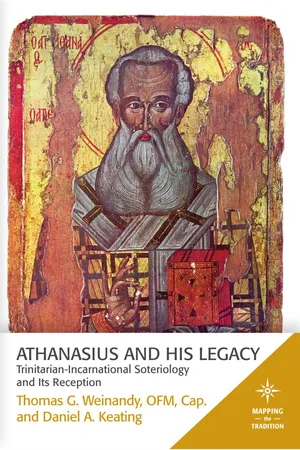
Athanasius and His Legacy
Trinitarian-Incarnational Soteriology and Its Reception
- 144 pages
- English
- ePUB (mobile friendly)
- Available on iOS & Android
eBook - ePub
Athanasius and His Legacy
Trinitarian-Incarnational Soteriology and Its Reception
About this book
Information
Topic
Theology & ReligionSubtopic
Christian TheologyII
The Contested Legacy of Athanasius
Introduction
Athanasius of Alexandria has divided modern opinion just as surely as he divided those of his contemporaries.[1]
—David Gwynn
From the start, conflict and contention have encompassed the figure of Athanasius. The epithet commonly employed in praise of Athanasius, contra mundum (against the world), aptly reflects the struggle that has beset him from his day until ours. Upon his elevation as Alexandria’s archbishop in 328 CE he became embroiled in disputes on several fronts. He was driven from his see five times, spending upward of seventeen years in exile. Throughout the forty-six years of his episcopal ministry, whether through personal contact or the written word, Athanasius combined a fierce defense of his conduct with a sharp refutation of those he termed “Arians,” all the while explicating the Trinitarian-incarnational account of the Christian faith that he championed. As the time of his death drew near (in 373), resident in his own city of Alexandria, he found relative peace, having been reconciled with many of his former opponents and able to see the impending triumph of the Nicene faith on the horizon.
A microcosm of the contested legacy of Athanasius appears in early fifth-century church histories. The dominant interpretation, wholly favorable to Athanasius, appears in Socrates, Sozomen, and Theodoret.[2] These church historians, writing between 439 and 450, recount the history of Athanasius’s struggles in great detail and judge him entirely innocent of all charges against him. In the words of Theodoret, Athanasius was “the champion of the truth.” “Athanasius very rapidly acquired legendary status as the one who defended Nicene orthodoxy pretty well single-handed through the years of Arian ascendency.”[3] The minority view, highly critical of Athanasius’s conduct and teaching, is espoused by Philostorgius (d. ca. 439), a strong supporter of the teaching of Aetius and Eunomius.[4] These divergent readings of Athanasius’s teaching and character will be replicated and further developed in the modern period. Notwithstanding this early contention over Athanasius’s legacy, the Eastern and Western Christian traditions have received Athanasius enthusiastically as the champion of Christian orthodoxy and the supreme exemplar—the icon—of the struggle for the faith against all odds. Any account of Athanasius’s reception must take into account this iconic—and sometimes hotly contested—role he played in a hugely pivotal era for the church.
The task of tracing the reception of Athanasius faces two notable challenges with respect to his written works. First, it is unclear how widely his written works were disseminated and actively used. Certain of his writings, for example his Life of Antony, had an enormous influence in both the East and the West, and several of his treatises and letters are cited frequently by later writers. But it appears that Athanasius was revered more than he was read. Consequently, there is no commentarial tradition on his major texts that we can track.
Second, some writings attributed to him, and by which he was best known, turn out not to have come from his pen. There is a broad pseudo-Athanasian corpus that often proved more popular than his actual writings. The most influential example is the Athanasian Creed, probably composed in late fifth-century Gaul. It functioned in the Western church both as a standard of orthodoxy and as the prime representative statement of Athanasius’s teaching. Athanasius’s genuine writings are certainly not unimportant for his reception in the Christian tradition, but it is preeminently his perseverance in great trial and the faith he contended for, enshrined in the Nicene and Athanasian Creeds, that stand out as the principal emblems of his achievement.
The account of Athanasius’s reception that follows makes no claim to thoroughness. The goal, rather, is to be representative. We will begin by examining his reception in the East, especially in the period immediately following his death, and then turn to investigate how he was received in the West, with a special focus on the role of the Athanasian Creed. We will then examine two illuminating and intriguing contra and pro Athanasius tendencies marked by the figures of Isaac Newton and John Henry Newman respectively. Finally, we will bring the account up to the present day by considering and evaluating the various contemporary—and contrasting—readings of Athanasius’s teaching and character.
- David M. Gwynn, Athanasius of Alexandria: Bishop, Theologian, Ascetic, Father (Oxford: Oxford University Press, 2012), 195. ↵
- See especially Socrates, Historia ecclesiastica, 4.20; and Theodoret, Historia ecclesiastica, 1.7, 4.17. For an overview and evaluation of these three church historians, see Gwynn, Athanasius of Alexandria, 168–70. Gwynn (Athanasius of Alexandria, 168) astutely observes that “the independent value of these three ecclesiastical historians for our knowledge of Athanasius is limited. For Eastern Christian tradition, their importance was immense.” ↵
- Young, From Nicaea to Chalcedon, 69. ↵
- For Philostorgius’s anti-Athanasian testimony, see Timothy D. Barnes, Athanasius and Constantius: Theology and Politics in the Constantinian Empire (Cambridge, MA: Harvard University Press, 1993); and Duane Wade-Hampton Arnold, The Early Episcopal Career of Athanasius of Alexandria (Notre Dame: University of Notre Dame Press, 1991). ↵
4
The Reception of Athanasius in the Eastern Tradition
O holy father Athanasius, like a pillar of orthodoxy
you refuted the heretical nonsense of Arius
by insisting that the Father and the Son are equal in essence.
O venerable father, beg Christ our God to save our souls.
you refuted the heretical nonsense of Arius
by insisting that the Father and the Son are equal in essence.
O venerable father, beg Christ our God to save our souls.
—Troparion to Athanasius[1]
The Eastern Christian tradition has received Athanasius as a champion of orthodoxy and a pillar of the church’s faith. This is true of the Byzantine churches, but equally of the Maronites and the non-Chalcedonian Eastern churches (Coptic, Armenian, and Syrian churches).[2] In the words of George Dragas, Athanasius’s “spiritual fame and radiance made him the spokesman of orthodoxy par excellence.”[3] The issue in question is not whether Athanasius was well received and appreciated in the East but how he was received and what particular impact he had on the Eastern tradition. To examine this, we will first look at the proximate reception of Athanasius in Basil of Caesarea, Gregory of Nazianzus, Cyril of Alexandria, and the early monastic movement. Then we will briefly consider two controversies in the later Byzantine tradition in which Athanasius’s legacy played a role: the controversy over the use of icons and the collision with the West over the theology of the filioque.
Basil of Caesarea
General summaries of the fourth century often depict Athanasius and the Cappadocian fathers (Basil, Gregory of Nazianzus, and Gregory of Nyssa) as if they were runners in a relay race. As the story is told, Athanasius ran the long, hard leg of the race from the Council of Nicaea, finally handing the baton over to the three fleet-footed Cappadocians who (in turn) carried the race through to the Council of Constantinople and beyond. Though it makes too simple what is in fact a complex relationship, this rough depiction has much to ...
Table of contents
- Cover
- Mapping the Tradition Series
- Title Page
- Copyright
- Dedication
- Table Of Contents
- Preface
- Athanasius’s Trinitarian-Incarnational Soteriology
- The Contested Legacy of Athanasius
- Bibliography
- Index of Names
Trusted by 375,005 students
Access to over 1.5 million titles for a fair monthly price.
Study more efficiently using our study tools.
Frequently asked questions
Yes, you can cancel anytime from the Subscription tab in your account settings on the Perlego website. Your subscription will stay active until the end of your current billing period. Learn how to cancel your subscription
No, books cannot be downloaded as external files, such as PDFs, for use outside of Perlego. However, you can download books within the Perlego app for offline reading on mobile or tablet. Learn how to download books offline
Perlego offers two plans: Essential and Complete
- Essential is ideal for learners and professionals who enjoy exploring a wide range of subjects. Access the Essential Library with 800,000+ trusted titles and best-sellers across business, personal growth, and the humanities. Includes unlimited reading time and Standard Read Aloud voice.
- Complete: Perfect for advanced learners and researchers needing full, unrestricted access. Unlock 1.5M+ books across hundreds of subjects, including academic and specialized titles. The Complete Plan also includes advanced features like Premium Read Aloud and Research Assistant.
We are an online textbook subscription service, where you can get access to an entire online library for less than the price of a single book per month. With over 1.5 million books across 990+ topics, we’ve got you covered! Learn about our mission
Look out for the read-aloud symbol on your next book to see if you can listen to it. The read-aloud tool reads text aloud for you, highlighting the text as it is being read. You can pause it, speed it up and slow it down. Learn more about Read Aloud
Yes! You can use the Perlego app on both iOS and Android devices to read anytime, anywhere — even offline. Perfect for commutes or when you’re on the go.
Please note we cannot support devices running on iOS 13 and Android 7 or earlier. Learn more about using the app
Please note we cannot support devices running on iOS 13 and Android 7 or earlier. Learn more about using the app
Yes, you can access Athanasius and His Legacy by Cap.OFM, Thomas G. Weinandy,Daniel A. Keating,Thomas G. Weinandy in PDF and/or ePUB format, as well as other popular books in Theology & Religion & Christian Theology. We have over 1.5 million books available in our catalogue for you to explore.