- 240 pages
- English
- ePUB (mobile friendly)
- Available on iOS & Android
eBook - ePub
About this book
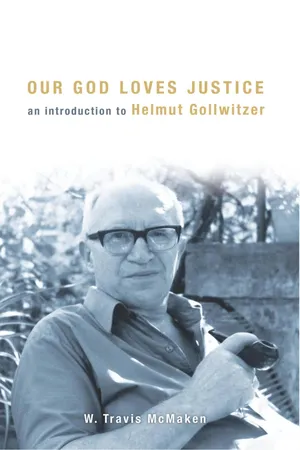
Helmut Gollwitzer was a direct heir of the theological legacy of the great Protestant theologian Karl Barth. Yet, Gollwitzer's work is perhaps least appreciated and studied, especially in English, of all of Barth's immediate "descendants." A Protestant theologian and member of the Confessing Church movement in World War II-era Germany, Gollwitzer studied under Karl Barth at the Universities of Bonn and Basle and was professor of Protestant theology at the University of Berlin. Deeply influenced by his mentor, Gollwitzer appropriated the methodological principles of Barth's theology and developed in new and particularly contextual directions one of Barth's most penetrating constructive insights in the doctrine of God. At the same time, Gollwitzer, more than any of Barth's other interpreters, embraced and extended the sociopolitical impulses and implications within Barth's theology. In this, Gollwitzer embodies a salient alternative for theological and political discourse, one especially needed in the American context of increasingly intertwined theological and political discourses. This volume, the first book-length study of Gollwitzer available in English, provides a helpful introduction to the life, theology, and political thought of this crucial theologian and public intellectual and makes clear Gollwitzer's importance to the North American context.
Information
Topic
Theology & ReligionSubtopic
Christian Theology1
Appendix 1: Must a Christian Be a Socialist?
Helmut Gollwitzer (1972)
I
“Socialists can be Christians; Christians must be socialists.”[1] Adolf Grimme formulated this statement in 1946 as his personal creed and as a basic principle for the relationship between socialism and Christianity.[2] When I merely put it up for discussion in 1971, the fiercest reactions were not from the socialists, but from the Christians. The distance that the intervening 25 years created cannot be more clearly identified. The immediate postwar period, the common experience of hunger, defeat, and the material losses, made a shared bearing of hardships and the burden of rebuilding appear to be the only possible, fair, and promising option. Thus, the word “socialism” received a new luster, freed from the skullduggery of National Socialism. Everyone wanted to get in on it. To admit to being a socialist brought no risk. The demands of socialization penetrated party programs and state constitutions.[3] Beyond these demands, however, it remained unclear whether a socialism tinted more by Christianity or by Marxism was meant—except with the communists and with the few other Marxists with whom Marxist theory, even though devoid of continued development, had survived the fascist liquidation of German Marxism. Adolf Grimme himself admittedly meant the word in a definite sense, which by all means included the overthrow of private capital’s ownership structures. The posthumously published book that he conceived while in prison during the war demonstrates this. In The Meaning and Absurdity of Christianity,[4] Grimme continues in an original manner the tradition of religious socialism in which he stood.
Today, however, and among the same demographic who used to be open to it, socialism has become a fear-mongering word that can be used in every instance of anti-reformist propaganda. The following factors coalesce in this: the discrediting of Eastern socialism by its lack of freedom and economic efficiency, the apparent demonstration of the viability of “free market economy” by means of rapid reconstruction and mass prosperity, and finally, the New Left’s refusal to share the general conclusion about the unsuitability of the socialist program based on the negative appearance of Eastern socialism and the positive appearance of Western capitalism. Vehement criticism of capitalism and the unflinching goal of a classless society once again gives a shape to the word “socialism” which, admittedly, does not appear immediately attractive to minds that are unaccustomed to it. That Christians must be socialists sounds much more shocking in 1971, therefore, than in 1946. We see this in how forgotten the religious socialists are today in their prophets’ graves, that are ornamented everywhere with commemoration, because Hermann Kutter’s They Must! (1903)—which was no different than Grimme’s statement—was certainly also their slogan. We see this in how very much the church and theological academy have come to terms with the restored capitalism of the 1950s and 1960s, so much so that they (including this epoch’s literature on social ethics) lack the imagination to think beyond it and are shocked when others do so.
II
Whatever our first response to it might be, the facts of Grimme’s statement should be examined calmly. Hardly anyone contests the first part—“Socialists can be Christians”—at least in the superficial sense. The socialist parties since the time of Friedrich Engels, including the Leninist parties, have repudiated Eugen Dühring’s demand for a religious ban for the socialist movement as “Prussian socialism,” and have always affirmed that Christians also can be members of the socialist and communist parties.[5] Of course, in a deeper sense, the still widely prevailing tradition of official Marxism will not concede this statement. Whether we use the word “socialist” to refer to the socialistic militant in the present or to the member of a future socialistic society, anyone who wants to be a socialist in the full sense cannot, at the same time, be a Christian. They must be dead to religion, and religion must be dead to them. While they intend and are able to be socialists and Christians at the same time, they inhabit an inconsistent combination of elements from the future with elements of the past which the party—confident in its enlightening influence—can tolerate so long as the religious elements of the past do not compromise the efficacy of the socialist elements of the future.
The reservations on the side of the church were not less significant. Admittedly, there have always been proponents of the compatibility of Christianity and socialism in the Protestant camp. But this was a minority group which would be silenced by 1933, along with the remaining socialists. And apart from this, the sympathy of the majority of the clergy and church folks for what referred to itself at that time as “national revolution” had dampened it. It still required considerable time even after 1945 before the conviction that Christians can be social democrats attained the self-evidence that it has today. It is still not so widely known in the Catholic camp. Church authorities at one time conceded that the SPD[6] is an option for Catholics, but at other times, they more or less concealed or denied this when the concession generated fears about dangerous consequences for the interests of the church hierarchy or of the party that benefited from it. Papal social encyclicals contested the compatibility of socialism and Catholicism before Populorum progressio (1967). Pius XII’s excommunication of practicing communists showed that the church hierarchy has a lower tolerance level compared with the communist parties, which have never carried out the excommunication of practicing Catholics (even if Catholic members are not allowed to rise to the party’s upper echelons). Although at the local level Don Camillo and Peppone[7] can find a human and Christian way of life with each other, this is possible only with the mutual agreement that one cannot be both a priest and a communist.
The first part of Grimme’s statement flatly contradicts this agreement, which makes it controversial still today. Admittedly, Grimme initially—in 1946—did not yet have in view the self-evident truth of the compatibility of being a social democrat and being a Christian. But beyond this straightforward political sense, he additionally meant “socialist” in a more radical manner. Grimme stood with his sympathies on the SPD’s left wing and did not begrudge Marxism. For him, socialism embraced the abolition of private ownership of the means of production and the goal of a classless society. He was, of course, fully aware that the alliance between being a socialist and being a Christian would change traditional Marxism somewhat. When Marxists become Christians, they do not automatically give up their Marxist conviction if it includes a program of social revolution. But becoming Christian impinges upon their ideological ambition for the removal of all religion—that is, their atheism—and lets their fighting methods be corrected in a humanizing fashion by their being as Christians. That socialists can be Christians implies the compatibility of socialist revolution with Christian faith, and at the same time, breaks Marxism’s previous link with obligatory atheism. As long as this previous link existed, and to the extent that it still exists, the link between Marxism and Christianity does not go beyond the category of alliance. And it has already achieved much if both sides will at least take this alliance seriously and maintain it as justified by the convergence of mutual goals. Christians and Marxists have always and again disappointed each other by terminating this alliance the moment it became annoying for its own side, or the moment one side no longer wanted to rely on it. Both sides should be clear about the truth of Roger Garaudy’s words: “The future of humanity cannot be built against believers, much less without them. The future of humanity will not be against the communists, much less can it be built without them.”[8] Such words still come out of the recent opposition between the two camps: it is either wage war or ally with one another, and the individual has to choose between them. But that a Christian can be a socialist must not only apply for all kinds of varieties of a Christian or democratic socialism, which have never brought their socialist theory and practice to sufficient determinacy. It must also apply for Marxism. The previous link between Marxism and obligatory atheism will thereby dissolve, confining Marxism to its political economy and sociorevolutionary program. Ambition for the removal of religion falls away. Whether this is possible without damage to Marxism is the subject of a vibrant discussion within Marxism in which the affirmative answer to this question is represented especially by Christian Marxists. Nevertheless, it is also represented by such Marxists who—without being Christians—have become skeptical toward the alleged scientificity of dialectical materialism, toward such an extrapolation to worldview. They see clearly how Marxism is a substitute for religion here through incorporating religious demands that bring with them the risk of dogmatism and fanaticism. And they see the handicap that such traditional Marxism, with its European heritage of atheism, creates for itself when spreading to other continents.
Outside of West Germany, the compatibility of Marxism and Christianity has already become self-evident for many people. The emergence of the New Left has also changed the situation within the Federal Republic. In the Latin countries of Europe and Latin America, in Africa, and in Asia, there are not an inconsiderable number of Christians —even pastors and priests—who are members of communist groups. The differences of worldview recede while political praxis unifies. Instead of the former dialogue between Christians and Marxists as representatives of different ideological camps, it is often already the case that, as Günther Nenning[9] rightly observed, “this kind of union of Christianity and Marxism in one person is now becoming normal. Thousands accomplish this as a matter of course, especially young people and especially in countries with strong Catholic and communist backgrounds, such as France, Italy, Spain, and Latin America. It occurs more than ever in countries with predominantly Protestant backgrounds, especially in Anglo-Saxon countries. Protestant theologians like Paul Tillich carried out the opening of Christianity to socialism long before the Catholic discovery of Marxism. The new dark red wave of socialism, whether it is called the New Left or something else, is full of post-dialogical Christian-Marxists who do not talk but act.”
III
Grimme’s statement expresses from the socialist side a minimal, pluralistic goal—to unite people with different worldviews for a shared political, socialist goal. Socialists are not required to be Christians any more than they are required to not be Christians. They can be Christians without becoming devalued as socialists. For the Christian side, however, the socialist Christian Grimme gives a maximal formulation: “Christians must be socialists,” and it is this part of the statement that provokes understandable opposition.
With this “must,” Christians as Christians appear to be bound—that is, in the name of God—to a particular political program, even to an “ideology,” and to one that does not stem from Christian roots for good measure. And it would not improve matters even if it came from such roots. Christian faith is under an obligation to no philosophy, to no manner of looking at the world, to no social order, and to no program. The root of Christian freedom is infringed upon where such a thing is undertaken. The gospel is perverted into law where this is the content of Christian proclamation so that it has the goal of turning Christians into socialists. The reformational termination of the unity of medieval social order and Christian faith, of Aristotelian philosophy and Christian theology, as well as the Confessing Church’s rejection of the German-Christian thesis—“Christians must be Nazis”—are great testimonies to the freedom of the gospel and the freedom of faith. If Grimme’s sentence entices one to go back behind the reformational emancipation of reason in its relation to the world through the gospel, then it must be rejected and reduced to the sentence—Just as socialists can be Christians, so also Christians can be socialists.
Christians “must” do nothing at all. No obligation, no compulsion to any prescribed work regulates their relation to God. The prodigal son does not have to head back home in order to acquire the father’s love. The father shows him by running to meet him that he has never ceased to love him. His love does not depend on conditions that must be met. It surrounds the son as the air of freedom: “All that is mine is yours.” Outside, the son had to do all kinds of things to obtain life.[10] Outside, he was enslaved by conditions, regulations, and ideologies. In the love of the father, he is a free lord of all things.[11] But “must” he not now be of service to his father? The must of love is really a new and novel must. It is not heteronomously imposed, related to the withdrawal of love with the threat of being thrown out of the father’s house. Rather, it is a must in the recipient of love itself, awakened by love itself and upheld by love. It is the must of happiness from the new connection with the father, the union of the will of the son with the will of the father, through which the son speaks: “Volo omnia, quae vult deus.”[12] Two things demo...
Table of contents
- Cover
- Endorsements for Our God Loves Justice
- Title Page
- Copyright
- Dedication
- Table Of Contents
- Acknowledgments
- Reading Helmut Gollwitzer in America
- Grace upon Grace: Helmut Gollwitzer’s Life and Work
- Gollwitzer’s Political Theology
- Gollwitzer’s Theological Politics
- Church and Confession
- Appendix 1: Must a Christian Be a Socialist?
- Appendix 2: Why Am I, as a Christian, a Socialist? Theses
- Bibliography
- Index of Subjects and Names
Trusted by 375,005 students
Access to over 1.5 million titles for a fair monthly price.
Study more efficiently using our study tools.
Frequently asked questions
Yes, you can cancel anytime from the Subscription tab in your account settings on the Perlego website. Your subscription will stay active until the end of your current billing period. Learn how to cancel your subscription
No, books cannot be downloaded as external files, such as PDFs, for use outside of Perlego. However, you can download books within the Perlego app for offline reading on mobile or tablet. Learn how to download books offline
Perlego offers two plans: Essential and Complete
- Essential is ideal for learners and professionals who enjoy exploring a wide range of subjects. Access the Essential Library with 800,000+ trusted titles and best-sellers across business, personal growth, and the humanities. Includes unlimited reading time and Standard Read Aloud voice.
- Complete: Perfect for advanced learners and researchers needing full, unrestricted access. Unlock 1.5M+ books across hundreds of subjects, including academic and specialized titles. The Complete Plan also includes advanced features like Premium Read Aloud and Research Assistant.
We are an online textbook subscription service, where you can get access to an entire online library for less than the price of a single book per month. With over 1.5 million books across 990+ topics, we’ve got you covered! Learn about our mission
Look out for the read-aloud symbol on your next book to see if you can listen to it. The read-aloud tool reads text aloud for you, highlighting the text as it is being read. You can pause it, speed it up and slow it down. Learn more about Read Aloud
Yes! You can use the Perlego app on both iOS and Android devices to read anytime, anywhere — even offline. Perfect for commutes or when you’re on the go.
Please note we cannot support devices running on iOS 13 and Android 7 or earlier. Learn more about using the app
Please note we cannot support devices running on iOS 13 and Android 7 or earlier. Learn more about using the app
Yes, you can access Our God Loves Justice by W. Travis McMaken in PDF and/or ePUB format, as well as other popular books in Theology & Religion & Christian Theology. We have over 1.5 million books available in our catalogue for you to explore.