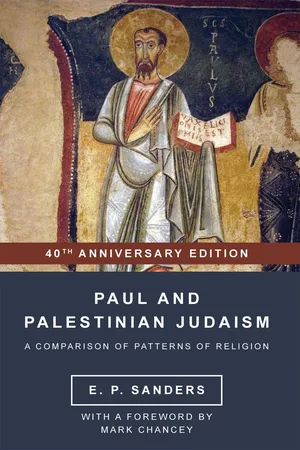
This landmark work, which has shaped a generation of scholarship, compares the apostle Paul with contemporary Judaism, both understood on their own terms. E. P. Sanders proposes a methodology for comparing similar but distinct religious patterns, demolishes a flawed view of rabbinic Judaism still prevalent in much New Testament scholarship, and argues for a distinct understanding of the apostle and of the consequences of his conversion. A new foreword by Mark A. Chancey outlines Sanders‘s achievement, reviews the principal criticisms raised against it, and describes the legacy he leaves future interpreters.
- 672 pages
- English
- ePUB (mobile friendly)
- Available on iOS & Android
eBook - ePub
Paul and Palestinian Judaism
About this book
Information
ONE
PALESTINIAN JUDAISM
I. TANNAITIC LITERATURE
1. The persistence of the view of Rabbinic religion as one of legalistic works-righteousness
In 1921, in an article which should be required reading for any Christian scholar who writes about Judaism,[1] George Foot Moore commented on a fundamental change which had taken place in the nineteenth century in works by Christian authors about Judaism. Through the eighteenth century Christian literature had primarily tried to show the agreement of Jewish views with Christian theology. To be sure, Judaism had been attacked – often viciously – but the overall intent was to convict Jews out of their own mouths: to show, for example, that their statements about intermediaries (logos, memra) proved the truth of Christian dogma. With F. Weber, however, everything changed.[2] For him, Judaism was the antithesis of Christianity. Judaism was a legalistic religion in which God was remote and inaccessible. Christianity is based on faith rather than works and believes in an accessible God.[3] Moore then showed the continuation of Weber’s picture of Judaism in Schürer[4] and Bousset,[5] and he indicated how inadequate and poorly founded such a construction is.[6]
When Moore followed his apparently devastating analysis with his own constructive presentation of early Rabbinic religion,[7] one would have thought that the question of whether he or Weber and his successors were basically correct would have been closed. In contrast to Weber, Schürer and Bousset, Moore knew the sources in detail and at first hand. In contrast to them, he wished to present a construction of Judaism for its own sake and on its own terms, not as part of a ‘background to the New Testament’ handbook which covers topics of interest to Christianity and leaves out the rest.[8] In contrast to Bousset in particular, he emphasized the Rabbinic material as basic to his construction. Bousset depended mainly on the Apocrypha and Pseudepigrapha, ‘with an especial penchant for the apocalypses’.[9] Moore criticized Bousset for calling his book ‘the religion of Judaism’, while basing it on sources to which, ‘so far as we know, Judaism never conceded any authority, while he discredits and largely ignores those which it has always regarded as normative’.[10] Thus we see the historical circumstances in which Moore’s much-criticized equation of ‘normative Judaism’ with Rabbinic Judaism arose.[11]
Moore’s critique of Weber and his successors, in which he was joined by many Jewish scholars,[12] should, as we said, have been successful. It was pronounced successful around 1936 by H. Loewe, who considered the false views of Wellhausen, Schürer, Charles, Bousset and Weber to have been sufficiently criticized by Herford, Moore, Schechter, Montefiore, Büchler, Marmorstein, Lauterbach, Finkelstein and others, so that Loewe himself did not see the need of continuing the apologia for Judaism.[13] In 1952, R. Marcus gave a similarly optimistic report:
Unpleasant as it is for modern Jews to carry on the long and wearying struggle to exculpate the Pharisees from the charges of hypocrisy and uncharitableness made against them by the Evangelists, it is the more consoling to realize how much modern Christian scholarship has done to correct the popular belief that there was an irreconcilable difference between Jesus and the Pharisees.[14]
This optimism seems widespread among Jewish scholars especially, and several have remarked to me that it is no longer necessary to argue against Christian biases. One suspects, however, that many Jewish scholars do not perceive the depth of the Protestant critique of Judaism. Marcus was content that the Pharisees are no longer openly accused of hypocrisy by scholars. He seems not to have realized that in his day (and, indeed, to the present day) the weight of New Testament scholarly opinion was behind a view of Judaism which holds it to be at best an inadequate religion and at worst one which destroys any hope of a proper relationship between God and man.
Most Jewish scholars, to be sure, have had other occupations than carrying on the ‘wearying struggle’ to get Christian scholars to see Rabbinic Judaism (or Pharisaism) in an unbiased light. It is worth pausing before describing how Weber’s view has continued in New Testament scholarship to note the more realistic attitude of the one Jewish scholar who has constantly been concerned with the problem of subjective bias in scholarship in this field, Samuel Sandmel. He recently noted that ‘the fact must be faced that value judgments on Judaism, as distinct from a detached description of it, constitute an ongoing reality in much of modern New Testament scholar ship, despite Moore’s valiant effort to correct an infelicitous trend’. He remarked that Jewish scholars sometimes, in reaction, tend to glorify Judaism. There is always the danger of subjective bias. He continued by assessing the present situation in New Testament scholarship:
If I were asked to comment on the chief difference between the attitude toward Judaism in the Christian scholarship prior to Moore’s time and that after it, I would say that, prior to Moore’s time, there was almost no effort to be fair to Judaism, and since Moore’s time, there has been a considerable effort, and considerable attainment, especially in America and Britain. There is still a great distance to go, but I have every confidence, possibly naively so, that that ability of scholarship to correct itself will some day bring about the assertion of detachment and objectivity even in this field.[15]
In a footnote to a reference to Schürer on the very page just quoted, however, Sandmel wrote as follows:
It can be set down as something destined to endure eternally that the usual Christian commentators will disparage Judaism and its supposed legalism, and Jewish scholars will reply, usually fruitlessly. I have addressed myself to this topic in three or four essays, and do not intend to pursue this any more beyond this one time, preferring to conclude that with those Christians who persist in deluding themselves about Jewish legalism, no academic communication is possible. The issue is not to bring these interpreters to love Judaism, but only to bring them to a responsible, elementary comprehension of it.[16]
Here we see that one Jewish scholar – a scholar of the New Testament who knows Christian New Testament scholarship intimately, who, unlike many, perceives what has been the dominant trend in New Testament scholarship with regard to Judaism, and who describes and has attempted the task of bringing to that scholarship ‘a responsible, elementary comprehension’ of Judaism[17] – has finally given up the effort on the grounds that it is fruitless to try to persuade those who refuse to be enlightened.
Despite the optimistic hope for the future, Sandmel accurately attributed the ‘infelicitous trend’ to ‘much of modern New Testament scholarship’. In fact, as we shall see, the view that Moore opposed and that Sandmel decries is very solidly entrenched in New Testament scholarship, appearing in the basic reference works and being held by many of the most influential scholars of the present and the immediately preceding generations. Weber’s general view of Judaism lives on in New Testament scholarship, unhindered by the fact that it has been denounced by such knowledgeable scholars as Moore and the others named by Loewe and despite the fact that many of its proponents, despite Moore’s scathing criticism on this point,[18]still cannot or do not look up the passages which they cite in support of their view and read them in context. It is necessary to show that this is the case.
So that we may have in mind the view that is going to be traced through successive generations of scholars, it will be useful first to summarize the most relevant points of Weber’s attempt to describe Judais...
Table of contents
- Cover
- Also by E. P. Sanders, from Fortress Press
- Title Page
- Copyright
- Dedication
- Table Of Contents
- Foreword
- Preface to the 40th Anniversary Edition
- Preface to the 1977 Edition
- Abbreviations
- Introduction
- Part One: Palestinian Judaism
- I. Tannaitic Literature
- II. The Dead Sea Scrolls
- III. Apocrypha and Pseudepigrapha
- IV. Palestinian Judaism 200 b.c.e.-200 c.e.
- Part Two: Paul
- V. Paul
- Conclusion
- Bibliography and System of References
Trusted by 375,005 students
Access to over 1.5 million titles for a fair monthly price.
Study more efficiently using our study tools.
Frequently asked questions
Yes, you can cancel anytime from the Subscription tab in your account settings on the Perlego website. Your subscription will stay active until the end of your current billing period. Learn how to cancel your subscription
No, books cannot be downloaded as external files, such as PDFs, for use outside of Perlego. However, you can download books within the Perlego app for offline reading on mobile or tablet. Learn how to download books offline
Perlego offers two plans: Essential and Complete
- Essential is ideal for learners and professionals who enjoy exploring a wide range of subjects. Access the Essential Library with 800,000+ trusted titles and best-sellers across business, personal growth, and the humanities. Includes unlimited reading time and Standard Read Aloud voice.
- Complete: Perfect for advanced learners and researchers needing full, unrestricted access. Unlock 1.5M+ books across hundreds of subjects, including academic and specialized titles. The Complete Plan also includes advanced features like Premium Read Aloud and Research Assistant.
We are an online textbook subscription service, where you can get access to an entire online library for less than the price of a single book per month. With over 1.5 million books across 990+ topics, we’ve got you covered! Learn about our mission
Look out for the read-aloud symbol on your next book to see if you can listen to it. The read-aloud tool reads text aloud for you, highlighting the text as it is being read. You can pause it, speed it up and slow it down. Learn more about Read Aloud
Yes! You can use the Perlego app on both iOS and Android devices to read anytime, anywhere — even offline. Perfect for commutes or when you’re on the go.
Please note we cannot support devices running on iOS 13 and Android 7 or earlier. Learn more about using the app
Please note we cannot support devices running on iOS 13 and Android 7 or earlier. Learn more about using the app
Yes, you can access Paul and Palestinian Judaism by E. P. Sanders in PDF and/or ePUB format, as well as other popular books in Theology & Religion & Biblical Studies. We have over 1.5 million books available in our catalogue for you to explore.