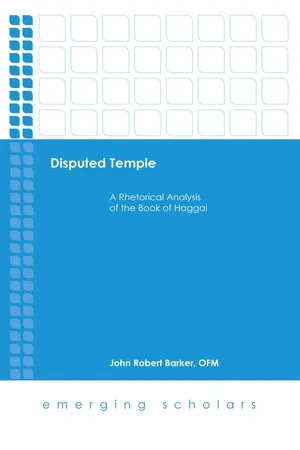
The prophet Haggai advocated for the rebuilding of the temple, destroyed by Babylon, in the tumultuous period of reconstruction under Persian dominion; so much is evident from a surface reading of the book . John Robert Barker goes further, using rhetorical criticism of the prophet‘s arguments to tease out the probable attitudes and anxieties among the Yehudite community that saw rebuilding as both undesirable and unfeasible. While some in the community accepted the prophet‘s claim that YHWH wanted the temple built, others feared that adverse agricultural and economic conditions, as well as the lack of a royal builder, were clear signs that YHWH did not approve or authorize the effort. Haggai‘s counterarguments-that YHWH would provide for the temple‘s adornment, would bring prosperity to Yehud once the temple was built, and had designated the Davidide Zerubbabel as the chosen royal builder-are combined with his vilification of opponents as unclean and non-Israelite. Barker‘s study thus allows Haggai to shed further light on the socioeconomic conditions of early Persian-period Yehud.
- 314 pages
- English
- ePUB (mobile friendly)
- Available on iOS & Android
eBook - ePub
About this book
Information
4
Rhetorical Analysis of Haggai 1
Introduction
The prophet Haggai urged temple reconstruction in the second year of Darius by addressing initial and subsequent objections to the project through argumentation and other rhetorical strategies. The composer of the Haggai Narrative further supported the project through rhetorical strategies in the narrative framework.
The controversy over the temple was essentially a policy dispute. The Yehudite community, we are told, had adopted a policy of waiting, maintaining that it was not the time to come and rebuild the temple (1:2). The prophet Haggai proposed an alternative policy, which was to build the temple immediately. As I will show, this proposal was accepted by some but not all members of the community. Even after work began on the temple, doubts remained about the propriety and feasibility of the project. The prophetic oracles and narrative portions in the balance of the HN are intended to answer and suppress those doubts regarding Haggai’s policy proposal. The entire HN may thus be analyzed as a rhetorical artifact of this policy dispute.
All policy disputes involve areas of potential disagreement that rhetoricians call “stock issues.” Advocates for the adoption or change of policy must address these issues successfully before an audience will accept their proposals. Because all policy disputes—no matter what the specific circumstances— involve them, stock issues provide a “taxonomy, a system of classifying the kinds of questions that can be at issue in a controversy.”[1] This makes them a useful tool for rhetorical analysis of a text that reflects or plays a role in a policy dispute.
The concept of stock issues was originally developed to aid in the formation of legal argumentation. Later it was adapted to deliberative disputes by Hultzén, whose work, though usually modified by other rhetoricians for greater analytical precision, remains the standard approach to stock issues. Hultzén referred to four stock issues (or frames of reference) in deliberative analysis: ill (or harm), reformability (now usually called cause or blame), remedy, and cost (or consequences). Within each of these frames of reference lies one or more potential points of disagreement in a policy dispute. To persuade an audience to accept a policy proposal, advocates must be prepared to address each frame of reference, overcoming any points of disagreement or resistance that may emerge during the course of controversy. If they fail to do so, it will be difficult if not impossible to persuade their audience to adopt the policy.[2]
The analysis of a rhetorical text from a policy dispute may be developed according to these stock issues, providing “a systematic methodology for breaking the [debate] proposition down into its vital component parts.”[3] This has the advantage of offering a thorough, relevant approach to the analysis while leaving room for further analysis of suasory elements of the text that are not peculiar to policy disputes (such as appeals to ethos or figures and tropes).
As the language and concepts of stock issues in policy debates inform the rhetorical analysis of the HN, it will be helpful to explain each of them here before proceeding.
An ill or harm is the perceived presence of an undesirable situation in or affecting the public realm, which creates an urgent and significant problem.[4] It is the perception of the ill that leads to proposals of policies, policy changes, or other courses of action to remedy it. Advocates suggest to a relevant audience that “the existing way of doing things results in serious internal problems or fails to achieve certain goals.”[5] Unless the audience already agrees that such an ill exists, the advocates will be obliged to convince them of it. Disagreements over the existence or quality of an ill may arise at various points. Opponents may deny the “facts” of the situation as described by policy advocates, suggesting they have misrepresented or misunderstood them. They may accept the facts as stated but reject the conclusion that they constitute a harm. Or they may accept that there is a problem, but deny that it is significant or urgent enough to require action. If the audience believes that an advocate’s definition of the ill is incorrect at any of these points, it will have no reason to accept the proposed course of action. The initial rhetorical aim, therefore, must be to convince the audience that there is an urgent, significant ill requiring its attention and action.
Rhetorical texts from policy disputes will usually show evidence of an advocate’s attempt to define the ill and, if it is controversial, to defend that definition or forestall potential objections to it. In cases where the existence or seriousness of a problem is not controversial, and the harm is recognized by all, a text will reveal little concern on the part of the advocate to meet or overcome opposition regarding the ill. The text may nevertheless devote considerable attention to the harm, not to persuade the audience of its existence, but rather to increase the cognitive or emotional “presence” of the harm as a strategy to motivate action to remove the harm.
The stock issue of cause or blame is concerned to determine the source of the ill once it has been acknowledged. A policy will not be adopted unless the audience is persuaded that the proposal will address the underlying cause of the harm.[6] Advocates of a policy have two persuasive obligations here. First, they must convince their audience that they have correctly identified the source or cause of the harm. Disputes over policy often hinge on the identification of cause. Second, they must persuade their audience that without a policy change, the underlying cause of harm cannot or will not be overcome.[7] If the audience accepts an advocate’s definition of the cause of the ill, but nevertheless believes that action is unnecessary to address it (by hoping, for example, that it will “go away” on its own somehow), they will be less likely to adopt the policy. “In other words, the advocate of change has the obligation to prove that the harms in the present system are inherent—that the solution of harms or achievement of goals is precluded by” the present policy.[8]
The stock issue of remedy is concerned with the proposed policy or course of action. Even once an advocate’s position on the harm and its cause has been accepted, there remains potential for disagreement about the efficacy of the proposal. An audience has no reason to adopt a course of action that is not expected to bring a solution. Thus advocates may be obliged to convince them that the policy will in fact remedy the harm.[9] Does the policy promise to address the cause of the problem? Will this, therefore, solve the problem itself? Finally, is the policy feasible? Even if the audience agrees that the proposed course of action will address the cause and solve the problem, if it believes that the course will be impossible to undertake because of, for example, lack of material or other resources, the policy will not be adopted. Advocates for a policy must persuade their audience that it will be both efficacious and feasible.
The stock issue of cost or consequences addresses the potential disadvantages to adopting the proposed policy. An audience may be persuaded of the efficacy of a course of action to remedy a harm, but may nevertheless identify disadvantages, “side effects,” or negative consequences of a proposal.[10] Advocates must therefore be prepared to persuade their audience that any perceived costs or burden imposed by the policy do not exist, are not as significant as supposed, or are less serious than the cost of not adopting the policy.[11]
These stock issues provide a helpful framework for understanding the persuasive aim, strategies, and dynamic of the HN, as reflected in the reported oracles of the prophet and the narrative additions of the composer.
Context of the Controversy
The opening verses present the historical context and major figures of the HN, as well as the controversy that informs it. The figures presented are Darius the king; YHWH; Haggai the prophet; Zerubbabel ben Shealtiel, the פחה of Yehud; Joshua ben Jehozadak, the high priest; and “this people” (העם הזה).
Darius the King
The HN is structured according to a series of specific dates on which the prophet speaks or is commanded to speak or act by YHWH (1:1; 2:1, 20), or on which significant events occur (1:15a; 2:18). These dates root the narrative in an identifiable historical context in which the temple controversy occurs. The opening verse of the HN informs us that the events take place “in the second year of Darius the king.” Four specific dates within that year are given in the course of the narrative: the first day of the sixth month (1:1), the twenty-fourth day of the same month (1:15a), the twenty-first day of the seventh month (1:15b–2:1a), and the twenty-fourth day of the ninth month (2:10, 18, 20).[12] The time frame for the HN is thus a little less than four months, all within the second year of Darius the king.[13]
Darius is the king of Persia. There were three Persian kings named Darius: Darius I (522–486); Darius II (425/4–405/4); and Darius III (335–330). It is almost universally accepted that the Persian king of Haggai (and Ezra and Zechariah) is Darius I.[14] Scholars generally take his second year to be 520 BCE. This date is based on the assumption that the composer is following the Babylo...
Table of contents
- Cover
- Title Page
- Copyright
- Table Of Contents
- Abbreviations
- Acknowledgments
- The Haggai Narrative
- Introduction to the Rhetorical Analysis of Haggai
- Text-Critical Analysis, Composition of Narrative, and Notes on Translation
- Objections and Obstacles to Reconstruction of the Temple
- Rhetorical Analysis of Haggai 1
- Rhetorical Analysis of Haggai 2
- Summary of Findings
- Bibliography
- Index of Scriptures
- Index of Name and Subjects
Trusted by 375,005 students
Access to over 1.5 million titles for a fair monthly price.
Study more efficiently using our study tools.
Frequently asked questions
Yes, you can cancel anytime from the Subscription tab in your account settings on the Perlego website. Your subscription will stay active until the end of your current billing period. Learn how to cancel your subscription
No, books cannot be downloaded as external files, such as PDFs, for use outside of Perlego. However, you can download books within the Perlego app for offline reading on mobile or tablet. Learn how to download books offline
Perlego offers two plans: Essential and Complete
- Essential is ideal for learners and professionals who enjoy exploring a wide range of subjects. Access the Essential Library with 800,000+ trusted titles and best-sellers across business, personal growth, and the humanities. Includes unlimited reading time and Standard Read Aloud voice.
- Complete: Perfect for advanced learners and researchers needing full, unrestricted access. Unlock 1.5M+ books across hundreds of subjects, including academic and specialized titles. The Complete Plan also includes advanced features like Premium Read Aloud and Research Assistant.
We are an online textbook subscription service, where you can get access to an entire online library for less than the price of a single book per month. With over 1.5 million books across 990+ topics, we’ve got you covered! Learn about our mission
Look out for the read-aloud symbol on your next book to see if you can listen to it. The read-aloud tool reads text aloud for you, highlighting the text as it is being read. You can pause it, speed it up and slow it down. Learn more about Read Aloud
Yes! You can use the Perlego app on both iOS and Android devices to read anytime, anywhere — even offline. Perfect for commutes or when you’re on the go.
Please note we cannot support devices running on iOS 13 and Android 7 or earlier. Learn more about using the app
Please note we cannot support devices running on iOS 13 and Android 7 or earlier. Learn more about using the app
Yes, you can access Disputed Temple by John Robert Barker in PDF and/or ePUB format, as well as other popular books in Theology & Religion & Biblical Criticism & Interpretation. We have over 1.5 million books available in our catalogue for you to explore.