Earth is changing in ways it hasn't for hundreds of thousands of years. At the same time, Christianity is breaking away from its millennium-long geographical and cultural center in the Euro-West. Its growth is in Asia, Africa, and Latin America, primarily in Pentecostal, evangelical, and independent churches. These dramatically changed planetary and ecclesial landscapes have led many to conclude that we need a new way of thinking about our collective existence: who are we and what is the nature of our responsibility in this deeply altered world? To address that question, biblical scholars Bruce C. Birch and Jacqueline E. Lapsley and Christian ethicists Larry L. Rasmussen and Cynthia Moe-Lobeda carry on "a new conversation" that engages how Christians are to understand the authority and use of Scripture, the basic elements of any full-bodied Christian ethic attuned to our circumstances, and the nature of our responsibility to our planetary neighbors and creation itself.
eBook - ePub
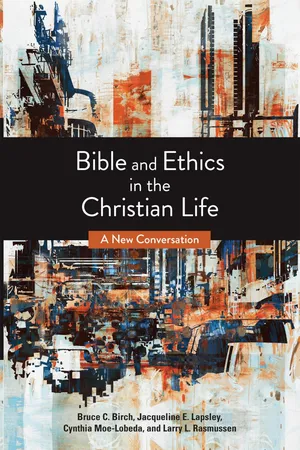
Bible and Ethics in the Christian Life
A New Conversation
- 296 pages
- English
- ePUB (mobile friendly)
- Available on iOS & Android
eBook - ePub
About this book
Information
II
Elements of the Moral Life
5
What Are Morality, Ethics, and Christian Ethics?
How are we to perceive the world and live in it? How do we do so in view of God’s boundless love for creation and presence within it, especially as God is revealed in the biblical witness and experienced in the lives of believers throughout time? How Christian communities respond to these questions is the story of Christian ethics and provides the structure of the Christian moral life. This chapter and the following two are an excursion into these questions.
Ethics and Morality
“Morality” and “ethics” are commonly used interchangeably. But in the discipline of ethics and in this volume, they are not. Morality refers to the lived dimension of life pertaining to doing and being—for individuals and groups—in ways that are good, right, and fitting. That simple statement cloaks a world of complexity, controversy, and intrigue. This chapter and the following two pursue that intrigue. At stake is life on Earth.
Ethics, on the other hand, is disciplined inquiry into morality. Ethics brings self-consciousness, method, intentionality, and sensitivity to the process of discerning what is good and right for any given situation and context. This dimension of ethics, known as moral decision-making or moral discernment, entails three interfacing tasks each with an accompanying question. A simple chart tells the tale:
| Tasks of Moral Discernment | Accompanying Questions |
| Descriptive | What is? |
| Constructive | What could be? |
| Normative | What ought to be? |
Moral decision-making or discernment is central to ethics. Yet, if understood as the entirety of ethics, it is dangerously limited. It ignores two other aspects of morality.
One is the question of moral-spiritual power to do and be what we ought. Human history and individual lives are shaped not only by people discerning what is right and then doing it but by people discerning what is right and then not doing it. Many people are certain, for example, that it is not moral to drive a car to work many times a week, given the tons of carbon emitted by driving and the dire impact of climate change on the world’s most vulnerable people. Yet, at this point, many continue driving to work. Ethics, as inquiry into morality, must include the questions of moral-spiritual power.
The second missing piece if ethics is limited to moral discernment is moral formation. Morality includes the formation of individuals and societies into people and groups who know and choose the good, and malformation toward the opposite. Ethics, therefore, must address the dynamics of moral formation and malformation.
The tasks and questions of moral deliberation expand, then, to become the tasks and questions of ethics as a whole.
| Tasks.of.Ethics | Accompanying Questions |
| Descriptive | What is? |
| Constructive | What could be? |
| Normative | What ought to be? |
| Formative | What morally forms and malforms us? What disables and enables the moral-spiritual power to do and be what we discern that we ought? |
| Practical | To what actions do these questions point? |
We have arrived at a fuller understanding of ethics. It brings self-consciousness, method, intentionality, and sensitivity to (1) discerning what is good and right for any given situation, (2) discovering what forms individuals and society toward the good and what malforms us away from it, and (3) uncovering and cultivating the moral-spiritual power to act toward the good.
Part 2 of this volume considers all three dimensions of the moral life—moral formation, moral discernment or deliberation, and moral agency—devoting chapter 6 to moral formation and chapter 7 to moral action and deliberation. In reality, however, the three are not separate. They are inseparably intertwined, forming and informing each other.
Ethics as Christian Ethics
Our primary concern in this book is not ethics, per se, but Christian ethics. Christian ethics is done from the perspective of what God is doing in the world as revealed in and by Jesus Christ and by the Holy Spirit working throughout creation, with human society a crucial dimension of it. Christian ethics considers moral discernment, formation, and agency in light of God’s love for the world and presence in, with, and for it.
Christian ethics is the disciplined art of coming to know ever more fully both the mystery that is God and the historical realities of life on Earth. But ethics does more; it holds these two in one breath, so that people may shape ways of life consistent with and empowered by God being with, in, among, and for creation. “Knowing” here refers not merely to “knowledge of” but to “being in relationship with.”
This is consistent with the meaning of the biblical Hebrew verb yadaʿ. It means “to know” not in the sense of cognitive knowledge but in the sense of entering into and experiencing that which is known. A most notable example is God’s statement to Moses, “I know their suffering” (Exod 3:7), implying divine relationship to human suffering (i.e., divine vulnerability).
Where vision and knowledge of God and of life’s realities are obscured, a task of Christian ethics is to know and see more truthfully. Where dominant forces distort historical realities by describing them falsely, ethics must “redescribe the world.”
“Holding in one breath,” God and the historical realities of life bridges chasms that are characteristic of modernity yet are contrary to the biblical witness. They include the separation of sacred from secular, of faith life from political life, of personal relationship with God from relationship with structures of society, of Jesus’s life and ministry from his execution, and of Christ from the ordinary world.
This notion of Christian ethics implies a purpose. It is not simply to iterate or reproduce past Christian ethical convictions. That is, the purpose is not to learn what our traditions say is right and good and then simply repeat it. Rather, Christian ethics is in the service of making Christian communities into living moral communities that can draw critically upon the traditions of the churches, put themselves in dialogue with other sources of moral wisdom, and read contemporary and historical circumstances clearly in order to craft ways of living consistent with faith in the God revealed in Jesus and the Spirit. By “ways of living,” we mean everything from personal lifestyle to influencing public policy and social structures. (In chapter 7, we work with the crucial distinction between reproducing moral traditions and drawing critically upon them.)
But that is not all. The purpose of Christian ethics is also to offer the resources of Christian traditions to efforts in the broader public to address the moral issues of our day. Given the rampant misuse of religion in the public sphere, the criteria for appropriate and valid use of religious resources is a vital question of Christian ethics. We consider that matter more fully at a later point. Suffice it here to note that Christian ethics does not negate other religious ethics and secular ethics, or claim to be superior to them. To the contrary, in addressing the life-and-death issues facing humanity today, Earth’s people must call upon all of the great faith traditions—and place them in conversation with each other and with other wisdom traditions—in order to plumb their depths for moral wisdom, guidance, and power to forge just and sustainable ways of life.
Christian ethical inquiry, then, draws upon the Bible, Christian historical traditions, and other sources of knowledge and moral wisdom to respond to the question noted above:
“How are we to perceive the world and live in it?” How do we do so in view of God’s boundless love for creation and presence within it, especially as God is revealed in the biblical witness and experienced in the lives of believers throughout time? Christian ethical inquiry holds together (1) the mystery of God’s unquenchable love for each and every one of us and for all of creation, and (2) the complex realities of life on Earth, including our daily lives.
Why Be Moral?
There is yet another dimension of ethical inquiry. Called “metaethics,” it asks and answers the question, Why be moral? Metaethics seeks to discover people’s most basic assumptions about right and wrong, good and evil. What do we regard as their origin or cause? Where, in the end, do we ground our own stands on moral matters? What is the final, bottom-line reason we give for what we seek to be and do? In a word, metaethics pushes us to disclose the sources of our morality and ethics.
For Christian ethics, metaethics rests in essential theological convictions. Consider, for example, Joseph Sittler’s remarks:
Before the church is the company of them that love God, it is the communion of them who acknowledge, and in that acknowledgment have their lives given a new center in One who loved them. The passive verb dominates the New Testament story! I love because I am loved; I know because I am known. I am the church, the body of Christ, because this body became my body.[1]
For teachers of ethics, few questions are more revealing of students’ basic orientation to God and to life than the metaethical question, Why be moral? A surprising number of students respond that being moral is the pathway to life in heaven after death. This is a problematic response, and one that has been the response by some Christian traditions throughout time.
Others have said quite the opposite. Good works do not earn our salvation. God’s love saves us, and the human choice to live rightly—summarized as loving as God loves—is a response to God’s gracious gift of unconditional love for us. Some articulate that response as one of gratitude, others as the living Christ dwelling within the believer, others as the work of the Holy Spirit. Regardless, the point is important in the work of ethics: before we are called to love others, we are beloved by God. Traditionally, the Great Commandment (“You shall love the Lord your God with all your heart, and with all your soul, and with all your mind. . . . You shall love your neighbor as yourself” Matt 22:37–39) is seen as generating two moral norms for human life—loving God and loving neighbor. But we argue there is a third—caring for creation—with a fourth norm that precedes them all: receiving and trusting the gracious love of God. (This is the metaethical level and the level this volume assumes.)
In short, we find four overarching norms for Christian ethics and metaethics:
- Acknowledging and trusting God’s gracious love
- Loving God with heart, soul, mind, and strength
- Loving “neighbor” with self-honoring and justice-making love
- Caring for creation
Method Matters
A quick look at history and at the church today reveals astounding —perhaps infinite—variety in response to ethical questions by communities of people who have sought to follow Jesus and the Spirit. This is crucial: Christian ethics does not assure specific unalterable answers to moral questions. Nor does it assure singular pathways for reaching answers. This variety may be seen as moral relativism, but it is not. It flows from the fact that God is a living and loving God, ever-creating, ever present to the changing needs and circumstances of human existence.
The diversity in ethical perspective and method stems also from the cultural conditioning that shapes and limits our perception and thinking, even without our awareness of these processes. E. F. Schumacher distinguished “thinking with” from “thinking about.” When we think, we do not just think, we think with concepts, ideas, images, metaphors, similes, and analogies. All of them join one thing with another to create a thought, express a feeling, or offer a point of view. Cumulatively, these “think withs” form a dynamic “mind-set.” They form the mind-set through which we view, interpret, and experience our world.[2]
“Thinking with” begins very early on, with our first relationships, our first words, and our first environment. As infants and toddlers, we learn an initial world through which we explore other worlds as we grow and move beyond our first circles of intimacy into other communities (school, for example).
We use “think withs” to think “about” anything and everything, big or small. What do we plan to do with our “one wild and precious life” (Mary Oliver)?[3] Should our town sponsor Syrian refugees? What should the next meal be? Was my stand in the recent election the right one? What do I most want to make of the time I have ...
Table of contents
- Cover
- Title Page
- Copyright
- Table Of Contents
- Figures
- Preface
- Introduction: A New Conversation
- The Bible as Moral Witness
- Elements of the Moral Life
- The Bible, Ethics, and the Moral Life
- Bibliography
- Name and Subject Index
- Scripture Index
Trusted by 375,005 students
Access to over 1.5 million titles for a fair monthly price.
Study more efficiently using our study tools.
Frequently asked questions
Yes, you can cancel anytime from the Subscription tab in your account settings on the Perlego website. Your subscription will stay active until the end of your current billing period. Learn how to cancel your subscription
No, books cannot be downloaded as external files, such as PDFs, for use outside of Perlego. However, you can download books within the Perlego app for offline reading on mobile or tablet. Learn how to download books offline
Perlego offers two plans: Essential and Complete
- Essential is ideal for learners and professionals who enjoy exploring a wide range of subjects. Access the Essential Library with 800,000+ trusted titles and best-sellers across business, personal growth, and the humanities. Includes unlimited reading time and Standard Read Aloud voice.
- Complete: Perfect for advanced learners and researchers needing full, unrestricted access. Unlock 1.5M+ books across hundreds of subjects, including academic and specialized titles. The Complete Plan also includes advanced features like Premium Read Aloud and Research Assistant.
We are an online textbook subscription service, where you can get access to an entire online library for less than the price of a single book per month. With over 1.5 million books across 990+ topics, we’ve got you covered! Learn about our mission
Look out for the read-aloud symbol on your next book to see if you can listen to it. The read-aloud tool reads text aloud for you, highlighting the text as it is being read. You can pause it, speed it up and slow it down. Learn more about Read Aloud
Yes! You can use the Perlego app on both iOS and Android devices to read anytime, anywhere — even offline. Perfect for commutes or when you’re on the go.
Please note we cannot support devices running on iOS 13 and Android 7 or earlier. Learn more about using the app
Please note we cannot support devices running on iOS 13 and Android 7 or earlier. Learn more about using the app
Yes, you can access Bible and Ethics in the Christian Life by Bruce C. Birch,Jacqueline E. Lapsley in PDF and/or ePUB format, as well as other popular books in Theology & Religion & Biblical Studies. We have over 1.5 million books available in our catalogue for you to explore.