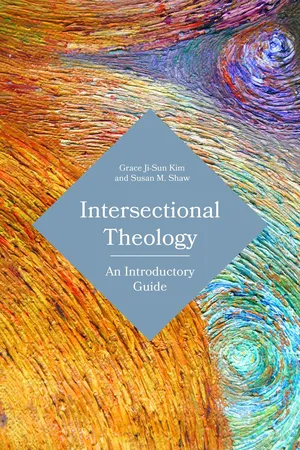
Intersectional Theology: An Introductory Guide offers a pathway for reflective Christians, pastors, and theologians to apply the concepts and questions of intersectionality to theology. Intersectionality is a tool for analysis, developed primarily by black feminists, to examine the causes and consequences of converging social identities (gender, race, class, sexual identity, age, ability, nation, religion) within interlocking systems of power and privilege (sexism, racism, classism, heterosexism, ableism, ageism, nativism) and to foster engaged, activist work toward social justice. Applied to theology, intersectionality demands attention to the Christian thinker's own identities and location within systems of power and the value of deep consideration of complementary, competing, and even conflicting points of view that arise from the experiences and understandings of diverse people.
This book provides an overview of theories of intersectionality and suggests questions of intersectionality for theology, challenging readers to imagine an intersectional church, a practice of welcome and inclusion rooted in an ecclesiology that embraces difference and centers social justice.
Rather than providing a developed systematic theology, Intersectional Theology encourages readers to apply its method in their own theologizing to expand their own thinking and add their experiences to a larger theology that moves us all toward the kin-dom of God.
- 170 pages
- English
- ePUB (mobile friendly)
- Available on iOS & Android
eBook - ePub
About this book
Information
Subtopic
Théologie chrétienne5
Practicing Intersectional Theology
This section calls on readers to imagine what it would look like for individual Christians and the church as a whole to center intersectionality in their/its practices. As a liberatory practice, intersectional theology means Christians must relinquish their individual privilege and work toward the dismantling of systems of oppression. Christians can no longer ignore racism, sexism, heterosexism, classism, ableism, and ageism. We need to name these interlocking systems of oppressions as sin and move toward reimagining a community that can live out intersectional theology. This section will explore possible applications of intersectional theology in the lives of individual Christians and the lives of faith communities and the church as a whole. In particular, we will examine what an intersectional theology might mean for the church’s internal functions—membership, baptism, communion—and also the church’s work in the world, particularly in our current political climate that has targeted already-marginalized people, often in the name of God.
Intersectionality and the Individual Christian
Intersectional theology calls us as individual Christians to examine our own commitments to justice and the extent of our actual embrace of differences within our practice of faith in daily life. In particular, intersectional thinking helps us understand identities as “a collective political subjectivity and conscious coalition that also leaves room for individual identity.”[1] In other words, intersectionality is a critical back-and-forth between individual persons and the collective political identities in which people find themselves within systems of domination and subordination. One’s identity is not monolithic but rather multidimensional, complex, and intersectional, situated within interlocking structures of power. One’s identity includes and is not limited to ethnicity, class, race, sexuality, gender, and ability, which all intersect and are interdependent. Our lives are complex and our multiple identities are not mutually exclusive. Therefore the axes of classism, racism, homophobia, ableism, and other issues play a role in characterizing ourselves and how we engage in the struggle for social justice. Audre Lorde states, “There is no such thing as a single-issue struggle, because we do not live single-issue lives.”[2] As women of color, we don’t just struggle with racism, we fight sexism, classism, and transphobia. As lesbians, we don’t just fight homophobia, but also sexism, racism, classism, and ableism. We are multiple identities and we fight multiple issues as these issues intersect and are interrelated within systems of power and privilege.
An Asian American community is not a single group with one history and identity but is rather a diverse, multiple, nonconforming group, just as are the individual members of it. Similarly, the LGBTQ community is complex, with multiple identities and axes that overlap, interrupt, and intersect to make the community diverse and come alive and be vibrant. Such are the realities of the individuals who are part of these groups that society likes to lump together and try to make it homogeneous for simplicity. The oppressions that individuals experience are compounded and multiplied due to the interweaving and untangling of the multiple sites of identity.
Patricia Hill Collins and Sirma Bilge emphasize that this understanding of identity is then a starting point and not an end in itself. Rather, individual and group identities become the impetus for intersectional inquiry and praxis[3]—understanding our social location and the location of others across multiple categories of identity within a political context leads to reflection and action for justice in the world. Rather than seeing this sense of identity and social location as divisive and isolating, Collins and Bilge see it as an opportunity for creating coalitional space.[4]
Kimberlé Crenshaw argues that intersectional identities provide opportunities for coalitions as individuals identify places to work within and across groups. So, for example, she explains that the intersectional experiences of women of color mean that rather than simply organizing on the basis of race, women and men of color can also organize as a coalition with race as a basis for coalition. In so doing, a group forms around issues of race but with attention to the power differences of gender.[5]
As individual Christians develop intersectional awareness, they can express greater attentiveness to working with others across differences and attending to power differences within groups. So, for example, we can imagine coalitions of straight and LGBTQ Christians working together for equality for LGBTQ Christians within the church, while working in coalition with non-Christian LGBTQ people for equality within society. Within these coalitions, intersectional praxis also demands attention to power differences across gender and gender identity, across race, across ability, across age, and across social class. Attention to our own intersectional identities increases our ability to make connections with those who share some facet of identity and to recognize the ways power works across our differences in identity. So, for example, white women and women of color may organize by gender to advocate for equity in church leadership, but they must attend to differences across race so that the impacts of race on women of color are not obscured and so white women do not replicate the exercise of power over women of color based on race. Similarly, Kelly Brown Douglas and Pamela R. Lightsey offer groundbreaking calls for womanist theologians to ensure that their organizing around the intersection of gender and race does not ignore homophobia in the black community and perpetuate discrimination against LGBTQ people.[6]
To live out our faith and spiritual journeys, we cannot bring just parts of ourselves, but we need to bring our whole selves. Our entire beings include the intersecting parts of our identity and our location within structures of power. Therefore, we must embrace, welcome, and accept our entire identities (and not simply the aspects that confer dominance) whether it be our nonconforming gender identity or queer sexual identity, which some communities of faith do not welcome, or our marginalized identity as persons of color who experience everyday harassment due to the color of our skin. Our individual relationship with God requires our whole beings to come to God so that we can live faithfully in God. This will help us to authentically live out the gospel message and work toward justice.
Our personal spiritual practices include prayer, meditation, reading the Bible, listening to the voice of God, and reflecting theologically upon our lives. These spiritual practices need to be lived out from the fluidity of our complicated identities. For example, how we approach and read Scripture arises out of our personal identity as a heterosexual Asian woman, or as a middle-class white lesbian, or as a poor Latina trans woman. These intersecting identities help us to read and interpret Scripture in a way that is liberating for all people. If our interpretation of Scripture continues to reinforce slavery, racism, homophobia, classism, marginalization, and patriarchy, then we are reading it all wrong. The central message of Jesus is to love everyone and to liberate those who are oppressed.
Jesus healed lepers. Lepers were the outcasts of society. Nobody wanted lepers around and thus they were placed on the outskirts of society. Even as they were thrown aside by society, Jesus loved them and healed them (Luke 17:11–17). When no one wanted to associate with lepers, Jesus welcomed them. This is the good news for us living intersectional lives. As spiritual individuals, we want to present our whole selves to Jesus, who accepts all of our intersectional identities.
As we pray and meditate, our experiences of oppression and domination play a role in how we pray and what we pray for. Intersectionality allows us to see the pain in the world and how we all need to be instruments in bringing love and peace rather than hatred and war. As Martin Luther King Jr. once stated, “True peace is not merely the absence of tension; it is the presence of justice.”[7] Intersectional spirituality moves us into spaces of courageous meditation to find the strength and motivation to fight for justice for ourselves and for others who are systematically oppressed.
As part of our spiritual practice we try to hear the voice of God in the church on Sunday mornings and also every day of our lives. Intersectionality’s focus on both/and rather than either/or encourages us to hear the voice of God in unconventional and unfamiliar places. We hear the voice of God crying out in the wilderness and in the pain when we see our brothers and sisters struggling under white supremacy, heteropatriarchy, Islamophobia, and other forms of oppression. We hear the small voice of God asking us to repent of our sins and move toward restoration and love. We are encouraged by the small voice of God to work against systems of oppression and toward communities of liberation, love, and joy.
Individual Christians attentive to intersectionality are aware of the simultaneous disadvantages and privileges at work in their own lives. They recognize the ways they are variously situated in relation to power and privilege, disadvantage and discrimination, and the ways their social location has impact on their lives, their theologies, and their embodiment of Christian faith. They approach relationships with others conscious of how these intersections shape interactions, and they pay special attention to how their own privileges may prevent them from comprehending the struggles and complexities of the lives of others who are differently situated. They bracket their own deeply held and cherished beliefs in order to make space for different, even competing, beliefs of others, in order to learn from others and engage in authentic dialogue that moves everyone toward greater justice and love. They use their privilege to work for social change, and they build alliances and coalitions across differences to work toward the beloved community. They refuse the divisions of the current political situation and see identities and identity politics as ways to make the workings of power across difference visible, to affirm those who are marginalized, and to identify strategies for positive change that benefit all humans. They see commitment to intersectional thinking as a tool to help them embody the gospel’s call to love our neighbors, to love our enemies, and to do good to all. Intersectionality becomes a practice that attunes us to our neighbors’ needs and helps us see our neighbors, even those who differ most from us, as full human beings, beloved of God, and our siblings in God’s family.
Intersectional Community
Community is important for all people. In contrast to Western empha...
Table of contents
- Cover
- Title Page
- Copyright
- Dedication
- Table Of Contents
- Acknowledgments
- Preface
- Introduction to Intersectionality
- Biography as Intersectional Theology
- Intersectionality as Theological Method
- Applying Intersectionality to Theology and the Bible
- Practicing Intersectional Theology
- Conclusion
- Glossary
- Bibliography
- Index
Trusted by 375,005 students
Access to over 1.5 million titles for a fair monthly price.
Study more efficiently using our study tools.
Frequently asked questions
Yes, you can cancel anytime from the Subscription tab in your account settings on the Perlego website. Your subscription will stay active until the end of your current billing period. Learn how to cancel your subscription
No, books cannot be downloaded as external files, such as PDFs, for use outside of Perlego. However, you can download books within the Perlego app for offline reading on mobile or tablet. Learn how to download books offline
Perlego offers two plans: Essential and Complete
- Essential is ideal for learners and professionals who enjoy exploring a wide range of subjects. Access the Essential Library with 800,000+ trusted titles and best-sellers across business, personal growth, and the humanities. Includes unlimited reading time and Standard Read Aloud voice.
- Complete: Perfect for advanced learners and researchers needing full, unrestricted access. Unlock 1.5M+ books across hundreds of subjects, including academic and specialized titles. The Complete Plan also includes advanced features like Premium Read Aloud and Research Assistant.
We are an online textbook subscription service, where you can get access to an entire online library for less than the price of a single book per month. With over 1.5 million books across 990+ topics, we’ve got you covered! Learn about our mission
Look out for the read-aloud symbol on your next book to see if you can listen to it. The read-aloud tool reads text aloud for you, highlighting the text as it is being read. You can pause it, speed it up and slow it down. Learn more about Read Aloud
Yes! You can use the Perlego app on both iOS and Android devices to read anytime, anywhere — even offline. Perfect for commutes or when you’re on the go.
Please note we cannot support devices running on iOS 13 and Android 7 or earlier. Learn more about using the app
Please note we cannot support devices running on iOS 13 and Android 7 or earlier. Learn more about using the app
Yes, you can access Intersectional Theology by Grace Ji-Sun Kim,Susan M. Shaw in PDF and/or ePUB format, as well as other popular books in Théologie et religion & Théologie chrétienne. We have over 1.5 million books available in our catalogue for you to explore.