The Influence of Barth
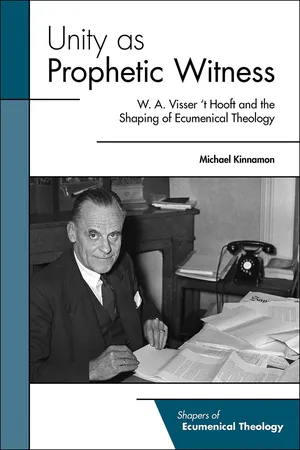
Given my experience with him, it is difficult for me to picture Willem Visser ’t Hooft as anything other than an old man—the grand old man of the ecumenical movement. There was a time, however, when Visser ’t Hooft was the youngest of ecumenical leaders. Indeed, the primary reservation to his selection in 1937 as general secretary of the World Council of Churches, then in process of formation, was his youth. It is a reminder of how central he was to the movement for six decades.
The man who became such a leading figure in the global church was born into a prominent, stable, and cultured Dutch family—his father a lawyer, his grandfather the presiding judge of the district tribunal in Haarlem. The year of his birth, 1900, seems appropriate in that he was a friend to many of the century’s leaders and participant in some of its momentous events. In order to honor the memory of a beloved aunt, Visser ’t Hooft’s father added her family name, Visser, to his own, ’t Hooft. The resulting name, which also seems curiously appropriate, means “head fisherman.” The young Visser ’t Hooft attended a “classical” secondary school where, in addition to Latin and Greek, he learned French, German, and English, languages in which he later communicated with equal proficiency. He also took private lessons in Hebrew.
His parents belonged to the Remonstrant Church, a community that had followed Jacobus Arminius in his resistance to certain teachings of Calvin and, by the start of the twentieth century, was dominated by liberal theology. Visser ’t Hooft recalls in his Memoirs that the local pastor, who had a considerable influence on him, had worked out an understanding of religion that owed much to the philosophy of Hegel. It was, he writes, “religion in a strongly intellectualized form,” with little emphasis on the scriptural witness to God’s incarnation in human history. “I was on the way to becoming a syncretist, who considered all varieties of religious experience as equally true and equally false.” The danger of syncretism was to remain a concern throughout his career.
Two factors moved him in another direction. The first, and more experiential, was his participation in the Dutch Student Christian Movement, where “personal encounter with Jesus was the centre of everything.” This call to commit his life to Christ was reinforced by a three-month stay at Woodbrooke, a Quaker center in England. What he experienced there was “the integration of conviction and life” and the exposure to a socially relevant gospel in a community where everyone was accepted, regardless of background. According to Robert Bilheimer, a close associate of Visser ’t Hooft’s at the WCC, the general secretary’s favorite biblical passage was 2 Corinthians 4:6: “For it is the God who said, ‘Let light shine out of darkness,’ who has shone in our hearts to give the light of the knowledge of the glory of God in the face of Jesus Christ.” Christ in our hearts. It is an indication of the abiding influence of these early encounters.
A second factor, more intellectual, was his reading of Karl Barth’s The Epistle to the Romans, which had a life-changing impact not only on Visser ’t Hooft but on many of his contemporaries. Barth’s theological position, often called dialectical or neoorthodox, was a direct challenge to liberal theology, and it provided the student Visser ’t Hooft with an intellectual basis for his new-found Christian commitment. “This was a man who proclaimed the death of all the little, comfortable gods and spoke again of the Living God of the Bible. It was as if all the different elements in my religious development could now fall into place. This was the message for which I had been waiting.” In his Memoirs, Visser ’t Hooft denies being a “Barthian”—in part, perhaps, because Barth issued scathing criticisms of early ecumenical conferences. He did, however, publish a pamphlet-length Introduction á Karl Barth in French (1931) and, in the Memoirs, expresses gratitude to Barth “for giving me ground under my feet” and for providing theological substance to the emerging movement.
A good example of what Visser ’t Hooft took from Barth can be seen in the latter’s communication to the Second World Conference on Faith and Order (Edinburgh, 1937), published in English as The Church and the Churches. Barth argues passionately that the current multiplicity of denominations compromises the church’s witness to the gospel, undermines its resistance to Europe’s “new paganisms,” and, most importantly, is a sinful denial of the New Testament, which “speaks of a variety of communities, of gifts, and of persons within the one Church.” He calls such division “unthinkable” and declares that Christians “must not allow ourselves to acquiesce in its reality.”
In Barth’s view, however, the effort to achieve a united church should not be seen as a quest for ecclesial unity itself and certainly not as a response to sociological imperatives. Rather, it must be “identical with the quest for Jesus Christ as the concrete Head and Lord of the Church.”Heis its unity. Only to the degree that the churches put their trust in him, that they confess Christ and live in obedience to his teaching, will they be one.
This helps account for Barth’s mistrust of most ecumenical initiatives. The ecumenical movement, he insists in his communication to Faith and Order, cannot be a step-by-step process of assimilating divergent theological perspectives. It must have no hint of doctrinal compromise in a mistaken attempt to camouflage differences. It is not to be confused with cooperation or emotional harmony—“to prescribe doses of love, patience, and tolerance is futile.” The union of the churches must be prayerfully discovered, not manufactured, because in Christ the church is already one “and does not await any desires, capacities, or labors of ours for its unification.” Human agreements achieved through dialogue can be received with gratitude, but they are signs of the oneness Christ gives and nothing more.
Barth goes so far in this text as to declare that “the union of the churches is too great a matter to be the result of a movement”—words, wrote Visser ’t Hooft, that “practically amounted to a denial of the ecumenical movement’s raison d’être.” The great theologian later revised his estimate of ecumenical endeavor, delivering an address at the WCC’s first assembly and participating actively in the drafting of a background paper on the theme for the second assembly. But he never provided a theological answer to the questions: How does unity grow? What moves the ecumenical movement? When Visser ’t Hooft took on this task in his 1957 Taylor Lectures at Yale Divinity School, published as The Pressure of Our Common Calling, he was drawing more on the work of such theological giants as Dietrich Bonhoeffer and William Temple than on that of Karl Barth.
Still, Visser ’t Hooft’s frequent assertion that ecumenism “is either a Christocentric movement or it is nothing at all,” his refusal to accept the papering over of differences, and his repeated denial that cooperation or conciliar fellowship are adequate expressions of our given unity in Christ clearly echo Barth. And some parts of his corpus, such as these sentences from The Wretchedness and Greatness of the Church (1944), could have come from Barth’s own pen: “For the Church, the whole Church, is to be found wherever His Word and His Spirit are at work. . . . Unity is thus really the work of Christ and not a product of our own goodwill. . . . It is not agreement between the churches. . . . To believe in the Church, One and Holy, is not to believe that this Church will come in some way and in some place; it is to believe that it is and seeks to manifest itself among us.”
Encounter with the Social Gospel
In 1924, having completed his theological examinations at the University of Leiden, Visser ’t Hooft accepted a position on the staff of the World Alliance of YMCAs in Geneva. The central office was dominated by American Christians, most of them supporters of the social gospel, a theological movement that tended to link salvation with social transformation. Much of his work, however, was with boys’ groups in Scandinavia and Germany, which meant that he was in regular contact with two contrasting theological worlds. For the Americans, World War I, which had been fought far from US soil, was “the war to end all wars.” Its end, along with the creation of the League of Nations, were seen as signs that the kingdom of God, with its promise of peace, could be advanced by human endeavor. For the Germans...