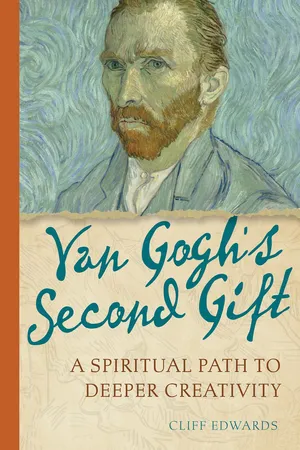
Cliff Edwards, a well-known Vincent Van Gogh author and scholar, explores Van Gogh's second gift--the surprising written works of Van Gogh in letters to his brother, fellow artists, and friends. Edwards illuminates Van Gogh's vision and creative process for readers as a way of living and creating more deeply. Van Gogh's Second Gift gives us another side of Van Gogh, whose poetic, creative, and original mind opened up startling insights on the creative process. A perfect book for creatives and those who want to understand more about one of the world's most beloved artists, the genius creator of works like Starry Night. Focusing on more than 40 letter excerpts, Edwards offers clear background and insights into Van Gogh's life and creative ideas, as well as suggestions for reflection and personal engagement. Van Gogh sketches are scattered throughout the book.
- 208 pages
- English
- ePUB (mobile friendly)
- Available on iOS & Android
eBook - ePub
About this book
Information
Topic
Personal DevelopmentSubtopic
Artist MonographsIllumination 1
Find Things Beautiful as Much as You Can
The first letter preserved from Vincent to Theo (Letter 001) was sent from The Hague in Holland in 1872, where Vincent was newly employed at the international art dealer, Goupil and Company, through the influence of his Uncle Vincent, a partner in the firm. At age sixteen, the younger Vincent wrote a few lines to his schoolboy brother, Theo, age twelve, remembering fondly the few days they had just spent together.
Two years and a dozen letters to Theo later, both brothers are working for Goupil at two different branch offices, and Vincent is now seeking to advise and reassure Theo that things will go well for him in this wonderful art business. In his letter, Vincent gathers that advice and spiritual support in a form he feels Theo will find familiar and welcome. The brothers having been steeped in the language of the Bible from their youth, Vincent echoes it in how he expresses his desire to speak with Theo face-to-face, and in how he offers heartfelt advice grounded in a spontaneous list of artists he admires—including many who are often forgotten or attacked rather than appreciated—all regarded by Vincent as mentors. Finally, he returns to a note of essential wisdom.

In its low-key way, the letter reveals Vincent’s concern for Theo and a confidence in the arts, artists, and nature as teachers. Vincent reminds Theo to open himself to beauty, though he reflects that too few people do so. As we read Van Gogh’s letters, we are reminded to do the same—to walk in the world, as taught by artists, with eyes to see beauty and love nature; to appreciate the lives and work of others that lead us to beauty and remind us to be open and generous.
Emphasis shown in this and other letters is original. In another translation of this passage, Johanna van Gogh-Bonger provides a gracious alternative wording: instead of “find things beautiful as much as you can,” she renders the sentence, “Admire as much as you can; most people do not admire enough.”
This openness to and gratitude for the gifts of others is an ongoing theme in Van Gogh’s life. It is often revealed in dialogical tension with his self-enforced “aloneness” and failure to find reliable companions to share his vision of a new and cooperative art sensitive to nature and the oppressed. But it’s clear through the letter and the long list of artists that Vincent has a sense for which creative companions support and stretch his own thought and words—and that these are an integral part of his own “find[ing] things beautiful as much as [he] can.”
Vincent to Theo, Letter 017
London, January 1874
How I’d like to talk to you about art again, but now we can only write to each other about it often; find things beautiful as much as you can, most people find too little beautiful.
I’m writing below a few names of painters whom I like very much indeed. Scheffer, Delaroche, Hérbert, Hamon. Leys, Tissot, Lagye, Boughton, Millais, Thijs Maris, Degroux, De Braekeleer Jr.
Millet, Jules Breton, Feyen-Perrin, Eugène Feyen, Brion, Jundt, George Saal. Israëls, Anker, Knaus, Vautier, Jourdan, Jalabert, Antigna, Compte-Calix, Rochussen, Meissonier, Zamacois, Madrazo, Ziem, Boudin, Gérôme, Fromentin, De Tournemine, Pasini.
Decamps, Bonington, Diaz, T. Rousseau, Troyon, Dupré, Paul Huet, Corot, Schreyer, Jacque, Otto Weber, Daubigny, Wahlberg, Bernier, Emile Breton, Chenu, César de Cock, Mlle Collart. Bodmer, Koekkoek, Schelfhout, Weissenbruch, and last but not least Maris and Mauve.
But I could go on like this for I don’t know how long, and then come all the old ones, and I’m sure I’ve left out some of the best new ones.
Always continue walking a lot and loving nature, for that’s the real way to learn to understand art better and better. Painters understand nature and love it, and teach us to see. . .
For Reflection
What things do you find truly beautiful? Can you name at least one such beautiful thing you have experienced today? You might begin with the smile of a child, the excitement of a pet, a simple landscape, a quiet corner, something said by a friend. Did you respond to those moments, express thanks for them, share them with others? How might Vincent’s enthusiasm in naming over sixty artists whose work he found beautiful lead you to open more widely your own sense of beauty and acknowledge its power to deepen your life?
For Creative Engagement
Make a list of beautiful moments you have experienced today. Commit to setting aside a time at the end of each day to search out such moments. Focus on even the simplest of such moments and express your thanks on paper, in paints, or in some other way related to your creative life. Imagine some way in which that beauty can be shared with another person tomorrow. See if you can find an encounter with beauty that asks of you what an encounter with a beautiful art object asked—even insisted—of the poet Rainer Maria Rilke: “You must change your life.”
Illumination 2
Remember, You Are a Pilgrim and Life Is a Long Walk
After a strong start in the art business at Goupil and Company, Vincent was suddenly and surprisingly asked to resign effective April 1, 1876. His insistence that he be allowed to return home for the Christmas holidays may have been a factor, but his unhappiness with being transferred to the Paris branch of the company and his seclusion in a Montmartre room with his Bible and a “disciple” named Gladwell may have added to his superiors’ displeasure. Vincent had obviously been moving in the direction of his father’s work in ministry. Nevertheless, he was shocked at the loss of his job in France. While he advertised for a church-related position in newspapers in England, what he found was a teaching job that gave him only room and board at a Mr. Stokes’ school for boys. However, he soon moved from that to a more suitable post at the Reverend Jones’s school in Isleworth, where he assisted a Wesleyan Methodist minister at several small churches outside London. He now saw himself solidly on course to Christian work related to his father’s profession. He soon wrote Theo, “Mr. Jones has promised me that I won’t have to teach so much any more, but that I may work in his parish from now on, visiting people, talking to them, and so on. May God give this his blessing” (Letter 093). Within a month he was excited that Rev. Jones had allowed him to preach in one of the small churches. On November 3, 1876, he wrote, “Theo, your brother spoke for the first time in God’s house last Sunday, in the place where it is written ‘I will give peace in this place’” (Letter 096, November 3, 1876). Vincent enclosed the full text of the sermon he had preached, based on Psalm 119:19, “I am a stranger in the earth: hide not thy commandments from me” (KJV).
Vincent’s excitement about his church-related work would be rather short-lived. Likely his father and uncles felt that serving an English Wesleyan Methodist pastor in impoverished parishes for barely any salary was not fit work for a Van Gogh, and so called him home. Several further “failures” to live up to his family’s expectations were to follow until, with Theo’s encouragement, Vincent took up his pencil and taught himself to draw at age twenty-seven. His art career spanned only a decade due to his untimely death.
In the portion of the sermon quoted below, already we see themes of mother, father, home, and the quest for a resolution of the antitheses in life, the coincidence of opposites that can be found in Vincent’s search for meaning. Another lifetime theme, that he was a “stranger” on the earth and a pilgrim with “secret chambers in his heart,” was also present in his musings. It was the restless, relentless search for deeper spiritual meaning that became the beginning of taking up the pencil, allowing him to explore in a physical, visual way the chambers of the heart.

Opening of Vincent’s first sermon, recorded in Letter 096, to Theo
Isleworth, November 3, 1876
It is an old faith and it is a good faith that our life is a pilgrim’s progress—that we are strangers in the earth, but that though this be so, yet we are not alone for our Father is with us. We are pilgrims, our life is a long walk, a journey from earth to heaven.
The beginning of this life is this. There is one who remembereth no more Her sorrow and Her anguish for joy that a man is born into the world. She is our Mother. The end of our pilgrimage is the entering in Our Fathers [sic] house where are many mansions, where He has gone before us to prepare a place for us. The end of this life is what we call death—it is an hour in which words are spoken, things are seen and felt that are kept in the secret chambers of the hearts of those who stand by, it is so that all of us have such things in our hearts or forebodings of such things. There is sorrow in the hour when a man is born into the world, but also joy—deep and unspeakable—thankfulness so great that it reacheth the highest Heavens. Yes the Angels of God, they smile, they hope and they rejoice when a man is born in the world. There is sorrow in the hour of death—but there too is joy unspeakable when it is the hour of death of one who has fought a good fight.
For Reflecti...
Table of contents
- Cover
- Title Page
- Copyright
- Table Of Contents
- Introduction
- Illumination 1
- Illumination 2
- Illumination 3
- Illumination 4
- Illumination 5
- Illumination 6
- Illumination 7
- Illumination 8
- Illumination 9
- Illumination 10
- Illumination 11
- Illumination 12
- Illumination 13
- Illumination 14
- Illumination 15
- Illumination 16
- Illumination 17
- Illumination 18
- Illumination 19
- Illumination 20
- Illumination 21
- Illumination 22
- Illumination 23
- Illumination 24
- Illumination 25
- Illumination 26
- Illumination 27
- Illumination 28
- Illumination 29
- Illumination 30
- Illumination 31
- Illumination 32
- Illumination 33
- Illumination 34
- Illumination 35
- Illumination 36
- Illumination 37
- Illumination 38
- Illumination 39
- Illumination 40
- Illumination 41
- A Brief Afterword
- Acknowledgments
- Notes
- List of Illustrations
Trusted by 375,005 students
Access to over 1.5 million titles for a fair monthly price.
Study more efficiently using our study tools.
Frequently asked questions
Yes, you can cancel anytime from the Subscription tab in your account settings on the Perlego website. Your subscription will stay active until the end of your current billing period. Learn how to cancel your subscription
No, books cannot be downloaded as external files, such as PDFs, for use outside of Perlego. However, you can download books within the Perlego app for offline reading on mobile or tablet. Learn how to download books offline
We are an online textbook subscription service, where you can get access to an entire online library for less than the price of a single book per month. With over 1.5 million books across 990+ topics, we’ve got you covered! Learn about our mission
Look out for the read-aloud symbol on your next book to see if you can listen to it. The read-aloud tool reads text aloud for you, highlighting the text as it is being read. You can pause it, speed it up and slow it down. Learn more about Read Aloud
Yes! You can use the Perlego app on both iOS and Android devices to read anytime, anywhere — even offline. Perfect for commutes or when you’re on the go.
Please note we cannot support devices running on iOS 13 and Android 7 or earlier. Learn more about using the app
Please note we cannot support devices running on iOS 13 and Android 7 or earlier. Learn more about using the app
Yes, you can access Van Gogh's Second Gift by Cliff Edwards in PDF and/or ePUB format, as well as other popular books in Personal Development & Artist Monographs. We have over 1.5 million books available in our catalogue for you to explore.