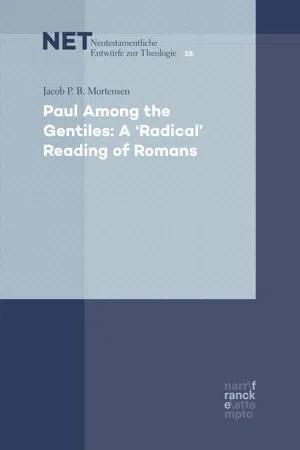
This exciting new interpretation of Paul's Letter to the Romans approaches Paul's most famous letter from one of the newest scholarly positions within Pauline Studies: The Radical New Perspective on Paul (also known as Paul within Judaism). As a point of departure, the author takes Paul's self-designation in 11: 13 as "apostle to the gentiles" as so determining for Paul's mission that the audience of the letter is perceived to be exclusively gentile. The study finds confirmation of this reading-strategy in the letter's construction of the interlocutor from chapter 2 onwards. Even in 2: 17, where Paul describes the interlocutor as someone who "calls himself a Jew, " it requests to perceive this person as a gentile who presents himself as a Jew and not an ethnic Jew. If the interlocutor is perceived in this way throughout the letter, the dialogue between Paul and the interlocutor can be perceived as a continuous, unified and developing dialogue. In this way, this interpretation of Romans sketches out a position against a more disparate and fragmentary interpretation of Romans.
- 366 pages
- English
- ePUB (mobile friendly)
- Available on iOS & Android
eBook - ePub
Paul Among the Gentiles: A "Radical" Reading of Romans
About this book
Information
1 The State of the Research – the radical new perspective
Introduction
My intent with this chapter is to consider a few representative positions of scholars who either explicitly or implicitly have worked to push the new perspective on Paul further.1 It almost goes without saying that the ‘radical’ new perspective on Paul extends and further elaborates on the ‘new’ perspective on Paul.2 However, as this ongoing process of refinement continues, the necessity of drawing further conclusions and mapping out new positions develop. Consequently, many of the scholars calling themselves ‘radicals’ find it necessary to bespeak the emergence of a new paradigm.3 Although I find the defining of a new paradigm questionable at this point, this introductory chapter serves the purpose of mapping out those fundamental paths that may have the potential to make the new perspective on Paul implode, and dissolve into something ‘radically’ other.
History of research
To my knowledge, only two scholars have tried to explain the development from the new perspective to the radical new perspective. The first scholar is John Gager, with his book, Reinventing Paul (2000), the second is Magnus Zetterholm, with his book, Approaches to Paul (2009). Both scholars describe themselves as belonging to the newest development in Pauline studies. Gager presents himself as part of the ‘New Views of Paul’, as differentiated from ‘The Traditional View of Paul’ (Gager 2000, v). When Gager wrote his book, the new perspective was still thriving, and many scholars connected to the impetus from this kind of research. In the years following the publication of his book, the radical perspective materialized more and more, and scholars began to distance themselves more specifically from the new perspective and, instead, to speak of a radical new perspective. So even if Gager fits best within the radical perspective, he ‘merely’ presents himself as a scholar holding the ‘New Views of Paul’.
Gager and Zetterholm stage the history of research on Paul in the same way: They present the research on Paul as moving from a ‘traditional’ view to a ‘New Perspective’, or even ‘Beyond the New Perspective’. Gager labels the ‘old’ view from which he distances himself ‘The Traditional View’. He organizes his study thematically, under headings such as, ‘Paul Converted from Judaism to Christianity’, ‘Paul Preached against the Law and Israel’, and ‘Generalizing and Universalizing’. Hence, Gager mentions few scholars, and he describes the ‘traditional’ view (i.e. all scholarship before his own) in broader terms, as though they all agreed on the points he presents. Zetterholm sets about his task slightly differently. He reviews the actual work of many different scholars and their specific books under three headings: ‘The Formation of the Standard View of Paul’, ‘Toward a New Perspective on Paul’, and ‘Beyond the New Perspective’. So the ways in which Gager and Zetterholm planned their presentations are similar: From something ‘old’, ‘traditional’, or ‘standard’, to something ‘new’ or ‘beyond the new’. But Gager approached this task from a thematic perspective, whereas Zetterholm approached it from the perspective of individual scholars.
The one thing lacking in both Gager’s and Zetterholm’s presentations is a critical view of their own radical positions or perspectives. This may be too much to ask of a scholar deeply involved in developing a new position. However, some sort of critical evaluation still needs to be presented. The only one of which I am aware is Terence L. Donaldson’s, in a book edited by Mark Nanos and Magnus Zetterholm, Paul within Judaism (2015).1 There is another critique, by Alexander Wedderburn, but this is more a critique of the new, rather than the radical new, perspective. However, I present some of the objections raised by Donaldson and Wedderburn, after a presentation of the ‘radicals’, and I also present some critical remarks of my own.
Scholarly predecessors to the radical perspective
Franz Mussner, Krister Stendahl, John Gager
Franz Mussner was a Catholic New Testament scholar teaching at the University of Trier and Regensburg from 1952/53 to 1981. During the course of his teaching he came to the conclusion that a proper perception of Judaism was a key to understanding the New Testament texts. He also actively engaged in Jewish-Christian dialogues in the years following the Second World War. Franz Mussner is a predecessor to the radical perspective, arguing for a Sonderweg interpretation of Rom 11:25–27. Some scholars argue that the Sonderweg interpretation may also be designated a ‘two covenant’ theology.1 The reason for this is to be found in the emphasis on the continued legitimacy of Israel’s covenant with God after the coming of Christ, and, hence, a positive evaluation of Judaism. Rom 11:25–27 states that ‘a hardening has come upon part of Israel, until the fullness of Gentiles has come in, and then [or in that way] all Israel will be saved. As it is written: Out of Zion will come the deliverer’. The Sonderweg interpretation more specifically argues that Israel will not be saved until the Second Coming of Christ. When Israel observes the Messiah descending to earth and hears the gospel proclaimed, she will respond to Christ and be converted.
Some scholars confuse the precise meaning of the Sonderweg by viewing the term as encompassing almost any distinction between the salvation of Israel and the salvation of believers in Christ.2 But there are at least two approaches to God’s salvation of Israel. The ‘two covenant’ solution maintains that Israel’s salvation bypasses Christ altogether. Scholars such as Krister Stendahl, John Gager, and Lloyd Gaston may be said to adopt this position.3 The other position works with a narrower definition of the Sonderweg solution, and argues that Jews will be saved through faith in Christ. However, this faith is engendered by the Second Coming of Christ, when he preaches the gospel to Israel on the final day. According to this interpretation, those who believe in Christ are saved in the ‘regular way’ (by believing in Christ), whereas Israel will be saved through a ‘special way’, a Sonderweg. Franz Mussner argues for this specific interpretation. Mussner also argues from the ‘conversion’ of Paul as a parallel to the conversion of Israel:4 Just as Paul became a Christian when Christ revealed himself to him on the road to Damascus, so all Israel will be saved when Christ reveals himself to Israel as the Messiah in his Second Coming on the final day. By arguing in this way, Mussner’s perception of Paul may be said to represent a ‘traditional’ Christian (Catholic) perception of Paul, but he has incorporated into this perception a positive presentation of Judaism and the salvation of Israel. Additionally, his post-Holocaust interest in Jewish–Christian dialogue may be said to be present in his interpretation of Paul, since Israel holds a special position, and has its own path to salvation. His idea that Israel holds a special position with regard to salvation, in Rom 9 to 11, makes it a predecessor to the radical perspective.
Although Krister Stendahl is often connected with the ‘two covenant’ solution, and therefore may be considered a predecessor to the radical perspective, the scholarly evidence is rather meagre. However, his background story may confirm his proclivity for a ‘two covenant’ solution. He was ordained in the Church of Sweden in 1944 as a Lutheran minister, and served as a parish priest and chaplain in Uppsala. In 1954 he received a doctorate at Uppsala University, and in that same year he went to Harvard Divinity School as a professor of New Testament studies. He returned to Sweden to serve as the Bishop of Stockholm from 1984 to 1988, but in the early 1990s he was a professor at Brandeis University. At Brandeis he helped to inaugurate a programme intended to enhance shared values among students of many religious backgrounds. From 1994 and onwards he became co-director of the Center for Religious Pluralism at the Shalom-Hartman Institute in Jerusalem. In his later years he did extensive work to promote interfaith relations, especially between Jews and Christians.
In his Final Account (1995), Stendahl writes that Paul does not conceive of Israel’s salvation with reference to Christ; when Paul writes that ‘all Israel will be saved’, he does not say, ‘Israel will accept Jesus Christ’.5 This point of Stendahl’s is rather convoluted, but it may be said to support a ‘two covenant’ interpretation. It may also be said to reflect a respect for Israel’s religio-ideological position, and their religious peculiarity. John Gager’s work is more outspoken in its support of a ‘two covenant’ solution.6 Gager maintains that the Jews will continue to be the people of God after the coming of Christ, and that Christ is the saviour exclusively of the Gentiles, not the Jews. Israel stands in a covenant relationship with God and enjoys a right standing with God because of God’s covenant faithfulness to them, as promised by the (Mosaic) law. Gager endorses E.P. Sanders’ concept of ‘covenantal nomism’,7 and he advocates an entirely positive picture of Judaism. This leads Gager to state that Paul never urged the Jews to accept Christ as their Messiah, nor did he condemn them for refusing to do so. And because Israel has been in a right standing with God since long before the Gentiles came into view, Gager reverses the meaning of the Sonderweg interpretation. According to Gager, Israel’s salvation was never in doubt. What Paul taught and preached was instead a ‘special way’ to salvation for Gentiles through Christ.8 The ‘original’ way was Israel’s remaining within its covenant relationship with God.
Lloyd Gaston
Lloyd Gaston is a predecessor of the radical new perspective on hermeneutical and theological grounds, rather than on historical ones. In his book, Paul and the Torah (1987), he opens his introduction presenting his novel take on Paul’s letters. First, he explains that his writing is part of (but not only) a ‘theology after Auschwitz’.1 According to Gaston, the insights from the Holocaust must result in a complete reversal of Christian theology, but not in a revision of the biblical texts. For one thing, this means that New Testament scholarship should expose underlying anti-Semitic currents, but it also means that New Testament scholarship may acquire new perspectives on Paul by being in contact with modern, post-Holocaust Judaism. By way of a ‘hermeneutic of experimentation’,2 Gaston invites scholars to address traditional problems of interpreting Paul from an entirely different angle than the usual one. Thus, instead of perceiving Paul as having assailed the foundations of Judaism, Gaston finds in Paul various statements concerning God’s continual election of, and love for Israel. He explains about the beginning of his project on Paul, that he ‘expected to find anti-Judaism particularly in Paul’.3 However, by way of his ‘hermeneutic of experimentation’, he realized that the Christian church did not replace Israel as God’s chosen people. To the contrary, Paul often identifies an ongoing covenant relationship between God and Israel: ‘Do we then overthrow the law by this faith? By no means! On the contrary, we uphold the law’ (Rom 3:31). Paul makes a similar statement elsewhere: ‘I ask, then, has God rejected his people? By no means!’ (Rom 11:1).
There are two access points to Gaston’s ‘opposite’ conclusions. The first concerns his positioning of Paul within Second Temple Judaism. In this regard, Gaston continues the work of E.P. Sanders. He writes: ‘… I shall assume that Paul understood ’covenantal nomism” very well indeed and that he is to be interpreted within the context of early Judaism …’4 However, the other approach to Gaston’s conclusions about Paul concerns Paul’s audience. The reason that Paul did not write in an anti-Semitic vein was because he did not write about Judaism for Jews; he wrote about Judaism for Gentiles. Because Paul really understood the concepts of covenant and commandment from within Judaism he could present Judaism in a different way to outsiders of Judaism. When summarizing the conclusions of his book, Gaston provides six headings, four of which concern Gentiles. Hence, four of the conclusions of Gaston’s work may be summarized as ‘Gentiles as Addressees’, ‘The Gentile Predicament’, ‘Gentiles and the Law’, ‘Israel and the Gentiles’.
Stanley Stowers
Many scholars consider Stanley Stowers’ book on Romans, A Rereading of Romans (1994), the most significant contribution to the discussion of Romans since E.P. Sanders’ Paul and Palestinian Judaism (1977).1 Indeed, Stowers embarks on a complete rereading of Romans, even if some parts of the letter receive more attention than others.2 Stowers continuously positions his own reading in opposition or as a challenge to what he designates a ‘traditional’ (Augustinian–Lutheran–Christian) interpretation of Romans. He does that in order to present a more ‘correct’ historical understanding of Romans. According to Stowers, Paul was not preoccupied with questions of human sinfulness and salvation, nor was the Judaism of his time. In this regard, Stowers’ rereading of Romans depends on, and further elaborates on, the new perspective on Paul and Krister Stendahl’s approach: He rejects Augustinian (and subsequent Western) readings of Paul; he emphasizes the ethnic rather than the individual aspects of Paul’s soteriology; and he conceives of the salvation of Jews and Gentiles as a ‘two covenant’ solution. Additionally, much of what Stowers argues may be found in Lloyd Gaston’s interpretations, even though Stowers does not seem to buy into Gaston’s hermeneutical and theological agendas.
A complete interpretation of Stowers is far too complex to summarize adequately. Nevertheless, almost every part of Stowers’ rereading is relevant to the radical perspective on Paul. In order to mediate this problem, I will highlight some key points that indicate how Stowers may be said to be a predecessor to the radical perspective. First, Stowers constructs the audience throughout the letter as Gentile. He meticulously distinguishes between the ‘implied audience’ and the ‘real audience’ of Romans. He claims that we cannot know anything about the ‘real’ audience’ of Romans. But it is obvious from the letter that Paul constructs the ‘implied audience’ as purely and distinctively Gentile. Hence, there is no ‘universal’ address in Paul’s gospel, but (merely) an address from a Jewish apostle to Gentiles interested in Judaism, about a Jewish way of living. Secondly, Stowers treats key passages of Romans as examples of the diatribe style or ‘speech-in-character’ (προσωποποιία). The obvious speech-in-character passage is 7:7–25, but Stowers also identifies the figure of προσωποποιία in 2:1–16, where Paul addresses a boastful G...
Table of contents
- Cover
- Titel
- Impressum
- Inhaltsverzeichnis
- Geleitwort aus dem Kreis der Herausgeberinnen und Herausgeber
- Preface
- Introduction
- 1 The State of the Research – the radical new perspective
- 2 Terminology: Jews, Gentiles, Christians, or something else?
- 3 Introductory Questions – Gentile addressees
- 4 A fictive Gentile interlocutor – προσωποποιία
- 5 Romans 1:18–32
- 6 Romans 2:1–29
- 7 Romans 3:1–31
- 8 Romans 4:1–25
- 9 Romans 5:1–21
- 10 Romans 6:1–7:6
- 11 Romans 7:7–25
- 12 Romans 8:1–39
- 13 Romans 9–11
- 14 Romans 12–15 and the relationship between theology and paraenesis
- Conclusion
- Bibliography
- Fußnoten
Trusted by 375,005 students
Access to over 1.5 million titles for a fair monthly price.
Study more efficiently using our study tools.
Frequently asked questions
Yes, you can cancel anytime from the Subscription tab in your account settings on the Perlego website. Your subscription will stay active until the end of your current billing period. Learn how to cancel your subscription
No, books cannot be downloaded as external files, such as PDFs, for use outside of Perlego. However, you can download books within the Perlego app for offline reading on mobile or tablet. Learn how to download books offline
Perlego offers two plans: Essential and Complete
- Essential is ideal for learners and professionals who enjoy exploring a wide range of subjects. Access the Essential Library with 800,000+ trusted titles and best-sellers across business, personal growth, and the humanities. Includes unlimited reading time and Standard Read Aloud voice.
- Complete: Perfect for advanced learners and researchers needing full, unrestricted access. Unlock 1.5M+ books across hundreds of subjects, including academic and specialized titles. The Complete Plan also includes advanced features like Premium Read Aloud and Research Assistant.
We are an online textbook subscription service, where you can get access to an entire online library for less than the price of a single book per month. With over 1.5 million books across 990+ topics, we’ve got you covered! Learn about our mission
Look out for the read-aloud symbol on your next book to see if you can listen to it. The read-aloud tool reads text aloud for you, highlighting the text as it is being read. You can pause it, speed it up and slow it down. Learn more about Read Aloud
Yes! You can use the Perlego app on both iOS and Android devices to read anytime, anywhere — even offline. Perfect for commutes or when you’re on the go.
Please note we cannot support devices running on iOS 13 and Android 7 or earlier. Learn more about using the app
Please note we cannot support devices running on iOS 13 and Android 7 or earlier. Learn more about using the app
Yes, you can access Paul Among the Gentiles: A "Radical" Reading of Romans by Jacob P. B. Mortensen in PDF and/or ePUB format, as well as other popular books in Teologia e religione & Religione. We have over 1.5 million books available in our catalogue for you to explore.