The Somerset Levels and Moors are part of a series of coastal floodplains that fringe both sides of the Severn Estuary. These areas have similar Holocene environmental histories and contain a wealth of waterlogged archaeological landscapes and discrete monuments. The importance of Somerset's prehistoric wetland heritage is shown by the fact that twenty-five percent of all the prehistoric waterlogged sites thought still to exist in England are from the Somerset moors, the County Museum in Taunton Castle holds the largest collection of conserved prehistoric worked wood in the UK, possibly in the whole of Europe, the Sweet Track (the oldest known wooden trackway in the UK) and Glastonbury Lake Village have produced the most complete record of Neolithic and Iron Age material culture in the UK and Glastonbury Lake Village was the best preserved prehistoric settlement ever discovered in the UK.
This substantial monograph presents the results of the MARISP project ( Monuments at Risk in Somerset Peatlands) which thoroughly assessed the condition of the wetland monuments and the ongoing threats to their survival and aimed to answer key research questions about the sites through the use of minimally invasive excavation and to inform the development of future national and county wetland strategies.
eBook - ePub
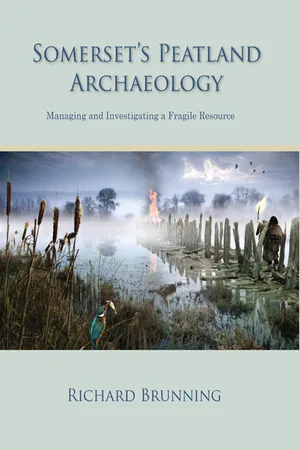
Somerset's Peatland Archaeology
Managing and Investigating a Fragile Resource
- 352 pages
- English
- ePUB (mobile friendly)
- Available on iOS & Android
eBook - ePub
About this book
Information
Subtopic
British HistoryIndex
Social Sciences1. Introduction to the Project
The Somerset Levels and Moors
The Somerset Levels and Moors are part of a series of coastal floodplains that fringe both sides of the Severn Estuary. These areas have similar Holocene environmental histories and contain a wealth of waterlogged archaeological landscapes and discrete monuments. This project forms a small part of the ongoing archaeological research into the area, which is coordinated by the Severn Estuary and Levels Research Committee (www.selrc.org.uk).
The Somerset Levels and Moors consist of extensive floodplain deposits in central Somerset in the valleys of the present rivers Axe, Brue, Parrett and Tone (Figure 1). In total they cover an area of 160,000 acres (650km2) and can be broadly divided into the coastal clay belt or ‘Levels’ and the inland, peat dominated, ‘moors’ (Figure 1). The extent of the lowland peat deposits has been mapped by the peat survey of Cope and Colborne (1981), which identified 202km2 of peat deposits 1–8.5m deep, covered in places by surface alluvium of varying thickness. This underestimates the extent of the peatlands because the survey did not cover the floodplain upstream of Langport or the middle Brue valley.

Figure 1. Somerset, with the Levels and Moors in blue.

Figure 2. Southlake moor in winter flood.
A circle of high ground surrounds these floodplains, with the Mendip Hills to the north, the Quantock Hills to the west and the Blackdown Hills to the south. This large catchment area produces extensive flooding of the lowland every winter (Figure 2). A long finger of hard geology, the Polden Hills, effectively divides the area into a northern and southern zone.
Scattered throughout the valleys are over a hundred ‘islands’ of hard geology that rise above the floodplain deposits and have been the foci for human activity throughout the Holocene period, right up to the present day. Some of the islands, such as the Isle of Wedmore, are several kilometres across and rise up over 100 metres. The smallest islands are just tens of metres across and are almost completely masked by Holocene clay or peat.
The Holocene palaeoenvironmental background
Considerable evidence for Holocene palaeoenvironmental change has been obtained from the Somerset Levels and Moors, especially from the central Brue valley, where over 60 years of research has been carried out. The Holocene sequence in the area has a broad tripartite lithostratigraphic division, corresponding to similar evidence from southern Britain and north-west Europe. The division distinguishes early Holocene silt dominated sequences, formed in mudflats and saltmarshes, from mid-Holocene intercalated silts and peats (formed in high inter-tidal to supra-tidal marshes) and then a return to silt dominance in the late Holocene (Allen 2006). In the Somerset area this division has been formalised into the Lower, Middle and Upper Somerset Levels Formation (Haslett et al. 2001) corresponding to the Wentlooge Formation on the Welsh coast. This broad tripartite division masks a more complicated sequence as shown by the existence of intercalated peat deposits in the earlier Holocene sequence (e.g. Kidson and Heyworth 1976; Hill et al. 2006 and Wilkinson 2007).
Climatic amelioration at the end of the Devensian glaciation appears to have occurred rapidly with temperatures broadly comparable to those of today being reached within a few hundred years between c. 7850 and c. 7550 cal BC (Atkinson et al. 1987 and Cope and Lemdahl 1995). The retreat of the glaciers led to eustatic global sea level rise from around -55m OD at the beginning of the Holocene to present day levels by c. 4900 cal BC (Tooley and Shennan 1987). This led to the submergence of the present Severn Estuary, the Somerset Levels and Moors, and the North Somerset and Avon Levels by c. 4500 BC (Figures 3 and 4).

Figure 3. The Somerset coast between c. 7,000 BC and c. 5,000 BC, representing the maximum extent of the Holocene transgression.
Thin peat layers are known from deep cores along the Somerset coastline and the M5 route (Kidson and Heyworth 1976; Long et al. 2001). These represent possible fluctuations in sea level rise giving rise to the formation of upper saltmarsh or supra-tidal marsh conditions. They exist between -21.3m OD up to c. -2m OD just below the beginning of the peat dominated Middle Somerset Levels Formation. Their existence suggests that the difference between the Lower and Middle Somerset Formations are not as strong as has previously been suggested.
Scientific dates for the Lower Somerset Levels (Severn) Formation, dated to before c. 5000 cal BC, have been very limited and focus on work in the inter-tidal area at Minehead (Jones et al. 2005) Woolaston (Brown et al. 2006) Burnham-on-Sea (Druce 1998) and Porlock (Jennings et al. 1998). The dates available before 1998 were used as sea level index points to suggest Mean Sea Levels, with a MSL of -25 to -26m OD at c. 7500 cal BC (Jennings et al. 1998). By c. 5900 to 6200 cal BC MSL had risen rapidly to between c. -12.5m to -14m OD and by c. 5000 cal BC MSL was c. -8m OD (Jennings et al. 1998, tab. 1, 166).
The implications of this rapid sea level rise on the changing coastline have been modelled in detail for the central Axe valley (Haslett et al. 2001) where the marine sediments of the Lower Somerset Levels Formation were studied in detail. Between c. 8000 and 5000 cal BC the sea level rise was c. 5–6mm yr-1 (Haslett et al. 2001, or 7.5mm according to Long et al. 2001). During this time the estuarine surface, which penetrated far inland of the modern coastline, would have been dominated by mudflats/low marsh environments (Figure 3). Midto high marsh would only occupy a narrow, relatively steeply inclined, fringe along the coastline (Haslett et al. 2001).
From c. 5000 cal BC the rate of sea level rise began to decrease from the previous very rapid rate of c. 5–6mm yr-1 to c. 2mm yr-1 between c. 5000 and 3000 cal BC (Haslett et al. 2001). This had major effects on the development of the coastline as organic sedimentation began to outpace sea level rise (Figure 4). This allowed the development of the Middle Somerset Levels Formation and Middle Wentlooge peat-dominated environments to develop. The deceleration in sea level rise would also have allowed the mid-marsh environments to expand and dominate a larger part of the estuary (Haslett et al. 2001). Eventually the higher marsh environments would squeeze out the middle marsh and would dominate the estuarine environment with small tidal creeks and a reduction in tidal flooding frequency (Haslett et al. 2001).
The timing of the change from silt to peat environments and the character of the peat environments varied from place to place. In general the peat deposits are thicker inland while towards the coast they become increasingly intercalated with silt layers, as at Minehead, Stolford, Burnham-on-Sea, Huntspill and East Brent.
Three periods of peat deposition were identified on the present foreshore at Minehead, forming between c. 5400 and 4500 cal BC (Jones et al. 2005). Very little dating and analysis has been carried out in the Parrett and Tone valleys. Around the mouth of the Parrett between Stolford and the Poldens Kidson and Heyworth (1976) recorded the Middle Somerset Levels Formation as intercalated peat and clay along the coast and as a thick peat layer further inland, deposition beginning around 4000 cal BC. The Middle Somerset Levels Formation exists as a thick peat layer in the central Parrett valley and has been briefly characterised by Alderton (1983) and has been dated on its base at Sutton Hams to c. 3900 cal BC (Coles and Dobson 1989). Further inland near Langport, recent evidence has dated the base of the Formation to 4840–4520 cal BC (Wilkinson 2006). This limited evidence suggests that the organic deposits of the Formation developed seawards over a period of several hundred years in the 5th millennium cal BC.
Much more information exists for the Brue and Axe valleys. Intercalated peat and silt deposits are known from Burnham-on-Sea (Druce 1999), the Huntspill River (Brunning and Farr Cox 2006), Walpole (Hollinrake and Hollinrake 2001) and East Brent (Haslett et al. 2001a). The M5 boreholes also show similar deposits (Long et al. 2001) although the accuracy of the interpretation may be open to question and they are undated. The intercalated peat deposits have been dated between 5440 and 3370 cal BC at Burnham-on-Sea (Druce 1999), between c. 4780 and 1320 cal BC at Walpole (Hollinrake and Hollinrake 2001). Godwin (1960) recorded intercalated peat and silt on the River Huntspill between Puriton Bridge and Withy Bridge. At Withy Bridge two peat layers (not noted by Godwin) formed in short lived higher saltmarsh conditions in the later Bronze Age and early Iron Age sandwiched between clays created in lower saltmarsh ecosystems (Vickery 1999).
A transect between Brean and Wedmore (Haslett et al. 2001a) showed the main peat deposit dividing into intercalated peat and clays at Brean and to the south in the area north of Brent Knoll. The beginning of the peat formation is dated to 4200–3200 cal BC and its surviving end to between c. 2000 and 1500 cal BC (Haslett et al. 2001a).
In the Axe valley the beginning of the main peat layer has been dated to between 4905 and 4540 cal BC, continuing until sometime between 1775 and 1425 cal BC (Haslett et al. 2001). In the central Brue valley peat formation began between 4500 and 4000 cal BC (Coles and Dobson 1989) with an earlier thin peat in places forming possibly as early as c. 4700 cal BC (Wilkinson 1999).
Most of the analysis of the main peat sequence has taken place in the central Brue valley, with only limited work elsewhere. The earliest peat layers were formed in Phragmites reedswamps. These gradually gave way to fen woodland, which was in turn replaced by raised bog peats in the middle Brue valley. At the eastern end of the valley around Glastonbury more diverse fen habitats persisted because of the influence of the River Brue as it flowed northwards into the Axe valley. A more detailed examination of the environmental sequence of the central Brue valley is presented in Chapter 7.
In the 2nd millennium cal BC there is a significant shift from the Middle to the Upper Somerset Levels Formation and their equivalents over a large part of ...
Table of contents
- Cover
- Title Page
- Copyright
- Contents
- List of Figures
- List of Tables
- Acknowledgements
- Summary
- Résumé
- Zusammenfassung
- Chapter 1: Introduction to the Project
- Chapter 2: Methodology
- Chapter 3: Trackways
- Chapter 4: Platforms and Pile Alignments
- Chapter 5: Lake Villages
- Chapter 6: Medieval Causeway
- Chapter 7: Preservervation and Environmental Change
- Chapter 8: Research and Management Strategies
- Appendix 1: Key for habitat groups and scale of abundance for plant macrofossil analysis tables
- Appendix 2: Abbreviations for ecological codes and statistics used for interpretation of insect remains in text and tables
- Appendix 3: MARISP pollen assessment plates
- Appendix 4: MARISP plant macrofossil assessment figures
- Appendix 5: Troels-Smith stratigraphic descriptions
- Bibliography
- Index
Trusted by 375,005 students
Access to over 1.5 million titles for a fair monthly price.
Study more efficiently using our study tools.
Frequently asked questions
Yes, you can cancel anytime from the Subscription tab in your account settings on the Perlego website. Your subscription will stay active until the end of your current billing period. Learn how to cancel your subscription
No, books cannot be downloaded as external files, such as PDFs, for use outside of Perlego. However, you can download books within the Perlego app for offline reading on mobile or tablet. Learn how to download books offline
Perlego offers two plans: Essential and Complete
- Essential is ideal for learners and professionals who enjoy exploring a wide range of subjects. Access the Essential Library with 800,000+ trusted titles and best-sellers across business, personal growth, and the humanities. Includes unlimited reading time and Standard Read Aloud voice.
- Complete: Perfect for advanced learners and researchers needing full, unrestricted access. Unlock 1.5M+ books across hundreds of subjects, including academic and specialized titles. The Complete Plan also includes advanced features like Premium Read Aloud and Research Assistant.
We are an online textbook subscription service, where you can get access to an entire online library for less than the price of a single book per month. With over 1.5 million books across 990+ topics, we’ve got you covered! Learn about our mission
Look out for the read-aloud symbol on your next book to see if you can listen to it. The read-aloud tool reads text aloud for you, highlighting the text as it is being read. You can pause it, speed it up and slow it down. Learn more about Read Aloud
Yes! You can use the Perlego app on both iOS and Android devices to read anytime, anywhere — even offline. Perfect for commutes or when you’re on the go.
Please note we cannot support devices running on iOS 13 and Android 7 or earlier. Learn more about using the app
Please note we cannot support devices running on iOS 13 and Android 7 or earlier. Learn more about using the app
Yes, you can access Somerset's Peatland Archaeology by Richard Brunning in PDF and/or ePUB format, as well as other popular books in Social Sciences & British History. We have over 1.5 million books available in our catalogue for you to explore.