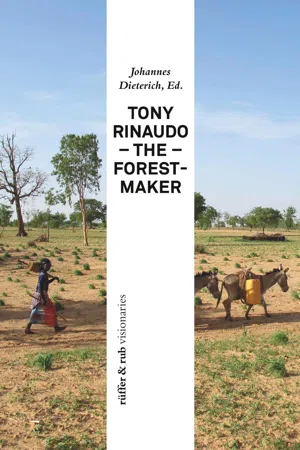
The Australian agronomist Tony Rinaudo revolutionized reforestation in Africa with Farmer Managed Natural Regeneration (FMNR). His method is based on deploying tree stumps and roots that still grow even in degraded landscapes: thanks to the protection and care of the shoots, the original tree population can be regenerated without major financial costs. The method is now successfully applied in at least 24 African countries. Where the desert was still expanding 20 years ago, farmers reforest large areas with FMNR: in Niger alone seven million hectares of land were already restored in this way.Up to 700 million people will possibly be obliged to leave their homelands during the next three decades because of increasing desertification in the landscapes where they live. In the opinion of scientists, there is only one hope: to convince the local farmers of 'sustainable land management'. Tony Rinaudo believes that with FMNR he has found the appropriate method for such management - and just in time to stop, or even to be able to reverse the destruction of livelihoods.
- 152 pages
- English
- ePUB (mobile friendly)
- Available on iOS & Android
eBook - ePub
About this book
Information
FMNR is Now a Widely Scaled-
Up Agricultural Practice in
the Drylands: A Robust Legacy
of Tony Rinaudo’s Career
Dennis Garrity
Introduction
Tony Rinaudo had an epiphany in Niger in the mid-1980s about the power of Farmer Managed Natural Regeneration (FMNR) to be a transformative practice for the African drylands. His journey to build on that epiphany, as described in the previous chapters of this book, was a powerful awakening. But it was not the most significant aspect of his journey — and of the impact of his work. What was most significant was his sheer determination and lifelong dedication to sharing the implications of that experience — initially in the pilot villages in Maradi, Niger, and then far and wide in Africa and around the world. This is what has made that ‘discovery’ so globally important today. Tony has made it his life’s work to inspire thousands of farmers, and hundreds of fellow professionals, about the potential of this transformative practice; such that today, FMNR is generally recognized as a foundational practice for a more productive and sustainable dryland agriculture in countries throughout Africa, Asia and the tropics worldwide. It was that perseverance which made all the difference.
FMNR is a practice that directly confronts the conventional paradigm of agriculture: that crops ought to be produced in clean, treeless fields. But such a new paradigm must be based on a very sound validation — by farmers’ experience and by science. That validated knowledge base has been accumulating in the decades following the epiphany in Niger. The evidence base is growing rapidly. There is now solid documentation of the millions of families that are successfully practising Farmer Managed Natural Regeneration on their farms, and in their community forest and grazing lands. And there is also a growing body of research literature that has validated farmer observations about the multi-dimensional benefits of this practice. This chapter delves further into both topics: what does science tell us about why the practice has such widespread potential, and what does the record of accelerating FMNR uptake in other countries tell us about its extremely wide-scale potential for future adoption?
The Context
Interest in the development of the African drylands has increased in recent years. This has been driven mainly by the recognition that these areas were the target of considerable humanitarian aid over the last three decades. Currently, they are the cause of great concern about rising insecurity and conflict. But comparatively little effort has been put into their development to increase people’s resilience and address insecurity and dependency on aid. The reawakened interest has translated into support for livestock and crop-based development pathways, and efforts to foster resilient livelihoods revolving around agricultural commodities. Such efforts, however, will be of limited impact without attention to a broader systems approach, which builds on the synergies that trees provide in these systems, and is based on a crop–tree–livestock perspective.
Dryland peoples and their communities have acquired, through the millennia, considerable resilience to overcome the challenges that they face. This enables them to recover following droughts, and other nature-induced shocks like floods and fires. However, the recent very high rate of human population growth in the drylands, along with the increasing frequency and intensity of droughts, are seriously undermining the resilience of both the land and the people.
In the agricultural domain, production of the most important dryland crops is already typically associated with dispersed trees in the farm fields. This form of land use is referred to as agroforestry parklands in the Sahelian context (Boffa 1999). Variants of the parkland system are also common in the Eastern and Southern Africa drylands (Dewees 1995).
Often, trees in these systems directly provide an important product such as wood, gum, oil or fruit. In addition, they provide an input into the production of other major products, such as foliage used as fodder for meat and milk production, tree nectar for honey and tree leaves as bio-fertilizers for improved soil health and crop production. A considerable number of well-recognized tree species and products are associated with the African drylands. These include the baobab tree (Adansonia digitata), which provides nutritious fruits and leaves; the shea tree (Vitellaria paradoxa) that provides oil used in cooking and in chocolate as well as cosmetics; gum arabic (Acacia senegalensis) that provides a gum that is used in many beverages and food items; and the acacia tree Faidherbia albida, which enriches soils and provides valuable pods and foliage for fodder. The environmental services derived from trees on farmlands provide another significant stream of benefits, such as soil and water conservation, and a more favourable microclimate for crops to withstand wind, heat and drought stress.
Tree-based systems provide regenerative or restorative effects that are realized at a landscape scale. They cover a wide range of practices that enrich the quality of the land resource and they provide additional environmental benefits such as watershed protection and enhanced biodiversity. The natural regeneration of trees may be applied across the entire range of land use types, including farmlands, forests, woodlands and rangelands. Restoration at scale has been achieved through the efforts of millions of rural residents across many countries. Examples include the evergreening of the farmlands in Niger, Mali, Senegal and Malawi as well as the large-scale watershed rehabilitation efforts in Ethiopia.
Opportunities to reduce vulnerability and increase resilience
It is important to distinguish between systems that are based on tree regeneration practices and those that are based on the purposeful planting and/or management of certain trees. The natural regeneration of trees leads to the emergence and use of a diversity of indigenous species that generate a range of products and services. In the drier areas of sub-Saharan Africa, natural regeneration accounts for an overwhelming majority of the trees that are being managed by farmers (greater than 90%).
These regenerative practices include Farmer Managed Natural Regeneration of trees (FMNR) in croplands and Assisted Natural Regeneration (ANR) through enclosures that rehabilitate rangelands or woodlands. They are based on the local selection and management of a diverse range of tree species that are well adapted to the local conditions and they entail very low establishment costs. They are currently being expanded on large areas throughout the arid and semi-arid drylands, and they are now seen as foundational systems for application throughout these agro-ecosystems. It is important to emphasize that the regeneration of trees on farms may occur throughout the farm, including in crop fields as well as on field boundaries. The result is a mosaic of trees that are integrated into land uses such as cropping, pastures and fallows.
The purposeful planting and management of certain types of tree species that can produce economically valuable products and services is also important. Tree planting is particularly widespread in the more sub-humid and humid zones, where rainfall is greater and tree survival is more successful. In these zones the risk of poor seedling survival, or of losing more mature trees due to drought, is less pronounced and the productivity of individual planted trees is also higher — thus, compensating for the greater costs of establishing them by planting from nursery-raised seedlings.
Farmer Managed Natural Regeneration and Assisted Natural Regeneration
Farmer Managed Natural Regeneration (FMNR) on agricultural lands and Assisted Natural Regeneration (ANR) on community lands provide the most cost-effective way of achieving a widespread increase in numbers of valuable, adapted and diverse trees. These practices have in common that people (individual farmers or entire communities) actively influence the natural biological regeneration processes in order to achieve tree patterns that better suit their needs. On agricultural lands, farmers identify naturally regenerating tree seedlings or sprouted rootstocks in their fields. They protect and manage them to provide various benefits (for direct products or to enhance crop or livestock production). On community lands, local groups may adopt the same practices and they may also introduce grazing management systems at the community level that are designed to allow successful tree regeneration in the targeted areas. Under both systems protecting the young trees, weeding around them and pruning them as they grow may be necessary to help them survive and flourish.
In recent years, FMNR has gained in popularity in many dryland areas in western, eastern and southern Africa. Because it requires very little or no cash investment, FMNR can expand rapidly through farmer-to-farmer and village-to-village diffusion. The case of Niger, which Tony Rinaudo initially spearheaded, provides the most dramatic example of how quickly and how extensively the practice can spread (Reij et al. 2009). But Niger is just the tip of the iceberg. A recent study carried out in Niger, Mali, Burkina Faso and Senegal has found that almost all farmers are now actively regenerating trees on their farms (Place and Binam, 2013).
Tree-based systems for natural resource management
The products and services derived from FMNR vary from location to location, depending on the tree species that are present in the area and are valued by farmers. Throughout the Sahel more than 100 different woody species are being managed by farmers through natural regeneration. These trees provide a high level of value to local people (Place and Binam, 2013). They contribute products for human consumption (more than USD 200 per household per year) and fodder for livestock during the late dry season. They also have positive effects on crop yield — accounting for roughly 15–25% increased millet and sorghum yields. Trees provide many environmental services, including carbon sequestration, watershed protection and soil health enrichment. These services can be generated either through FMNR, Assisted Natural Regeneration (ANR) or by purposeful tree planting. All trees sequester carbon at a relatively stable proportion of 0.5 of their woody biomass dry weight. Tree growth is slower in more arid environments. The annual above-ground carbon sequestration from a typical regenerated field may be around 1 tonne per hectare in the semiarid regions with an additional third of that below ground. These systems supply a large amount of nitrogen very cheaply. They also benefit soils in many other ways such as soil carbon build-up and improved soil physical structure.
A livelihood is classified as sustainable when it can cope with — and recover from — stresses and shocks. In addition, it needs to maintain or enhance family assets and capabilities, both now and in future, while not undermining the natural resource base (DFID 2000). Livelihoods in the drylands are affected by a number of natural hazards. Repetitive drought is the most prominent one. Others include floods as well as animal and human diseases that are often triggered or intensified by droughts and floods. Other factors — such as weak institutions and inappropriate policies — are human-induced hazards. These exacerbate the impacts of the natural hazards. Conflict is another shock that is increasingly common in dryland areas: witness the prolonged quarter-century of conflict in Somalia, the widespread insecurity in the northern regions of Mali and Niger, in north-eastern Nigeria and throughout the Central African Republic. Drylands are also prone to economic risks that are felt primarily in terms of shortages of food and fodder as well as price spikes for food and inputs during periods of stress.
Vulnerability is often the result of extreme poverty especially where poor people have limited options to sustain their livelihoods. It is also due to exposure to hazards that affect the primary livelihoods of the poor. A typical example from the drylands is when a long-term drought pushes up food prices, worsening the condition of pastoralists’ or agropastoralists’ livestock and even causing the death of the animals. Rural people may find themselves in a position where it is difficult to sell excess stock to buy food and guard against future hunger in this situation. Or they find that livestock prices have collapsed because many people are disposing of their herds simultaneously. Then they find themselves locked into a massively deteriorating livelihood crisis.
Resilience is a desirable condition, often regarded as the converse of vulnerability, where people have the means to protect themselves from such hazards. But complete protection from exposure to drought, flood and other eco-physical factors is not possible.
Trees reduce exposure to shocks
In the drylands of Africa, there is relatively little that individual households can do to reduce their exposure to shocks, short of moving away from the affected area. If a household is located in a place that is affected by a weather or price shock, it will be exposed. However, many households acting together through collective action can achieve landscape-level effects that do in fact reduce exposure. An example of this is the reduced incidence of weather-induced dust storms in south-central Niger that has occurred due to the widespread regeneration of agricultural landscapes with FMNR. The dust storm frequency and intensity has declined markedly after the communities created a contiguous tree cover over an immense area through FMNR. Farmers also testify that in the absence of tree populations on their fields they were often forced to replant their crops multiple times as high winds bury or kill the emerging crop seedlings. But with regenerated tree populations the wind speeds in the fields are dramatically reduced and planting more than once is no longer necessary.
At the macro level, recent modelling studies have demonstrated that tree-covered landscapes, which have higher evapotranspiration rates, have a tendency to increase rainfall in the landscapes downwind from them (Ent et al., 2010), thus reducing their exposure to drought.
Trees reduce sensitivity to shocks | Trees can play an important role in reducing household sensitivity to shocks. Although trees are not impervious to climate change, their deep rooting systems, which access deeper sources of water, make them less vulnerable to seasonal rainfall reductions. This robustness enables trees to play a particularly important role in reducing sensitivity to at least three important types of shocks: weather-related, climate-related and health-related shocks (Place et al., 2016).
Reduced sensitivity to weather-related shocks | The dominant weather-related shocks are droughts which are unusually severe, frequent or prolonged. Trees in crop fields directly and significantly ameliorate the severity of drought effects on annual crop performance by creating a more favourable microclimate. Crops in the vicinity of trees experience a higher level of humidity in the crop canopy, reducing plant desiccation. Trees also slightly shade the crops, reducing solar over-radiation stress. They also dramatically increase the infiltration and storage of rainfall in the soil by reducing surface run-off (Ilstedt et al., 2016). The additional foliage that trees provide increases the soil organic matter which enhances both soil moisture storage capacity and nutrient availability to the crops. Moreover, there are circumstances in which some trees effectively transfer water from lower depths, bringing it up close to the soil surface through their root systems and making such water available to nearby crops (‘hydraulic lift’ — Bayala et al., 2014). Together, these phenomena reduce the rate of onset of crop water stress, enabling crops to more successfully withstand periods of drought during the growing season.
Reduced sensitivity to climate-related shocks | Global temperatures are increasing as a result of climate change. Average temperatures in the Sahel have increased by about one degree Celsius during the past 40 years (UNEP 2011). Periods of extreme day-time temperatures are also more frequent and severe. Most annual crops experience a reduction in their yield potential as a result of higher temperatures due to two processes: they...
Table of contents
- Notes
- Table of Contents
- Preface: Anne Rüffer
- Prologue: Johannes Dieterich
- Tony’s Travails: Johannes Dieterich
- Discovering the Underground Forest: Tony Rinaudo
- FMNR is Now a Widely Scaled-Up Agricultural Practice in the Drylands: A Robust Legacy of Tony Rinaudo’s Career: Dennis Garrity
- “Trust Would Be a Good Starting Point”: Interview with Günter Nooke
- Postscript: Tony Rinaudo
- Appendix
- About the Authors
- Copyright
Trusted by 375,005 students
Access to over 1.5 million titles for a fair monthly price.
Study more efficiently using our study tools.
Frequently asked questions
Yes, you can cancel anytime from the Subscription tab in your account settings on the Perlego website. Your subscription will stay active until the end of your current billing period. Learn how to cancel your subscription
No, books cannot be downloaded as external files, such as PDFs, for use outside of Perlego. However, you can download books within the Perlego app for offline reading on mobile or tablet. Learn how to download books offline
We are an online textbook subscription service, where you can get access to an entire online library for less than the price of a single book per month. With over 1.5 million books across 990+ topics, we’ve got you covered! Learn about our mission
Look out for the read-aloud symbol on your next book to see if you can listen to it. The read-aloud tool reads text aloud for you, highlighting the text as it is being read. You can pause it, speed it up and slow it down. Learn more about Read Aloud
Yes! You can use the Perlego app on both iOS and Android devices to read anytime, anywhere — even offline. Perfect for commutes or when you’re on the go.
Please note we cannot support devices running on iOS 13 and Android 7 or earlier. Learn more about using the app
Please note we cannot support devices running on iOS 13 and Android 7 or earlier. Learn more about using the app
Yes, you can access Tony Rinaudo by Johannes Dieterich in PDF and/or ePUB format, as well as other popular books in Technology & Engineering & Science & Technology Biographies. We have over 1.5 million books available in our catalogue for you to explore.