If you want a closer look into what happened with Miles Davis' music in the 1980's, this is the book for you.10 years ago I planned an updated Danish version of my dissertation "That's Right" from 1991. The project stranded because of financial shortcomings. Things have changed, and this book is a result of that.The dissertation looks at the music Miles Davis recorded in the 1980's. The historic context is described. Miles Davis as an improviser is described and analysed. Focus is on "Blues", "Spanish modes", "Pop" and "Modern composition". The esthetic guidelines he used are stated.When you go to page one you are back in time in the year of 1991. A few more recent comments and explanations have been included.

- 236 pages
- English
- ePUB (mobile friendly)
- Available on iOS & Android
eBook - ePub
That's Right
About this book
Information
The analysis
Each analysis provides an overview of the recording, showing the most considerable events. Theme presentations are indicated in the overview by theme, meaning that theme A is the theme relating to form part A. The analysis starts by examining the basis for the improvisation. Included is the applied rhythm, illustrated by the ground rhythm used in drums and percussion and any related ostinatos. The form arrangements applied in the recording are illustrated by the overall sections, including e.g. the intro, theme presentations, solos and coda. The form parts relating to the themes of the recordings are analysed, and the improvisation is analysed in terms of form. The harmonic content is illustrated by any modes, vamps and extended chord progressions. The melodies are illustrated by the themes related to the form parts. Since improvisation is often made based on the theme, it is attempted to describe the characterstic features of the theme. Then, follows the analysis of the improvisation. Only Davis’ solo playing will be discussed. However, where it engages in a dialogue, both parts are considered.
The analysis of the improvised solos applies the concept of an ‘oplæg’, defined as an idea which decisively form the development of the solo.
An oplæg may thus be very few tones played in variation, a motif, a rhythmical idea, etc. To make an analogy with an oral oplæg (oral presentation), these oplæg may be prepared and thus form part of Davis’ improvisational “vocabulary”.
During the solos, it is often seen that “one word leads to another” in continuation of an oplæg. In a number of cases, the oplæg has ties to the theme. The possible climax or relative static state of the solos is described.
Blues
The album Star People (‘83) introduces blues to the repertoire that Miles Davis chose to record after his comeback. The album includes basic blues in the title track and a blues-variant in It Gets Better. With these recordings, Davis returns to some of his roots. On the cover there is a comment on this: “The blues was always around when I was in St. Louis” … “I played it because I heard blues played by the bands that came up from Oklahoma and Missouri and Kansas.” A new light is attempted to be shed on these roots. It is particularly the exploration of the extremely slow tempi and the increasing use of keyboards that has opened up new opportunities. Star People, That’s Right and Violet are all slow blues, but in each their own way. The formal dispositions applied by the two recordings are completely different and the chord progressions are also different. That’s Right from the album Decoy (‘84) applies an open form and can in short be described as blues reduced to its essence. Violet from the album Aura (recorded in ‘85 and released in ‘89) is a “blues – and yet something much larger than blues. In the same way as blue is only a constituent of violet.”23 Despite some differences Violet also has a number of similarities with That’s Right. Tutu from the album of the same name (‘86) is another blues variant. It stands out from the others in terms of formal disposition and since its ground rhythm includes a slow, half tempo and a relatively low-key fast tempo. With Violet and Tutu, the chapters on pop and modern composition are touched upon, which shows how widely blues is applied. Violet is the last part of the Aura suite and is thus characterised by modern composition. Tutu is an album with a very consistent and distinctive sound. The actual pop hit of the album, Perfect Way, is thus not the only track with pop features. With the revival of blues, Davis found a way to a wider audience since the expression of this music struck a direct chord with a broader segment of listeners. People listening to soul, r&b, rock, gospel and country are all familiar with the blues. It has a strong appeal to many people of all kinds. Davis formulates this appeal in an ethnic context, and by doing so he emphasizes the origin of this music: “Black people in particular react to it every time. I remember one night in Dayton a while back, some woman was having a conversation with my trumpet.”24
Star People (18‘44)
Recorded in August-November 1982; however, Intro and Prelude was probably recorded separately in December 1982 or February 1983.
Composed by Miles Davis
Miles Davis: Synthesizer and trumpet with Harmon mute
Mino Cinelu: percussion
Bill Evans: tenor saxophone
Al Foster: drums
Marcus Miller: bass
Mike Stern: guitar
John Scofield: guitar
Overview of the recording:
| Intro | Trumpet solo | Guitar solo | Trumpet solo | Tenor sax solo |
| (0’35) | (6x12) | (2x12) | (2x12) | (12) |
| Trumpet solo | Interlude | Guitar solo | Trumpet solo |
| (2x12) | (0’40) | (3x12, +4) | (8) |
The numbers in parentheses indicate durations: (0’35) means 35 seconds, (6x12) means six times 12 bars.
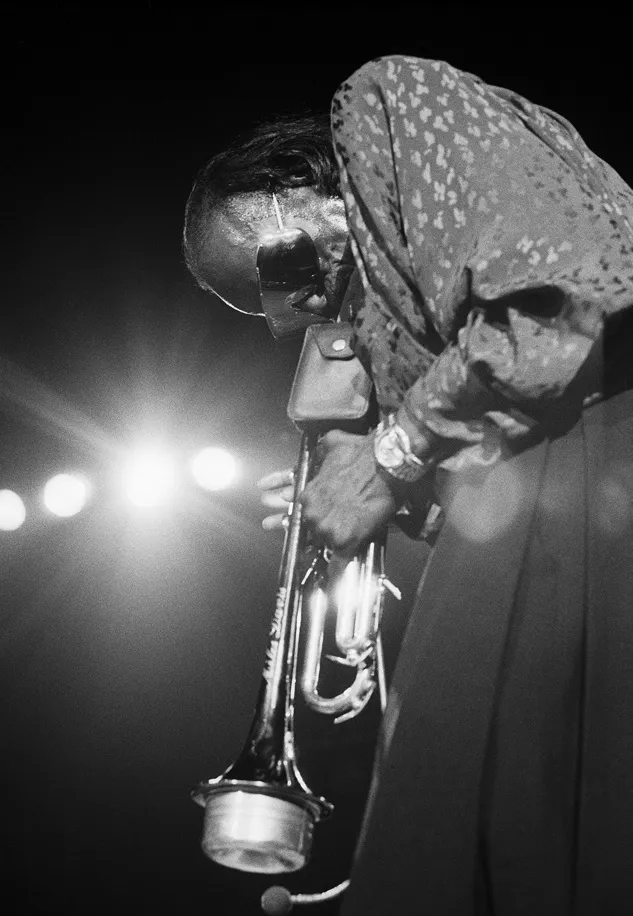
Miles Davis Falkoner Centret 1985 | G. Valentin
Rhythm
Intr...
Table of contents
- Dedication
- Table of Contents
- Preface
- Introduction
- Miles Davis in absentia
- Delimitation of material
- The analysis
- Perspectivisation
- Bibliography
- Discography
- Being a resonant Being
- A special thanks to …
- Appendix
- Copyright
Trusted by 375,005 students
Access to over 1.5 million titles for a fair monthly price.
Study more efficiently using our study tools.
Frequently asked questions
Yes, you can cancel anytime from the Subscription tab in your account settings on the Perlego website. Your subscription will stay active until the end of your current billing period. Learn how to cancel your subscription
No, books cannot be downloaded as external files, such as PDFs, for use outside of Perlego. However, you can download books within the Perlego app for offline reading on mobile or tablet. Learn how to download books offline
Perlego offers two plans: Essential and Complete
- Essential is ideal for learners and professionals who enjoy exploring a wide range of subjects. Access the Essential Library with 800,000+ trusted titles and best-sellers across business, personal growth, and the humanities. Includes unlimited reading time and Standard Read Aloud voice.
- Complete: Perfect for advanced learners and researchers needing full, unrestricted access. Unlock 1.5M+ books across hundreds of subjects, including academic and specialized titles. The Complete Plan also includes advanced features like Premium Read Aloud and Research Assistant.
We are an online textbook subscription service, where you can get access to an entire online library for less than the price of a single book per month. With over 1.5 million books across 990+ topics, we’ve got you covered! Learn about our mission
Look out for the read-aloud symbol on your next book to see if you can listen to it. The read-aloud tool reads text aloud for you, highlighting the text as it is being read. You can pause it, speed it up and slow it down. Learn more about Read Aloud
Yes! You can use the Perlego app on both iOS and Android devices to read anytime, anywhere — even offline. Perfect for commutes or when you’re on the go.
Please note we cannot support devices running on iOS 13 and Android 7 or earlier. Learn more about using the app
Please note we cannot support devices running on iOS 13 and Android 7 or earlier. Learn more about using the app
Yes, you can access That's Right by Torben Kragsbjerg in PDF and/or ePUB format, as well as other popular books in Media & Performing Arts & Music. We have over 1.5 million books available in our catalogue for you to explore.