Particularly in the aftermath of the 9/11 terrorist attack, the threat of terrorism, however, defined, has been invoked as a common 'justification' in the pursuit of remodelling policies, laws, and institutions, both at the international and in the domestic politico-legal showground. The broader central theme that this book explores is the normative vibe under which the present-day counterterrorism discourse is construed and sculpted in the legislative and institutional structures of an authoritarian state where the political power and government institutions are functioning under a single-party-monopolised system. Presenting the Ethiopian legislative and institutional frameworks as a case study, the book critically reflects on the extent that the international legal and/or institutional counterterrorism response is sensitised in a manner lessening the risk of conflating authoritarian regime's unbearable reactions to citizens' legitimate demands and resistances against its repression vis-àvis that of its response to the common threat of international terrorism. In particular, the book ponders whether or not the range of the substantive and procedural aspects of the Ethiopian antiterrorism legislative and institutional frameworks are wrought to fit into the main objectives and standards that emanate from the pertinent international laws relating to terrorism and the international human rights law as well as the domestic constitutional law maxims.
eBook - PDF
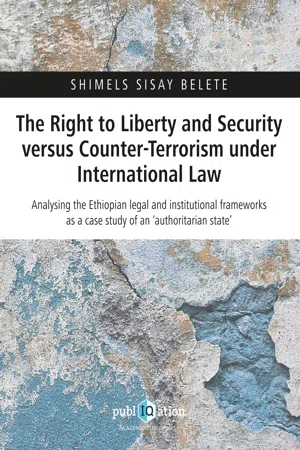
The Right to Liberty and Security versus Counter-Terrorism under International Law
Analysing the Ethiopian legal and institutional frameworks as a case study of an 'authoritarian state'
- 505 pages
- English
- PDF
- Available on iOS & Android
eBook - PDF
The Right to Liberty and Security versus Counter-Terrorism under International Law
Analysing the Ethiopian legal and institutional frameworks as a case study of an 'authoritarian state'
About this book
Information
Table of contents
- Title
- Copyright
- Preface
- Acknowledgements
- Acronyms and Abbreviations
- Contents
- Introduction
- Chapter 1. Briefing the Post-1991 Ethiopian Politico-Legal Lineaments: Impetuses in Moulding the Extant Version of the Domestic ‘Terrorism’ Cliché
- Chapter 2. The Quest for Human Rights Standardization in International Law Relating to Terrorism: Rethinking the ‘No Need of Compatibility’ Cliché in State’s Counterterrorism Obligations
- Chapter 3. The Terrorism Discourse and Anchoring Its Definitional Lacuna in International Law: A Step in Appraising Ethiopia’s ‘Self-Guided’ National Approach
- Chapter 4. A Crime of ‘Terrorist Act’ under the Ethiopian Anti-Terrorism Law: A Critical Appraisal of its Definitional Scope in Light of the International Terrorism Law’s Lensing Purview
- Chapter 5. Proscribing Groups as Terrorist Organizations: Whose Mandate Is It for That Matter? Assessing Ethiopia’s ‘Judiciary-Exclusion’ Approach
- Chapter 6. Countering Terrorism and the Pursuit of the Right to Liberty and Security of Person: International Human Rights Law as a Standard Legal Framework
- Chapter 7. Parsing the Content and Scope of the Right to Liberty and Security in the Context of Countering Terrorism Milieus
- Chapter 8. Procedural Guarantees against Arbitrary Deprivation of Liberty in the Enforcement of the Criminal Justice System: Assessing the Normative Standards in the Ethiopian Anti-Terrorism Proclamation
- Conclusion
- Bibliography
Trusted by 375,005 students
Access to over 1.5 million titles for a fair monthly price.
Study more efficiently using our study tools.
Frequently asked questions
Yes, you can cancel anytime from the Subscription tab in your account settings on the Perlego website. Your subscription will stay active until the end of your current billing period. Learn how to cancel your subscription
No, books cannot be downloaded as external files, such as PDFs, for use outside of Perlego. However, you can download books within the Perlego app for offline reading on mobile or tablet. Learn how to download books offline
Perlego offers two plans: Essential and Complete
- Essential is ideal for learners and professionals who enjoy exploring a wide range of subjects. Access the Essential Library with 800,000+ trusted titles and best-sellers across business, personal growth, and the humanities. Includes unlimited reading time and Standard Read Aloud voice.
- Complete: Perfect for advanced learners and researchers needing full, unrestricted access. Unlock 1.5M+ books across hundreds of subjects, including academic and specialized titles. The Complete Plan also includes advanced features like Premium Read Aloud and Research Assistant.
We are an online textbook subscription service, where you can get access to an entire online library for less than the price of a single book per month. With over 1.5 million books across 990+ topics, we’ve got you covered! Learn about our mission
Look out for the read-aloud symbol on your next book to see if you can listen to it. The read-aloud tool reads text aloud for you, highlighting the text as it is being read. You can pause it, speed it up and slow it down. Learn more about Read Aloud
Yes! You can use the Perlego app on both iOS and Android devices to read anytime, anywhere — even offline. Perfect for commutes or when you’re on the go.
Please note we cannot support devices running on iOS 13 and Android 7 or earlier. Learn more about using the app
Please note we cannot support devices running on iOS 13 and Android 7 or earlier. Learn more about using the app
Yes, you can access The Right to Liberty and Security versus Counter-Terrorism under International Law by Shimels Sisay Belete in PDF and/or ePUB format, as well as other popular books in Law & Criminal Law. We have over 1.5 million books available in our catalogue for you to explore.