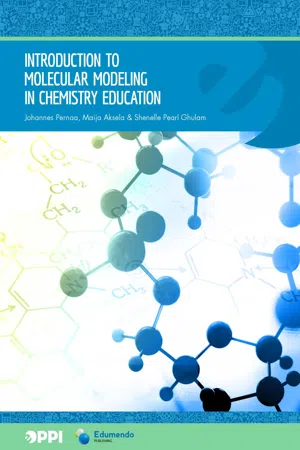
Welcome to learn molecular modeling in chemistry education.Molecular modeling is an essential tool for chemistry teachers. It can be used for anything from student-centred activities to teacher-oriented visualizations and evaluation. This book offers theoretical insights and hands-on modeling activities. The goal is to learn how to implement molecular modeling in chemistry teaching. The exercises are performed using Edumol.fi web application, which is a free JSmol-JSME-based molecular modeling and visualization service.
eBook - ePub
Introduction to Molecular Modeling in Chemistry Education
- 120 pages
- English
- ePUB (mobile friendly)
- Available on iOS & Android
eBook - ePub
Introduction to Molecular Modeling in Chemistry Education
About this book
Trusted by 375,005 students
Access to over 1.5 million titles for a fair monthly price.
Study more efficiently using our study tools.
Information
1. MOLECULAR MODELING IN CHEMISTRY INSTRUCTION
Computer-aided molecular modeling which is used in chemistry research can also be an effective educational tool at different stages from basic education to universities and teacher training (e.g. Aksela & Lahtela-Kakkonen, 2001; Pernaa, 2011; Aksela & Lundell, 2008). From a chemistry teacher’s point of view, computer-aided modeling is one of the most useful uses of information and communications technology (ICT) in chemistry teaching (Helppolainen & Aksela, 2015).
This chapter first examines molecular modeling, its possibilities and challenges in light of research knowledge. After the theoretical background, we will discuss the usage of molecular modeling in the planning and application of chemistry teaching. In order to understand the real world possibilities and challenges, we use a model called technological pedagogical content knowledge (TPCK).
THE POTENTIAL AND CHALLENGES OF MOLECULAR MODELING
Models and modeling are an essential part of chemistry and its teaching (e.g. Gilbert & Justi, 2016). In the research of chemistry, models are exploited at every stage of the process: forming hypotheses, observing the action of a phenomenon, explaining research results or formulating new predictions based on models. The models unite theoretical and experimental chemistry by visualizing connections between the three levels of chemical knowledge. (Justi & Gilbert, 2002). By using different models of chemistry – analogical models and computer graphics – an invisible phenomenon may be made visible, which then makes it easier to understand chemistry (Barnea, 2000). Molecular modeling is a so called metacognitive tool (Tversky, 2005) that helps us to communicate, to present information about chemistry and to process that information.
A chemistry model is used to describe a visualization of a specific phenomenon in chemistry. These visualizations help to represent thinking: they make it easier to remember and to process information, as well as to cooperate with others (Jones et al., 2005). A model in chemistry can be a concrete model like a scale model or a molecular model made of plastic, a verbal figure of speech used in an oral or a written description, a mathematical model like the general gas law, a visual model like a picture or a graph or a gestural model like the movement of a hand (Gilbert, Boulter & Elmer, 2000). Electronic molecular models can take the following forms: wire, tube, ball-and-stick, space-filling and dot surface.
Computer-aided molecular modeling is advanteageous in teaching because:
- it helps students understand chemistry on three different levels: macroscopic (a visible phenomenon), submicroscopic (e.g. electron density) and symbolic (e.g. a formula or a template) (Barak & Dori, 2005; Frailich, Kesner, & Hofstein, 2008)
- it helps to understand chemistry as a modern field of science (Aksela & Lundell, 2009)
- it helps to improve skills in visualization and to understand the concept of a model and three-dimensional molecular structures (Barnea, 2000, Pernaa et al., 2009)
- it supports the elucidation and learning of many concepts in chemistry (Aksela & Lundell, 2008; Kozma & Russell, 2005; Russell & Kozma, 2005), for example chemical bonds (Barnea, 2000; Pernaa et al., 2009), isomerism (Dori & Barak, 2001), orbitals (Flemming, Hart & Savage, 2000; Pernaa et al., 2009), functional groups (Dori & Barak, 2001), electrochemistry (Yang, Greenbowe & Andre, 2004), the structure of a substance and the proceeding of a chemical reaction (Williamson & Abraham, 1995), infrared spectroscopy (Aksela & Lundell, 2008), electron density (Aksela & Lundell, 2008), chemical equilibrium and solution chemistry (Russell & Kozma, 2005) and phenomena in biochemistry (Pernaa et al., 2009).
- it supports higher-order thinking skills (Webb, 2005; Aksela & Lundell, 2008; Dori & Kaberman, 2012)
- it improves the making of questions and the skills in inquiry-based learning and modeling, and it makes it easier to shift from three-dimensional models to structural formulas (Dori & Kaberman, 2012)
- it inspires towards learning concepts of chemistry (Barnea & Dori, 1996; Webb, 2005; Aksela & Lundell, 2008)
- it supports the handling of experimentally achieved phenomena and discussions about them (Kozma, 2003; Aksela & Lundell, 2008).
With the help of molecular modeling, it is possible to practice practice spatial skills (visual-spatial ability) that are extremely important skills in the teaching and learning of natural sciences (Uttal, Meadow, Tipton, Hand, Alden & Warren, 2013).
The challenges one might encounter when using computer-aided molecular modeling are the same as for using ICT in chemistry teaching generally: teachers usually have (i) a shortage of time allocated for molecular modeling, (ii) a shortage of technological pedagogical content knowledge (TPCK) and (iii) a deficiency of suitable software or teaching materials, and (iv) teaching large groups of students may also be quite challenging. (Aksela, & Lundell, 2008; Helppolainen & Aksela, 2015; Pernaa & Aksela, 2009)
The barriers for using molecular modeling can be divided into first-order barriers, second-order barriers and third-order barriers (see figure 1.1). For example, the necessary resources can be thought of as first-order barriers (Ertmer et al., 2012). A second-order barrier is for example a teacher’s beliefs about the usefulness of the usage (Ertmer et al., 2012). Third-order barriers are design thinking skills that mean using the application at the right time in the right place in various teaching environments (Tsai & Chai, 2012). It is important to take the above-mentioned challenges into consideration in the planning and teaching of molecular models.

Figure 1.1 The barriers for using ICT.
TECHNOLOGICAL PEDAGOGICAL CONTENT KNOWLEDGE (TPCK) IN MOLECULAR MODELING
In all teaching that involves the use of ICT, including molecular modeling, a teacher needs technological pedagogical content knowledge (see figure 1.2) (Helppolainen & Aksela, 2015; Koehler, & Mishra, 2008; 2009; Chai, Koh, Tsai, & Tan, 2011; Rogers, & Twidle, 2013).

Figure 1.2 In the instruction of molecular modeling, a teacher needs technological pedagogical content knowledge (TPCK; Koehler, & Mishra, 2008; 2009), which consists of pedagogical content knowledge (PCK), technological content knowledge (TCK) and technological pedagogical knowledge (TPK).
TPCK describes how we can use technology in teaching, for example as a support in creating information subject-specifically (Chai, Koh & Tsai, 2013). TPCK consists of pedagogical content knowledge (PCK), technological pedagogical knowledge (TPK) and technological content knowledge (TCK). Content knowledge (CK) and technological content knowledge (TCK) have especially been observed as being significant in the development of TPCK (Chai et al., 2011). It has been observed that chemistry teachers have flaws in both TCK and TPK (Helppolainen & Aksela, 2015).
In the introduction of molecular modeling, it is important for a teacher to get acquainted with the following themes:
- information concerning the studied phenomenon (CK, the contents of chemistry)
- pedagogical information concerning the teaching of a phenomenon (PK, processes dealing with the teaching and learning of chemistry)
- technological information about molecular modeling (TK, how to use a device or a program; further information is provided in the chapters of this book). From the perspective of learning chemistry and developing the needed skills, it is crucial that a teacher uses his/her pedagogical content knowledge (PCK) in the instruction of molecular modeling.
Molecular modeling additionally contains the following areas:
- students’ prior knowledge of a chemistry phenomenon studied in class
- students’ attitudes and skills in using computers for learning
- information about the curriculum (aims, instruction and evaluation
- information about suitable methods for teaching and evaluation.
Technological pedagogical knowledge (TPK) refers to the various ways in which molecular modeling programs can be used to support classroom learning. In everyday practice, the teacher must adapt his or her teaching strategy to make use of the technological means that are available. For example, not every classroom has a large quantity of devices. If only one device is available (e.g. a smartphone or a computer), the teacher can use a projector to display the program for everyone and the content can be discussed together. This method works well both in student-centered and in teacher-centered approach.
If there are only a few devices available, the students can work in smaller groups. Additionally, setting up different workstations within the classroom can be a handy way to utilize molecular modeling: students can go from station to station in small groups and work on various tasks covering different phenomena. On the other hand, if every student has their own device, they can work independently at school or at home. Students can also be given molecular modeling exercises as homework.
In order to give a meaningful introduction to molecular modeling, the teacher must be acquainted with modeling programs, have technical knowledge of their performance, and be able to utilize these programs in the classroom. In this way the teacher can truly advance students’ understanding of various phenomena in chemistry (TCK). The more teachers practice their technical know-how in using molecular modelling programs, the easier it gets. With the help of the numerous examples and exercises in this book, practicing cannot get easier.
STREAMLINED USING OF MOLECULAR MODELING
When teaching molecular modeling, it is important to highlight its role as a way of presenting and spreading out research results in chemistry. Additionally, it is important to discuss the restrictions of the models. This is why models need to be tested individually or in groups. Students can be divided into three different levels based on how they understand the models and how they are able to use them. First-level students think that these models represent perfect copies of the reality or that they are just “toys”. Second-level students think that these models have been created for a specific purpose, but they believe these models to represent reality to some extent. Third-level students understand that these models have been created to be scientific tools. (Justi & Gilbert, 2002)
Using molecular modeling should be a part of the curriculum framework (Aksela, Lundell & Pernaa, 2008). In streamlined teaching, the aim of usage is directing the realization and evaluation of teaching. It is also important for teachers to explicitly tell students what are the learning aims of each particular lesson (see figure 1.3).

Figure 1.3 The stages of streamlined teaching of molecular modeling.
When using molecular modeling, it is important to make the student an active thinker and user. It is good to start using the program at an early stage. Even young children are able to practice their skills in visualization with the help of molecular modeling. In the learning of chemical phenomena, molecular modeling can be exploited starting from lower secondary school. It is also suitable for differentiation: for example, it might encourage students who do well in chemistry to develop a further interest towards learning chemistry. Furthermore, it may facilitate low-achieving students to understand chemical phenomena which are usually considered to be quite abstract. (Gilbert & Justi, 2016) Molecular modeling is also quite suitable for supporting the learning of chemical phenomena via inquiry-based activities. It can be used both before and after the inquiry-based activity, as it is used in researches in chemistry.
It is important to use versatile pedagogical teaching methods in order to support understanding of chemical phenomena. For example having a group discussion about the phenomenon before and after modeling is very important. Before starting modeling exercises, it is also advantageous to be aware of students’ prior knowledge of chemical phenomenona. In order to discover what a student knows about a phenomenon, it is possible to create concept maps, have discussions or do tasks prior to modeling. Working in small groups and getting peer support may help students who experience anxiety about working with computers. Using molecular models made of plastic side by side with virtual models makes it easier for some students to understand the chemical phenomenon at hand. Combined use of new and old modelling methods makes it easier for the teacher to introduce computer-aided molecular model...
Table of contents
- Foreword
- Acknowledgements
- Topics
- Table of Contents
- 1. Molecular modeling in chemistry instruction
- 2. From desktop software to web applications: The historical analysis of molecular modeling tools used in Finnish chemistry education
- 3. Edumol
- 4. Computer-based molecular models
- 5. Molecular visualizations and informal chemistry learning
- 6. Partial charges and electrostatic potential surface
- 7. Visualizing chemical bonding
- 8. Visualizing hybridization
- 9. Isomerism
- 10. Introduction to cheminformatics: Biomodels and databases
- 11. Next step: Design your own visualization exercises
- Authors
- Index
- Copyright
Frequently asked questions
Yes, you can cancel anytime from the Subscription tab in your account settings on the Perlego website. Your subscription will stay active until the end of your current billing period. Learn how to cancel your subscription
No, books cannot be downloaded as external files, such as PDFs, for use outside of Perlego. However, you can download books within the Perlego app for offline reading on mobile or tablet. Learn how to download books offline
Perlego offers two plans: Essential and Complete
- Essential is ideal for learners and professionals who enjoy exploring a wide range of subjects. Access the Essential Library with 800,000+ trusted titles and best-sellers across business, personal growth, and the humanities. Includes unlimited reading time and Standard Read Aloud voice.
- Complete: Perfect for advanced learners and researchers needing full, unrestricted access. Unlock 1.5M+ books across hundreds of subjects, including academic and specialized titles. The Complete Plan also includes advanced features like Premium Read Aloud and Research Assistant.
We are an online textbook subscription service, where you can get access to an entire online library for less than the price of a single book per month. With over 1.5 million books across 990+ topics, we’ve got you covered! Learn about our mission
Look out for the read-aloud symbol on your next book to see if you can listen to it. The read-aloud tool reads text aloud for you, highlighting the text as it is being read. You can pause it, speed it up and slow it down. Learn more about Read Aloud
Yes! You can use the Perlego app on both iOS and Android devices to read anytime, anywhere — even offline. Perfect for commutes or when you’re on the go.
Please note we cannot support devices running on iOS 13 and Android 7 or earlier. Learn more about using the app
Please note we cannot support devices running on iOS 13 and Android 7 or earlier. Learn more about using the app
Yes, you can access Introduction to Molecular Modeling in Chemistry Education by Johannes Pernaa,Maija Aksela,Shenelle Pearl Ghulam in PDF and/or ePUB format, as well as other popular books in Physical Sciences & Chemistry. We have over 1.5 million books available in our catalogue for you to explore.