This handbook, translated from the German, deals with change processes in companies and organizations. It provides information on the fundamental principles, background and methods and instruments of change management and is aimed at those responsible for change management within companies and organizations, as well as at external consultants, coaches and trainers.The book combines the focal areas of organizational development and human resources within a single holistic approach to the planning and management of change processes, offering guidance on: - The fundamental principles, leadership, dynamics and management of change processes and corporate/organizational culture- Typical errors to avoid; success factors- Specific instruments of change management, divided into structural and analogous interventions- Environment and limiting factors, organizational forms and consulting issuesThe authors are experienced change management consultants: Prof. Dr. Georg Kraus is owner of Dr. Kraus & Partner Bruchsal, one of the leading change management consultant firms in Germany and professor for leadership and interpersonal skills, Christel Becker-Kolle is a psychologist with a deep understanding of personal transformation and Thomas Fischer a highly-experienced change management trainer.
eBook - ePub
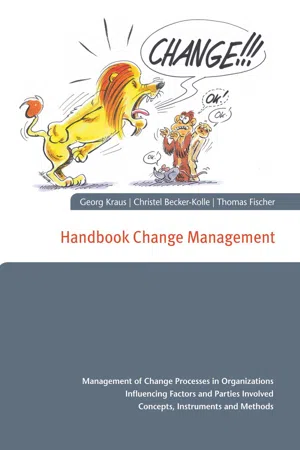
Handbook Change Management
Management of Change Processes in Organizations Influencing Factors and Parties Involved Concepts, Instruments and Methods
- 320 pages
- English
- ePUB (mobile friendly)
- Available on iOS & Android
eBook - ePub
Handbook Change Management
Management of Change Processes in Organizations Influencing Factors and Parties Involved Concepts, Instruments and Methods
About this book
Information
1 What is Change Management?
Change is part of life. Despite this fact, people strive for stability. The desire to have control, security and order often shape the way we think and act. It is difficult to determine the source of this need. Is it an early childhood longing for security? Is it because we constantly attempt to reduce the complexity of reality to a point where it makes sense? There are several models that attempt to explain why humans tend to hold on to the present state. Though the analysis of these basic patterns is an interesting and revealing study, this work will focus on the symptoms and behavior patterns rather than the psychological and evolutionary biological explanatory models of the human being. The following axioms are the basis of this study in change management.
Nothing is stationary, everything constantly changes
We change biologically every day as we grow older. Through age and information, our knowledge changes, as does our way of thinking. Organizations change, even unconsciously as employees change their base of knowledge through experience. Regardless of these daily shifts, many hold on to the status quo.
Change is not always easily recognized by the observer
There are changes that are not visible to the observer. The homo sapiens does not recognize the evolution of the homo sapiens. We can develop an evolutionary theory based on the past, but we cannot see that we are caught up in this biological process of change ourselves. This also applies to observations of natural phenomena such as mountains. Erosion is so minimal to the observer that he cannot see the change within his conception of time. Change managers like to bring up the “boiled frog” example. If you throw a frog into hot water it will jump right back out. If you put the frog in cold water, however, and slowly heat it up, it will not be aware of the gradual increase in temperature. More often than not, it will miss the point at which it could jump out of the pot. The water is then so warm that the frog’s extremities are numb and it can no longer jump, even though it wants to. This example symbolizes how dangerous it is to overlook change.
It is often difficult to recognize one’s own change
We are often not aware of our own change. Our surroundings then serve as a mirror for our change. People who have developed a good defense mechanism towards feedback and criticism are at risk of changing in a certain direction without noticing. This is often referred to as “step-by-step realization”. We don’t recognize our own change until an outside impulse, such as an event, feedback, or a crisis make us realize that
our self-image needs to be revised.

Change brings uncertainty and is therefore often avoided
We prefer to live in a state of clarity. Rituals and traditions make us feel as though the world is controlled and manageable. This longing for perceived security can be observed in small settings (e. g. marriage) as well as in large settings (e. g. traditions and religions). The creation of illusions as a form of security is an important engine in human behavior.
Change often requires physical and psychological energy and is therefore often avoided
It is exhausting to deal with change. It is uncomfortable to observe, evaluate, and adjust to change in our surroundings and within ourselves. Therefore, if we can sidestep change, we often will.
With any change, there are winners and losers
Change usually leads to a shift in power, as social structures and hierarchies alter. Benefits that we have grown accustomed to are removed or given to others, responsibilities are adjusted, and social demands are questioned. Some individuals are affected, while others are involved. “Scrambled eggs with bacon” is a good analogy. When you make scrambled eggs with bacon, the chicken is involved and the pig is affected. Change is similar and resistance is therefore more or less intense. Those involved agree or observe, while those impacted fight openly or secretly against the change. Each person focuses on their own well-being and can individually reject and boycott necessary change if they believe they will emerge as losers. An example are dictators, who are not willing to support change in their country because of their own need for self-preservation.
Time strengthens structures (in thinking and in organizations)
The longer people have experienced and approved of certain structures, the more difficult it is to let them go. Because of this, older people tend to struggle with a change in their thinking more than others. Traditional organizational structures are often perceived as “given” and are, therefore, not questioned. The ability to mirror observations with our own encounters and to make judgements based on these experiences makes daily life easier, because we do not need to constantly question everything. But it also leads to an acceptance of familiar phenomena and a failure to question the status quo. This, in turn leads to a so-called “operational blindness”.
Most changes in the history of change processes were so-called “big bangs”. Big changes, apart from those caused by nature, such as volcano eruptions or periods of drought, were often attributed to a crisis. Generally, a situation was exhausted and stretched to the limit until people were ready to act. In some cases, the resistance to change was so strong, that entire societies perished rather than adjust to the new circumstances. While reacting to a crisis can be viewed as “dealing with change”, it is not considered a rational approach, as the focus becomes crisis management. A continuous process of change, during which people constantly confront and adjust, is much more desirable. This applies to leaders as well as followers.
The objective of this book is to explain why change management is the one of the most important leadership skills and to illustrate how leaders should approach change. The term “change management” has only become popular in the past few years and originates with the Anglo-Saxon language, as do many management vocabularies. The term “organizational change management” is also a common business term, but is aligned with the people side of change management. For the purpose of this book and in following the latest trend, we will use the term “change management” to describe professional management of change rather than tie it to a methodological concept. Change management should therefore be considered a metaconcept that summarizes individual enhancing or contradicting concepts. We will describe each facet of managing change in addition to describing entire concepts as an integrated approach to the subject.
Although change management has played a role for as long as mankind exists, we will focus on the modern definition within this book. Change management has its roots in the 1950s. Until the 1960s most organizations had a strong hierarchical structure. Employees were generally given clearly defined tasks. The organization was seen as absolute and the authority of superiors was generally accepted without question.
The generation of 68, those that protested the social constraints of the time, called for a stronger focus on employees. Activities around group dynamics, team training and team development began popping up in organizations. These employee-oriented approaches further evolved over time and were labelled “organizational development” in the 80s. Most of these organizational development approaches continued to focus heavily on influencing employee behavior and showed signs of evolving into the group dynamic approach. Until the mid-1990s, there was a clear distinction between structural and strategic changes in an organization and employee focused reform. Since the proponents of these approaches represent different practices, this is understandable. A more integrated view of “driving change” has emerged only in the past ten years.
The Springer Gabler business dictionary defines change management as the strategy of planned and systematic change, which happens when organizational structure, corporate culture, and individual behavior is influenced, with the greatest possible inclusion of all involved employees. The chosen holistic perspective takes into consideration the interaction between individuals, groups, organizations, technology, environment, time and communication patterns, value structures, power constellations, etc., which exist in the relevant organization.
1.1 Reasons and Causes for Change Management
There are multiple reasons for change. The following list gives examples of possible causes of change processes:
- Financial crisis
- Change in the market
- New technologies
- New management
- Global projects / cooperation
- Knowledge management
- Management training
- Changes in the environment (i. e. privatization or new legal requirements)
- Organizational changes
- Mergers
- Outsourcing
- Process changes
- Project work
- New forms of work organization
There are generally three ways in which change can occur:
- Crisis / Revolution
- Renewal / Change
- Adaptation / Evolution
A crisis constitutes a change due to external factors and requires quick action and deep cuts. The organization must adapt in order to survive. Renewal or planned change is a planned strategic restructuring of an organization. Management recognizes it and reinvents the organization. Adaptation is an evolutionary approach, where those involved continuously work on their personal development.
1.2 Segments of Change Management
Although most change processes and methods are distinctive, we were able to identify certain common characteristics on a higher level. The fo...
Table of contents
- The Authors
- Table of Contents
- Summary
- 1. What is Change Management?
- 2. Types of Change Processes
- 3. Leadership in the change process
- 4. Dynamics of change
- 5. Systemic management of change processes
- 6. Organizational culture / corporate culture
- 7. Typical mistakes in change processes
- 8. Factors for success in change processes
- 9. Role of stakeholders in the change process
- 10. Structural interventions
- 11. Analogue interventions in change processes
- 12. Organizational structures
- 13. External and internal consultants during change processes
- Index
- Copyright
Trusted by 375,005 students
Access to over 1.5 million titles for a fair monthly price.
Study more efficiently using our study tools.
Frequently asked questions
Yes, you can cancel anytime from the Subscription tab in your account settings on the Perlego website. Your subscription will stay active until the end of your current billing period. Learn how to cancel your subscription
No, books cannot be downloaded as external files, such as PDFs, for use outside of Perlego. However, you can download books within the Perlego app for offline reading on mobile or tablet. Learn how to download books offline
Perlego offers two plans: Essential and Complete
- Essential is ideal for learners and professionals who enjoy exploring a wide range of subjects. Access the Essential Library with 800,000+ trusted titles and best-sellers across business, personal growth, and the humanities. Includes unlimited reading time and Standard Read Aloud voice.
- Complete: Perfect for advanced learners and researchers needing full, unrestricted access. Unlock 1.5M+ books across hundreds of subjects, including academic and specialized titles. The Complete Plan also includes advanced features like Premium Read Aloud and Research Assistant.
We are an online textbook subscription service, where you can get access to an entire online library for less than the price of a single book per month. With over 1.5 million books across 990+ topics, we’ve got you covered! Learn about our mission
Look out for the read-aloud symbol on your next book to see if you can listen to it. The read-aloud tool reads text aloud for you, highlighting the text as it is being read. You can pause it, speed it up and slow it down. Learn more about Read Aloud
Yes! You can use the Perlego app on both iOS and Android devices to read anytime, anywhere — even offline. Perfect for commutes or when you’re on the go.
Please note we cannot support devices running on iOS 13 and Android 7 or earlier. Learn more about using the app
Please note we cannot support devices running on iOS 13 and Android 7 or earlier. Learn more about using the app
Yes, you can access Handbook Change Management by Georg Kraus,Christel Becker-Kolle,Thomas Fischer in PDF and/or ePUB format, as well as other popular books in Business & Management. We have over 1.5 million books available in our catalogue for you to explore.