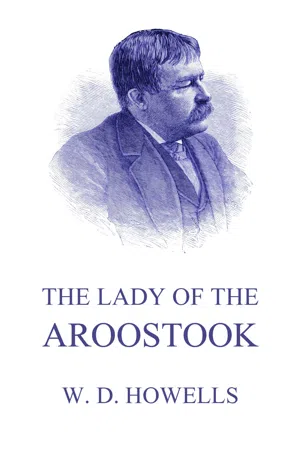
At the time when Mr. Howells's novel, "The Lady of the Aroostook", was published, it was regarded as an antidote to some recent poisons. It is its patriotic and chivalrous purpose to rescue the American woman from the aspersions from which she had suffered in one or two quarters before, and to show of what fine stuff she is really made. Very original materials have been chosen with which to work out this idea, and the result is a fresh, vivacious, elevated story, in which real novelty of conception is combined with all the other fine qualities which have given Mr. Howells his easy distinction among writers of fiction. But the "Aroostook" is a ship, and not the remote county of Maine of that name; and the events of the story take place upon her deck and in her cabin during a voyage from Boston to the Mediterranean. We will not spoil the book for the reader by describing its plan in detail. We will only add here that in it Mr. Howells seems to have written with a pen of broader moral nib, so to speak, than usual; a high and generous purpose taking the lead of a mere technical skill. The character of the story's obvious motive, and the strong and steady hand with which it is carried out, give "The Lady of the Aroostook" a foremost place among the works of this author.
- 360 pages
- English
- ePUB (mobile friendly)
- Available on iOS & Android
eBook - ePub
The Lady of the Aroostook
About this book
Trusted by 375,005 students
Access to over 1.5 million titles for a fair monthly price.
Study more efficiently using our study tools.
Information
Subtopic
ClassicsIndex
LiteratureXXIII.
When Lydia came to breakfast she found her uncle alone in the room, reading Galignani's Messenger. He put down his paper, and came forward to take her hand. “You are all right this morning, I see, Miss Lydia,” he said. “You were quite up a stump, last night, as your countrymen say.”
At the same time hands were laid upon her shoulders from behind, and she was pulled half round, and pushed back, and held at arm's-length. It was Mrs. Erwin, who, entering after her, first scanned her face, and then, with one devouring glance, seized every detail of her dress—the black silk which had already made its effect—before she kissed her. “You are lovely, my dear! I shall spoil you, I know; but you're worth it! What lashes you have, child! And your aunt Maria made and fitted that dress? She's a genius!”
“Miss Lydia,” said Mr. Erwin, as they sat down, “is of the fortunate age when one rises young every morning.” He looked very fresh himself in his clean-shaven chin, and his striking evidence of snowy wristbands and shirt-bosom. “Later in life, you can't do that. She looks as blooming,” he added, gallantly, “as a basket of chips,—as you say in America.”
“Smiling,” said Lydia, mechanically correcting him.
“Ah! It is? Smiling,—yes; thanks. It's very good either way; very characteristic. It would be curious to know the origin of a saying like that. I imagine it goes back to the days of the first settlers. It suggests a wood-chopping period. Is it—ah—in general use?” he inquired.
“Of course it isn't, Henshaw!” said his wife.
“You've been a great while out of the country, my dear,” suggested Mr. Erwin.
“Not so long as not to know that your Americanisms are enough to make one wish we had held our tongues ever since we were discovered, or had never been discovered at all. I want to ask Lydia about her voyage. I haven't heard a word yet. Did your aunt Maria come down to Boston with you?”
“No, grandfather brought me.”
“And you had good weather coming over? Mr. Erwin told me you were not seasick.”
“We had one bad storm, before we reached Gibraltar; but I wasn't seasick.”
“Were the other passengers?”
“One was.” Lydia reddened a little, and then turned somewhat paler than at first.
“What is it, Lydia?” her aunt subtly demanded. “Who was the one that was sick?”
“Oh, a gentleman,” answered Lydia.
Her aunt looked at her keenly, and for whatever reason abruptly left the subject. “Your silk,” she said, “will do very well for church, Lydia.”
“Oh, I say, now!” cried her husband, “you're not going to make her go to church to-day!”
“Yes, I am! There will be more people there to-day than any other time this fall. She must go.”
“But she's tired to death,—quite tuckered, you know.”
“Oh, I'm rested, now,” said Lydia. “I shouldn't like to miss going to church.”
“Your silk,” continued her aunt, “will be quite the thing for church.” She looked hard at the dress, as if it were not quite the thing for breakfast. Mrs. Erwin herself wore a morning-dress of becoming delicacy, and an airy French cap; she had a light fall of powder on her face. “What kind of overthing have you got?” she asked.
“There's a sack goes with this,” said the girl, suggestively.
“That's nice! What is your bonnet?”
“I haven't any bonnet. But my best hat is nice. I could—”
“No one goes to church in a hat! You can't do it. It's simply impossible.”
“Why, my dear,” said her husband, “I saw some very pretty American girls in hats at church, last Sunday.”
“Yes, and everybody knew they were Americans by their hats!” retorted Mrs. Erwin.
“I knew they were Americans by their good looks,” said Mr. Erwin, “and what you call their stylishness.”
“Oh, it's all well enough for you to talk. You're an Englishman, and you could wear a hat, if you liked. It would be set down to character. But in an American it would be set down to greenness. If you were an American, you would have to wear a bonnet.”
“I'm glad, then, I'm not an American,” said her husband; “I don't think I should look well in a bonnet.”
“Oh, stuff, Henshaw! You know what I mean. And I'm not going to have English people thinking we're ignorant of the common decencies of life. Lydia shall not go to church in a hat; she had better never go. I will lend her one of my bonnets. Let me see, which one.” She gazed at Lydia in critical abstraction. “I wear rather young bonnets,” she mused aloud, “and we're both rather dark. The only difficulty is I'm so much more delicate—” She brooded upon the question in a silence, from which she burst exulting. “The very thing! I can fuss it up in no time. It won't take two minutes to get it ready. And you'll look just killing in it.” She turned grave again. “Henshaw,” she said, “I wish you would go to church this morning!”
“I would do almost anything for you, Josephine; but really, you know, you oughtn't to ask that. I was there last Sunday; I can't go every Sunday. It's bad enough in England; a man ought to have some relief on the Continent.”
“Well, well. I suppose I oughtn't to ask you,” sighed his wife, “especially as you're going with us to-night.”
“I'll go to-night, with pleasure,” said Mr. Erwin. He rose when his wife and Lydia left the table, and opened the door for them with a certain courtesy he had; it struck even Lydia's uneducated sense as something peculiarly sweet and fine, and it did not overawe her own simplicity, but seemed of kind with it.
The bonnet, when put to proof, did not turn out to be all that it was vaunted. It looked a little odd, from the first; and Mrs. Erwin, when she was herself dressed, ended by taking it off, and putting on Lydia the hat previously condemned. “You're divine in that,” she said. “And after all, you are a traveler, and I can say that some of your things were spoiled coming over,—people always get things ruined in a sea voyage,—and they'll think it was your bonnet.”
“I kept my things very nicely, aunt Josephine,” said Lydia conscientiously. “I don't believe anything was hurt.”
“Oh, well, you can't tell till you've unpacked; and we're not responsible for what people happen to think, you know. Wait!” her aunt suddenly cried. She pulled open a drawer, and snatched two ribbons from it, which she pinned to the sides of Lydia's hat, and tied in a bow under her chin; she caught out a lace veil, and drew that over the front of the hat, and let it hang in a loose knot behind. “Now,” she said, pushing her up to a mirror, that she might see, “it's a bonnet; and I needn't say anything!”
They went in Mrs. Erwin's gondola to the palace in which the English service was held, and Lydia was silent, as she looked shyly, almost fearfully, round on the visionary splendors of Venice.
Mrs. Erwin did not like to be still. “What are you thinking of, Lydia?” she asked.
“Oh! I suppose I was thinking that the leaves were beginning to turn in the sugar orchard,” answered Lydia faithfully. “I was thinking how still the sun would be in the pastures, there, this morning. I suppose the stillness here put me in mind of it. One of these bells has the same tone as our bell at home.”
“Yes,” said Mrs. Erwin. “Everybody finds a familiar bell in Venice. There are enough of them, goodness knows. I don't see why you call it still, with all this clashing and banging. I suppose this seems very odd to you, Lydia,” she continued, indicating the general Venetian effect. “It's an old story to me, though. The great beauty of Venice is that you get more for your money here than you can anywhere else in the world. There isn't much society, however, and you mustn't expect to be very gay.”
“I have never been gay,” said Lydia.
“Well, that's no reason you shouldn't be,” returned her aunt. “If you were in Florence, or Rome, or even Naples, you could have a good time. There! I'm glad your uncle didn't hear me say that!”
“What?” asked Lydia.
“Good time; that's an Americanism.”
“Is it?”
“Yes. He's perfectly delighted when he catches me in one. I try to break myself of them, but I don't always know them myself. Sometimes I feel almost like never talking at all. But you can't do that, you know.”
“No,” assented Lydia.
“And you have to talk Americanisms if you're an American. You mustn't think your uncle isn't obliging, Lydia. He is. I oughtn't to have asked him to go to church,—it bores him so much. I used to feel terribly about it once, when we were first married. But things have changed very much of late years, especially with all this scientific talk. In England it's quite different from what it used to be. Some of the best people in society are skeptics now, and that makes it quite another thing.” Lydia looked grave, but she said nothing, and her aunt added, “I wouldn't have asked him, but I had a little headache, myself.”
“Aunt Josephine,” said Lydia, “I'm afraid you're doing too much for me. Why didn't you let me come alone?”
“Come alone? To church!” Mrs. Erwin addressed her in a sort of whispered shriek. “It would have been perfectly scandalous.”
“To go to church alone?” demanded Lydia, astounded.
“Yes. A young girl mustn't go anywhere alone.”
“Why?”
“I'll explain to you, sometime, Lydia; or rather, you'll learn for yourself. In Italy it's very different from what it is in America.” Mrs. Erwin suddenly started up and bowed with great impressiveness, as a gondola swept towards them. The gondoliers wore shirts of blue silk, and long crimson sashes. On the cushions of the boat, beside a hideous little man who was sucking the top of an ivory-handled stick, reclined a beautiful woman, pale, with purplish rings round the large black eyes with which, faintly smiling, she acknowledged Mrs. Erwin's salutation, and then stared at Lydia.
“Oh, you may look, and you may look, and you may look!” cried Mrs. Erwin, under her breath. “You've met more than your match at last! ...
Table of contents
- I.
- II.
- III.
- IV.
- V.
- VI.
- VII.
- VIII.
- IX.
- X.
- XI.
- XII.
- XIII.
- XIV.
- XV.
- XVI.
- XVII.
- XVIII.
- XIX.
- XX.
- XXI.
- XXII.
- XXIII.
- XXIV.
- XXV.
- XXVI.
- XXVII.
Frequently asked questions
Yes, you can cancel anytime from the Subscription tab in your account settings on the Perlego website. Your subscription will stay active until the end of your current billing period. Learn how to cancel your subscription
No, books cannot be downloaded as external files, such as PDFs, for use outside of Perlego. However, you can download books within the Perlego app for offline reading on mobile or tablet. Learn how to download books offline
Perlego offers two plans: Essential and Complete
- Essential is ideal for learners and professionals who enjoy exploring a wide range of subjects. Access the Essential Library with 800,000+ trusted titles and best-sellers across business, personal growth, and the humanities. Includes unlimited reading time and Standard Read Aloud voice.
- Complete: Perfect for advanced learners and researchers needing full, unrestricted access. Unlock 1.5M+ books across hundreds of subjects, including academic and specialized titles. The Complete Plan also includes advanced features like Premium Read Aloud and Research Assistant.
We are an online textbook subscription service, where you can get access to an entire online library for less than the price of a single book per month. With over 1.5 million books across 990+ topics, we’ve got you covered! Learn about our mission
Look out for the read-aloud symbol on your next book to see if you can listen to it. The read-aloud tool reads text aloud for you, highlighting the text as it is being read. You can pause it, speed it up and slow it down. Learn more about Read Aloud
Yes! You can use the Perlego app on both iOS and Android devices to read anytime, anywhere — even offline. Perfect for commutes or when you’re on the go.
Please note we cannot support devices running on iOS 13 and Android 7 or earlier. Learn more about using the app
Please note we cannot support devices running on iOS 13 and Android 7 or earlier. Learn more about using the app
Yes, you can access The Lady of the Aroostook by William Dean Howells in PDF and/or ePUB format, as well as other popular books in Literature & Classics. We have over 1.5 million books available in our catalogue for you to explore.