Who is right, the idealists or the materialists? The question, once stated in this way, hesitation becomes impossible. Undoubtedly the idealists are wrong and the materialists right. Yes, facts are before ideas; yes, the ideal, as Proudhon said, is but a flower, whose root lies in the material conditions of existence. Yes, the whole history of humanity, intellectual and moral, political and social, is but a reflection of its economic history.All branches of modem science, of true and disinterested science, concur in proclaiming this grand truth, fundamental and decisive: The social world, properly speaking, the human world - in short, humanity - is nothing other than the last and supreme development - at least on our planet and as far as we know - the highest manifestation of animality. But as every development necessarily implies a negation, that of its base or point of departure, humanity is at the same time and essentially the deliberate and gradual negation of the animal element in man; and it is precisely this negation, as rational as it is natural, and rational only because natural - at once historical and logical, as inevitable as the development and realization of all the natural laws in the world - that constitutes and creates the ideal, the world of intellectual and moral convictions, ideas.
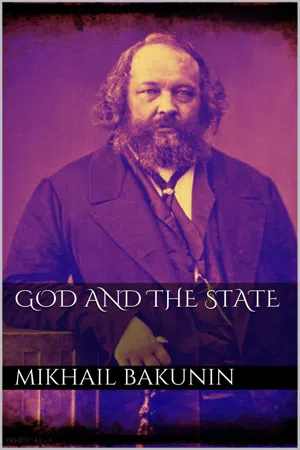
- 116 pages
- English
- ePUB (mobile friendly)
- Available on iOS & Android
eBook - ePub
God and the State
About this book
Information
II
II
I have stated the chief practical reason of the power still exercised today over the masses by religious beliefs. These mystical tendencies do not signify in man so much an aberration of mind as a deep discontent at Heart. They are the instinctive and passionate protest of the human being against the narrowness, the platitudes, the sorrows, and the shame of a wretched existence. For this malady, I have already said, there is but one remedy - Social Revolution.
In the meantime I have endeavored to show the causes responsible for the birth and historical development of religious hallucinations in the human conscience. Here it is my purpose to treat this question of the existence of a God, or of the divine origin of the world and of man, solely from the standpoint of its moral and social utility, and I shall say only a few words, to better explain my thought, regarding the theoretical grounds of this belief.
All religions, with their gods, their demigods, and their prophets, their messiahs and their saints, were created by the credulous fancy of men who had not attained the full development and full possession of their faculties. Consequently, the religious heaven is nothing but a mirage in which man, exalted by ignorance and faith, discovers his own image, but enlarged and reversed - that is, divinized. The history of religion, of the birth, grandeur, and decline of the gods who have succeeded one another in human belief, is nothing, therefore, but the development of the collective intelligence and conscience of mankind. As fast as they discovered, in the course of their historically progressive advance, either in themselves or in external nature, a power, a quality, or even any great defect whatever, they attributed them to their gods, after having exaggerated and enlarged them beyond measure, after the manner of children, by an act of their religious fancy. Thanks to this modesty and pious generosity of believing and credulous men, heaven has grown rich with the spoils of the earth, and, by a necessary consequence, the richer heaven became, the more wretched became humanity and the earth. God once installed, he was naturally proclaimed the cause, reason, arbiter and absolute disposer of all things: the world thenceforth was nothing, God was all; and man, his real creator, after having unknowingly extracted him from the void, bowed down before him, worshipped him, and avowed himself his creature and his slave.
Christianity is precisely the religion par excellence, because it exhibits and manifests, to the fullest extent, the very nature and essence of every religious system, which is the impoverishment, enslavement, and annihilation of humanity for the benefit of divinity.
God being everything, the real world and man are nothing. God being truth, justice, goodness, beauty, power, and life, man is falsehood, iniquity, evil, ugliness, impotence, and death. God being master, man is the slave. Incapable of finding justice, truth, and eternal life by his own effort, he can attain them only through a divine revelation. But whoever says revelation says revealers, messiahs, prophets, priests, and legislators inspired by God himself; and these, once recognized as the representatives of divinity on earth, as the holy instructors of humanity, chosen by God himself to direct it in the path of salvation, necessarily exercise absolute power. All men owe them passive and unlimited obedience; for against the divine reason there is no human reason, and against the justice of God no terrestrial justice holds. Slaves of God, men must also be slaves of Church and State, in so far as the State is consecrated by the Church. This truth Christianity, better than all other religions that exist or have existed, understood, not excepting even the old Oriental religions, which included only distinct and privileged nations, while Christianity aspires to embrace entire humanity; and this truth Roman Catholicism, alone among all the Christian sects, has proclaimed and realized with rigorous logic. That is why Christianity is the absolute religion, the final religion; why the Apostolic and Roman Church is the only consistent, legitimate, and divine church.
With all due respect, then, to the metaphysicians and religious idealists, philosophers, politicians, or poets: The idea of God implies the abdication of human reason and justice; it is the most decisive negation of human liberty, and necessarily ends in the enslavement of mankind, both in theory and practice.
Unless, then, we desire the enslavement and degradation of mankind, as the Jesuits desire it, as the mÙmiers, pietists, or Protestant Methodists desire it, we may not, must not make the slightest concession either to the God of theology or to the God of metaphysics. He who, in this mystical alphabet, begins with A will inevitably end with Z; he who desires to worship God must harbor no childish illusions about the matter, but bravely renounce his liberty and humanity.
If God is, man is a slave; now, man can and must be free; then, God does not exist.
I defy anyone whomsoever to avoid this circle; now, therefore, let all choose.
Is it necessary to point out to what extent and in what manner religions debase and corrupt the people? They destroy their reason, the principal instrument of human emancipation, and reduce them to imbecility, the essential condition of their slavery. They dishonor human labor, and make it a sign and source of servitude. They kill the idea and sentiment of human justice, ever tipping the balance to the side of triumphant knaves, privileged objects of divine indulgence. They kill human pride and dignity, protecting only the cringing and humble. They stifle in the heart of nations every feeling of human fraternity, filling it with divine cruelty instead.
All religions are cruel, all founded on blood; for all rest principally on the idea of sacrifice - that is, on the perpetual immolation of humanity to the insatiable vengeance of divinity. In this bloody mystery man is always the victim, and the priest - a man also, but a man privileged by grace - is the divine executioner. That explains why the priests of all religions, the best, the most humane, the gentlest, almost always have at the bottom of their hearts - and, if not in their hearts, in their imaginations, in their minds (and we know the fearful influence of either on the hearts of men) - something cruel and sanguinary.
None know all this better than our illustrious contemporary idealists. They are learned men, who know history by heart; and, as they are at the same time living men, great souls penetrated with a sincere and profound love for the welfare of humanity, they have cursed and branded all these misdeeds, all these crimes of religion with an eloquence unparalleled. They reject with indignation all solidarity with the God of positive religions and with his representatives, past, present, and on earth.
The God whom they adore, or whom they think they adore, is distinguished from the real gods of history precisely in this - that he is not at all a positive god, defined in any way whatever, theologically or even metaphysically. He is neither the supreme being of Robespierre and J. J. Rousseau, nor the pantheistic god of Spinoza, nor even the at once immanent, transcendental, and very equivocal god of Hegel. They take good care not to give him any positive definition whatever, feeling very strongly that any definition would subject him to the dissolving power of criticism. They will not say whether be is a personal or impersonal god, whether he created or did not create the world; they will not even speak of his divine providence. All that might compromise him. They content themselves with saying "God" and nothing more. But, then, what is their God? Not even an idea; it is an aspiration.
It is the generic name of all that seems grand, good, beautiful, noble, human to them. But why, then, do they not say, "Man." Ah! because King William of Prussia and Napoleon III, and all their compeers are likewise men: which bothers them very much. Real humanity presents a mixture of all I that is most sublime and beautiful with all that is vilest and most monstrous in the world. How do they get over this? Why, they call one divine and the other bestial, representing divinity and animality as two poles, between which they place humanity. They either will not or cannot understand that these three terms are really but one, and that to separate them is to destroy them.
They are not strong on logic, and one might say that they despise it. That is what distinguishes them from the pantheistical and deistical metaphysicians, and gives their ideas the character of a practical idealism, drawing its inspiration much less from the severe development of a thought than from the experiences, I might almost say the emotions, historical and collective as well as individual, of life. This gives their propaganda an appearance of wealth and vital power, but an appearance only; for life itself becomes sterile when paralyzed by a logical contradiction.
This contradiction lies here: they wish God, and they wish humanity. They persist in connecting two terms which, once separated, can come together again only to destroy each other. They say in a single breath: "God and the liberty of man," "God and the dignity, justice, equality, fraternity, prosperity of men" - regardless of the fatal logic by virtue of which, if God exists, all these things are condemned to non-existence. For, if God is, he is necessarily the eternal, supreme, absolute master, and, if such a master exists, man is a slave; now, if he is a slave, neither justice, nor equality, nor fraternity, nor prosperity are possible for him. In vain, flying in the face of good sense and all the teachings of history, do they represent their God as animated by the tenderest love of human liberty: a master, whoever he may be and however liberal he may desire to show himself, remains none the less always a master. His existence necessarily implies the slavery of all that is beneath him. Therefore, if God existed, only in one way could he serve human liberty - by ceasing to exist.
A jealous lover of human liberty, and deeming it the absolute condition of all that we admire and respect in humanity, I reverse the phrase of Voltaire, and say that, if God really existed, it would be necessary to abolish him.
The severe logic that dictates these words is far too evident to require a development of this argument. And it seems to me impossible that the illustrious men, whose names so celebrated and so justly respected I have cited, should not have been struck by it themselves, and should not have perceived the contradiction in which they involve themselves in speaking of God and human liberty at once. To have disregarded it, they must have considered this inconsistency or logical license practically necessary to humanity's well-being.
Perhaps, too, while speaking of liberty as something very respectable and very dear in their eyes, they give the term a meaning quite different from the conception entertained by us, materialists and Revolutionary Socialists. Indeed, they never speak of it without immediately adding another word, authority - a word and a thing which we detest with all our heart.
What is authority? Is it the inevitable power of the natural laws which manifest themselves in the necessary concatenation and succession of phenomena in the physical and social worlds? Indeed, against these laws revolt is not only forbidden - it is even impossible. We may misunderstand them or not know them at all, but we cannot disobey them; because they constitute the basis and fundamental conditions of our existence; they envelop us, penetrate us, regulate all our movements, thoughts, and acts; even when we believe that we disobey them, we only show their omnipotence.
Yes, we are absolutely the slaves of these laws. But in such slavery there is no humiliation, or, rather, it is not slavery at all. For slavery supposes an external master, a legislator outside of him whom he commands, while these laws are not outside of us; they are inherent in us; they constitute our being, our whole being, physically - intellectually, and morally: we live, we breathe, we act, we think, we wish only through these laws. Without them we are nothing, we are not. Whence, then, could we derive the power and the wish to rebel against them?
In his relation to natural laws but one liberty is possible to man - that of recognizing and applying them on an ever-extending scale in conformity with the object of collective and individual emancipation or humanization which he pursues. These laws, once recognized, exercise an authority which is never disputed by the mass of men. One must, for instance, be at bottom either a fool or a theologian or at least a metaphysician, jurist, or bourgeois economist to rebel against the law by which twice two make four. One must have faith to imagine that fire will not burn nor water drown, except, indeed, recourse be had to some subterfuge founded in its turn on some other natural law. But these revolts, or, rather, these attempts at or foolish fancies of an impossible revolt, are decidedly, the exception; for, in general, it may be said that the mass of men, in their daily lives, acknowledge the government of common sense - that is, of the sum of the natural laws generally recognized - in an almost absolute fashion.
The great misfortune is that a large number of natural laws, already established as such by science, remain unknown to the masses, thanks to the watchfulness of these tutelary governments that exist, as we know, only for the good of the people. There is another difficulty - namely, that the major portion of the natural laws connected with the development of human society, which are quite as necessary, invariable, fatal, as the laws that govern the physical world, have not been duly established and recognized by science itself.
Once they shall have been recognized by science, and then from science, by means of an extensive system of popular education and instruction, shall have passed into the consciousness of all, the question of liberty will be entirely solved. The most stubborn authorities must admit that then there will be no need either of political organization or direction or legislation, three things which, whether they emanate from the will of the sovereign or from the vote of a parliament elected by universal suffrage, and even should they conform to the system of natural laws - which has never been the case and never will be the case - are always equally fatal and hostile to the liberty of the masses from the very fact that they impose upon them a system of external and therefore despotic laws.
The liberty of man consists solely in this: that he obeys natural laws because he has himself recognized them as such, and not because they have been externally imposed upon him by any extrinsic will whatever, divine or human, collective or individual.
Suppose a learned academy, composed of the most illustrious representatives of science; suppose this academy charged with legislation for and the organization of society, and that, inspired only by the purest love of truth, it frames none but laws in absolute harmony with the latest discoveries of science. Well, I maintain, for my part, that such legislation and such organization would be a monstrosity, and that for two reasons: first, that human science is always and necessarily imperfect, and that, comparing what it has discovered with what remains to be discovered, we may say that it is still in its cradle. So that were we to try to force the practical life of men, collective as well as individual, into strict and exclusive conformity with the latest data of science, we should condemn society as well as individuals to suffer martyrdom on a bed of Procrustes, which would soon end by dislocating and stifling them, life ever remaining an infinitely greater thing than science.
The second reason is this: a society which should obey legislation emanating from a scientific academy, not because it understood itself the rational character of this legislation (in which case the existence of the academy would become useless), but because this legislation, emanating from the academy, was imposed in the name of a science which it venerated without comprehending - such a society would be a society, not of men, but of brutes. It would be a second edition of those missions in Paraguay which submitted so long to the government of the Jesuits. It would surely and rapidly descend to the lowest stage of idiocy.
But there is still a third reason which would render su...
In the meantime I have endeavored to show the causes responsible for the birth and historical development of religious hallucinations in the human conscience. Here it is my purpose to treat this question of the existence of a God, or of the divine origin of the world and of man, solely from the standpoint of its moral and social utility, and I shall say only a few words, to better explain my thought, regarding the theoretical grounds of this belief.
All religions, with their gods, their demigods, and their prophets, their messiahs and their saints, were created by the credulous fancy of men who had not attained the full development and full possession of their faculties. Consequently, the religious heaven is nothing but a mirage in which man, exalted by ignorance and faith, discovers his own image, but enlarged and reversed - that is, divinized. The history of religion, of the birth, grandeur, and decline of the gods who have succeeded one another in human belief, is nothing, therefore, but the development of the collective intelligence and conscience of mankind. As fast as they discovered, in the course of their historically progressive advance, either in themselves or in external nature, a power, a quality, or even any great defect whatever, they attributed them to their gods, after having exaggerated and enlarged them beyond measure, after the manner of children, by an act of their religious fancy. Thanks to this modesty and pious generosity of believing and credulous men, heaven has grown rich with the spoils of the earth, and, by a necessary consequence, the richer heaven became, the more wretched became humanity and the earth. God once installed, he was naturally proclaimed the cause, reason, arbiter and absolute disposer of all things: the world thenceforth was nothing, God was all; and man, his real creator, after having unknowingly extracted him from the void, bowed down before him, worshipped him, and avowed himself his creature and his slave.
Christianity is precisely the religion par excellence, because it exhibits and manifests, to the fullest extent, the very nature and essence of every religious system, which is the impoverishment, enslavement, and annihilation of humanity for the benefit of divinity.
God being everything, the real world and man are nothing. God being truth, justice, goodness, beauty, power, and life, man is falsehood, iniquity, evil, ugliness, impotence, and death. God being master, man is the slave. Incapable of finding justice, truth, and eternal life by his own effort, he can attain them only through a divine revelation. But whoever says revelation says revealers, messiahs, prophets, priests, and legislators inspired by God himself; and these, once recognized as the representatives of divinity on earth, as the holy instructors of humanity, chosen by God himself to direct it in the path of salvation, necessarily exercise absolute power. All men owe them passive and unlimited obedience; for against the divine reason there is no human reason, and against the justice of God no terrestrial justice holds. Slaves of God, men must also be slaves of Church and State, in so far as the State is consecrated by the Church. This truth Christianity, better than all other religions that exist or have existed, understood, not excepting even the old Oriental religions, which included only distinct and privileged nations, while Christianity aspires to embrace entire humanity; and this truth Roman Catholicism, alone among all the Christian sects, has proclaimed and realized with rigorous logic. That is why Christianity is the absolute religion, the final religion; why the Apostolic and Roman Church is the only consistent, legitimate, and divine church.
With all due respect, then, to the metaphysicians and religious idealists, philosophers, politicians, or poets: The idea of God implies the abdication of human reason and justice; it is the most decisive negation of human liberty, and necessarily ends in the enslavement of mankind, both in theory and practice.
Unless, then, we desire the enslavement and degradation of mankind, as the Jesuits desire it, as the mÙmiers, pietists, or Protestant Methodists desire it, we may not, must not make the slightest concession either to the God of theology or to the God of metaphysics. He who, in this mystical alphabet, begins with A will inevitably end with Z; he who desires to worship God must harbor no childish illusions about the matter, but bravely renounce his liberty and humanity.
If God is, man is a slave; now, man can and must be free; then, God does not exist.
I defy anyone whomsoever to avoid this circle; now, therefore, let all choose.
Is it necessary to point out to what extent and in what manner religions debase and corrupt the people? They destroy their reason, the principal instrument of human emancipation, and reduce them to imbecility, the essential condition of their slavery. They dishonor human labor, and make it a sign and source of servitude. They kill the idea and sentiment of human justice, ever tipping the balance to the side of triumphant knaves, privileged objects of divine indulgence. They kill human pride and dignity, protecting only the cringing and humble. They stifle in the heart of nations every feeling of human fraternity, filling it with divine cruelty instead.
All religions are cruel, all founded on blood; for all rest principally on the idea of sacrifice - that is, on the perpetual immolation of humanity to the insatiable vengeance of divinity. In this bloody mystery man is always the victim, and the priest - a man also, but a man privileged by grace - is the divine executioner. That explains why the priests of all religions, the best, the most humane, the gentlest, almost always have at the bottom of their hearts - and, if not in their hearts, in their imaginations, in their minds (and we know the fearful influence of either on the hearts of men) - something cruel and sanguinary.
None know all this better than our illustrious contemporary idealists. They are learned men, who know history by heart; and, as they are at the same time living men, great souls penetrated with a sincere and profound love for the welfare of humanity, they have cursed and branded all these misdeeds, all these crimes of religion with an eloquence unparalleled. They reject with indignation all solidarity with the God of positive religions and with his representatives, past, present, and on earth.
The God whom they adore, or whom they think they adore, is distinguished from the real gods of history precisely in this - that he is not at all a positive god, defined in any way whatever, theologically or even metaphysically. He is neither the supreme being of Robespierre and J. J. Rousseau, nor the pantheistic god of Spinoza, nor even the at once immanent, transcendental, and very equivocal god of Hegel. They take good care not to give him any positive definition whatever, feeling very strongly that any definition would subject him to the dissolving power of criticism. They will not say whether be is a personal or impersonal god, whether he created or did not create the world; they will not even speak of his divine providence. All that might compromise him. They content themselves with saying "God" and nothing more. But, then, what is their God? Not even an idea; it is an aspiration.
It is the generic name of all that seems grand, good, beautiful, noble, human to them. But why, then, do they not say, "Man." Ah! because King William of Prussia and Napoleon III, and all their compeers are likewise men: which bothers them very much. Real humanity presents a mixture of all I that is most sublime and beautiful with all that is vilest and most monstrous in the world. How do they get over this? Why, they call one divine and the other bestial, representing divinity and animality as two poles, between which they place humanity. They either will not or cannot understand that these three terms are really but one, and that to separate them is to destroy them.
They are not strong on logic, and one might say that they despise it. That is what distinguishes them from the pantheistical and deistical metaphysicians, and gives their ideas the character of a practical idealism, drawing its inspiration much less from the severe development of a thought than from the experiences, I might almost say the emotions, historical and collective as well as individual, of life. This gives their propaganda an appearance of wealth and vital power, but an appearance only; for life itself becomes sterile when paralyzed by a logical contradiction.
This contradiction lies here: they wish God, and they wish humanity. They persist in connecting two terms which, once separated, can come together again only to destroy each other. They say in a single breath: "God and the liberty of man," "God and the dignity, justice, equality, fraternity, prosperity of men" - regardless of the fatal logic by virtue of which, if God exists, all these things are condemned to non-existence. For, if God is, he is necessarily the eternal, supreme, absolute master, and, if such a master exists, man is a slave; now, if he is a slave, neither justice, nor equality, nor fraternity, nor prosperity are possible for him. In vain, flying in the face of good sense and all the teachings of history, do they represent their God as animated by the tenderest love of human liberty: a master, whoever he may be and however liberal he may desire to show himself, remains none the less always a master. His existence necessarily implies the slavery of all that is beneath him. Therefore, if God existed, only in one way could he serve human liberty - by ceasing to exist.
A jealous lover of human liberty, and deeming it the absolute condition of all that we admire and respect in humanity, I reverse the phrase of Voltaire, and say that, if God really existed, it would be necessary to abolish him.
The severe logic that dictates these words is far too evident to require a development of this argument. And it seems to me impossible that the illustrious men, whose names so celebrated and so justly respected I have cited, should not have been struck by it themselves, and should not have perceived the contradiction in which they involve themselves in speaking of God and human liberty at once. To have disregarded it, they must have considered this inconsistency or logical license practically necessary to humanity's well-being.
Perhaps, too, while speaking of liberty as something very respectable and very dear in their eyes, they give the term a meaning quite different from the conception entertained by us, materialists and Revolutionary Socialists. Indeed, they never speak of it without immediately adding another word, authority - a word and a thing which we detest with all our heart.
What is authority? Is it the inevitable power of the natural laws which manifest themselves in the necessary concatenation and succession of phenomena in the physical and social worlds? Indeed, against these laws revolt is not only forbidden - it is even impossible. We may misunderstand them or not know them at all, but we cannot disobey them; because they constitute the basis and fundamental conditions of our existence; they envelop us, penetrate us, regulate all our movements, thoughts, and acts; even when we believe that we disobey them, we only show their omnipotence.
Yes, we are absolutely the slaves of these laws. But in such slavery there is no humiliation, or, rather, it is not slavery at all. For slavery supposes an external master, a legislator outside of him whom he commands, while these laws are not outside of us; they are inherent in us; they constitute our being, our whole being, physically - intellectually, and morally: we live, we breathe, we act, we think, we wish only through these laws. Without them we are nothing, we are not. Whence, then, could we derive the power and the wish to rebel against them?
In his relation to natural laws but one liberty is possible to man - that of recognizing and applying them on an ever-extending scale in conformity with the object of collective and individual emancipation or humanization which he pursues. These laws, once recognized, exercise an authority which is never disputed by the mass of men. One must, for instance, be at bottom either a fool or a theologian or at least a metaphysician, jurist, or bourgeois economist to rebel against the law by which twice two make four. One must have faith to imagine that fire will not burn nor water drown, except, indeed, recourse be had to some subterfuge founded in its turn on some other natural law. But these revolts, or, rather, these attempts at or foolish fancies of an impossible revolt, are decidedly, the exception; for, in general, it may be said that the mass of men, in their daily lives, acknowledge the government of common sense - that is, of the sum of the natural laws generally recognized - in an almost absolute fashion.
The great misfortune is that a large number of natural laws, already established as such by science, remain unknown to the masses, thanks to the watchfulness of these tutelary governments that exist, as we know, only for the good of the people. There is another difficulty - namely, that the major portion of the natural laws connected with the development of human society, which are quite as necessary, invariable, fatal, as the laws that govern the physical world, have not been duly established and recognized by science itself.
Once they shall have been recognized by science, and then from science, by means of an extensive system of popular education and instruction, shall have passed into the consciousness of all, the question of liberty will be entirely solved. The most stubborn authorities must admit that then there will be no need either of political organization or direction or legislation, three things which, whether they emanate from the will of the sovereign or from the vote of a parliament elected by universal suffrage, and even should they conform to the system of natural laws - which has never been the case and never will be the case - are always equally fatal and hostile to the liberty of the masses from the very fact that they impose upon them a system of external and therefore despotic laws.
The liberty of man consists solely in this: that he obeys natural laws because he has himself recognized them as such, and not because they have been externally imposed upon him by any extrinsic will whatever, divine or human, collective or individual.
Suppose a learned academy, composed of the most illustrious representatives of science; suppose this academy charged with legislation for and the organization of society, and that, inspired only by the purest love of truth, it frames none but laws in absolute harmony with the latest discoveries of science. Well, I maintain, for my part, that such legislation and such organization would be a monstrosity, and that for two reasons: first, that human science is always and necessarily imperfect, and that, comparing what it has discovered with what remains to be discovered, we may say that it is still in its cradle. So that were we to try to force the practical life of men, collective as well as individual, into strict and exclusive conformity with the latest data of science, we should condemn society as well as individuals to suffer martyrdom on a bed of Procrustes, which would soon end by dislocating and stifling them, life ever remaining an infinitely greater thing than science.
The second reason is this: a society which should obey legislation emanating from a scientific academy, not because it understood itself the rational character of this legislation (in which case the existence of the academy would become useless), but because this legislation, emanating from the academy, was imposed in the name of a science which it venerated without comprehending - such a society would be a society, not of men, but of brutes. It would be a second edition of those missions in Paraguay which submitted so long to the government of the Jesuits. It would surely and rapidly descend to the lowest stage of idiocy.
But there is still a third reason which would render su...
Table of contents
- God and the State
- I
- II
- III
- IV Credo quod absurdum
- Copyright
Trusted by 375,005 students
Access to over 1.5 million titles for a fair monthly price.
Study more efficiently using our study tools.
Frequently asked questions
Yes, you can cancel anytime from the Subscription tab in your account settings on the Perlego website. Your subscription will stay active until the end of your current billing period. Learn how to cancel your subscription
No, books cannot be downloaded as external files, such as PDFs, for use outside of Perlego. However, you can download books within the Perlego app for offline reading on mobile or tablet. Learn how to download books offline
Perlego offers two plans: Essential and Complete
- Essential is ideal for learners and professionals who enjoy exploring a wide range of subjects. Access the Essential Library with 800,000+ trusted titles and best-sellers across business, personal growth, and the humanities. Includes unlimited reading time and Standard Read Aloud voice.
- Complete: Perfect for advanced learners and researchers needing full, unrestricted access. Unlock 1.5M+ books across hundreds of subjects, including academic and specialized titles. The Complete Plan also includes advanced features like Premium Read Aloud and Research Assistant.
We are an online textbook subscription service, where you can get access to an entire online library for less than the price of a single book per month. With over 1.5 million books across 990+ topics, we’ve got you covered! Learn about our mission
Look out for the read-aloud symbol on your next book to see if you can listen to it. The read-aloud tool reads text aloud for you, highlighting the text as it is being read. You can pause it, speed it up and slow it down. Learn more about Read Aloud
Yes! You can use the Perlego app on both iOS and Android devices to read anytime, anywhere — even offline. Perfect for commutes or when you’re on the go.
Please note we cannot support devices running on iOS 13 and Android 7 or earlier. Learn more about using the app
Please note we cannot support devices running on iOS 13 and Android 7 or earlier. Learn more about using the app
Yes, you can access God and the State by Mikhail Bakunin in PDF and/or ePUB format, as well as other popular books in Politics & International Relations & Politics. We have over 1.5 million books available in our catalogue for you to explore.