So many versions of the Divine Comedy exist in English that a new one might well seem needless. But most of these translations are in verse, and the intellectual temper of our time is impatient of a transmutation in which substance is sacrificed for form's sake, and the new form is itself different from the original. The conditions of verse in different languages vary so widely as to make any versified translation of a poem but an imperfect reproduction of the archetype. It is like an imperfect mirror that renders but a partial likeness, in which essential features are blurred or distorted. Dante himself, the first modern critic, declared that "nothing harmonized by a musical bond can be transmuted from its own speech without losing all its sweetness and harmony, " and every fresh attempt at translation affords a new proof of the truth of his assertion. Each language exhibits its own special genius in its poetic forms. Even when they are closely similar in rhythmical method their poetic effect is essentially different, their individuality is distinct. The hexameter of the Iliad is not the hexameter of the Aeneid. And if this be the case in respect to related forms, it is even more obvious in respect to forms peculiar to one language, like the terza rima of the Italian, for which it is impossible to find a satisfactory equivalent in another tongue.
- 175 pages
- English
- ePUB (mobile friendly)
- Available on iOS & Android
eBook - ePub
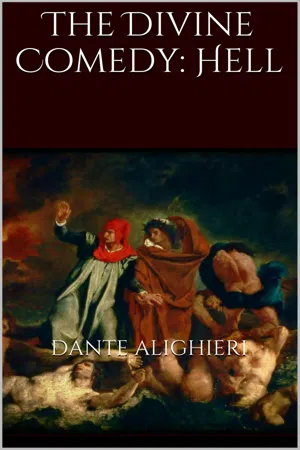
The Divine Comedy: Hell
About this book
Information
HELL.

CANTO I. Dante, astray in a wood, reaches the foot of a hill which he begins to ascend; he is hindered by three beasts; he turns back and is met by Virgil, who proposes to guide him into the eternal world.
Midway upon the road of our life I found myself within a dark wood, for the right way had been missed. Ah! how hard a thing it is to tell what this wild and rough and dense wood was, which in thought renews the fear! So bitter is it that death is little more. But in order to treat of the good that there I found, I will tell of the other things that I have seen there. I cannot well recount how I entered it, so full was I of slumber at that point where I abandoned the true way. But after I had arrived at the foot of a hill, where that valley ended which had pierced my heart with fear, I looked on high, and saw its shoulders clothed already with the rays of the planet[1] that leadeth men aright along every path. Then was the fear a little quieted which in the lake of my heart had lasted through the night that I passed so piteously. And even as one who with spent breath, issued out of the sea upon the shore, turns to the perilous water and gazes, so did my soul, which still was flying, turn back to look again upon the pass which never had a living person left.
[1] The sun, a planet according to the Ptolemaic system.
After I had rested a little my weary body I took my way again along the desert slope, so that the firm foot was always the lower. And ho! almost at the beginning of the steep a she-leopard, light and very nimble, which was covered with a spotted coat. And she did not move from before my face, nay, rather hindered so my road that to return I oftentimes had turned.
The time was at the beginning of the morning, and the Sun was mounting upward with those stars that were with him when Love Divine first set in motion those beautiful things;[1] so that the hour of the time and the sweet season were occasion of good hope to me concerning that wild beast with the dappled skin. But not so that the sight which appeared to me of a lion did not give me fear. He seemed to be coming against me, with head high and with ravening hunger, so that it seemed that the air was affrighted at him. And a she-wolf,[2] who with all cravings seemed laden in her meagreness, and already had made many folk to live forlorn,—she caused me so much heaviness, with the fear that came from sight of her, that I lost hope of the height And such as he is who gaineth willingly, and the time arrives that makes him lose, who in all his thoughts weeps and is sad,—such made me the beast without repose that, coming on against me, little by little was pushing me back thither where the Sun is silent.
[1] According to old tradition the spring was the season of the creation.
[2] These three beasts correspond to the triple division of sins into those of incontinence, of violence, and of fraud. See Canto XI.
While I was falling back to the low place, before mine eyes appeared one who through long silence seemed hoarse. When I saw him in the great desert, "Have pity on me!" I cried to him, "whatso thou art, or shade or real man." He answered me: "Not man; man once I was, and my parents were Lombards, and Mantuans by country both. I was born sub Julio, though late, and I lived at Rome under the good Augustus, in the time of the false and lying gods. Poet was I, and sang of that just son of Anchises who came from Troy after proud Ilion had been burned. But thou, why returnest thou to so great annoy? Why dost thou not ascend the delectable mountain which is the source and cause of every joy?"
"Art thou then that Virgil and that fount which poureth forth so large a stream of speech?" replied I to him with bashful front: "O honor and light of the other poem I may the long seal avail me, and the great love, which have made me search thy volume! Thou art my master and my author; thou alone art he from whom I took the fair style that hath done me honor. Behold the beast because of which I turned; help me against her, famous sage, for she makes any veins and pulses tremble." "Thee it behoves to hold another course," he replied, when he saw me weeping, "if thou wishest to escape from this savage place; for this beast, because of which thou criest out, lets not any one pass along her way, but so hinders him that she kills him! and she has a nature so malign and evil that she never sates her greedy will, and after food is hungrier than before. Many are the animals with which she wives, and there shall be more yet, till the hound [1] shall come that will make her die of grief. He shall not feed on land or goods, but wisdom and love and valor, and his birthplace shall be between Feltro and Feltro. Of that humble[2] Italy shall he be the salvation, for which the virgin Camilla died, and Euryalus, Turnus and Nisus of their wounds. He shall hunt her through every town till he shall have set her back in hell, there whence envy first sent her forth. Wherefore I think and deem it for thy best that thou follow me, and I will be thy guide, and will lead thee hence through the eternal place where thou shalt hear the despairing shrieks, shalt see the ancient spirits woeful who each proclaim the second death. And then thou shalt see those who are contented in the fire, because they hope to come, whenever it may be, to the blessed folk; to whom if thou wilt thereafter ascend, them shall be a soul more worthy than I for that. With her I will leave thee at my departure; for that Emperor who reigneth them above, because I was rebellious to His law, wills not that into His city any one should come through me. In all parts He governs and them He reigns: there in His city and His lofty seat. O happy he whom thereto He elects!" And I to him, "Poet, I beseech thee by that God whom thou didst not know, in order that I may escape this ill and worse, that thou lead me thither whom thou now hest said, so that I may see the gate of St. Peter, and those whom thou makest so afflicted."
[1] Of whom the hound is the symbol, and to whom Dante looked for the deliverance of Italy from the discorda and misrule that made her wretched, is still matter of doubt, after centuries of controversy.
[2] Fallen, humiliated.
Then he moved on, and I behind him kept.
CANTO II. Dante, doubtful of his own powers, is discouraged at the outset.—Virgil cheers him by telling him that he has been sent to his aid by a blessed Spirit from Heaven.—Dante casts off fear, and the poets proceed.
The day was going, and the dusky air was taking the living things that are on earth from their fatigues, and I alone was preparing to sustain the war alike of the road, and of the woe which the mind that erreth not shall retrace. O Muses, O lofty genius, now assist me! O mind that didst inscribe that which I saw, here shall thy nobility appear! I began:—"Poet, that guidest me, consider my virtue, if it is sufficient, ere to the deep pass thou trustest me. Thou sayest that the parent of Silvius while still corruptible went to the immortal world and was there in the body. Wherefore if the Adversary of every ill was then courteous, thinking on the high effect that should proceed from him, and on the Who and the What,[1] it seemeth not unmeet to the man of understanding; for in the empyreal heaven he had been chosen for father of revered Rome and of her empire; both which (to say truth indeed) were ordained for the holy place where the successor of the greater Peter hath his seat. Through this going, whereof thou givest him vaunt, he learned things which were the cause of his victory and of the papal mantle. Afterward the Chosen Vessel went thither to bring thence comfort to that faith which is the beginning of the way of salvation. But I, why go I thither? or who concedes it? I am not Aeneas, I am not Paul; me worthy of this, neither I nor others think; wherefore if I give myself up to go, I fear lest the going may be mad. Thou art wise, thou understandest better than I speak."
[1] Who he was, and what should result.
And as is he who unwills what he willed, and because of new thoughts changes his design, so that he quite withdraws from beginning, such I became on that dark hillside: wherefore in my thought I abandoned the enterprise which had been so hasty in the beginning.
"If I have rightly understood thy speech," replied that shade of the magnanimous one, "thy soul is hurt by cowardice, which oftentimes encumbereth a man so that it turns him back from honorable enterprise, as false seeing does a beast when it is startled. In order that thou loose thee from this fear I will tell thee wherefore I have come, and what I heard at the first moment that I grieved for thee. I was among those who are suspended,[1] and a Lady called me, so blessed and beautiful that I besought her to command. Her eyes were more lucent than the star, and she began to speak to me sweet and low, with angelic voice, in her own tongue: 'O courteous Mantuan soul, of whom the fame yet lasteth in the world, and shall last so long as the world endureth! a friend of mine and not of fortune upon the desert hillside is so hindered on his road that he has turned for fear, and I am afraid, through that which I have heard of him in heaven, lest already he be so astray that I may have risen late to his succor. Now do thou move, and with thy speech ornate, and with whatever is needful for his deliverance, assist him so that I may be consoled for him. I am Beatrice who make thee go. I come from a place whither I desire to return. Love moved me, and makes me speak. When I shall be before my Lord, I will commend thee often unto Him.' Then she was silent, and thereon I began: 'O Lady of Virtue, thou alone through whom the human race surpasseth all contained within that heaven which hath the smallest circles! [2] so pleasing unto me is thy command that to obey it, were it already done, were slow to me. Thou hast no need further to open unto me thy will; but tell me the cause why thou guardest not thyself from descending down here into this centre, from the ample place whither thou burnest to return.' 'Since thou wishest to know so inwardly, I will tell thee briefly,' she replied to me, 'wherefore I fear not to come here within. One ought to fear those things only that have power of doing harm, the others not, for they are not dreadful. I am made by God, thanks be to Him, such that your misery toucheth me not, nor doth the flame of this burning assail me. A gentle Lady[3] is in heaven who hath pity for this hindrance whereto I send thee, so that stern judgment there above she breaketh. She summoned Lucia in her request, and said, "Thy faithful one now hath need of thee, and unto thee I commend him." Lucia, the foe of every cruel one, rose and came to the place where I was, seated with the ancient Rachel. She said, "Beatrice, true praise of God, why dost thou not succor him who so loved thee that for thee he came forth from the vulgar throng? Dost thou not hear the pity of his plaint? Dost thou not see the death that combats him beside the stream whereof the sea hath no vaunt?" In the world never were persons swift to seek their good, and to fly their harm, as I, after these words were uttered, came here below, from my blessed seat, putting my trust in thy upright speech, which honors thee and them who have heard it.' After she had said this to me, weeping she turned her lucent eyes, whereby she made me more speedy in coming. And I came to thee as she willed. Thee have I delivered from that wild beast that took from thee the short ascent of the beautiful mountain. What is it then? Why, why dost thou hold back? why dost thou harbor such cowardice in thy heart? why hast thou not daring and boldness, since three blessed Ladies care for thee in the court of Heaven, and my speech pledges thee such good?"
[1] In Limbo, neither in Hell nor Heaven.
[2] The heaven of the moon, nearest to the earth.
[3] The Virgin.
As flowerets, bent and closed by the chill of night, after the sun shines on them straighten themselves all open on their stem, so I became with my weak virtue, and such good daring hastened to my heart that I began like one enfranchised: "Oh compassionate she who succored me! and thou courteous who didst speedily obey the true words that she addressed to thee! Thou by thy words hast so disposed my heart with desire of going, that I have returned unto my first intent. Go on now, for one sole will is in us both: Thou Leader, thou Lord, and thou Master." Thus I said to him; and when he had moved on, I entered along the deep and savage road.
CANTO III. The gate of Hell.—Virgil lends Dante in.—The punishment of the neither good nor bad.—Aeheron, and the sinners on its bank.—Charon.—Earthquake.—Dante swoons.
"Through me is the way into the woeful city; through me is the way into eternal woe; through me is the way among the lost people. Justice moved my lofty maker: the divine Power, the supreme Wisdom and the primal Love made me. Before me were no things created, unless eternal, and I eternal last. Leave every hope, ye who enter!"
These words of color obscure I saw written at the top of a gate; whereat I, "Master, their meaning is dire to me."
And he to me, like one who knew, "Here it behoves to leave every fear; it behoves that all cowardice should here be dead. We have come to the place where I have told thee that thou shalt see the woeful people, who have lost the good of the understanding."
And when he had put his hand on mine, with a glad countenance, wherefrom I took courage, he brought me within the secret things. Here sighs, laments, and deep wailings were resounding though the starless air; wherefore at first I wept thereat. Strange tongues, horrible cries, words of woe, accents of anger, voices high and hoarse, and sounds of hands with them, were making a tumult which whirls forever in that air dark without change, like the sand when the whirlwind breathes.
And I, who had my head girt with horror, said, "Master, what is it that I hear? and what folk are they who seem in woe so vanquished?"
And he to me, "This miserable measure the wretched souls maintain of those who lived without infamy and without praise. Mingled are they with that caitiff choir of the angels, who were not rebels, nor were faithful to God, but were for themselves. The heavens chased them out in order to be not less beautiful, nor doth the depth of Hell receive them, because the damned would have some glory from them."
And I, "Master, what is so grievous to them, that makes them lament so bitterly?"
He answered, "I will tell thee very briefly. These have no hope of death; and their blind life is so debased, that they are envious of every other lot. Fame of them the world permitteth not to be; mercy and justice disdain them. Let us not speak of them, but do thou look and pass on."
And I, who was gazing, saw a banner, that whirling ran so swiftly that it seemed to me to scorn all repose, and behind it came so long a train of folk, that I could never have believed death had undone so many. After I had distinguished some among them, I saw and knew the shade of him who made, through cowardice, the great refusal. [1] At once I understood and was certain, that this was the sect of the caitiffs displeasing unto God, and unto his enemies. These wretches, who never were alive, were naked, and much stung by gad-flies and by wasps that were there. These streaked their faces with blood, which, mingled with tears, was harvested at their feet by loathsome worms.
[1] Who is intended by these words is uncertain.
And when I gave myself to looking onward, I saw people on the bank of a great river; wherefore I said, "Master, now grant to me that I may know who these are, and what rule makes them appear so ready to pass over, as I discern through the faint light." And he to me, "The things will be clear to thee, when we shall set our steps on the sad marge of Acheron." Then with eyes bashful and cast down, fearing lest my speech had been irksome to him, far as to the river I refrained from speaking.
And lo! coming toward us in a boat, an old man, white with ancient hair, crying, "Woe to you, wicked souls! hope not ever to see Heaven! I come to carry you to the other bank, into eternal darkness, to heat and frost. And thou who art there, living soul, depart from these that are dead." But when he saw that I did not depart, he said, "By another way, by other ports thou shalt come to the shore, not here, for passage; it behoves that a lighter bark bear thee."[1]
[1] The boat that bears the souls to Purgatory. Charon recognizes that Dante is not among the damned.
And my Leader to him, "Charon, vex not thyself, it is thus willed there where is power to do that which is willed; and farther ask not." Then the fleecy cheeks were quiet of the pilot of the livid marsh, who round about his eyes had wheels of flame.
But those souls, who were weary and naked, changed color, and gnashed their teeth soon as they heard his cruel words. They blasphemed God and their parents, the human race, the place, the time and the seed of their sowing and of their birth. Then, bitterly weeping, they drew back all of them together to the evil bank, that waits for every man who fears not God. Charon the demon, with eyes of glowing coal, beckoning them, collects them all; he beats with his oar whoever lingers.
As in autumn the leaves fall off one after the other, till the bough sees all its spoils upon the earth, in like wise the evil seed of Adam throw themselves from that shore one by one at signals, as the bird at his call. Thus they go over the dusky wave, and before they have landed on the farther side, already on this a new throng is gathered.
"My son," said the courteous Master, "those who die in the wrath of God, all meet together here from every land. And they are eager to pass over the stream, for the divine justice spurs them, so that fear is turned to desire. This way a good soul never passes; and therefore if Charon snarleth at thee, thou now mayest well know what his speech signifies." This ended, the dark plain trembled so mightily, that the memory of the terror even now bathes me with sweat. The tearful land gave forth a wind that flashed a vermilion light which vanquished every sense of mine, and I fell as a man whom slumber seizes.
CANTO IV. The further side of Acheron.—Virgil leads Dante into Limbo, the First Circle of Hell, containing the spirits of those who lived virtuously but without Christianity.—Greeting of Virgil by his fellow poets.—They enter a castle, where are the shades of ancient worthies.—Virgil and Dante depart.
A heavy thunder broke the deep sleep in my head, so that I started up like a person who by force is wakened. And risen erect, I moved my rested eye round about, and looked fixedly to distinguish the place where I was. True it is, that I found myself on the verge of the valley of the woeful abyss that gathers in thunder of infinite wailings. Dark, profound it was, and cloudy, so that though I fixed my sight on the bottom I did not discern anything there.
"Now we descend down here into the blind world," began the Poet all deadly pale, "I will be first, and thou shalt be second."
And I, who had observed his color, said, "How shall I come, if thou fearest, who art wont to be a comfort to my doubting?" And he to me, "The anguish of the folk who are down here depicts upon my face that pity which thou takest for fear. Let us go on, for the long way urges us."
So he set forth, and so he made me enter within the first circle that girds the abyss. Here, so far as could be heard, there was no plaint but that of sighs which made the eternal air to tremble: this came of the woe without torments felt by the crowds, which were many and great, of infants and of women and of men.
The good Master to me, "Thou dost not ask what spirits are these that thou seest. Now I would have thee know, before thou goest farther, that they sinned not; and if they have merits it sufficeth not, because they had not baptism, which is part of the faith that thou believest; and if they were before Christianity, the...
Midway upon the road of our life I found myself within a dark wood, for the right way had been missed. Ah! how hard a thing it is to tell what this wild and rough and dense wood was, which in thought renews the fear! So bitter is it that death is little more. But in order to treat of the good that there I found, I will tell of the other things that I have seen there. I cannot well recount how I entered it, so full was I of slumber at that point where I abandoned the true way. But after I had arrived at the foot of a hill, where that valley ended which had pierced my heart with fear, I looked on high, and saw its shoulders clothed already with the rays of the planet[1] that leadeth men aright along every path. Then was the fear a little quieted which in the lake of my heart had lasted through the night that I passed so piteously. And even as one who with spent breath, issued out of the sea upon the shore, turns to the perilous water and gazes, so did my soul, which still was flying, turn back to look again upon the pass which never had a living person left.
[1] The sun, a planet according to the Ptolemaic system.
After I had rested a little my weary body I took my way again along the desert slope, so that the firm foot was always the lower. And ho! almost at the beginning of the steep a she-leopard, light and very nimble, which was covered with a spotted coat. And she did not move from before my face, nay, rather hindered so my road that to return I oftentimes had turned.
The time was at the beginning of the morning, and the Sun was mounting upward with those stars that were with him when Love Divine first set in motion those beautiful things;[1] so that the hour of the time and the sweet season were occasion of good hope to me concerning that wild beast with the dappled skin. But not so that the sight which appeared to me of a lion did not give me fear. He seemed to be coming against me, with head high and with ravening hunger, so that it seemed that the air was affrighted at him. And a she-wolf,[2] who with all cravings seemed laden in her meagreness, and already had made many folk to live forlorn,—she caused me so much heaviness, with the fear that came from sight of her, that I lost hope of the height And such as he is who gaineth willingly, and the time arrives that makes him lose, who in all his thoughts weeps and is sad,—such made me the beast without repose that, coming on against me, little by little was pushing me back thither where the Sun is silent.
[1] According to old tradition the spring was the season of the creation.
[2] These three beasts correspond to the triple division of sins into those of incontinence, of violence, and of fraud. See Canto XI.
While I was falling back to the low place, before mine eyes appeared one who through long silence seemed hoarse. When I saw him in the great desert, "Have pity on me!" I cried to him, "whatso thou art, or shade or real man." He answered me: "Not man; man once I was, and my parents were Lombards, and Mantuans by country both. I was born sub Julio, though late, and I lived at Rome under the good Augustus, in the time of the false and lying gods. Poet was I, and sang of that just son of Anchises who came from Troy after proud Ilion had been burned. But thou, why returnest thou to so great annoy? Why dost thou not ascend the delectable mountain which is the source and cause of every joy?"
"Art thou then that Virgil and that fount which poureth forth so large a stream of speech?" replied I to him with bashful front: "O honor and light of the other poem I may the long seal avail me, and the great love, which have made me search thy volume! Thou art my master and my author; thou alone art he from whom I took the fair style that hath done me honor. Behold the beast because of which I turned; help me against her, famous sage, for she makes any veins and pulses tremble." "Thee it behoves to hold another course," he replied, when he saw me weeping, "if thou wishest to escape from this savage place; for this beast, because of which thou criest out, lets not any one pass along her way, but so hinders him that she kills him! and she has a nature so malign and evil that she never sates her greedy will, and after food is hungrier than before. Many are the animals with which she wives, and there shall be more yet, till the hound [1] shall come that will make her die of grief. He shall not feed on land or goods, but wisdom and love and valor, and his birthplace shall be between Feltro and Feltro. Of that humble[2] Italy shall he be the salvation, for which the virgin Camilla died, and Euryalus, Turnus and Nisus of their wounds. He shall hunt her through every town till he shall have set her back in hell, there whence envy first sent her forth. Wherefore I think and deem it for thy best that thou follow me, and I will be thy guide, and will lead thee hence through the eternal place where thou shalt hear the despairing shrieks, shalt see the ancient spirits woeful who each proclaim the second death. And then thou shalt see those who are contented in the fire, because they hope to come, whenever it may be, to the blessed folk; to whom if thou wilt thereafter ascend, them shall be a soul more worthy than I for that. With her I will leave thee at my departure; for that Emperor who reigneth them above, because I was rebellious to His law, wills not that into His city any one should come through me. In all parts He governs and them He reigns: there in His city and His lofty seat. O happy he whom thereto He elects!" And I to him, "Poet, I beseech thee by that God whom thou didst not know, in order that I may escape this ill and worse, that thou lead me thither whom thou now hest said, so that I may see the gate of St. Peter, and those whom thou makest so afflicted."
[1] Of whom the hound is the symbol, and to whom Dante looked for the deliverance of Italy from the discorda and misrule that made her wretched, is still matter of doubt, after centuries of controversy.
[2] Fallen, humiliated.
Then he moved on, and I behind him kept.
CANTO II. Dante, doubtful of his own powers, is discouraged at the outset.—Virgil cheers him by telling him that he has been sent to his aid by a blessed Spirit from Heaven.—Dante casts off fear, and the poets proceed.
The day was going, and the dusky air was taking the living things that are on earth from their fatigues, and I alone was preparing to sustain the war alike of the road, and of the woe which the mind that erreth not shall retrace. O Muses, O lofty genius, now assist me! O mind that didst inscribe that which I saw, here shall thy nobility appear! I began:—"Poet, that guidest me, consider my virtue, if it is sufficient, ere to the deep pass thou trustest me. Thou sayest that the parent of Silvius while still corruptible went to the immortal world and was there in the body. Wherefore if the Adversary of every ill was then courteous, thinking on the high effect that should proceed from him, and on the Who and the What,[1] it seemeth not unmeet to the man of understanding; for in the empyreal heaven he had been chosen for father of revered Rome and of her empire; both which (to say truth indeed) were ordained for the holy place where the successor of the greater Peter hath his seat. Through this going, whereof thou givest him vaunt, he learned things which were the cause of his victory and of the papal mantle. Afterward the Chosen Vessel went thither to bring thence comfort to that faith which is the beginning of the way of salvation. But I, why go I thither? or who concedes it? I am not Aeneas, I am not Paul; me worthy of this, neither I nor others think; wherefore if I give myself up to go, I fear lest the going may be mad. Thou art wise, thou understandest better than I speak."
[1] Who he was, and what should result.
And as is he who unwills what he willed, and because of new thoughts changes his design, so that he quite withdraws from beginning, such I became on that dark hillside: wherefore in my thought I abandoned the enterprise which had been so hasty in the beginning.
"If I have rightly understood thy speech," replied that shade of the magnanimous one, "thy soul is hurt by cowardice, which oftentimes encumbereth a man so that it turns him back from honorable enterprise, as false seeing does a beast when it is startled. In order that thou loose thee from this fear I will tell thee wherefore I have come, and what I heard at the first moment that I grieved for thee. I was among those who are suspended,[1] and a Lady called me, so blessed and beautiful that I besought her to command. Her eyes were more lucent than the star, and she began to speak to me sweet and low, with angelic voice, in her own tongue: 'O courteous Mantuan soul, of whom the fame yet lasteth in the world, and shall last so long as the world endureth! a friend of mine and not of fortune upon the desert hillside is so hindered on his road that he has turned for fear, and I am afraid, through that which I have heard of him in heaven, lest already he be so astray that I may have risen late to his succor. Now do thou move, and with thy speech ornate, and with whatever is needful for his deliverance, assist him so that I may be consoled for him. I am Beatrice who make thee go. I come from a place whither I desire to return. Love moved me, and makes me speak. When I shall be before my Lord, I will commend thee often unto Him.' Then she was silent, and thereon I began: 'O Lady of Virtue, thou alone through whom the human race surpasseth all contained within that heaven which hath the smallest circles! [2] so pleasing unto me is thy command that to obey it, were it already done, were slow to me. Thou hast no need further to open unto me thy will; but tell me the cause why thou guardest not thyself from descending down here into this centre, from the ample place whither thou burnest to return.' 'Since thou wishest to know so inwardly, I will tell thee briefly,' she replied to me, 'wherefore I fear not to come here within. One ought to fear those things only that have power of doing harm, the others not, for they are not dreadful. I am made by God, thanks be to Him, such that your misery toucheth me not, nor doth the flame of this burning assail me. A gentle Lady[3] is in heaven who hath pity for this hindrance whereto I send thee, so that stern judgment there above she breaketh. She summoned Lucia in her request, and said, "Thy faithful one now hath need of thee, and unto thee I commend him." Lucia, the foe of every cruel one, rose and came to the place where I was, seated with the ancient Rachel. She said, "Beatrice, true praise of God, why dost thou not succor him who so loved thee that for thee he came forth from the vulgar throng? Dost thou not hear the pity of his plaint? Dost thou not see the death that combats him beside the stream whereof the sea hath no vaunt?" In the world never were persons swift to seek their good, and to fly their harm, as I, after these words were uttered, came here below, from my blessed seat, putting my trust in thy upright speech, which honors thee and them who have heard it.' After she had said this to me, weeping she turned her lucent eyes, whereby she made me more speedy in coming. And I came to thee as she willed. Thee have I delivered from that wild beast that took from thee the short ascent of the beautiful mountain. What is it then? Why, why dost thou hold back? why dost thou harbor such cowardice in thy heart? why hast thou not daring and boldness, since three blessed Ladies care for thee in the court of Heaven, and my speech pledges thee such good?"
[1] In Limbo, neither in Hell nor Heaven.
[2] The heaven of the moon, nearest to the earth.
[3] The Virgin.
As flowerets, bent and closed by the chill of night, after the sun shines on them straighten themselves all open on their stem, so I became with my weak virtue, and such good daring hastened to my heart that I began like one enfranchised: "Oh compassionate she who succored me! and thou courteous who didst speedily obey the true words that she addressed to thee! Thou by thy words hast so disposed my heart with desire of going, that I have returned unto my first intent. Go on now, for one sole will is in us both: Thou Leader, thou Lord, and thou Master." Thus I said to him; and when he had moved on, I entered along the deep and savage road.
CANTO III. The gate of Hell.—Virgil lends Dante in.—The punishment of the neither good nor bad.—Aeheron, and the sinners on its bank.—Charon.—Earthquake.—Dante swoons.
"Through me is the way into the woeful city; through me is the way into eternal woe; through me is the way among the lost people. Justice moved my lofty maker: the divine Power, the supreme Wisdom and the primal Love made me. Before me were no things created, unless eternal, and I eternal last. Leave every hope, ye who enter!"
These words of color obscure I saw written at the top of a gate; whereat I, "Master, their meaning is dire to me."
And he to me, like one who knew, "Here it behoves to leave every fear; it behoves that all cowardice should here be dead. We have come to the place where I have told thee that thou shalt see the woeful people, who have lost the good of the understanding."
And when he had put his hand on mine, with a glad countenance, wherefrom I took courage, he brought me within the secret things. Here sighs, laments, and deep wailings were resounding though the starless air; wherefore at first I wept thereat. Strange tongues, horrible cries, words of woe, accents of anger, voices high and hoarse, and sounds of hands with them, were making a tumult which whirls forever in that air dark without change, like the sand when the whirlwind breathes.
And I, who had my head girt with horror, said, "Master, what is it that I hear? and what folk are they who seem in woe so vanquished?"
And he to me, "This miserable measure the wretched souls maintain of those who lived without infamy and without praise. Mingled are they with that caitiff choir of the angels, who were not rebels, nor were faithful to God, but were for themselves. The heavens chased them out in order to be not less beautiful, nor doth the depth of Hell receive them, because the damned would have some glory from them."
And I, "Master, what is so grievous to them, that makes them lament so bitterly?"
He answered, "I will tell thee very briefly. These have no hope of death; and their blind life is so debased, that they are envious of every other lot. Fame of them the world permitteth not to be; mercy and justice disdain them. Let us not speak of them, but do thou look and pass on."
And I, who was gazing, saw a banner, that whirling ran so swiftly that it seemed to me to scorn all repose, and behind it came so long a train of folk, that I could never have believed death had undone so many. After I had distinguished some among them, I saw and knew the shade of him who made, through cowardice, the great refusal. [1] At once I understood and was certain, that this was the sect of the caitiffs displeasing unto God, and unto his enemies. These wretches, who never were alive, were naked, and much stung by gad-flies and by wasps that were there. These streaked their faces with blood, which, mingled with tears, was harvested at their feet by loathsome worms.
[1] Who is intended by these words is uncertain.
And when I gave myself to looking onward, I saw people on the bank of a great river; wherefore I said, "Master, now grant to me that I may know who these are, and what rule makes them appear so ready to pass over, as I discern through the faint light." And he to me, "The things will be clear to thee, when we shall set our steps on the sad marge of Acheron." Then with eyes bashful and cast down, fearing lest my speech had been irksome to him, far as to the river I refrained from speaking.
And lo! coming toward us in a boat, an old man, white with ancient hair, crying, "Woe to you, wicked souls! hope not ever to see Heaven! I come to carry you to the other bank, into eternal darkness, to heat and frost. And thou who art there, living soul, depart from these that are dead." But when he saw that I did not depart, he said, "By another way, by other ports thou shalt come to the shore, not here, for passage; it behoves that a lighter bark bear thee."[1]
[1] The boat that bears the souls to Purgatory. Charon recognizes that Dante is not among the damned.
And my Leader to him, "Charon, vex not thyself, it is thus willed there where is power to do that which is willed; and farther ask not." Then the fleecy cheeks were quiet of the pilot of the livid marsh, who round about his eyes had wheels of flame.
But those souls, who were weary and naked, changed color, and gnashed their teeth soon as they heard his cruel words. They blasphemed God and their parents, the human race, the place, the time and the seed of their sowing and of their birth. Then, bitterly weeping, they drew back all of them together to the evil bank, that waits for every man who fears not God. Charon the demon, with eyes of glowing coal, beckoning them, collects them all; he beats with his oar whoever lingers.
As in autumn the leaves fall off one after the other, till the bough sees all its spoils upon the earth, in like wise the evil seed of Adam throw themselves from that shore one by one at signals, as the bird at his call. Thus they go over the dusky wave, and before they have landed on the farther side, already on this a new throng is gathered.
"My son," said the courteous Master, "those who die in the wrath of God, all meet together here from every land. And they are eager to pass over the stream, for the divine justice spurs them, so that fear is turned to desire. This way a good soul never passes; and therefore if Charon snarleth at thee, thou now mayest well know what his speech signifies." This ended, the dark plain trembled so mightily, that the memory of the terror even now bathes me with sweat. The tearful land gave forth a wind that flashed a vermilion light which vanquished every sense of mine, and I fell as a man whom slumber seizes.
CANTO IV. The further side of Acheron.—Virgil leads Dante into Limbo, the First Circle of Hell, containing the spirits of those who lived virtuously but without Christianity.—Greeting of Virgil by his fellow poets.—They enter a castle, where are the shades of ancient worthies.—Virgil and Dante depart.
A heavy thunder broke the deep sleep in my head, so that I started up like a person who by force is wakened. And risen erect, I moved my rested eye round about, and looked fixedly to distinguish the place where I was. True it is, that I found myself on the verge of the valley of the woeful abyss that gathers in thunder of infinite wailings. Dark, profound it was, and cloudy, so that though I fixed my sight on the bottom I did not discern anything there.
"Now we descend down here into the blind world," began the Poet all deadly pale, "I will be first, and thou shalt be second."
And I, who had observed his color, said, "How shall I come, if thou fearest, who art wont to be a comfort to my doubting?" And he to me, "The anguish of the folk who are down here depicts upon my face that pity which thou takest for fear. Let us go on, for the long way urges us."
So he set forth, and so he made me enter within the first circle that girds the abyss. Here, so far as could be heard, there was no plaint but that of sighs which made the eternal air to tremble: this came of the woe without torments felt by the crowds, which were many and great, of infants and of women and of men.
The good Master to me, "Thou dost not ask what spirits are these that thou seest. Now I would have thee know, before thou goest farther, that they sinned not; and if they have merits it sufficeth not, because they had not baptism, which is part of the faith that thou believest; and if they were before Christianity, the...
Table of contents
- The Divine Comedy: Hell
- INTRODUCTION.
- AIDS TO THE STUDY OF THE DIVINE COMEDY.
- HELL.
- Copyright
Trusted by 375,005 students
Access to over 1.5 million titles for a fair monthly price.
Study more efficiently using our study tools.
Frequently asked questions
Yes, you can cancel anytime from the Subscription tab in your account settings on the Perlego website. Your subscription will stay active until the end of your current billing period. Learn how to cancel your subscription
No, books cannot be downloaded as external files, such as PDFs, for use outside of Perlego. However, you can download books within the Perlego app for offline reading on mobile or tablet. Learn how to download books offline
Perlego offers two plans: Essential and Complete
- Essential is ideal for learners and professionals who enjoy exploring a wide range of subjects. Access the Essential Library with 800,000+ trusted titles and best-sellers across business, personal growth, and the humanities. Includes unlimited reading time and Standard Read Aloud voice.
- Complete: Perfect for advanced learners and researchers needing full, unrestricted access. Unlock 1.5M+ books across hundreds of subjects, including academic and specialized titles. The Complete Plan also includes advanced features like Premium Read Aloud and Research Assistant.
We are an online textbook subscription service, where you can get access to an entire online library for less than the price of a single book per month. With over 1.5 million books across 990+ topics, we’ve got you covered! Learn about our mission
Look out for the read-aloud symbol on your next book to see if you can listen to it. The read-aloud tool reads text aloud for you, highlighting the text as it is being read. You can pause it, speed it up and slow it down. Learn more about Read Aloud
Yes! You can use the Perlego app on both iOS and Android devices to read anytime, anywhere — even offline. Perfect for commutes or when you’re on the go.
Please note we cannot support devices running on iOS 13 and Android 7 or earlier. Learn more about using the app
Please note we cannot support devices running on iOS 13 and Android 7 or earlier. Learn more about using the app
Yes, you can access The Divine Comedy: Hell by Dante Alighieri in PDF and/or ePUB format, as well as other popular books in Literature & Poetry. We have over 1.5 million books available in our catalogue for you to explore.