It is reasonable to expect that a musician shall be at least an accurate and legible writer as well as a reader of the language of his Art. The immense increase in the amount of music published, and its cheapness, seem rather to have increased than decreased this necessity, for they have vastly multiplied activity in the Art. If they have not intensified the necessity for music-writing, they have increased the number of those by whom the necessity is felt.Intelligent knowledge of Notation is the more necessary inasmuch as music writing is in only a comparatively few cases mere copying. Even when writing from a copy, some alteration is frequently necessary, as will be shown in the following pages, requiring independent knowledge of the subject on the part of the copyist.Yet many musicians, thoroughly competent as performers, cannot write a measure of music without bringing a smile to the lips of the initiated.Many performers will play or sing a note at sight without hesitation, which, asked to write, they will first falter over and then bungle-at least by writing it at the wrong octave.The admirable working of theoretical examination papers is sometimes in ridiculous contrast with the puerility of the writing.Psychologists would probably say that this was because conceptual action is a higher mental function than perceptual: in other words, that recollection is harder than recognition.The remedy is simple. Recognition must be developed till it becomes recollection: the writing of music must be taught concurrently with the reading of it.
- 41 pages
- English
- ePUB (mobile friendly)
- Available on iOS & Android
eBook - ePub
How to Write Music
About this book
Information
Subtopic
MusicOpen Score to Short Score.
41.—In transcribing from open score to short score, a single
sound sung by two voices simultaneously beginning and
ending at the same time, should, if a whole note, be
represented by two note-heads linked; if a half note or shorter
note, by having two stems, one up and the other down:
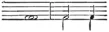
Fig. 29.
42.— Black notes, though of
different lengths, may have the same note-head
if they begin at the same time, the
difference being shown in the hook or hooks:

Fig. 30.
But a whole note and a half note must have separate
note-heads, since a stem would turn a whole note into a half note;
and a whole note or half note and a quarter note must have separate
note-heads, since a note cannot be white and black at the same
time. In this case the note-head
of shorter duration must be written first
:

Fig. 31.
The rule is sometimes relaxed, and the longer note written
first, when the shorter note is the first of a group.
Albeit a half note and an eighth, or other hooked note, may
have the same note-head, provided this be that of the
half note , because the hook shows that in one part
the note is intended to be read as an eighth note. They cannot have
an eighth note-head because there is nothing to distinguish the
stem of a half note from that of a quarter:

Fig. 32.
43.—Notes cannot have the same note-head which
begin at different times, even though
they end at the same time. This would
involve writing one of them in the wrong part of the measure (see
“Placing of Notes,” par.
14).
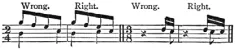
Fig. 33.
Hence, as a dotted quarter is a sixteenth shorter than two
dotted eighths and a sixteenth, and therefore the final note does
not begin at the same time (though
it ends at the same time) in the treble
and alto parts of the last group of Fig. 16 (par. 35), the example
is inaccurate. It should have been written thus:

Fig. 34.
and would be so played were the passage given, say, to two
violins.
[The tyro must not mistake the above two final note-heads,
the longer of which comes first, for a
breach of the rule exemplified in Fig. 31 (par. 42), and which
applies to two notes which begin at the
same time. Here the longer note begins before
the shorter one.]
44.—In part-music all the accidentals in an open score will
have to be reproduced in short score. Each performer is only
supposed to read his own part, and cannot be assumed to have seen
an accidental in another part which, had it been seen, would have
rendered one in his own unnecessary. Thus the sharps in Fig.
35

Fig. 35.
will remain in a transcription to short score,
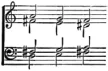
Fig. 36.
if intended for part-singers or players. (A pianist or
organist would not need the second sharp in each stave, while
probably preferring it as a recognition
of the part-writing character of the music.)
45.—In music which is not
part-writing, the transcriber will have to use his discretion
as to the repetition of accidentals which have already appeared in
another “part” in the same measure. The guiding principle will be
to avoid the likelihood of error on the part of a competent
reader.
46.—Care must be taken to turn the stems of half notes and
shorter notes according to the principles of short score, and not
necessarily as they are in the open score.
Short Score to Open Score.
47.—Co-relatively, in transcribing from short score to open, it will occasionally be necessary to put accidentals in the latter which are not in the former. The commonest form of this is probably in extracting a single part, soprano, alto, tenor, or bass, from an ordinary short score hymn or chant book, and writing it in a part-book for the particular voice. Thus, in transcribing the tenor of the following extract from the hymn-tune “H...
Table of contents
- How to Write Music
- Introductory.
- Choice of Paper.
- Scoring.
- Barring.
- Clefs.
- Signatures.
- Notation of Rhythm.
- Placing of Notes.
- Rests.
- Dots.
- Stems.
- Hooks.
- Vocal Music.
- Open Score to Short Score.
- Short Score to Open Score.
- Extracting a Single Part.
- Accidentals.
- Legibility.
- Facility.
- Copyright.
- Copyright
Trusted by 375,005 students
Access to over 1.5 million titles for a fair monthly price.
Study more efficiently using our study tools.
Frequently asked questions
Yes, you can cancel anytime from the Subscription tab in your account settings on the Perlego website. Your subscription will stay active until the end of your current billing period. Learn how to cancel your subscription
No, books cannot be downloaded as external files, such as PDFs, for use outside of Perlego. However, you can download books within the Perlego app for offline reading on mobile or tablet. Learn how to download books offline
We are an online textbook subscription service, where you can get access to an entire online library for less than the price of a single book per month. With over 1.5 million books across 990+ topics, we’ve got you covered! Learn about our mission
Look out for the read-aloud symbol on your next book to see if you can listen to it. The read-aloud tool reads text aloud for you, highlighting the text as it is being read. You can pause it, speed it up and slow it down. Learn more about Read Aloud
Yes! You can use the Perlego app on both iOS and Android devices to read anytime, anywhere — even offline. Perfect for commutes or when you’re on the go.
Please note we cannot support devices running on iOS 13 and Android 7 or earlier. Learn more about using the app
Please note we cannot support devices running on iOS 13 and Android 7 or earlier. Learn more about using the app
Yes, you can access How to Write Music by Clement A. Harris in PDF and/or ePUB format, as well as other popular books in Media & Performing Arts & Music. We have over 1.5 million books available in our catalogue for you to explore.