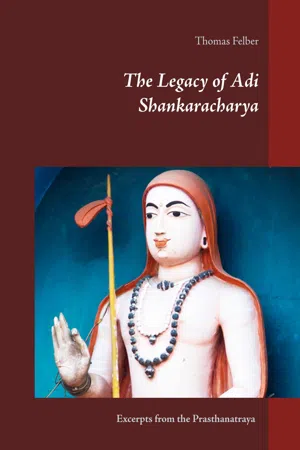
Shankara Bhagavatpada (~788 - 820 CE) was a true master of the highest caliber who expounded the ancient teachings of the Bhagavad Gita, the Principal Upanishads, and the Brahma Sutras, usually known as Prasthanatraya in an ingenious way.This anthology of nearly 1900 selections arranged in 160 topics from different English translations of the Prasthanatraya and other sources should assist any serious seeker regarding modern Vedantic exegesis.
- 480 pages
- English
- ePUB (mobile friendly)
- Available on iOS & Android
eBook - ePub
The Legacy of Adi Shankaracharya
About this book
Information
Table of contents
- Dedication
- Table of Contents
- Abbreviations
- Preface
- Abhaysa
- Abode
- Absolute
- Adhyaropa Apavada
- Adhyasa
- Afflictions
- Agnihotra
- Aims
- Akasa
- Anandamaya
- Anger
- Anirvacaniya
- Ashrama
- Atman
- Attachment
- Avastatraya (Avasthātraya Viveka)
- Avatar
- Avidya
- Avidya has no absolute existence
- Avidya is imagined
- Avyakta
- Bhagavan
- Bhakti (Devotion)
- Birth/Death
- Bliss
- Bondage
- Brahmacharya
- Brahman
- Causal Body (Kāraṇa-Śarīra)
- Cause/Effect (Kāraṇa-Kārya Viveka)
- Consciousness
- Creation/Dissolution
- Deep Sleep State (Sushupti)
- Deep Sleep State (No Avidya)
- Desire
- Dharma
- Disciple
- Doership
- Dream-State (Svapna)
- Duties
- Egoism
- Elements
- Evilness
- Fear
- Free Will
- Food
- Freedom
- Gayatri
- God (Īśvara)
- Gods (Devas)
- Grief
- Gunas
- Guru
- Happiness
- Heart
- Heaven
- Hiranyagarbha
- Humility
- Illustrations
- Immortality
- Individual Soul (Jiva)
- Infinity
- Intellect (Buddhi)
- Jnana-Yoga
- Karma
- Karma-Yoga
- Knowledge (Empirical)
- Liberation (Moksha)
- Liberation by Stages
- Love
- Lust
- Man of Realization (Jivanmukti)
- Mantra
- Maya
- Maya as a teaching model
- Maya is imagined due to Avidya
- Meditation
- Merit/Demerit
- Mind
- Mithya
- Muni
- Namarupa
- Non-Duality (Advaita)
- Northern/Southern Path
- OM
- Organs of Actions (Karma Indriyas)
- Organs of Perception (Jnana Indriyas)
- Pain
- Peace
- Perception
- Physical Body (Sthūla Śarīra)
- Prajapati
- Pramana
- Prana
- Prarabdha Karma
- Prayer
- Pride
- Purification of the Mind (Sattva śuddhi)
- Purpose of Creation
- Qualifications (Sādhana Chathushtaya Sampatti)
- Rebirth
- Refutations (of other schools of thought)
- Refutation of Abhasavada (Theory of Appearances)
- Refutation of Anekajivavada (Theory of many Jivas)
- Refutation of Asatkaryavada (Arambhavada)
- Refutation of Avacchedavada (Theory of Delimitation)
- Refutation of the Bhagavata Doctrine
- Refutation of Bhatta Mimamsa
- Refutation of Buddhistic Doctrines
- Refutation of Drishti-Srishti/Srishti-Drishti Vada
- Refutation of Dualism
- Refutation of Ekajivavada (Theory of one Jiva)
- Refutation of Jainism
- Refutation of Lokayata (Carvaka, Materialists)
- Refutation of Nastikavada (Atheism)
- Refutation of Nyāya-Vaiśeṣika
- Refutation of Parinamavada (Theory of Transformation)
- Refutation of Pratibimbavada (Reflection Theory)
- Refutation of Purva Mimamsa
- Refutation of Samkhya
- Refutation of Sarvastivada (Buddhist Realism)
- Refutation of Satkaryavada
- Refutation of Sunyavada (Absolute Nihilism)
- Refutation of Vijnanavada (Buddhist Idealism)
- Refutation of Yadrcchavada (Accidentalism)
- Refutation of Yoga
- Religious Practices
- Renunciation (Sannyasa)
- Rites
- Sadhana
- Samadhi
- Samsara
- Satyam
- Scriptures
- Self-Knowledge (Ātmajñāna)
- Sentient & Insentient
- Sheaths (Pañca-Kośa-Viveka)
- Shraddha
- Siddhi
- Sin
- Sorrow
- Strength
- Subtle Body (Sūkṣma Śarīra)
- Swoon
- Tapas (Austerity)
- Truth
- Turiya
- Upadhi
- Upanishad
- Upasana
- Vaisvanara
- Vasanas
- Vedanta
- Vedas
- Virat
- Vivarta-Vada
- Waking-State (Jagrat)
- Wife
- World (Phenomenal)
- Yoga
- Bibliography
- General Index
- Copyright
Trusted by 375,005 students
Access to over 1.5 million titles for a fair monthly price.
Study more efficiently using our study tools.
Frequently asked questions
Yes, you can cancel anytime from the Subscription tab in your account settings on the Perlego website. Your subscription will stay active until the end of your current billing period. Learn how to cancel your subscription
No, books cannot be downloaded as external files, such as PDFs, for use outside of Perlego. However, you can download books within the Perlego app for offline reading on mobile or tablet. Learn how to download books offline
Perlego offers two plans: Essential and Complete
- Essential is ideal for learners and professionals who enjoy exploring a wide range of subjects. Access the Essential Library with 800,000+ trusted titles and best-sellers across business, personal growth, and the humanities. Includes unlimited reading time and Standard Read Aloud voice.
- Complete: Perfect for advanced learners and researchers needing full, unrestricted access. Unlock 1.5M+ books across hundreds of subjects, including academic and specialized titles. The Complete Plan also includes advanced features like Premium Read Aloud and Research Assistant.
We are an online textbook subscription service, where you can get access to an entire online library for less than the price of a single book per month. With over 1.5 million books across 990+ topics, we’ve got you covered! Learn about our mission
Look out for the read-aloud symbol on your next book to see if you can listen to it. The read-aloud tool reads text aloud for you, highlighting the text as it is being read. You can pause it, speed it up and slow it down. Learn more about Read Aloud
Yes! You can use the Perlego app on both iOS and Android devices to read anytime, anywhere — even offline. Perfect for commutes or when you’re on the go.
Please note we cannot support devices running on iOS 13 and Android 7 or earlier. Learn more about using the app
Please note we cannot support devices running on iOS 13 and Android 7 or earlier. Learn more about using the app
Yes, you can access The Legacy of Adi Shankaracharya by Thomas Felber in PDF and/or ePUB format, as well as other popular books in Histoire & Histoire du monde. We have over 1.5 million books available in our catalogue for you to explore.