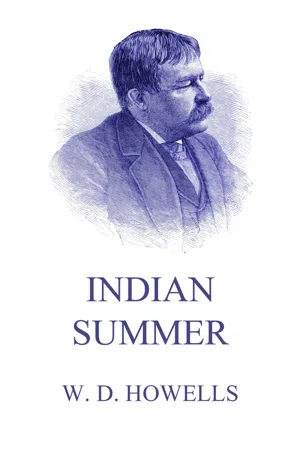
Mr. Howells is giving us in ' Indian Summer' some of the very best work he has ever done; full of the same dainty piquantness, but alive with deeper sympathies and meanings. This is full, not merely of what average people say and do, but of what average people think and feel behind what they say and do. The difference between 'Silas Lapham' and 'Indian Summer' is like the difference between a pearl and an opal: the opal has a soul. Nothing could be more entertaining than the letter of Mrs. Bowen as a perfect illustration of a poor woman trying to be just, but unconsciously adding a touch to make it seem that the other woman has not won so much after all; while Colville's bright talk, Mr. Howells's allusion to his own work, and bits of description of the beautiful old garden, are as amusing as anything Mr. Howells has ever given; and to all this there is added a depth of significance lending dignity to the funniness.
- 448 pages
- English
- ePUB (mobile friendly)
- Available on iOS & Android
eBook - ePub
Indian Summer
About this book
Information
Subtopic
ClassicsIndex
LiteratureXVI
When Colville came in the morning, Mrs. Bowen received him. They shook hands, and their eyes met in the intercepting glance of the night before.
"Imogene will be here in a moment," she said, with a naturalness that made him awkward and conscious.
"Oh, there is no haste," he answered uncouthly. "That is, I am very glad of the chance to speak a moment with you, and to ask your—to profit by what you think best. I know you are not very well pleased with me, and I don't know that I can ever put myself in a better light with you—the true light. It seems that there are some things we must not do even for the truth's sake. But that's neither here nor there. What I am most anxious for is not to take a shadow of advantage of this child's—of Imogene's inexperience, and her remoteness from her family. I feel that I must in some sort protect her from herself. Yes—that is my idea. But should be very willing, if you thought best, to go away and stay away till she has heard from her people, and let her have that time to think it all over again. She is very young—so much younger than I! Or, if you thought it better, I would stay, and let her remain free while I held myself bound to any decision of hers. I am anxious to do what is right. At the same time"—he smiled ruefully—"there is such a thing as being so disinterested that one may seem uninterested. I may leave her so very free that she may begin to suspect that I want a little freedom myself. What shall I do? I wish to act with your approval."
Mrs. Bowen had listened with acquiescence and intelligence that might well have looked like sympathy, as she sat fingering the top of her hand-screen, with her eyelids fallen. She lifted them to say, "I have told you that I will not advise you in any way. I cannot. I have no longer any wish in this matter. I must still remain in the place of Imogene's mother; but I will do only what you wish. Please understand that, and don't ask me for advice any more. It is painful." She drew her lower lip in a little, and let the screen fall into her lap.
"I'm sorry, Mrs. Bowen, to do anything—say anything—that is painful to you," Colville began. "You know that I would give the world to please you——" The words escaped him and left him staring at her.
"What are you saying to me, Theodore Colville?" she exclaimed, flashing a full-eyed glance upon him, and then breaking into a laugh, as unnatural for her. "Really, I don't believe you know!"
"Heaven knows I meant nothing but what I said," he answered, struggling stupidly with a confusion of desires which every man but no woman will understand. After eighteen hundred years, the man is still imperfectly monogamous. "Is there anything wrong in it?"
"Oh no! Not for you," she said scornfully.
"I am very much in earnest," he went on hopelessly, "in asking your opinion, your help, in regard to how I shall treat this affair."
"And I am still more in earnest in telling you that I will give you no opinion, no help. I forbid you to recur to the subject." He was silent, unable to drop his eyes from hers. "But for her," continued Mrs. Bowen, "I will do anything in my power. If she asks my advice I will give it, and I will give her all the help I can."
"Thank you," said Colville vaguely.
"I will not have your thanks," promptly retorted Mrs. Bowen, "for I mean you no kindness. I am trying to do my duty to Imogene, and when that is ended, all is ended. There is no way now for you to please me—as you call it—except to keep her from regretting what she has done."
"Do you think I shall fail in that?" he demanded indignantly.
"I can offer you no opinion. I can't tell what you will do."
"There are two ways of keeping her from regretting what she has done; and perhaps the simplest and best way would be to free her from the consequences, as far as they're involved in me," said Colville.
Mrs. Bowen dropped herself back in her armchair. "If you choose to force these things upon me, I am a woman, and can't help myself. Especially, I can't help myself against a guest."
"Oh, I will relieve you of my presence," said Colville. "I've no wish to force anything upon you—least of all myself." He rose, and moved toward the door.
She hastily intercepted him. "Do you think I will let you go without seeing Imogene? Do you understand me so little as that? It's too late for you to go! You know what I think of all this, and I know, better than you, what you think. I shall play my part, and you shall play yours. I have refused to give you advice or help, and I never shall do it. But I know what my duty to her is, and I will fulfil it. No matter how distasteful it is to either of us, you must come here as before. The house is as free to you as ever—freer. And we are to be as good friends as ever—better. You can see Imogene alone or in my presence, and, as far as I am concerned, you shall consider yourself engaged or not, as you choose. Do you understand?"
"Not in the least," said Colville, in the ghost of his old bantering manner. "But don't explain, or I shall make still less of it."
"I mean simply that I do it for Imogene and not for you."
"Oh, I understand that you don't do it for me."
At this moment Imogene appeared between the folds of the portière, and her timid, embarrassed glance from Mrs. Bowen to Colville was the first gleam of consolation that had visited him since he parted with her the night before. A thrill of inexplicable pride and fondness passed through his heart, and even the compunction that followed could not spoil its sweetness. But if Mrs. Bowen discreetly turned her head aside that she need not witness a tender greeting between them, the precaution was unnecessary. He merely went forward and took the girl's hand, with a sigh of relief. "Good morning, Imogene," he said, with a kind of compassionate admiration.
"Good morning," she returned half-inquiringly.
She did not take a seat near him, and turned, as if for instruction, to Mrs. Bowen. It was probably the force of habit. In any case, Mrs. Bowen's eyes gave no response. She bowed slightly to Colville, and began, "I must leave Imogene to entertain you for the present, Mr.—"
"No!" cried the girl impetuously; "don't go." Mrs. Bowen stopped. "I wish to speak with you—with you and Mr. Colville together. I wish to say—I don't know how to say it exactly; but I wish to know—You asked him last night, Mrs. Bowen, whether he wished to consider it an engagement?"
"I thought perhaps you would rather hear from your mother—"
"Yes, I would be glad to know that my mother approved; but if she didn't, I couldn't help it. Mr. Colville said he was bound, but I was not. That can't be. I wish to be bound, if he is."
"I don't quite know what you expect me to say."
"Nothing," said Imogene. "I merely wished you to know. And I don't wish you to sacrifice anything to us. If you think best, Mr. Colville will not see me till I hear from home; though it won't make any difference with me what I hear."
"There's no reason why you shouldn't meet," said Mrs. Bowen absently.
"If you wish it to have the same appearance as an Italian engagement——"
"No," said Mrs. Bowen, putting her hand to her head with a gesture she had; "that would be quite unnecessary. It would be ridiculous under the circumstances. I have thought of it, and I have decided that the American way is the best."
"Very well, then," said Imogene, with the air of summing up; "then the only question is whether we shall make it known or not to other people."
This point seemed to give Mrs. Bowen greater pause than any. She was a long time silent, and Colville saw that Imogene was beginning to chafe at her indecision. Yet he did not see the moment to intervene in a debate in which he found himself somewhat ludicrously ignored, as if the affair were solely the concern of these two women, and none of his.
"Of course, Mrs. Bowen," said the girl haughtily, "if it will be disagreeable to you to have it known——"
Mrs. Bowen b...
Table of contents
- I
- II
- III
- IV
- V
- VI
- VII
- VIII
- IX
- X
- XI
- XII
- XIII
- XIV
- XV
- XVI
- XVII
- XVIII
- XIX
- XX
- XXI
- XXII
- XXIII
- XXIV
Trusted by 375,005 students
Access to over 1.5 million titles for a fair monthly price.
Study more efficiently using our study tools.
Frequently asked questions
Yes, you can cancel anytime from the Subscription tab in your account settings on the Perlego website. Your subscription will stay active until the end of your current billing period. Learn how to cancel your subscription
No, books cannot be downloaded as external files, such as PDFs, for use outside of Perlego. However, you can download books within the Perlego app for offline reading on mobile or tablet. Learn how to download books offline
Perlego offers two plans: Essential and Complete
- Essential is ideal for learners and professionals who enjoy exploring a wide range of subjects. Access the Essential Library with 800,000+ trusted titles and best-sellers across business, personal growth, and the humanities. Includes unlimited reading time and Standard Read Aloud voice.
- Complete: Perfect for advanced learners and researchers needing full, unrestricted access. Unlock 1.5M+ books across hundreds of subjects, including academic and specialized titles. The Complete Plan also includes advanced features like Premium Read Aloud and Research Assistant.
We are an online textbook subscription service, where you can get access to an entire online library for less than the price of a single book per month. With over 1.5 million books across 990+ topics, we’ve got you covered! Learn about our mission
Look out for the read-aloud symbol on your next book to see if you can listen to it. The read-aloud tool reads text aloud for you, highlighting the text as it is being read. You can pause it, speed it up and slow it down. Learn more about Read Aloud
Yes! You can use the Perlego app on both iOS and Android devices to read anytime, anywhere — even offline. Perfect for commutes or when you’re on the go.
Please note we cannot support devices running on iOS 13 and Android 7 or earlier. Learn more about using the app
Please note we cannot support devices running on iOS 13 and Android 7 or earlier. Learn more about using the app
Yes, you can access Indian Summer by William Dean Howells in PDF and/or ePUB format, as well as other popular books in Literature & Classics. We have over 1.5 million books available in our catalogue for you to explore.