Karl Popper (1902-1994) is one of the great thinkers of the modern age. He developed his key idea, the "open society" already at age 17. Popper at the time believed passionately in Newton's theory of gravitation, by which the science of the day explained the motion of all bodies on earth and in the heavens. But during the great eclipse of 1919 observations were made that confirmed for the first time Einstein's theory of relativity. The London Times wrote: "Scientific Revolution; New Theory of the Universe; Newton's Conception Overthrown." If this is so, concluded Popper, and if a genius like Newton can prove to have been wrong and his knowledge, after two hundred years, can be replaced by a better knowledge, then perhaps there are no such things as truths "true once and for all". It was at this point that he developed his brilliant key idea: "Scientific knowledge is not knowledge; it is only conjectural knowledge." Every scientific theory must count as "true" only for so long as it cannot be refuted by some counter-example or replaced by a better theory. And just for this reason modern society must always be open to critiques and new theories. This applies also, indeed quite especially, to politics. Instead of calling, like Plato, for an ideal state, or pursuing, like Marx and Hegel, "totalitarian" philosophical-historical goals, the scientific method of trial and error must also be applied to politics.Was Popper right? Is all our knowledge merely conjectural knowledge resting on trial and error? And did Plato, Hegel and Marx really pave the way for totalitarianism? Is what we need to improve society really rather the method of "hard science"? Can we solve our problems using Popper's "piecemeal social technology"? Popper gives clear and unmistakable answers. The book appears as part of the popular series "Great Thinkers in 60 Minutes".
- 120 pages
- English
- ePUB (mobile friendly)
- Available on iOS & Android
eBook - ePub
About this book
Trusted by 375,005 students
Access to over 1.5 million titles for a fair monthly price.
Study more efficiently using our study tools.
Information
Popper’s Central Idea
Popper’s Revolutionary Theory of
Knowledge: Science as Merely
Provisional Truth
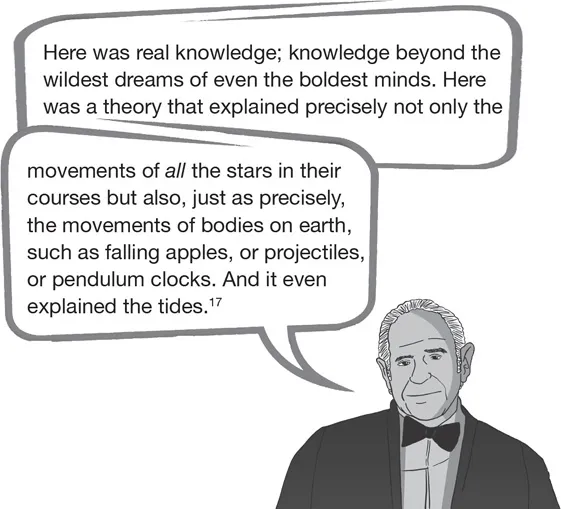
Popper’s central philosophical idea, whereby all our knowledge is merely provisional, i.e. a “conjectural knowledge” which is subject at any time to alteration, represented, at the time he first advanced it, an enormous provocation. Before Popper, researchers and scientists had generally believed that there really were such things as “laws of Nature”, i.e. ultimate laws to which the cosmos had to conform and which determined all that happened in it. A generation as recent as that of our own grandfathers still learnt from their physics teachers that these “laws of Nature”, in contradistinction to the claims of religion and mere belief, represented authentic knowledge. Now that the secrets of these laws had been unlocked by science, and most particularly by the theories of mechanics and gravitation developed by Newton, one was in a position, or such was the suggestion, to understand the world once and for all and to solve all the problems posed by it. Newton’s theory appeared to be the crown and completion of all science:
This mood of enormous confidence was in fact typical of that age of the Industrial Revolution that set in around a hundred years after Newton’s remarkable discoveries and largely on the basis of these. Humanity’s belief in progress was still unconditional. Almost daily, some new discovery, invention or machine came along to further revolutionize everyday life. Liebig’s fertilizers multiplied the yields of agriculture; Arkwright’s new spinning frames and Cartwright’s looms saw to it that whole populations, for the first time in history, were properly clothed. Iron began, on a large scale, to be successfully smelted from iron ore and soon the whole world witnessed how even the most distant locations could be bound together by railways and by steamships.
Newton’s mechanics and theory of gravitation, along with their practical implementation in technical revolutions, appeared to have explained the whole of Nature and subjected it once and for all to Man’s control. Faith in progress and euphoria over the new techniques were so strong at this time that the British manufacturer of steel goods Wilkinson had himself buried in a steel coffin under a three-foot-high steel obelisk. Nature’s laws had finally been revealed, so that everything now seemed possible. With Newton’s physics, it was generally believed, Man had climbed to the very summit and endpoint of all possible knowledge. Until, that is, that solar eclipse of 1919.
With Einstein, and the conclusions that Popper drew from Einstein’s 1919 vindication, this euphoria and this illusion came suddenly to an end. Nature itself, Popper now declared to the world, knows no laws. Rather, it is Man who imputes laws to Nature. It is a kind of hubris, then, to speak of “laws of Nature” at all. What were long called “laws of Nature”, Popper went on, were really only products of the minds of certain scientists which had been applied to Nature, sometimes with more success and sometimes with less. It is we human beings, then, not Nature, that make these “laws”. And we, being fallible, make mistakes as we do so and must, again and again, correct these mistakes:
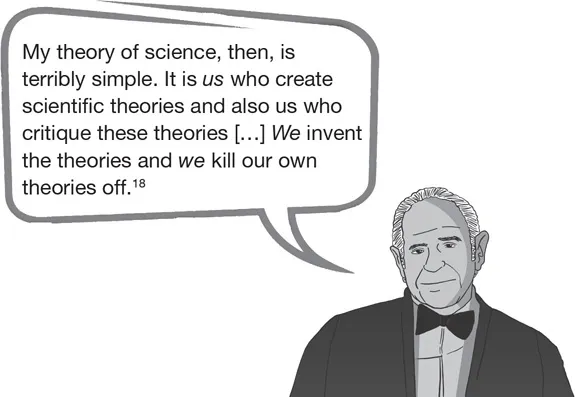
It is necessary, then, to draw a clear distinction between the inventing of theories and the actual physical world. The physical world of Nature, argues Popper, exists completely independently of the human mind and is something of a radically different kind from Man’s experience of it. And just because this is so we must always adopt a critical attitude toward all the theories into which we attempt to cram Nature and must remain mistrustful of our own supposed knowledge. Nature and mind can never be brought into total harmony with one another. The scientist, therefore, must be aware, each time he arrives at some new piece of knowledge, that this latter will remain valid only until some new knowledge comes along to refute and invalidate it. Were researchers completely serious about their work, each one of them would attempt, before publishing his or her theory, to prove this latter false and, in the case where this attempt proved successful, drop the theory again, unpublished. In this regard, Popper considered Einstein to be the model of the true scientist:
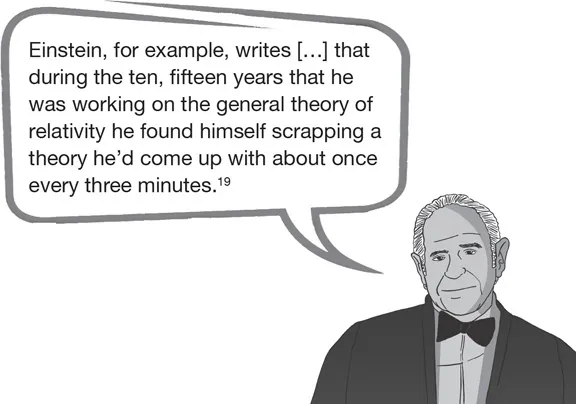
Moreover, Einstein himself had, just prior to the great eclipse of 1919 that had been such a turning point for Popper, personally urged other scientists to test those predictions of his ensuing from the theory of relativity and, if possible, to prove them false and reject them:
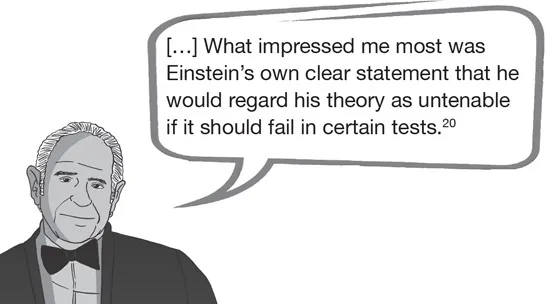
With this invitation to falsify his theory, Einstein ran the greatest imaginable risk, yet remained very modest while doing so:
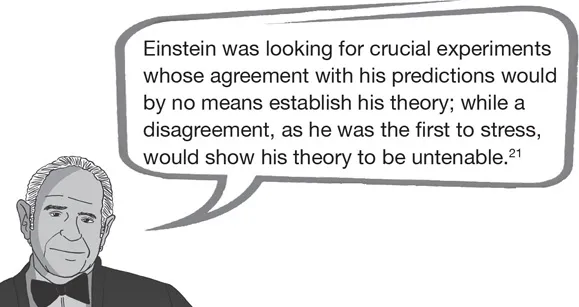
It was this attitude that led Popper to the really decisive idea for his theory of scientific knowledge. If the very best that could be hoped for, as regards Einstein’s theory, from these photographs taken during the eclipse of 1919 was not that this theory would thereby be proven true for all time but only that it would remain, for the present at least, un-disproven, then it followed that the decisive criterion for the truth or otherwise of a scientific claim was not, as had hitherto generally been believed, the successful performance of a large number of experiments that would go to confirm the claim in question but rather the disconfirmation of this claim which might occur through one single experimental finding. Or, to recur to the “swan” example alluded to above: not even a thousand successive photos of white swans can finally and definitively confirm the claim that “all swans are white”; but if, on taking a thousand-and-first photo, the swan shown on it proved to be black, this would indeed finally and definitively disconfirm this claim or, to use Popper’s terminology, definitively “falsify” the “all swans are white” theory:
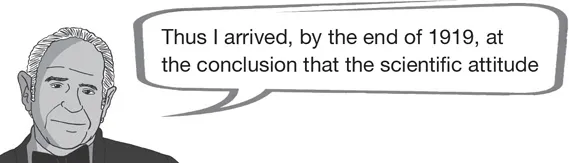
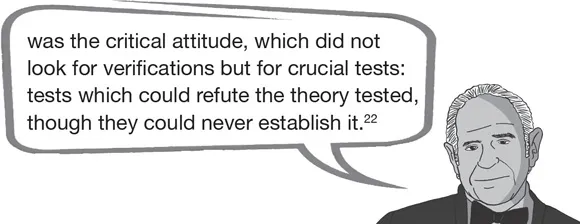
In this way Popper’s new theory of science was born. Popper put falsification in the place of verification. But this was not all he did. He also posed the question of how scientists arrived at their theories in the first place.
Deduction Instead of Induction:
“A Human Being is not a Bucket”
How do scientific theories arise? At the time of Popper’s first writing the inductive method was the most generally adopted and recognized practice. Popper himself, though, was a passionate advocate of the deductive method, arguing that it was an epistemological approach that was both more honest and yielded richer results.
“Induction” comes from the Latin word inducere, meaning “lead into” or “take up into”. To follow the “inductive method”, then, implies that one must first “take up” or gather into oneself a large number of sense-impressions and experiences in order subsequently, in a second step, to form, from all these gathered-up impressions and experiences, a theory. Popper rejects this account of theory-formation, calling it “the bucket theory of the human mind”. He mockingly writes of the inductive theory that, for this latter
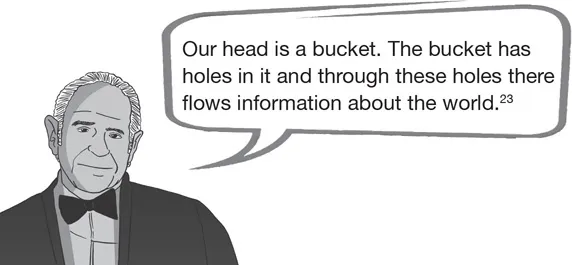
In this “allegory of the bucket”, then, our eye-sockets and the openings of our ears and nose would be the “holes” through which images, sounds, smells and other empirical impressions would enter into us. Scientists proceeding according to the inductive method look for some common denominator for these impressions; that is to say, they try to formulate theoretical statements which can apply equally and universally to all these empirical experiences that come seeping into our consciousness:
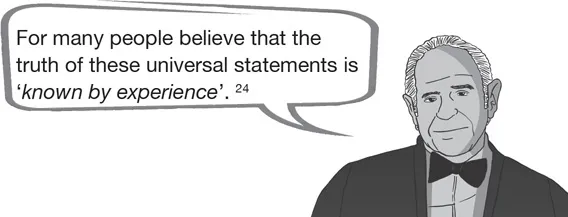
According to this “bucket theory”, through the evaluation of the maximum quantity of data taken up and gathered into oneself in this way one should, in the end, be able to arrive at a fully secured and established knowledge. But it is just such a procedure that Popper calls fundamentally into question:
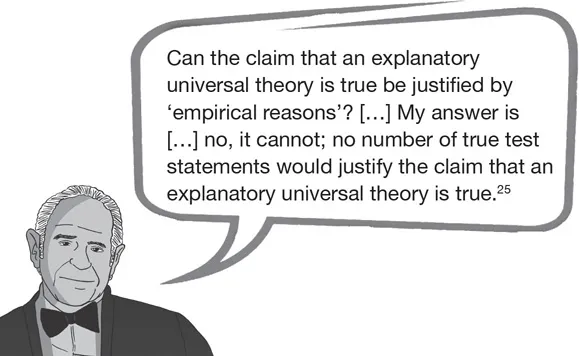
Here, the swans enter once again into the question. No number of test statements about swans ca...
Table of contents
- Acknowledgements
- About the book
- Table of Contents
- Popper’s Great Discovery
- Popper’s Central Idea
- Of What Use is Popper’s Discovery for Us Today?
- Bibliographical References
- Already published in the same series
- Coming soon in the same series
- The author
- Copyright
Frequently asked questions
Yes, you can cancel anytime from the Subscription tab in your account settings on the Perlego website. Your subscription will stay active until the end of your current billing period. Learn how to cancel your subscription
No, books cannot be downloaded as external files, such as PDFs, for use outside of Perlego. However, you can download books within the Perlego app for offline reading on mobile or tablet. Learn how to download books offline
Perlego offers two plans: Essential and Complete
- Essential is ideal for learners and professionals who enjoy exploring a wide range of subjects. Access the Essential Library with 800,000+ trusted titles and best-sellers across business, personal growth, and the humanities. Includes unlimited reading time and Standard Read Aloud voice.
- Complete: Perfect for advanced learners and researchers needing full, unrestricted access. Unlock 1.5M+ books across hundreds of subjects, including academic and specialized titles. The Complete Plan also includes advanced features like Premium Read Aloud and Research Assistant.
We are an online textbook subscription service, where you can get access to an entire online library for less than the price of a single book per month. With over 1.5 million books across 990+ topics, we’ve got you covered! Learn about our mission
Look out for the read-aloud symbol on your next book to see if you can listen to it. The read-aloud tool reads text aloud for you, highlighting the text as it is being read. You can pause it, speed it up and slow it down. Learn more about Read Aloud
Yes! You can use the Perlego app on both iOS and Android devices to read anytime, anywhere — even offline. Perfect for commutes or when you’re on the go.
Please note we cannot support devices running on iOS 13 and Android 7 or earlier. Learn more about using the app
Please note we cannot support devices running on iOS 13 and Android 7 or earlier. Learn more about using the app
Yes, you can access Popper in 60 Minutes by Walther Ziegler in PDF and/or ePUB format, as well as other popular books in Philosophy & Philosophy History & Theory. We have over 1.5 million books available in our catalogue for you to explore.