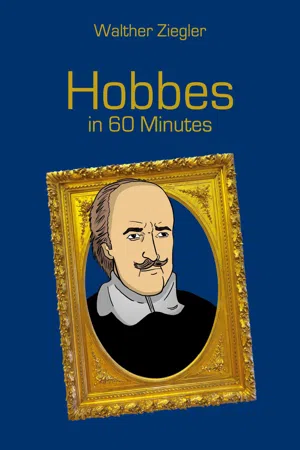
Thomas Hobbes is the founder of the modern theory of the state. He gained worldwide fame with his thesis that Man is not, by nature, a peaceful or sociable being but rather always pursues, egoistically, first and foremost his own welfare and advantage. Were there no state, with their laws, judges and police, we would live in a constant "war of all against all". Not because Man is essentially wicked but because such behaviour is dictated by our nature as predatory animals: "Man is an arrant wolf to Man". With this oft-cited phrase, however, Hobbes in fact provided the first modern legitimation for the state. The state, he argued, is necessary and in the interest of all insofar as it provides human beings with mutual protection from the fraud, theft and murder which they would otherwise commit upon one another and secures a peaceful coexistence for everyone. Only the state creates the security of law for all who live in it. Hobbes also warns us against quitting too lightly this condition of life in an established state or endangering it by entering into civil war: "I also show that the condition of Man outside civil society is that of a perpetual war of all against all." The book "Hobbes in 60 Minutes" explains, with the aid of some 70 important passages quoted from Hobbes's principal writings Leviathan and De Cive, the philosopher's key notion of "the state of Nature" and the famous theory of the state he developed as a proposal for transcending this state. The book is published as part of the popular series "Great Thinkers in 60 Minutes".
- 84 pages
- English
- ePUB (mobile friendly)
- Available on iOS & Android
eBook - ePub
About this book
Information
Hobbes’s Central Idea
“Homo Homini Lupus” – The Wolf-Like Nature of Man
Homo homini lupus is a phrase which can be translated “Man is a wolf to Man”. Nowadays, it is a phrase inextricably associated in people’s minds with Hobbes. It was, however, not originally his own. He drew a similar phrase from the much less well-known ancient Roman author Titus Maccius Plautus and remodelled it for the purposes of his own theory.14
At first glance one might understand the phrase to mean that one must always be on one’s guard against one’s fellow human beings because these latter are always, in their inmost hearts, predators, hungry and morally unscrupulous competitors for everything. In short, the message would be: Man is wicked. But this is only part of the truth about Hobbes’s intention in using the phrase. Hobbes was concerned above all to show how human beings would behave in a situation ungoverned by any law, a situation in which there was no state, no civilization and thus no regulation laying down social rules for what is “good” and what is “evil”.
What counts above all else in such a lawless, anarchistic, primitive society is ensuring one’s bare survival. Man may not be essentially wicked but he has no choice except to do all that is in his power to do when it comes to ensuring his own survival. This instinct of self-preservation is natural and unproblematic so long as each individual is simply seeking his personal nourishment and consuming it on the spot. Problems arise, however, where two individuals or groups both covet the same object. For example, where both lay claim to the same bountiful valley, the same field to grow crops on, or the same hunting ground. Conflict may also arise where someone is inhabiting a wind-sheltered cave that another person may wish for himself:

It is in such situations that “Man becomes a wolf to Man” – but not because Man is essentially morally corrupt, let alone wicked. His instinct of self-preservation, and the actions that this necessitates, compel him to do what he does:

In the “state of Nature” Man simply does that which his nature dictates to him, even if we are loth to accept what this is:

But experience teaches us, says Hobbes, that such is indeed the case. Nature, indeed, cannot be blamed for this. We cannot reproach Nature with being what it is:

As gravity or centrifugal force for the planets, the drive to self-preservation is, for Man, the basic force that keeps us, our whole life long, in constant movement. This applies, indeed, not just to “the state of Nature”. We “civilized human beings” also strive to survive. We consult doctors if we are ill, buy warm clothes for the winter; see to it that we earn money; attempt to live as comfortably and in as good health as possible; and secure our houses against burglary and theft. But in the “civilized” condition of a society governed by a state human beings’ will to self-preservation plays out within the framework of fixed rules and laws regulating property and exchange of property. In the “state of Nature”, by contrast, there are no supermarkets, property leases, or regular monetary incomes. The needs of different human beings crash and collide with one another in a completely unregulated and uninhibited way:

But competition for scarce goods is not the only reason why, in the “state of Nature”, each man must become “a wolf” to other men:

Hobbes uses the word “diffidence” here in its 17th-century rather than its modern sense, referring rather to something that we would call, today, “mistrust”.
The problem of mistrust is the problem that human beings, being naturally equipped with reason, will equally naturally always try to gain a strategic advantage. This is a tendency which we must assume to exist not only in ourselves but in everyone that we encounter. We need always to be fundamentally mistrustful because we compete, in the “state of Nature”, not only for things that we need to survive at each present moment, i.e. for things to quench our immediate hunger and thirst, but also for what is required to ensure that our future needs will also be met. This being the case, human beings can be more merciless than any beast of prey:

Other animals are satisfied and settle down to sleep once they have eaten and drunk their fill. Man, however, remains constantly tense and on the alert:

Such an “assuring of a contented life” not just at present but in future requires, then, the personal power to keep all one’s enemies in check and even to

Hobbes also mentions as a “cause of quarrel” competition and the attempt to increase power that comes along with it. And finally, as a third “cause of quarrel” in the “state of Nature”, he speaks of the desire for “glory”, that is to say, the struggle to be respected and honoured by other human beings. This, among the three causes named by Hobbes, is the only one that is not related to the imperatives of simple physical survival. Hobbes mentions it, nonetheless, because it is an impulse deeply rooted in human nature. Nietzsche too later noted vanity of this sort to be a vice so deeply rooted in humanity that there would likely never be found any remedy for it. Thus, it is possible that a violent quarrel over “glory” might arise from But besides these three “causes of quarrel” in Hobbes’s “state of Nature”, namely, “competition”, “diffidence” and “glory”, there is also a more comprehensive structural reason why Man here “becomes a wolf to Man”. This is the natural equality that tends to exist between human beings as regards our bodily strength and intellectual capacity. Since all human beings possess in these regards more or less the same level of ability, all will tend to perceive there to be at least a chance of their getting what they need by force or cunning. Hobbes is aware, indeed, that certain disparities in size and physique do exist between one human being and another. But he is of the view that such small disparities play in the end, in the “state of Nature”, no role that is real...
Table of contents
- Acknowledgements
- Table of Contents
- Hobbes’s Great Discovery
- Hobbes’s Central Idea
- Of What Use Is Hobbes’s Discovery for Us Today?
- Bibliographical References
- Further information
- The author
- Copyright
Trusted by 375,005 students
Access to over 1.5 million titles for a fair monthly price.
Study more efficiently using our study tools.
Frequently asked questions
Yes, you can cancel anytime from the Subscription tab in your account settings on the Perlego website. Your subscription will stay active until the end of your current billing period. Learn how to cancel your subscription
No, books cannot be downloaded as external files, such as PDFs, for use outside of Perlego. However, you can download books within the Perlego app for offline reading on mobile or tablet. Learn how to download books offline
Perlego offers two plans: Essential and Complete
- Essential is ideal for learners and professionals who enjoy exploring a wide range of subjects. Access the Essential Library with 800,000+ trusted titles and best-sellers across business, personal growth, and the humanities. Includes unlimited reading time and Standard Read Aloud voice.
- Complete: Perfect for advanced learners and researchers needing full, unrestricted access. Unlock 1.5M+ books across hundreds of subjects, including academic and specialized titles. The Complete Plan also includes advanced features like Premium Read Aloud and Research Assistant.
We are an online textbook subscription service, where you can get access to an entire online library for less than the price of a single book per month. With over 1.5 million books across 990+ topics, we’ve got you covered! Learn about our mission
Look out for the read-aloud symbol on your next book to see if you can listen to it. The read-aloud tool reads text aloud for you, highlighting the text as it is being read. You can pause it, speed it up and slow it down. Learn more about Read Aloud
Yes! You can use the Perlego app on both iOS and Android devices to read anytime, anywhere — even offline. Perfect for commutes or when you’re on the go.
Please note we cannot support devices running on iOS 13 and Android 7 or earlier. Learn more about using the app
Please note we cannot support devices running on iOS 13 and Android 7 or earlier. Learn more about using the app
Yes, you can access Hobbes in 60 Minutes by Walther Ziegler in PDF and/or ePUB format, as well as other popular books in Philosophy & Philosophy History & Theory. We have over 1.5 million books available in our catalogue for you to explore.