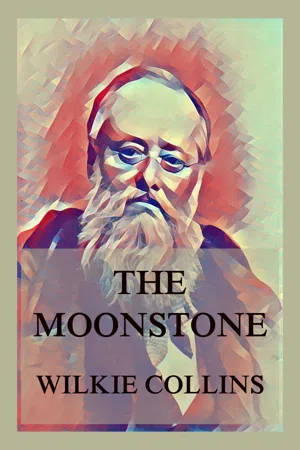
"I'm sick to death of novels with an earnest purpose. I'm sick to death of outbursts of eloquence, and large-minded philanthropy, and graphic descriptions, and unsparing anatomy of the human heart, and all that sort of thing. Good gracious me! Isn't it the original intention or purpose, or whatever you call it, of a work of fiction, to set out distinctly by telling a story? And how many of these books, I should like to know, do that? Why, so far as telling a story is concerned, the greater part of them might as well be sermons as novels. Oh, dear me! what I want is something that seizes hold of my interest, and makes me forget when it is time to dress for dinner—something that keeps me reading, reading, reading, in a breathless state, to find out the end." Wilkie Collins' confession of faith as a novelist is comprised in the above speech of his sprightly heroine, Miss Jessie Yelverton, in 'The Queen of Hearts'. He is emphatically a story-writer. He is unrivaled in the construction of an elaborate and intricate plot, and he certainly succeeds in making his readers "go on reading, reading, reading, in a breathless state, to find out the end." Wilkie Collins' career has been a progressive one. There are some ardent novel readers who will doubtless remember the publication of 'Antonina', and a few years later of 'Basil' – two books of singular power. Soon after Mr. Dickens commenced the publication of Household Words, there appeared in that periodical a number of short stories which were remarkable for the perfection of their style, the elaboration and originality of their plots and their general artistic finish. Then came a novel, 'The Dead Secret', also published in Household Words, in which the wonderful skill of the author in con structing and unfolding a plot was for the first time fully displayed. The 'Woman in White followed', and the claims of Wilkie Collins to be considered a great novelist were at once firmly established. He is, however, no mere weaver of intricate plots—no teller of elaborately constructed stories only. Few characters in modern fiction are as well drawn and sustained as that of Count Fosco, the cool, sensible, intellectual villain in 'The Woman in White.' Collins also possesses, in common with Anthony Trollope, the power of delineating a heroine who shall be neither a dressed-up doll nor an impossible angel. Rachel Verinder in 'The Moonstone' bears witness to the truth of this assertion. This novel is the best that Mr. Collins has given to the world and possibly the best he has ever written. The story is singularly original; and when we remember the force and extent of Hindoo superstition, we can scarcely venture to pronounce it improbable. And how admirably is the story told! Clear, lucid and forcible in style, never straying into the alluring but pernicious paths of description or dissertation, the narrative moves onward in its unbroken and entrancing course. Let the impatient reader, hurrying to reach the dénouement, skip half a dozen pages. Instantly the thread of the story is broken, the tale becomes incomprehensible, the incidents lose their coherence. 'The Moonstone' is a perfect work of art, and to remove any portion of the cunningly constructed fabric destroys the completeness and beauty of the whole.
- 824 pages
- English
- ePUB (mobile friendly)
- Available on iOS & Android
eBook - ePub
The Moonstone
About this book
Information
Subtopic
ClassicsIndex
LiteratureTHE STORY
FIRST PERIOD. THE LOSS OF THE DIAMOND (1848)
The Events related by Gabriel Betteredge, house-steward in the service of Julia, Lady Verinder.
CHAPTER I
In the first part of Robinson Crusoe, at page one hundred and twenty-nine, you will find it thus written:
“Now I saw, though too late, the Folly of beginning a Work before we count the Cost, and before we judge rightly of our own Strength to go through with it.”
Only yesterday, I opened my Robinson Crusoe at that place. Only this morning (May twenty-first, eighteen hundred and fifty), came my lady’s nephew, Mr. Franklin Blake, and held a short conversation with me, as follows:—
“Betteredge,” says Mr. Franklin, “I have been to the lawyer’s about some family matters; and, among other things, we have been talking of the loss of the Indian Diamond, in my aunt’s house in Yorkshire, two years since. Mr. Bruff thinks as I think, that the whole story ought, in the interests of truth, to be placed on record in writing—and the sooner the better.”
Not perceiving his drift yet, and thinking it always desirable for the sake of peace and quietness to be on the lawyer’s side, I said I thought so too. Mr. Franklin went on.
“In this matter of the Diamond,” he said, “the characters of innocent people have suffered under suspicion already—as you know. The memories of innocent people may suffer, hereafter, for want of a record of the facts to which those who come after us can appeal. There can be no doubt that this strange family story of ours ought to be told. And I think, Betteredge, Mr. Bruff and I together have hit on the right way of telling it.”
Very satisfactory to both of them, no doubt. But I failed to see what I myself had to do with it, so far.
“We have certain events to relate,” Mr. Franklin proceeded; “and we have certain persons concerned in those events who are capable of relating them. Starting from these plain facts, the idea is that we should all write the story of the Moonstone in turn—as far as our own personal experience extends, and no farther. We must begin by showing how the Diamond first fell into the hands of my uncle Herncastle, when he was serving in India fifty years since. This prefatory narrative I have already got by me in the form of an old family paper, which relates the necessary particulars on the authority of an eye-witness. The next thing to do is to tell how the Diamond found its way into my aunt’s house in Yorkshire, two years ago, and how it came to be lost in little more than twelve hours afterwards. Nobody knows as much as you do, Betteredge, about what went on in the house at that time. So you must take the pen in hand, and start the story.”
In those terms I was informed of what my personal concern was with the matter of the Diamond. If you are curious to know what course I took under the circumstances, I beg to inform you that I did what you would probably have done in my place. I modestly declared myself to be quite unequal to the task imposed upon me—and I privately felt, all the time, that I was quite clever enough to perform it, if I only gave my own abilities a fair chance. Mr. Franklin, I imagine, must have seen my private sentiments in my face. He declined to believe in my modesty; and he insisted on giving my abilities a fair chance.
Two hours have passed since Mr. Franklin left me. As soon as his back was turned, I went to my writing-desk to start the story. There I have sat helpless (in spite of my abilities) ever since; seeing what Robinson Crusoe saw, as quoted above—namely, the folly of beginning a work before we count the cost, and before we judge rightly of our own strength to go through with it. Please to remember, I opened the book by accident, at that bit, only the day before I rashly undertook the business now in hand; and, allow me to ask—if that isn’t prophecy, what is?
I am not superstitious; I have read a heap of books in my time; I am a scholar in my own way. Though turned seventy, I possess an active memory, and legs to correspond. You are not to take it, if you please, as the saying of an ignorant man, when I express my opinion that such a book as Robinson Crusoe never was written, and never will be written again. I have tried that book for years—generally in combination with a pipe of tobacco—and I have found it my friend in need in all the necessities of this mortal life. When my spirits are bad—Robinson Crusoe. When I want advice—Robinson Crusoe. In past times when my wife plagued me; in present times when I have had a drop too much—Robinson Crusoe. I have worn out six stout Robinson Crusoes with hard work in my service. On my lady’s last birthday she gave me a seventh. I took a drop too much on the strength of it; and Robinson Crusoe put me right again. Price four shillings and sixpence, bound in blue, with a picture into the bargain.
Still, this don’t look much like starting the story of the Diamond—does it? I seem to be wandering off in search of Lord knows what, Lord knows where. We will take a new sheet of paper, if you please, and begin over again, with my best respects to you.
CHAPTER II
I spoke of my lady a line or two back. Now the Diamond could never have been in our house, where it was lost, if it had not been made a present of to my lady’s daughter; and my lady’s daughter would never have been in existence to have the present, if it had not been for my lady who (with pain and travail) produced her into the world. Consequently, if we begin with my lady, we are pretty sure of beginning far enough back. And that, let me tell you, when you have got such a job as mine in hand, is a real comfort at starting.
If you know anything of the fashionable world, you have heard tell of the three beautiful Miss Herncastles. Miss Adelaide; Miss Caroline; and Miss Julia—this last being the youngest and the best of the three sisters, in my opinion; and I had opportunities of judging, as you shall presently see. I went into the service of the old lord, their father (thank God, we have got nothing to do with him, in this business of the Diamond; he had the longest tongue and the shortest temper of any man, high or low, I ever met with)—I say, I went into the service of the old lord, as page-boy in waiting on the three honourable young ladies, at the age of fifteen years. There I lived till Miss Julia married the late Sir John Verinder. An excellent man, who only wanted somebody to manage him; and, between ourselves, he found somebody to do it; and what is more, he throve on it and grew fat on it, and lived happy and died easy on it, dating from the day when my lady took him to church to be married, to the day when she relieved him of his last breath, and closed his eyes for ever.
I have omitted to state that I went with the bride to the bride’s husband’s house and lands down here. “Sir John,” she says, “I can’t do without Gabriel Betteredge.” “My lady,” says Sir John, “I can’t do without him, either.” That was his way with her—and that was how I went into his service. It was all one to me where I went, so long as my mistress and I were together.
Seeing that my lady took an interest in the out-of-door work, and the farms, and such like, I took an interest in them too—with all the more reason that I was a small farmer’s seventh son myself. My lady got me put under the bailiff, and I did my best, and gave satisfaction, and got promotion accordingly. Some years later, on the Monday as it might be, my lady says, “Sir John, your bailiff is a stupid old man. Pension him liberally, and let Gabriel Betteredge have his place.” On the Tuesday as it might be, Sir John says, “My lady, the bailiff is pensioned liberally; and Gabriel Betteredge has got his place.” You hear more than enough of married people living together miserably. Here is an example to the contrary. Let it be a warning to some of you, and an encouragement to others. In the meantime, I will go on with my story.
Well, there I was in clover, you will say. Placed in a position of trust and honour, with a little cottage of my own to live in, with my rounds on the estate to occupy me in the morning, and my accounts in the afternoon, and my pipe and my Robinson Crusoe in the evening—what more could I possibly want to make me happy? Remember what Adam wanted when he was alone in the Garden of Eden; and if you don’t blame it in Adam, don’t blame it in me.
The woman I fixed my eye on, was the woman who kept house for me at my cottage. Her name was Selina Goby. I agree with the late William Cobbett about picking a wife. See that she chews her food well and sets her foot down firmly on the ground when she walks, and you’re all right. Selina Goby was all right in both these respects, which was one reason for marrying her. I had another reason, likewise, entirely of my own discovering. Selina, being a single woman, made me pay so much a week for her board and services. Selina, being my wife, couldn’t charge for her board, and would have to give me her services for nothing. That was the point of view I looked at it from. Economy—with a dash of love. I put it to my mistress, as in duty bound, just as I had put it to myself.
“I have been turning Selina Goby over in my mind,” I said, “and I think, my lady, it will be cheaper to marry her than to keep her.”
My lady burst out laughing, and said she didn’t know which to be most shocked at—my language or my principles. Some joke tickled her, I suppose, of the sort that you can’t take unless you are a person of quality. Understanding nothing myself but that I was free to put it next to Selina, I went and put it accordingly. And what did Selina say? Lord! how little you must know of women, if you ask that. Of course she said, Yes.
As my time drew nearer, and there got to be talk of my having a new coat for the ceremony, my mind began to misgive me. I have compared notes with other men as to what they felt while they were in my interesting situation; and they have all acknowledged that, about a week before it happened, they privately wished themselves out of it. I went a trifle further than that myself; I actually rose up, as it were, and tried to get out of it. Not for nothing! I was too just a man to expect she would let me off for nothing. Compensation to the woman when the man gets out of it, is one of the laws of England. In obedience to the laws, and after turning it over carefully in my mind, I offered Selina Goby a feather-bed and fifty shillings to be off the bargain. You will hardly believe it, but it is nevertheless true—she was fool enough to refuse.
After that it was all over with me, of course. I got the new coat as cheap as I could, and I went through all the rest of it as cheap as I could. We were not a happy couple, and not a miserable couple. We were six of one and half-a-dozen of the other. How it was I don’t understand, but we always seemed to be getting, with the best of motives, in one another’s way. When I wanted to go upstairs, there was my wife coming down; or when my wife wanted to go down, there was I coming up. That is married life, according to my experience of it.
After five years of misunderstandings on the stairs, it pleased an all-wise Providence to relieve us of each other by taking my wife. I was left with my little girl Penelope, and with no other child. Shortly afterwards Sir John died, and my lady was left with her little girl, Miss Rachel, and no other child. I have written to very poor purpose of my lady, if you require to be told that my little Penelope was taken care of, under my good mistress’s own eye, and was sent to school and taught, and made a sharp girl, and promoted, when old enough, to be Miss Rachel’s o...
Table of contents
- PROLOGUE
- THE STORY
Trusted by 375,005 students
Access to over 1.5 million titles for a fair monthly price.
Study more efficiently using our study tools.
Frequently asked questions
Yes, you can cancel anytime from the Subscription tab in your account settings on the Perlego website. Your subscription will stay active until the end of your current billing period. Learn how to cancel your subscription
No, books cannot be downloaded as external files, such as PDFs, for use outside of Perlego. However, you can download books within the Perlego app for offline reading on mobile or tablet. Learn how to download books offline
Perlego offers two plans: Essential and Complete
- Essential is ideal for learners and professionals who enjoy exploring a wide range of subjects. Access the Essential Library with 800,000+ trusted titles and best-sellers across business, personal growth, and the humanities. Includes unlimited reading time and Standard Read Aloud voice.
- Complete: Perfect for advanced learners and researchers needing full, unrestricted access. Unlock 1.5M+ books across hundreds of subjects, including academic and specialized titles. The Complete Plan also includes advanced features like Premium Read Aloud and Research Assistant.
We are an online textbook subscription service, where you can get access to an entire online library for less than the price of a single book per month. With over 1.5 million books across 990+ topics, we’ve got you covered! Learn about our mission
Look out for the read-aloud symbol on your next book to see if you can listen to it. The read-aloud tool reads text aloud for you, highlighting the text as it is being read. You can pause it, speed it up and slow it down. Learn more about Read Aloud
Yes! You can use the Perlego app on both iOS and Android devices to read anytime, anywhere — even offline. Perfect for commutes or when you’re on the go.
Please note we cannot support devices running on iOS 13 and Android 7 or earlier. Learn more about using the app
Please note we cannot support devices running on iOS 13 and Android 7 or earlier. Learn more about using the app
Yes, you can access The Moonstone by Wilkie Collins in PDF and/or ePUB format, as well as other popular books in Literature & Classics. We have over 1.5 million books available in our catalogue for you to explore.