eBook - ePub
Image, Memory and Monumentality
Archaeological Engagements with the Material World
- 366 pages
- English
- ePUB (mobile friendly)
- Available on iOS & Android
eBook - ePub
Image, Memory and Monumentality
Archaeological Engagements with the Material World
About this book
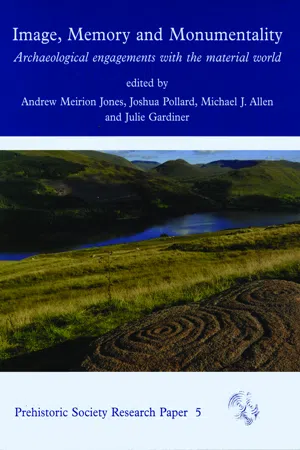
Leading scholars in these 29 commissioned papers in honour of Richard Bradley discuss key themes in prehistoric archaeology that have defined his career, such as monumentality, memory, rock art, landscape, material worlds and field practice. The scope is broad, covering both Britain and Europe, and while the focus is very much on the archaeology of later prehistory, papers also address the interconnection between prehistory and historic and contemporary archaeology. The result is a rich and varied tribute to Richard's energy and intellectual inspiration.
Information
Subtopic
British HistoryIndex
History1
Richard Bradley: the man on the other side of the wall
Bob Chapman
In late 1969 I went to see my tutor David Clarke in Peterhouse, Cambridge. On entering the room, I was greeted by the sight of David and (as I seem to remember) a scarecrow like individual engrossed in animated talk on sherds of Beaker pottery from a site at Belle Tout on the south coast. David’s enthusiasm for the site led me to invite Richard (for it was he) to give a talk on Belle Tout (Bradley 1970) to the students’ Archaeological Field Club during the following year. Not only did he come, but he brought a friend with him. We had, on occasions, welcomed speakers bringing friends along to these talks (including a well-known Roman archaeologist with a female companion who had just walked out on her author husband), but never before a friend whose occupation was a grave digger! In 1971 I went to a conference on The Explanation of Culture Change, organised by Colin Renfrew in Sheffield (Renfrew 1973), walked into the non-speakers room, with its close circuit television, and there was Richard again. We spent three memorable days discussing all aspects of archaeology, perfecting impersonations of senior members of the profession, and revelling (in more than one sense of the word) in participant observation of the assembled archaeologists. I remember him telling me that he had recently been appointed as a lecturer at the University of Reading, but that he was already looking to move to a more established centre for archaeology. We next met when Reading advertised a Lectureship in Later Prehistory in 1976 (Mike Fulford having been appointed in the meantime to a Lectureship in Roman Archaeology in 1974, and Grenville Astill joining us later in 1978) and I was lucky enough to secure the position.
Since 1976 I have worked with Richard in the Department of Archaeology at Reading (for at least twenty years either next door or across the corridor), designed and taught modules with him, attended conferences together, visited his excavations and travelled with him to Wales, Northumberland, North America, Ireland, Denmark and Portugal. As such I have seen him in many different habitats, but his essential characteristics and qualities remain the same. This is a man who is absorbed by archaeology. He devours new publications, either over coffee in Blackwells or in his second home in the Sackler Library in Oxford. Often he can be seen through the window of his door in the department in Reading working his way through the latest publication that has arrived in the mail: whether he sustains his concentration or gives way to a post lunch ‘siesta’ is usually a good indication of the stimulus of the publication. When he is in the department he is consumed with desire to share the latest news (of sites) and gossip (of people) with his colleagues and to learn of their own activities. On many occasions, and especially when there are new radiocarbon dates from his excavations, he may impart the same news to the same colleague on more than one occasion, whether on the same, or consecutive, days. When he used to teach undergraduates, before subject reviews and the full assault of audit culture on higher education, his classes were occasions for the sharing of ideas, not the delivery of core knowledge or transferable skills. When engaged in fieldwork, he is equally absorbed, noting every detail of a monument and its situation, noticing problems with interpretations, and sharing the wider implications of a particular site (whether it be his own or not) with accompanying colleagues and students.
Such absorption has left Richard with no mental time or space for the daily world of meetings and administration in the university. There is always a sense of his impatience and frustration that administration cannot be accomplished in a matter of minutes rather than hours. I imagine him wondering how it could possibly be the case that module description forms take up the time that could be used for having ideas. He will not thank me for this, but there is almost a sense of him being a ‘throwback’ to the days of people like Stuart Piggott, who was known to use his wastepaper basket for ‘filing’ university memos. Richard’s absorption shows, I think, in other ways. His driving is in the Gordon Childe mode, but has never caused the havoc that it has threatened. Information technology has brought him, like all of us, great benefits, but technical malfunctions provoke an almost Basil Fawlty like response: printer problems are especially guaranteed to produce an outburst of colourful language, although he has not yet been known to stride out of the department to secure the necessary branch with which to thrash the offending equipment. Students have also witnessed examples of absorption that resulted in unexpected actions: most famous of all was the occasion when he took off his jacket during a lecture and threw it onto the window ledge, missing the target and consigning his jacket to flight through the first floor window and into the courtyard below. I do not remember exactly when the phrase ‘doing a Bradle’ was coined (Richard will remind me of this, no doubt), but it subsumed all kinds of activities that suggested the triumph of mental absorption in archaeology over administrative necessities, physical coordination and even bodily awareness. How anyone could spend a whole day ascending and descending a Scottish mountain looking at rock art with his boots on the wrong feet is still the source of much humour in the department. To his credit, Richard is always self-deprecating about such events.
Richard’s archaeology has always had a distinctive style. He has never associated himself with an ‘–ism’ and has always tried to distance himself from a party-line, especially if he thinks that it is deterministic or what he calls ‘hard line’. Never a card carrying member of any theoretical school, he once referred to himself (in conversation) as an ‘eclectic’. He is not a theoretician, but he engages with theory and material evidence, searching for order and pattern in the archaeological record. Pattern is as important as process in his research. If you look through his books (many of which are what he would call ‘ideas’ books), you see how he has kept abreast of the latest theoretical approaches (often derived from anthropology), and yet not made them worthy or boring. For example, see how he moved from what he called ‘Binfordian fellow travelling’ in some early work (Bradley 1978), through exploration of structural Marxist models of alliance, kinship and exchange (Bradley 1984), to models of consumption and the use of material culture (Bradley 1990), social memory and ritual (Bradley 1993; 1998; 2005). Philosophically he seems to have moved from a more materialist to a more idealist stance through his career, increasingly studying human experience and what might be called the superstructure (eg, art, ritual, ideology). That he is drawn to such areas of study is perhaps not surprising, given the literary and artistic allusions and quotations from novels and poetry that are visible in his books: he even began one book with the statement that he approached the subject matter ‘through a novel and a painting’ (Bradley 1993, 1).
These books, along with a mountain of articles in periodicals and edited volumes, are easily accessible to undergraduate and postgraduate students. Since his last classes for undergraduates nearly 15 years ago, his main teaching has involved an increasing number of Masters and PhD students, who all receive a remarkable amount of time and enthusiasm. In return the students give generously of their time in helping to maintain Richard’s research infrastructure, whether this be the organisation of fieldwork, his bookshelves, his computer, his Powerpoints or even (on one occasion) his wastepaper basket.
Archaeology in Reading has grown out of all recognition since Richard’s appointment in 1971, when it was a very small part of the Department of History. It became a separate department in 1977, moved into the Faculty of Science as part of the School of Human and Environmental Sciences in 2002 (when it also colonised its own, newly constructed, building), it has 19 full-time members of the academic staff and it has an international reputation for its excellence in teaching and research. Such growth is a team effort, but it is worth noting that there are a number of staff who applied to Reading for a job because of the department’s distinctive reputation in Social Archaeology, which Richard had initiated. Reading is now the larger and more established department that he was seeking 40 years ago and he has enjoyed its growth, and the support and sociability of the increasing number of colleagues.
Richard will have a mixed reaction to receiving the festschrift treatment. It will no doubt provoke uncomfortable feelings about this formal rite of passage for senior members of the profession. I think that he will be more than a little embarrassed. He may communicate that embarrassment to colleagues on more than one occasion. But underneath I think that he will be quite touched. So let me end this short contribution in the informal way that he would appreciate: well done Bradle!
Acknowledgments
I would like to thank Mike Fulford and Roberta Gilchrist for their helpful comments on a draft of this paper, although I remain responsible for its content and expression.
Bibliography
Bradley, R. 1970. The excavation of a Beaker settlement at Belle Tout, east Sussex, England. Proceedings of the Prehistoric Society 36, 312–79
Bradley, R. 1978. The Prehistoric Settlement of Britain. London: Routledge and Kegan Paul
Bradley, R. 1984. The Social Foundations of Prehistoric Britain. London: Longman
Bradley, R. 1990. The Passage of Arms. Cambridge: Cambridge University Press
Bradley, R. 1993. Altering the Earth. Edinburgh: Society of Antiquaries of Scotland
Bradley, R. 1998. The Significance of Monuments. London: Routledge
Bradley, R. 2005. Ritual and Domestic Life in Prehistoric Europe. London: Routledge
Renfrew, C. (ed.) 1973. The Explanation of Culture Change: Models in Prehistory. London: Duckworth
2
Drinking Tea with Richard Bradley
Sue Alcock
In 1990 I applied for a position, divided between the Departments of Archaeology and of Classics, at the University of Reading. American and female, I was two years past my PhD at Cambridge, and it was my first job. I thought at the time that I was extremely lucky. And indeed I was: many years later, I am still reaping the benefits of my great good fortune.
In an academic job there is much you can negotiate, or at least attempt to negotiate: salary, space, technical support, teaching load. But the most important thing of all – the composition of your colleagues – is usually a lap-of-the-gods roll-of-the-dice. I landed in what was (compared to the situation at Reading today) a small, modestly housed Department of Archaeology. But the people, many of whom had already been together for years at that point, were something else again. The chief protagonists in my time were Richard, Bob Chapman, Heinrich Härke and Mike Fulford, also known in departmental parlance as The Bradle, Bob Binford (or Be-Bob, in honour of a serious blues predilection), and, I am sorry to report, the Hun … I think Mike (then department chair) escaped ritual encapsulation, as did Grenville Astill. An honorary fellow traveller in Classics, Andrew Wallace-Hadrill, was cognominated either the Wobbly Handrail or the Finn (the latter because Richard thought he looked like conductor Esa-Pekka Salonen). I became the Ballcock.
I know we all were working extremely hard, and our academic output (especially Richard’s in this fertile period) will support that assertion. But we also found time to talk, especially in the seriously ratty institutional tearoom one floor up. In my memory at least, it was a rare day that some combination or other of us didn’t storm up the stairs and sit for a bit, and sometimes a bit more. Of such moments are formative experiences made.
I learned a lot from all of them, but let me speak of Richard. I had read my Bradley at Cambridge, of course; had been enchanted by Bradley (1984). But Richard in the flesh and in the flow, over tea, was a mind-expanding substance. I learned of General Pitt-Rivers at Cranborne Chase and of how to think creatively with ‘old data’. I had a front row seat for the thinking behind what became Altering the Earth (1993) – my personal favourite of all Richard’s many evocative book titles, though The Significance of Monuments (1998) is not far behind. Monuments, landscape, memory, the finding of artefacts in ‘unexpected’ places and the stories that can then be wrought: all these were engaging Richard’s mind, and what Richard was thinking about, we heard. I appear to have spent much of my subsequent academic career playing in Richard’s expansive sandbox, in other periods and parts of the world.
As Be-Bob already noted in his essay for this volume, Richard has always avoided academic pigeonholes, and it would be a foolish person indeed who tried to contain him within one. We talked about this once over tea, and the message that one need neither accept the labels of others, nor follow the herd, has stood me in good stead in later life. In that same conversation (and yes, I really remember this) Richard also told me he didn’t originally study to be an archaeologist (law, wasn’t it?), one sign of the unconventionality of mind that is undoubtedly among his greatest gifts. Add to that an abiding interest in art, poetry, and music, which runs as a strong current throughout Richard’s work, and you can begin, partially, to grasp the sources of his basal originality and ongoing creativity.
What embedded much of this in my mind was not just the appealing smarts of what was being said, but the equally appealing zest with which it was conveyed. A Richard enjoying a subject is a Richard with a gleam in his eye, and if I say a somewhat manic gleam, it is said with both affection and accuracy. And the gestures ... If the wave of British royalty is akin to the delicate screwing in of a light bulb, Richard’s hands, in full descriptive mode, resemble nothing so much as twin windmills of enthusiasm. Small stuff was not allowed to interfere with the joy of thought and communication, with some of the idiosyncratic results Bob has described. The most epic ‘doing a Bradle’ of the early 1990s, an episode which involved Richard attempting to dry his hands, has clearly been censored, but I am happy to reminisce further on request.
Richard was never an institution builder in the traditional sense of someone willing to take up the burdens of administration, advocacy and collective leadership. But the longevity of his commitment to the Department of Archaeology at Reading, the consistent high quality of his work and his profile, and his ethos of intellectual independence: all contributed to making it the strong and distinguished place of scholarly enterprise it is today. But when I was at Reading (a stint which lasted only a couple years, before I made the hard decision to go back home to the States), it was something more than that, at least for me.
Academic institutions change endlessly through time. People come and go, strictures and budgets evolve and harden, life moves on. But there can exist moments and spaces, however brief and delimited, of true scholarly generosity and collegiality, where you can sit, drink tea, and talk about what you love with people of like mind and heart. If you get moments like that, enjoy them for yourself. If you can, create them for others. They may be ephemeral, but they last forever.
So Richard? Thank you. You altered our earth.
Bibliography
Bradley, R. 1984. The Social Foundations of Britain. London: Longman
3
Are Models of Prestige Goods Economies and Conspicuous Consumption Applicable to the Archaeology of the Bronze to Iron Age Transition in Britain?
John C. Barrett
Models of prestige exchange and conspicuous consumption have been widely applied to the interpretation of archaeological deposits and possible developments in political structure in later prehistory. This paper explores the reasons for the popularity of these models before questioning their validity. In their place an alternative model of value is offered in which commonly held values did not derive from competitive systems of exchange and display but from a practical involvement in the forces that governed the reproduction of life.
Over the last 40 or so years Richard Bradley’s research has explored the span of European prehistory, from post-glacial hunter gatherers to the first contacts between indigenous societies and the westward expansion of the Roman Empire. His research output is extensive, and at the risk of over simplification it can be summarised as addressing three major themes: the management of landscape resources; the nature of exchange relations accompanying strategies of consumption; and the marking of the landscape by means of rock art and monument building. As Richard has demonstrated, the ways the relationships between these three themes changed over time can be used to write a narrative for prehistory. In this contribution I will consider one such relationship, that between land and the processes of artefact exchange and consumption, and the narratives that have arisen from it in the period that defines the end of the Bronze Age and the beginning of the Iron Age. This theme played a role central to Richard’s work between the 1970s and early 1990s enabling him to explore the changing patterns in landscape organisation, artefact deposition and monument construction between the last half of the 2nd millennium and the first half of the 1st millennium BC. My purpose in the paper is to question the widespread assumption that prestige goods economies and conspicuous consumption were mechanisms basic to the social dynamics of that period.
An indigenous Iron Age
The fundamental change in the explanation of culture change that occurred during the 1960s is well known. The long-established presumption that the developments witnessed in artefact style and monument construction were driven either by invasion or by diffusion was rejected (Clark 1966). In its place cultural assemblages were viewed as the mechanisms by which differently organised populations were maintained by the exploitation of various kinds of resource. As a consequence ...
Table of contents
- Cover Page
- Title Page
- Copyright Page
- Contents
- List of Figures and Tables
- Contributors
- Abstract
- French Language Abstract
- German Language Abstract
- Acknowledgements
- Preface: Richard Bradley: By Andrew Meirion Jones and Joshua Pollard
- Editors' Introduction
- Tabula Gratularia
- 1. Richard Bradley: the man on the other side of the wall (By Bob Chapman)
- 2. Drinking Tea with Richard Bradley (By Susan Alcock)
- 3. Are Models of Prestige Goods Economies and Conspicuous Consumption Applicable to the Archaeology of the Bronze to Iron Age Transition in Britain? (By John C. Barrett)
- 4. Stonehenge and the Beginning of the British Neolithic (By Mike Parker Pearson)
- 5. The Stonehenge Landscape Before Stonehenge (By Colin Ricichards and Julian Thomas)
- 6. Henges, Rivers and Exchange in Neolithic Yorkshire (By Jan Harding)
- 7. The Social Lives of the Small Neolithic Monuments of the Upper Thames Valley (By Gill Hey)
- 8. Landscape Archaeology and British Prehistory: questions of heuristic value (By Andrew Fleming)
- 9. Cursus Continuum: further discoveries in the Dorset Cursus environs, Cranborne Chase, Dorset (By Martin Green)
- 10. Prehistoric Woodland Ecology (By Martin Bell and Gordon Noble)
- 11. Not Out of the Woods Yet: some reflections on Neolithic ecological relationships with woodland (By Micichael J. Allen and Julie Gardiner)
- 12. Conquest Ideology, Ritual, and Material Culture (By Heinrich HÄrke)
- 13. Diversity and Distinction: characterising the individual buried at Wilsford G58, Wiltshire (By Ann Woodward and Stuart Needham)
- 14. Extended and Condensed Relations: bringing together landscapes and artefacts (By Chrisis Gosden)
- 15. Missing the Point: implications of the appearance and development of transverse arrowheads in southern Britain, with particular reference to petit tranchet and chisel types (By Rosamund M.J. Cleal)
- 16. Biographies and Afterlives (By Mark Edmonds)
- 17. Contextualising Kilmartin: building a narrative for developments in western Scotland and beyond, from the Early Neolithic to the Late Bronze Age (By Alisison Sheridan)
- 18. History-making in Prehistory: examples from Çatalhöyük and the Middle East (By Ian Hodder)
- 19. Being Alive and Being Dead: house and grave in the LBK (By Alasdair Whittle)
- 20. Ash and Antiquity: archaeology and cremation in contemporary Sweden (By Howard Williams)
- 21. In the Wake of a Voyager: feet, boats and death rituals in the North European Bronze Age (By Joakim Goldhahn)
- 22. The Northernmost Rock-carvings of the Nordic Bronze Age Tradition in Norway: context and landscape (By Flemming Kaul)
- 23. Ships, Rock Shelters and Transcosmological Travel in Scandinavia and Southern Africa (By J.D. Lewis-Williams)
- 24. Images in their Time: new insights into the Galician petroglyphs (By Ramón FábregasValcarce and CarlosRodríguez-Rellán
- 25. Circular Images and Sinuous Paths: engaging with the biography of rock art research in the Atlantic façade of north-west Iberia (By Lara Bacelar Alves)
- 26. Advances in the Study of British Prehistoric Rock Art (By Stan Beckensall)
- 27. Culturally Modified Trees: a discussion based on rock-art images (By Peter Skoglund)
- 28. Landscape Edges: directions for Bronze Age field systems (By David Yates)
- 29. Archaeology and the Repeatable Experiment: a comparative agenda (By Chrisistopher Evans)
- 30. Four Sites, Four Methods (By Aaron Watson)
- Index
Trusted by 375,005 students
Access to over 1.5 million titles for a fair monthly price.
Study more efficiently using our study tools.
Frequently asked questions
Yes, you can cancel anytime from the Subscription tab in your account settings on the Perlego website. Your subscription will stay active until the end of your current billing period. Learn how to cancel your subscription
No, books cannot be downloaded as external files, such as PDFs, for use outside of Perlego. However, you can download books within the Perlego app for offline reading on mobile or tablet. Learn how to download books offline
We are an online textbook subscription service, where you can get access to an entire online library for less than the price of a single book per month. With over 1.5 million books across 990+ topics, we’ve got you covered! Learn about our mission
Look out for the read-aloud symbol on your next book to see if you can listen to it. The read-aloud tool reads text aloud for you, highlighting the text as it is being read. You can pause it, speed it up and slow it down. Learn more about Read Aloud
Yes! You can use the Perlego app on both iOS and Android devices to read anytime, anywhere — even offline. Perfect for commutes or when you’re on the go.
Please note we cannot support devices running on iOS 13 and Android 7 or earlier. Learn more about using the app
Please note we cannot support devices running on iOS 13 and Android 7 or earlier. Learn more about using the app
Yes, you can access Image, Memory and Monumentality by Andrew Meirion Jones, Joshua Pollard, Julie Gardiner, Michael J. Allen, Andrew Meirion Jones,Joshua Pollard,Julie Gardiner,Michael J. Allen, Julie Gardiner in PDF and/or ePUB format, as well as other popular books in History & British History. We have over 1.5 million books available in our catalogue for you to explore.