A collection of essays examining the roles played by music in American and European society during the Second World War.
Global conflicts of the twentieth century fundamentally transformed not only national boundaries, power relations, and global economies, but also the arts and culture of every nation involved. An important, unacknowledged aspect of these conflicts is that they have unique musical soundtracks.
Music in World War II explores how music and sound took on radically different dimensions in the United States and Europe before, during, and after World War II. Additionally, the collection examines the impact of radio and film as the disseminators of the war's musical soundtrack. Contributors contend that the European and American soundtrack of World War II was largely one of escapism rather than the lofty, solemn, heroic, and celebratory mode of "war music" in the past. Furthermore, they explore the variety of experiences of populations forced from their homes and interned in civilian and POW camps in Europe and the United States, examining how music in these environments played a crucial role in maintaining ties to an idealized "home" and constructing politicized notions of national and ethnic identity.
This fascinating, well-constructed volume of essays builds understanding of the role and importance of music during periods of conflict and highlights the unique aspects of music during World War II.
"A collection that offers deeply informed, interdisciplinary, and original views on a myriad of musical practices in Europe, Great Britain, and the United States during the period." —Gayle Magee, co-editor of
Over Here, Over There: Transatlantic Conversations on the Music of World War I
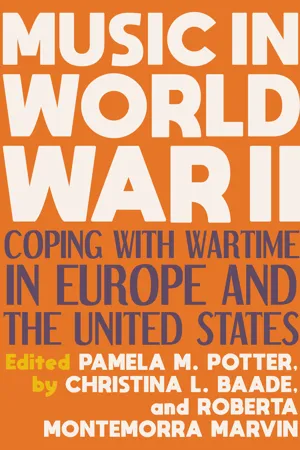
eBook - ePub
Music in World War II
Coping with Wartime in Europe and the United States
- 318 pages
- English
- ePUB (mobile friendly)
- Available on iOS & Android
eBook - ePub
Music in World War II
Coping with Wartime in Europe and the United States
About this book
Information
Subtopic
Social HistoryPART I
ON THE AIRWAVES AND THE SCREEN
ONE

SANDY CALLING
Forging an Intimate Wartime Public at the BBC Theater Organ
CHRISTINA L. BAADE
ON DECEMBER 28, 1941, THE Sunday Pictorial published a profile of Sandy Macpherson, the British Broadcasting Corporation’s resident theater organist, calling him “a radio fairy godfather.” The profile offered a few tidbits about Macpherson—he was Canadian, “easy-going,” and “quite unconceited and unawed by his fame”—but its main focus was on how, with the help of his theater organ, “radio’s most human personality” could unite families separated by war through the magic of radio. Describing Macpherson as “probably the BBC’s best contribution to the war so far,” the article celebrated his requests or messages programs, in which listeners wrote in with a song request and a message for a family member in the hopes that Sandy would include it in one of his broadcasts, which were heard at home (Sandy’s Half-Hour) and abroad (Sandy Calling the Middle East, Sandy’s Half-Hour for Canada, Sandy Calling India).1 The article opened with a vivid depiction of one such moment:
Somewhere in the Middle East a soldier is listening to the camp’s radio set, tuned in on Britain. He is listening with one ear to organ music, while he is writing a letter home. Then he sits bolt upright, for the quiet voice of the radio has given out his name.
I have a request for Gunner Smith from his wife and small daughter. The tune is “I’ll Walk Beside You.” And your wife hopes, Gunner Smith, that you’ll have a happy birthday.
That is the sort of little human miracle that happens to dozens of families every week, and the man who is responsible is Sandy Macpherson, BBC organist.2
The power of Macpherson’s broadcasts lay not simply in the connections they offered for those lucky enough to be selected, but in the public acknowledgment they represented for everyone separated by the war—demonstrating that the personal sensation of longing was also a public experience, a mark of participation in the nation’s war effort.
The potency of Gunner Smith’s story resided in what listeners had long understood: skillful broadcasters sounded like they were speaking directly to you, but it was an illusion—except when Sandy Macpherson actually did say your name. By the start of World War II, radio was established as a mass medium that offered an intimate listening experience. This duality was at the heart of radio’s “intimate public,” the term Jason Loviglio coined to describe the “new cultural space created by radio broadcasting,” with its ability to cross between—and sometimes transgress—the boundaries of public and private. As Loviglio observed, “Radio voices were thrilling because they moved with impunity back and forth from private to public modes of performance”; however, that very movement also highlighted contestations over where the line between public and private should be drawn and who got to decide.3
As I show in this chapter, Macpherson’s powerful appeal to wartime listeners was rooted in his ability to bridge modes of personal and public address in his radio performances, but his straddling of these modes also inspired intense ambivalence for leaders at the BBC and even the War Office. For the British, World War II itself was a moment when traditional boundaries between public and private were called into question—most strikingly when noncombatants became targets in the Blitz—but also in government measures that impacted everyday private life through rationing, national service, and propaganda, which suggested there was a proper way for citizens to feel about the war.4 For his critics, the question was whether Macpherson and his organ encouraged the sort of public feeling—particularly among the forces—that would help Britain win the war. Would reminders of home stiffen the resolve of the fighting forces, or would they undermine their morale?
A corollary to these questions involved how longing could be expressed on the air, what emotional registers were acceptable in its expression, and who should be allowed to articulate it. In his broadcasts, Macpherson centered the often sentimental and clichéd words, voices, and musical choices of ordinary people—men, women, and even children—using the theater organ, an instrument that was closely associated with modern mass culture and, for some, overly emotional bad taste. By foregrounding popular song, ordinary voices, and “affective and emotional attachments,” Macpherson’s programs participated in another form of “intimate public,” articulated by Lauren Berlant, which “operates when a market opens up to a bloc of consumers, claiming to circulate texts and things that express those people’s particular core interests and desires”—in this case, ordinary Britons separated by war.5 While sharing with Loviglio an interest in mediatized tensions between private and public, the locus of Berlant’s intimate public was commercial entertainment, sentimentality, and public femininity—topics that became flashpoints in wartime debates about Macpherson, his messages programs, and cinema organs in general. It was not simply Macpherson’s movement between a public and personal address that drove his popularity with listeners and, simultaneously, ambivalence from the BBC leadership; it was also the ways in which music and speech on his programs forged an intimate public in Berlant’s sense.
Published in the last days of 1941, the Sunday Pictorial article captured a high point in Macpherson’s wartime radio work. From the earliest days of the war, listeners and the more populist critics celebrated Macpherson’s reassuring presence and provision of popular entertainment. Highbrows might chafe, but airing popular music and family messages seemed a sure way to boost morale—including that of Gunner Smith “somewhere in the Middle East.” The Sunday Pictorial’s celebratory tone affirmed this approach, particularly with the still-fresh memory of the British army’s success at Tobruk, Libya, where it had ended a 242-day siege on December 7 (a victory overshadowed by news of the Pearl Harbor attack). However, significant military setbacks in early 1942 raised fresh concerns about morale and the effects of sentimental music on the radio. In this climate—and with new leadership at the BBC (Sir Cecil Graves and Robert Foot became joint directors-general in January 1942; Arthur Bliss became the new Music Department head in April)—Macpherson’s programs, the intimate public they fostered, and even the theater organ itself became subject to censure, despite their continued popularity among listeners. Throughout the war, Macpherson, his programs, and the theater organ continued to inspire both affection and animus—responses that hinged in no small part on the two notions of intimate public advanced by Loviglio and Berlant.
“POPULAR ENTERTAINMENT FOR THE MASSES”: THEATER ORGANS AT THE BBC
In December 1941, around the time that Sunday Pictorial’s readers learned about Gunner Smith, the composer and BBC Overseas Music Director Arthur Bliss penned some thoughts about the theater organ and its enthusiasts. In an early draft of what would become the BBC’s new music policy, he wrote: “The delight Caliban takes in [the theater organ] is its evocative power to recall the hand-holding atmosphere of a cinema, where he can enjoy, suffer, and live vicariously. Certain successions of chords free the tear glands; the music starts a physical sensation of a cloying kind, offensive to a vigorous mind. The cinema organ exploits with skill its red plush quality. . . . It is a dope as insidious as opium.”6
Infantilizing, emotional, and escapist, the theater organ embodied the worst of modern mass entertainment for Bliss, who would soon bring his musical standards and sense of mission to his new role as BBC director of music. Bliss did not spare those who liked the instrument: by citing “Caliban,” the savage half-monster who inhabited Prospero’s island in Shakespeare’s Tempest, he not only underlined the baseness of their tastes but also cast them as antithetical to the BBC’s mission of cultural uplift, which was symbolized by Prospero and the spirit Ariel, whose images stood in relief over the main entrance of Broadcasting House.7
Although Bliss’s rhetoric situated the theater organ firmly within the “red plush” realm of the cinema, he was, in actuality, attacking a well-established component of BBC entertainment broadcasting. Critics might have considered the cinema organ to be the illegitimate sibling of the church organ, but, from the 1920s the BBC treated it as respectable popular entertainment that might become a gateway to “better,” more serious musical fare. Indeed, cinema organs remained popular in the United Kingdom well into the sound film era, helped, in part, by the BBC’s promotion and patronage. When, in 1936, the BBC acquired a state-of-the-art Compton organ, the Times of London described theater organs as the most popular entertainment offered by the BBC, outpacing dance bands and variety.8
Such an assertion may seem surprising, given the marginalization of theater organs in popular music histories.9 However, with their streamlined consoles, “powerful pipework,” and electronic circuitry, cinema organs embodied modern ideals of design and efficiency.10 They first arrived in the United Kingdom from the United States in 1925, but the origins story went back to the nineteenth century.11 According to Reginald Foort, who became the BBC’s first resident theater organist, the instrument was born from an Anglo-American marriage between the “ideas and inventions” of the British church musician, organ builder, and electrical engineer Robert Hope-Jones and the industrial expertise of the Americans Farny and Howard Wurlitzer.12 The Wurlitzers and other manufacturers promoted their organs as “one-man orchestras,” which replaced the costs and hassles of employing an orchestra. Cinema and other venue owners would gain an instrument that offered a wide dynamic and timbral palette, abundant tuned percussion, special sound effects, and the distinctive flute-like Tibia Clausa, to which tremulant, a powerful vibrato, was almost always applied. As Foort explained, the cinema organ could “represent in turn a symphony orchestra, a cathedral organ, or a jazz-band. An almost lifelike reproduction in sound can be produced for any incident occurring on the screen, such as a baby c...
Table of contents
- Cover
- Title Page
- Copyright
- Contents
- Dedication
- Preface / Roberta Montemorra Marvin
- Introduction: Music and Global War in the Short Twentieth Century / Pamela M. Potter
- Part I: On the Airwaves and the Screen
- Part II: Opera, Theater Stage, and Concerts
- Part III: National Imaginaries
- Afterword: Trans/national Soundscapes in World War II / Annegret Fauser
- Selected Works
- Index
Trusted by 375,005 students
Access to over 1.5 million titles for a fair monthly price.
Study more efficiently using our study tools.
Frequently asked questions
Yes, you can cancel anytime from the Subscription tab in your account settings on the Perlego website. Your subscription will stay active until the end of your current billing period. Learn how to cancel your subscription
No, books cannot be downloaded as external files, such as PDFs, for use outside of Perlego. However, you can download books within the Perlego app for offline reading on mobile or tablet. Learn how to download books offline
Perlego offers two plans: Essential and Complete
- Essential is ideal for learners and professionals who enjoy exploring a wide range of subjects. Access the Essential Library with 800,000+ trusted titles and best-sellers across business, personal growth, and the humanities. Includes unlimited reading time and Standard Read Aloud voice.
- Complete: Perfect for advanced learners and researchers needing full, unrestricted access. Unlock 1.5M+ books across hundreds of subjects, including academic and specialized titles. The Complete Plan also includes advanced features like Premium Read Aloud and Research Assistant.
We are an online textbook subscription service, where you can get access to an entire online library for less than the price of a single book per month. With over 1.5 million books across 990+ topics, we’ve got you covered! Learn about our mission
Look out for the read-aloud symbol on your next book to see if you can listen to it. The read-aloud tool reads text aloud for you, highlighting the text as it is being read. You can pause it, speed it up and slow it down. Learn more about Read Aloud
Yes! You can use the Perlego app on both iOS and Android devices to read anytime, anywhere — even offline. Perfect for commutes or when you’re on the go.
Please note we cannot support devices running on iOS 13 and Android 7 or earlier. Learn more about using the app
Please note we cannot support devices running on iOS 13 and Android 7 or earlier. Learn more about using the app
Yes, you can access Music in World War II by Pamela M. Potter, Christina L. Baade, Roberta Montemorra Marvin, Pamela M. Potter,Christina Baade,Roberta Montemorra Marvin,Christina L. Baade, Pamela M. Potter, Christina Baade, Roberta Montemorra Marvin in PDF and/or ePUB format, as well as other popular books in Media & Performing Arts & Social History. We have over 1.5 million books available in our catalogue for you to explore.