Jessica Korn challenges the notion that the eighteenth-century principles underlying the American separation of powers system are incompatible with the demands of twentieth-century governance. She demostrates the continuing relevance of these principles by questioning the dominant scholarship on the legislative veto. As a short-cut through constitutional procedure invented in the 1930s and invalidated by the Supreme Court's Chadha decision in 1983, the legislative veto has long been presumed to have been a powerful mechanism of congressional oversight. Korn's analysis, however, shows that commentators have exaggerated the legislative veto's significance as a result of their incorrect assumption that the separation of powers was designed solely to check governmental authority. The Framers also designed constitutional structure to empower the new national government, institutionalizing a division of labor among the three branches in order to enhance the government's capacity.
By examining the legislative vetoes governing the FTC, the Department of Education, and the president's authority to extend most-favored-nation trade status, Korn demonstrates how the powers that the Constitution grants to Congress made the legislative veto short-cut inconsequential to policymaking. These case studies also show that Chadha enhanced Congress's capacity to pass substantive laws while making it easier for Congress to preserve important discretionary powers in the executive branch. Thus, in debunking the myth of the legislative veto, Korn restores an appreciation of the enduring vitality of the American constitutional order.
eBook - PDF
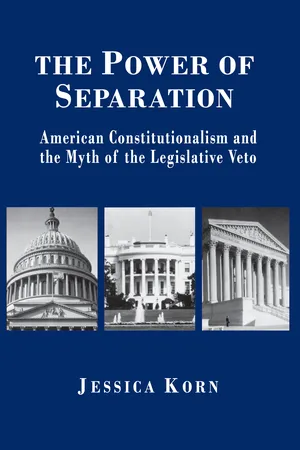
The Power of Separation
American Constitutionalism and the Myth of the Legislative Veto
- 196 pages
- English
- PDF
- Available on iOS & Android
eBook - PDF
About this book
Information
Publisher
Princeton University PressYear
2020Print ISBN
9780691058566
9780691021355
eBook ISBN
9780691219349
Table of contents
- Cover Page
- Half-title Page
- Title Page
- Copyright Page
- Dedication Page
- Contents
- Chapter One: Introduction: American Constitutionalism and American Political Science
- Chapter Two : The American Separation of Powers Doctrine
- Chapter Three : The Legislative Veto
- Chapter Four : The Legislative Veto over the Federal Trade Commission
- Chapter Five : Legislative Vetoes in Education Statutes
- Chapter Six : Legislative Vetoes over Presidential Authority to Extend Most-Favored-Nation Status
- Chapter Seven : Conclusion
- Notes
- Acknowledgments
- Name Index
- General Index
Trusted by 375,005 students
Access to over 1.5 million titles for a fair monthly price.
Study more efficiently using our study tools.
Frequently asked questions
Yes, you can cancel anytime from the Subscription tab in your account settings on the Perlego website. Your subscription will stay active until the end of your current billing period. Learn how to cancel your subscription
No, books cannot be downloaded as external files, such as PDFs, for use outside of Perlego. However, you can download books within the Perlego app for offline reading on mobile or tablet. Learn how to download books offline
Perlego offers two plans: Essential and Complete
- Essential is ideal for learners and professionals who enjoy exploring a wide range of subjects. Access the Essential Library with 800,000+ trusted titles and best-sellers across business, personal growth, and the humanities. Includes unlimited reading time and Standard Read Aloud voice.
- Complete: Perfect for advanced learners and researchers needing full, unrestricted access. Unlock 1.5M+ books across hundreds of subjects, including academic and specialized titles. The Complete Plan also includes advanced features like Premium Read Aloud and Research Assistant.
We are an online textbook subscription service, where you can get access to an entire online library for less than the price of a single book per month. With over 1.5 million books across 990+ topics, we’ve got you covered! Learn about our mission
Look out for the read-aloud symbol on your next book to see if you can listen to it. The read-aloud tool reads text aloud for you, highlighting the text as it is being read. You can pause it, speed it up and slow it down. Learn more about Read Aloud
Yes! You can use the Perlego app on both iOS and Android devices to read anytime, anywhere — even offline. Perfect for commutes or when you’re on the go.
Please note we cannot support devices running on iOS 13 and Android 7 or earlier. Learn more about using the app
Please note we cannot support devices running on iOS 13 and Android 7 or earlier. Learn more about using the app
Yes, you can access The Power of Separation by Jessica Korn in PDF and/or ePUB format, as well as other popular books in Law & Public Law. We have over 1.5 million books available in our catalogue for you to explore.