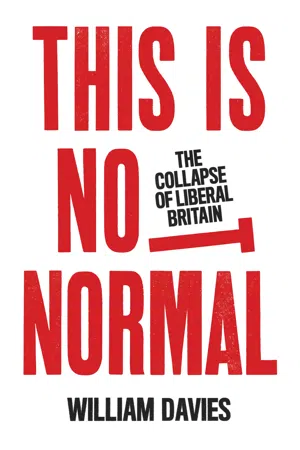
Since 2016, the UK has been in a crisis of its own making: but this is not the fault of Brexit but of a larger problem of our politics. The status of political parties, the mainstream media, public experts and officials have all been disrupted. Along the way, there have been shocking and exhilarating events: the unforeseen 2017 election result, the horrific details of Grenfell Tower and the Windrush scandal, the sudden rise and fall of the Brexit Party.As the 'mainstream' of politics and media has come under attack, the basic norms of public life have been thrown into question.
This Is Not Normal takes stock of a historical moment that no longer recognises itself. Davies tells a story of the apparently chaotic and irrational events, and extracts their underlying logic and long-term causes. What we are seeing is the effects of the 2008 financial crash, the failure of the British neoliberal project, the dying of Empire, and the impact of the changes that technology and communications have had on the idea of the public sphere as well as the power of information. This is an essential book for anyone who wants to make sense of this current moment. .
- 256 pages
- English
- ePUB (mobile friendly)
- Available on iOS & Android
eBook - ePub
About this book
Information
1
‘The People Have Spoken’
The shock of the EU referendum result prompted outrage and panic within the liberal establishment. Did truth not count any longer? Why had the tabloids been allowed to fan the anti-European flames for so long? Was the economy going to fall off a cliff? In the immediate aftermath of the referendum, there was bewilderment and fear regarding the loss of political stability and the emergence of an apparently kamikaze nationalist force. The entire era of globalisation – cultural and economic – seemed to have come to a sudden halt. Within three weeks of the referendum, Theresa May was installed as the new prime minister, and immediately set out a new type of Conservative programme, ostensibly sympathetic to the sentiments of the ‘left behind’. Apparently, now in the safe hands of the former home secretary, the protective, punitive state was back. For just under a year, cheered to the rafters by the Daily Mail and much of her own party, she sought to channel the passions of Brexit to expand her authority. So high was her confidence by the spring of 2017, that she did the very thing she had promised not to do: call an early election.
Initial Ruptures
It became clear early on in the night of the referendum that Leave had extraordinary levels of support in the North East, taking 70 per cent of the votes in Hartlepool and 61 per cent in Sunderland. It subsequently emerged that Wales had voted for Leave overall, especially strongly in the South around areas such as Newport. It is easy to focus on the recent history of Tory-led austerity when analysing this, as if anger towards elites and immigrants was simply an effect of the public spending cuts of the previous six years or (more structurally) the collapse of Britain’s pre-2007 debt-driven model of growth.
But consider the longer history of these regions as well. They are well recognised as Labour’s historic heartlands, sitting on coalfields and/or around ship-building cities. Indeed, outside of London and Scotland, they were among the only blobs of Labour red on the 2015 electoral map. There is no reason to think that they should not stay red in a future election. But in the language of Marxist geographers, they have had no successful ‘spatial fix’ since the stagflation crisis of the 1970s. Thatcherism gutted them with pit closures and monetarism, but generated no private sector jobs to fill the space. The entrepreneurial investment that neoliberals always believe is just around the corner never materialised.
New Labour’s solution was to spread wealth in their direction using fiscal policy: public sector back-office jobs were strategically relocated to South Wales and the North East to alleviate deindustrialisation, while tax credits made low-productivity service work more socially viable. This effectively created a shadow welfare state that was never publicly spoken of, co-existing with a political culture that heaped scorn on dependency. The infamous comment, sometimes attributed to Peter Mandelson, that the Labour heartlands could be depended on to vote Labour no matter what ‘because they’ve got nowhere else to go’, spoke of a dominant attitude. In Nancy Fraser’s terms, New Labour offered ‘redistribution’ but no ‘recognition’.1
This cultural contradiction wasn’t sustainable and nor was the geographic one. Not only was the ‘spatial fix’ relatively short term, seeing as it depended on rising tax receipts from the South East and a centre-left government willing to spread money quite lavishly (albeit discreetly), it also failed to deliver what many of those Brexit voters perhaps crave the most: the dignity of being self-sufficient, not necessarily in a neoliberal sense, but certainly in a communal, familial and fraternal sense.
By the same token, it seems unlikely that voters in these regions (or Cornwall or other economically peripheral spaces) would feel ‘grateful’ to the EU for subsidies. Knowing that your business, farm, family or region is dependent on the beneficence of wealthy liberals is unlikely to be a recipe for satisfaction. More bizarrely, the regions with the closest economic ties to the EU in general (and not just of the subsidised variety) were the most likely to vote Leave. While it may be one thing for an investment banker to understand that they ‘benefit from the EU’ in regulatory terms, it is quite another to encourage poor and culturally marginalised people to feel grateful towards the elites that sustain them through handouts, month by month. Resentment develops not in spite of this generosity, but arguably because of it. This isn’t to discredit what the EU does in terms of redistribution, but pointing to handouts is a psychologically and politically naive basis on which to justify remaining in the EU.
In this context, the Vote Leave campaign slogan ‘take back control’ was a piece of political genius. It worked on every level from the macroeconomic to the psychoanalytic. Think of what it means on an individual level to rediscover control. To be a person without control (for instance to suffer incontinence or a facial tick) is to be the butt of cruel jokes, to be potentially embarrassed in public. It potentially reduces one’s independence. What was so clever about the language of the Leave campaign was that it spoke directly to this feeling of inadequacy and embarrassment, then promised to eradicate it. The promise had nothing to do with economics or policy, but everything to do with the psychological allure of autonomy and self-respect. Nigel Farage’s political strategy was to take seriously communities who’d otherwise been taken for granted for much of the past fifty years.
This doesn’t necessarily have to translate into nationalistic pride or racism (although it might well do), but it does at the very least mean no longer being laughed at. Those who have ever laughed at ‘chavs’ (such as the millionaire stars of Little Britain) have something to answer for right now. The willingness of Nigel Farage to weather the scornful laughter of metropolitan liberals (for instance through his periodic appearances on Have I Got News For You) could equally have made him look brave in the eyes of many potential Leave voters. I can’t help feeling that every smug, liberal, snobbish barb that Ian Hislop threw Farage’s way on that increasingly hateful programme was ensuring that revenge would be all the greater, once it arrived. The giggling, from which Boris Johnson also benefited handsomely, needs to stop.
Brexit reflects a much deeper cultural and political malaise, one that also appears to be driving the rise of Donald Trump in the US. Among people who have utterly given up on the future, political movements don’t need to promise any desirable and realistic change. If anything, they are more comforting and trustworthy if predicated on the notion that the future is beyond rescue, for that chimes more closely with people’s private experiences. The discovery of the ‘Case Deaton effect’ in the US – unexpectedly high mortality rates among white working classes – is linked to rising alcohol and opiate abuse and to rising suicide rates. It has also been shown to correlate closely to geographic areas with the greatest support for Trump.2 It seems clear that – beyond the rhetoric of ‘Great Britain’ and ‘democracy’ – Brexit was never really articulated as a viable policy, and only ever as a destructive urge, which some no doubt now feel guilty for giving way to.
Thatcher and Reagan rode to power by promising a brighter future, which never quite materialised other than for a minority with access to elite education and capital assets. The contemporary populist promise to make Britain or America ‘great again’ is not made in the same way. It is not a pledge or a policy platform; it’s not to be measured in terms of results. When made by the likes of Boris Johnson, it’s not even clear if it’s meant seriously or not. It’s more an offer of a collective real-time hallucination, that can be indulged in like a video game.
The Remain campaign continued to rely on forecasts, warnings and predictions, in the hope that eventually people would be dissuaded from ‘risking it’. But to those who have given up on the future already, this is all just more political rhetoric. In any case, the entire practice of modelling the future in terms of ‘risk’ has lost credibility, as evidenced by the now terminal decline of opinion polling as a tool for political control.
The failure of ‘facts’
One of the complaints made most frequently by liberal commentators, economists and media pundits was that the referendum campaign was being conducted without regard to ‘truth’. This isn’t quite right. It was conducted without adequate regard to facts. To the great frustration of the Remain campaign, their ‘facts’ never cut through, whereas Leave’s statistics (most famously the £350 million/week price tag of EU membership) were widely accepted.
What is a ‘fact’ exactly? Mary Poovey argues that a new way of organising and perceiving the world came into existence at the end of the fifteenth century with the invention of double-entry book-keeping.3 This new style of knowledge is that of facts, representations that seem both context-independent, but also magically slot seamlessly into multiple contexts as and when they are needed. The basis for this magic is that measures and methodologies (such as accounting techniques) become standardised, but then treated as apolitical, thereby allowing numbers to move around freely in public discourse without difficulty or challenge. In order for this to work, the infrastructure that produces ‘facts’ needs careful policing, ideally through centralisation in the hands of statistics agencies or elite universities (the rise of commercial polling in the 1930s was already a challenge to the authority of ‘facts’ in this respect).
This game has probably been up for some time. As soon as media outlets start making a big deal about the facts of a situation, for instance with ‘fact check’ bulletins, it is clear that numbers have already become politicised. ‘Facts’ (such as statistics) survived as an authoritative basis for public and democratic deliberation for most of the 200 years following the French Revolution. But the politicisation of social sciences, metrics and policy administration means that the ‘facts’ produced by official statistical agencies must now compete with other conflicting ‘facts’. The deconstruction of ‘facts’ has been partly pushed by varieties of postmodern theory since the 1960s, but it is also an inevitable effect of the attempt (beloved of New Labour) to turn policy into a purely scientific exercise.
The attempt to reduce politics to a utilitarian science (most often, to neoclassical economics) eventually backfires, once the science in question then starts to become politicised. ‘Evidence-based policy’ is now far too long in the tooth to be treated entirely credulously, and people tacitly understand that it often involves a lot of ‘policy-based evidence’. When the Remain camp appealed to their ‘facts’, forecasts and models, they hoped that these would be judged to be outside of the fray of politics. More absurdly, they seemed to imagine that the opinions of bodies such as the IMF might be viewed as ‘independent’. Economics has been such a crucial prop for political authority over the past thirty-five years that it is now anything but outside of the fray of politics.
In place of facts, we now live in a world of data. Instead of trusted measures and methodologies being used to produce numbers, a dizzying array of numbers is produced by default, to be mined, visualised, analysed and interpreted however we wish. If risk modelling (using notions of statistical normality) was the defining research technique of the nineteenth and twentieth centuries, sentiment analysis is the defining one of the emerging digital era. We no longer have stable, ‘factual’ representations of the world, but unprecedented new capacities to sense and monitor what is bubbling up where, who’s feeling what, what’s the general vibe.
Financial markets are themselves far more like tools of sentiment analysis (representing the mood of investors) than producers of ‘facts’. This is why it was so absurd to look to currency markets and spread-betters for the truth of what would happen in the referendum: they could only give a sense of what certain people felt would happen in the referendum at certain times. Given the absence of any trustworthy facts (in the form of polls), they could then only provide a sense of how investors felt about Britain’s national mood: a sentiment regarding a sentiment. As the 23 June 2016 turned into 24 June, it became manifestly clear that prediction markets are little more than an aggregative representation of the same feelings and moods that one might otherwise detect via Twitter. They’re not in the business of truth-telling, but of mood-tracking.
What Sort of Crisis Is This?
The bankruptcy of Lehman Brothers in September 2008 was an emergency. This was manifest in its rapid pace and the threat that it might spread exponentially, just like a fire. While the warning signs had been present for over a year prior to the collapse of Lehmans, the emergency occurred over a series of hours, and demanded an immediate policy response. The state acted as a fire brigade on the basis that the emergency would otherwise have spiralled out of control. The fact that the financial crisis may have cost a sum of money comparable to a world war does not mean the rescue wasn’t worth it, if the alternative was total social meltdown.
Brexit has a completely different rhythm, which is why comparisons to Lehmans don’t reveal very much. The weirdest thing about the week following the referendum has been the eerie sense of waiting for something to happen, the collapse of sterling notwithstanding. All that’s happened so far is pretty much exactly what experts and policymakers predicted, whereas the experts were temporarily stumped during September 2008. Investors aren’t panicking right now, they’re simply responding as everyone said they would. It’s the long-term future that is much more worrying. If Lehmans was a housefire (which was spreading), this is more like someone choosing to buy a house that the surveyor has found to be suffering long-term subsidence, but going ahead with the purchase anyway. Not only do the emergency services not care, they can’t help you anyway. Meanwhile your insurance company (who you never liked in the first place) told you repeatedly they couldn’t underwrite it.
Where they are framed as such, emergencies can be used to entrench the status quo even more firmly, making a situation more reliant on existing powers rather than less. This is clearly what happened with neoliberalism from 2008 onwards: states and banks benefited from the ultra-fast pace of economic meltdown in being able to implement measures (often with little deliberation, sometimes overnight or over weekends) that would rescue the status quo. Hence, states successfully sustained the flawed model of capitalism which privileged the financial sector for another eight years, while pushing the costs elsewhere. But Brexit is a crisis of the state first and foremost. This makes it slower but ultimately far more transformative and frightening.
The question is, what is the relation between the economic crisis of 2008 and the political one of 2016, and why the delay between the two? The first thing to note is that the ‘emergency’ of 2008 was never allowed to become a proper crisis, in the sense of a turning point or conclusive judgement. It was bad and scary, but in rescuing the situation, policymakers ensured that nothing would fundamentally change. Crucially, the nature of the rescue (and subsequent policies such as negative interest rates, austerity measures, national bailout and quantitative easing) meant that debt obligations were upheld at all costs. Rather than learn from the mistakes of the past and start afresh (through debt write-offs and bankruptcies) in a different direction, this absolutist respect for debts means that the power relations of the past (between creditor and debtor) are sustained and exacerbated. To insist on the sanctity of debt obligations is a way of ensuring that politics and economics are safely insulated from one another, thereby ensuring that an economic disaster avoids becoming a fully fledged crisis. This insulation was time-limited: in the UK, it turns out to have lasted eight years.
Given that the post-2008 regime of regulation, corporate governance and growth was roughly the same as the pre-2008 one, it should always have been clear that 2008 would be the first ‘prong’ of a two-pronged crisis. Most critical observers suspected that the second ‘prong’ would be similar to the first: another collapse in the credibility of financial derivatives, only this time without the same possibilities for a sovereign rescue. That would necessarily have produced far-reaching political change, for the simple reason that another rescue of the status quo wouldn’t have been viable.
Instead, crisis has emanated from outside of the financial sector altogether, from democracy itself. For Britain, June 2016 might provide the full-stop at the end of a paragraph that began with September 2008 (or arguably a year earlier with Northern Rock). Historians may well look at Lehmans and Brexit as entangled with each other in various ways, but the exact causal connections between the first and second ‘prongs’ of the capitalist crisis are far from clear. What I think we can say instead is that both are consequences of the rise of finance from the 1980s onwards.
The term ‘financialisation’ refers to various processes whereby the logic of finance permeates the non-financial economy and society. All manner of economic and non-economic entities (such as higher education and homes) become valued in terms of their capacity to earn future returns on investment. Giovanni Arrighi argued that all phases of national capitalist expansion eventually reach their peak, then experience a compensatory wave of financial expansion as they go into decline.4 This grants a national economic power a few more years of wealth accumulation, but on the basis of shifting paper around and mediating financial agreements, rather than producing things of any use. This is a case of buying time.5
The rampant expansion of Britain’s financial sector from the 1980s onwards did exactly this, drawing money towards London (and to some extent the UK), but only on the basis that this is where money is made and traded, rather than because of productive activity. Hence, combating inflation and protecting sterling (that is, demonstrating respect for money as a good in itself ) were the pivotal instruments of British industrial policy from Thatcher through to Cameron. That ended last Thursday.
Buying a few more years of prosperity via the financial sector carries severe social costs. In particular, it produces some very awkward cultural and political divisions. These never quite resemble traditional class divisions, as between ‘bourgeoisie’ and ‘proletariat’ (where the former exploits the labour power of the latter). Instead, those who happen to own assets (often thanks to family inheritance) do vastly better than those that don’t. Where they choose to leverage these assets to buy more assets, then their advantages can grow exponentially. What begins with a slice of luck can rapidly snowball into a new rentier class (the ‘1 per cent’).6 The liberal attempt to anchor economic inequalities in differences in ‘merit’ or ‘talent’ or ‘effort’ comes under greater and greater strain, until eventually it loses credibility altogether. The market loses its status as a ‘level playing field’, producing an ideological crisis.
Furthermore, it produces a sense of intergenerational conflict that is equally difficult to crowbar into traditional class divisions. Certain individuals now seem hugely privileged, simply by virtue of being born between 1940 and 1970, while subsequent generations seem to do progressively worse. The current focus on ‘generations’ imposes sharp dividing lines of the sort that market researchers tend to like (such as ‘baby-boomers’ against ‘millennials’), but exaggerates the binary nature of the politics. Underneath this is steady asset price inflation, year on year, and declining social provision, both enabled by the steady expansion of credit in circulation. In the UK, it becomes less economically fortunate to be born with each year that passes.
While the underlying inequalities wrought by finance may not fall neatly into binary oppositions, they seem to have influenced the politics of Remain versus Leave in certain ways. Leave voters consisted roughly of those who have already accumulated assets over their lives plus some who are unlikely to ever do so. Remain voters consisted of those who still feel (for whatever reason) that they could make financialisation work for them, either because they’re young or because they’re still benefiting from asset appreciation. To put that another way, many of the first group would view money as debt ...
Table of contents
- Cover Page
- Halftitle Page
- Title Page
- Dedication
- Copyright Page
- Contents
- Introduction
- 1. ‘The People Have Spoken’
- 2. Quagmire
- 3. ‘The People’ versus ‘Politics’
- Afterword: In the Wreckage of Liberalism
- Acknowledgements
- Notes
Trusted by 375,005 students
Access to over 1.5 million titles for a fair monthly price.
Study more efficiently using our study tools.
Frequently asked questions
Yes, you can cancel anytime from the Subscription tab in your account settings on the Perlego website. Your subscription will stay active until the end of your current billing period. Learn how to cancel your subscription
No, books cannot be downloaded as external files, such as PDFs, for use outside of Perlego. However, you can download books within the Perlego app for offline reading on mobile or tablet. Learn how to download books offline
We are an online textbook subscription service, where you can get access to an entire online library for less than the price of a single book per month. With over 1.5 million books across 990+ topics, we’ve got you covered! Learn about our mission
Look out for the read-aloud symbol on your next book to see if you can listen to it. The read-aloud tool reads text aloud for you, highlighting the text as it is being read. You can pause it, speed it up and slow it down. Learn more about Read Aloud
Yes! You can use the Perlego app on both iOS and Android devices to read anytime, anywhere — even offline. Perfect for commutes or when you’re on the go.
Please note we cannot support devices running on iOS 13 and Android 7 or earlier. Learn more about using the app
Please note we cannot support devices running on iOS 13 and Android 7 or earlier. Learn more about using the app
Yes, you can access This is Not Normal by William Davies in PDF and/or ePUB format, as well as other popular books in Politics & International Relations & Essays in Politics & International Relations. We have over 1.5 million books available in our catalogue for you to explore.