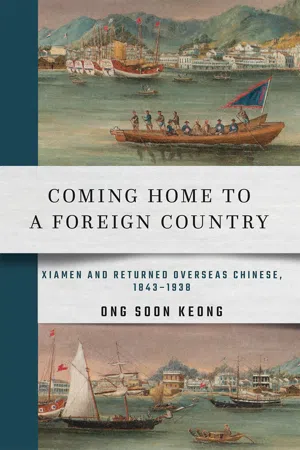
Coming Home to a Foreign Country
eBook - ePub

Coming Home to a Foreign Country

Xiamen and Returned Overseas Chinese, 1843–1938

  1. 252 pages
  2. English
  3. ePUB (mobile friendly)
  4. Available on iOS & Android
eBook - ePub

Coming Home to a Foreign Country

Xiamen and Returned Overseas Chinese, 1843–1938

About this book

Ong Soon Keong explores the unique position of the treaty port Xiamen (Amoy) within the China-Southeast Asia migrant circuit and examines its role in the creation of Chinese diasporas. Coming Home to a Foreign Country addresses how migration affected those who moved out of China and later returned to participate in the city's economic revitalization, educational advancement, and urban reconstruction. Ong shows how the mobility of overseas Chinese allowed them to shape their personal and community identities for pragmatic and political gains. This resulted in migrants who returned with new money, knowledge, and visions acquired abroad, which changed the landscape of their homeland and the lives of those who stayed.

Placing late Qing and Republican China in a transnational context, Coming Home to a Foreign Country explores the multilayered social and cultural interactions between China and Southeast Asia. Ong investigates the role of Xiamen in the creation of a China-Southeast Asia migrant circuit; the activities of aspiring and returned migrants in Xiamen; the accumulation and manipulation of multiple identities by Southeast Asian Chinese as political conditions changed; and the motivations behind the return of Southeast Asian Chinese and their continual involvement in mainland Chinese affairs. For Chinese migrants, Ong argues, the idea of "home" was something consciously constructed.

Ong complicates familiar narratives of Chinese history to show how the emigration and return of overseas Chinese helped transform Xiamen from a marginal trading outpost at the edge of the Chinese empire to a modern, prosperous city and one of the most important migration hubs by the 1930s.

Frequently asked questions

Yes, you can cancel anytime from the Subscription tab in your account settings on the Perlego website. Your subscription will stay active until the end of your current billing period. Learn how to cancel your subscription.
At the moment all of our mobile-responsive ePub books are available to download via the app. Most of our PDFs are also available to download and we're working on making the final remaining ones downloadable now. Learn more here.
Perlego offers two plans: Essential and Complete
  • Essential is ideal for learners and professionals who enjoy exploring a wide range of subjects. Access the Essential Library with 800,000+ trusted titles and best-sellers across business, personal growth, and the humanities. Includes unlimited reading time and Standard Read Aloud voice.
  • Complete: Perfect for advanced learners and researchers needing full, unrestricted access. Unlock 1.4M+ books across hundreds of subjects, including academic and specialized titles. The Complete Plan also includes advanced features like Premium Read Aloud and Research Assistant.
Both plans are available with monthly, semester, or annual billing cycles.
We are an online textbook subscription service, where you can get access to an entire online library for less than the price of a single book per month. With over 1 million books across 1000+ topics, we’ve got you covered! Learn more here.
Look out for the read-aloud symbol on your next book to see if you can listen to it. The read-aloud tool reads text aloud for you, highlighting the text as it is being read. You can pause it, speed it up and slow it down. Learn more here.
Yes! You can use the Perlego app on both iOS or Android devices to read anytime, anywhere — even offline. Perfect for commutes or when you’re on the go.
Please note we cannot support devices running on iOS 13 and Android 7 or earlier. Learn more about using the app.
Yes, you can access Coming Home to a Foreign Country by Soon Keong Ong in PDF and/or ePUB format, as well as other popular books in History & Chinese History. We have over one million books available in our catalogue for you to explore.

Information

1

DEFINING XIAMEN

Trade and Migration before the Opium War (1839–1842)
The early treaty ports were not picked by chance, much less created de novo by the blessings of European trade. They were shrewdly chosen as points of entrance into the avenues of Chinese maritime trade which already existed.
—John K. Fairbank, Trade and Diplomacy on the China Coast (1953)
The signing of the Treaty of Nanjing signaled a decided shift in the balance of power between China and Great Britain in the latter’s favor. But more than a military victory for the British, the treaty also positioned them better than ever to exploit the China market they had coveted for centuries. Not only did they gain a permanent foothold at the doorstep of China in Hong Kong, the British also ended the long-standing “Canton system” (1757–1842) that many of them found frustratingly restrictive by opening up four more ports—Shanghai, Ningbo, Fuzhou, and Xiamen—in addition to Canton (Guangzhou) for foreign trade. And as John King Fairbank reminded us, the new ports were not indiscriminately chosen; nor were they new markets established by and for the European trade.1 As a matter of fact, the British had consciously selected these ports not only because they were easily accessible from beyond China but also because they were where foreign merchants could “tap” the China market as close as possible to where the action already was.2 Ningbo was the traditional base for trade between Zhejiang Province, cities in North China, and the coasts of Japan and Korea; Shanghai, though small, was already a recognized port at the mouth of the Yangtze River; Fuzhou was the port for tributary trade with Ryukyu and Formosa; and Xiamen, the central focus of our study, was the center of an established and far-reaching maritime trading network on the China coast that extended to Southeast Asia.3 The first half of this chapter thus examines the rise of Xiamen as a maritime trading center from the seventeenth to nineteenth centuries, culminating with its opening as a treaty port after the Opium War.
While the British correctly identified Xiamen as the epicenter of commercial activities in South Fujian, they largely overlooked the fact that it was also, for centuries, the launch pad for lawful and clandestine travelers migrating to Taiwan and Southeast Asia. Xiamen’s opening as a treaty port further enhanced its position as a migration hub as an unprecedented number of South Fujianese found their way through Xiamen to venues overseas.4 By1930, no fewer than 1.7 million Chinese had left China through its port.5
There is no doubt that the Opium War and its aftermath triggered the mass migration of Chinese abroad. But unlike Hong Kong, whose function as an “in-between place” only came about after the British takeover, Xiamen was already well accustomed to the movement of people, and its reputation as the embarkation point of South Fujian was also well known to potential migrants in the region. In the second half of this chapter, we look at the interplay between trade and migration in South Fujian and the migration routes of the Fujianese before the mid-1800s. As we shall see, Xiamen and the Fujianese were well positioned to take advantage of the conditions and mechanisms that the treaty port era offered. And the continuation and expansion of migration through Xiamen deeply affected the port city’s commercial activities and determined its development in ways that were unforeseen by the British.

Trade

Maritime Trade in South Fujian

Contrary to the common impression of Chinese as “earthbound,” South Fujianese from today’s Xiamen, Zhangzhou, and Quanzhou areas have long garnered a reputation as the preeminent “sea merchants” in the country.6 There were many reasons why these Hokkiens—as they refer to themselves in the local dialect overseas—took to maritime trade, and the most fundamental one was necessity. Fujian’s topography was not particularly kind to those whose livelihood depended on working the land. With over 90 percent of the province mountainous, there was little room left for river plains to grow grains. Farmers in Fujian thus faced a formidable challenge if they wanted to gain self-sufficiency, and competition for arable land became a persistent source of violence in the province. As one seventeenth-century observer lamented, the hunger for land had led Fujianese peasants “to quarrel like dogs barking with bared teeth, and even to fight with and kill one another.”7
For those fortunate or powerful enough to acquire a piece of land, they often found Fujian’s soil acidic, with many of its nutrients leached out, requiring much effort and heavy fertilization before it could be productive again. Regrettably, this was a luxury not many tillers could afford. Little wonder rice was chronically in short supply in Fujian, and as early as the Song dynasty (960–1279), the province already had to rely on other provinces to supply the favorite southern staple. As one Song official confirmed in his memorial in the early thirteenth century: “The harvest in Fuzhou, Quanzhou, and Xinghua is normally poor. Even in years of good harvest the supply is exhausted within half a year. All watch for the merchants bringing in rice supplies from both North and South.”8 What is noteworthy is that since Fujian was girded by highlands on three sides, effectively cutting it off from its neighbors, interprovincial trade overland was difficult and expensive.9 The transport of rice thus had to be conducted along China’s coast. And as Fujian’s dependence on imported rice continued, the increasing coastal rice trade not only became an integral fixture of the province’s economy but also instilled in the people of Fujian a seaward and mercantile mind-set.10
While it is true that Fujianese initially looked to the sea for reprieve, it is equally true that they soon found seaborne trade an attractive alternative to farming. The economic motivation behind their involvement in maritime activities was pithily captured in the now-famous aphorism “[the people of Fujian] viewed the seas as their paddies and built ships for profits.”11 Indeed, the inhabitants of Fujian had been the master shipbuilders of China since ancient times and had been constructing ships capable of cruising long distances up the coastline to the Korean peninsula and down to Indochina and the Malay peninsula.12 However, their maritime enterprise was largely contained during the first millennium AD due to a lack of state support and the fact that foreign trade was largely conducted in Chinese ports, with Indian, Persian, and later Arab vessels ferrying in precious cargoes from Southeast Asia and beyond.13 This is to say, there was no need for Chinese merchants to venture overseas. Still, Hokkien merchants did venture southward to initiate limited trade with their Southeast Asian counterparts by the eighth century and expanded their seaborne businesses after the collapse of the Tang dynasty at the beginning of the tenth century. But the “golden age of the Hokkien maritime trade” did not arrive until the twelfth and thirteenth centuries during the Southern Song dynasty (1127–1279).14
In 1127, the Jurchen Jin dynasty (1115–1234) invaded and took the Song capital of Kaifen, forcing the Song court to flee south and established a new capital at Hangzhou.15 Having lost a large expanse of taxable farm land in the North, the Southern Song court came to rely more on trade, especially foreign mari...

Table of contents

  1. Measures, Weights, and Currencies
  2. Acknowledgments
  3. Introduction
  4. 1. Defining Xiamen
  5. 2. Opening for Business
  6. 3. Facilitating Migration
  7. 4. Manipulating Identities
  8. 5. Transforming Xiamen
  9. 6. Making Home
  10. Conclusions
  11. Bibliography
  12. Index