eBook - ePub
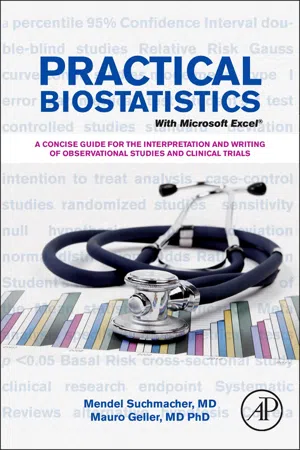
Practical Biostatistics
A Friendly Step-by-Step Approach for Evidence-based Medicine
- 248 pages
- English
- ePUB (mobile friendly)
- Available on iOS & Android
eBook - ePub
Practical Biostatistics
A Friendly Step-by-Step Approach for Evidence-based Medicine
About this book
Evidence-based medicine aims to apply the best available evidence gained from the scientific method to medical decision making. It is a practice that uses statistical analysis of scientific methods and outcomes to drive further experimentation and diagnosis. The profusion of evidence-based medicine in medical practice and clinical research has produced a need for life scientists and clinical researchers to assimilate biostatistics into their work to meet efficacy and practical standards. Practical Biostatistics provides researchers, medical professionals, and students with a friendly, practical guide to biostatistics. With a detailed outline of implementation steps complemented by a review of important topics, this book can be used as a quick reference or a hands-on guide to effectively incorporate biostatistics in clinical trials.
- Customized presentation for biological investigators with examples taken from current clinical trials in multiple disciplines
- Clear and concise definitions and examples provide a pragmatic guide to bring clarity to the applications of statistics in improving human health
- Addresses the challenge of assimilation of mathematical concepts to better interpret literature, to build stronger studies, to present research effectively, and to improve communication with supporting biostatisticians
Information
Topic
MedicineSubtopic
PharmacologyPart I
Introduction
The objective of Part I is to instruct the reader on how to choose the study type that best fits his or her research goals and material resources as well as how to determine the study type of a given paper.
Chapter 1
Study Type Determination
A crucial stage in research planning is to determine the most suitable study type, according to the investigator’s hypothesis (Chapter 4) and material resources available. A proposed classification of study types for epidemiological and clinical research is detailed in this chapter.
1.1 Epidemiological Studies
Epidemiological studies aim to establish the frequency of a condition in a given population. In this type of study, establishing reliable risk or etiological correlations is not possible because precise consistency between risk factors exposure or nonexposure, as well as between affected or nonaffected groups, cannot be achieved. For this reason, epidemiological studies remain mostly limited to measuring frequencies. Suspected risk correlations should be clarified through analytical studies.
Epidemiological studies can be classified into three types: ecological studies, cross-sectional studies, and longitudinal studies.
1.1.1 Ecological Studies
Ecological studies aim to determine the frequency of a given condition, supposedly associated with some environmental factor, during parallel or subsequent past time spans. For example, during the past 3 years, students from school A, which is located in an underprivileged district, have been presenting a higher frequency of upper respiratory virus infection compared to students from school B, which is located in a middle-class district, whose frequency is considered usual.
1.1.2 Cross-Sectional Studies
In cross-sectional studies, the frequency of a given condition in a naturally evolving population under a suspected exposure factor is analyzed, like a snapshot (Figure 1.1).

Figure 1.1 Schematic representation of cross-sectional study type.
1.1.3 Longitudinal Studies
In longitudinal studies, a cohort is followed for several years, or sometimes decades, in order to establish the frequencies of specific conditions and their correlation with environmental or other biological factors. Comparisons can be performed intrasubject or between different subjects, if possible. A classic example is the Framingham Heart Study, which began in 1948 with 5209 subjects and is currently in its third generation of participants. Knowledge on important environmental factors currently associated with cardiovascular risk, such as lifestyle (smoking, diet, and exercise) and aspirin use, has been derived from this study.
1.2 Analytical Studies
Analytical studies aim to establish correlation strength between a condition and a factor putatively associated with its origin and/or natural history. These types of studies are the main focus of this book and can be classified either as observational or intervention studies.
1.2.1 Observational Studies
In observational studies, the frequency of a condition in a population is studied under so-called “natural” circumstances. As such, active intervention from the investigator on these circumstances is not applicable. The main objective of observational studies is to establish the degree of hazard for a certain condition in relation to a considered exposure factor. Submitting the observed population to “real world” situations is its advantage. Its limitation is that it yields less accurate conclusions because uncontrolled variables and potential confounders may generate bias. Observational studies can be classified as case–control or cohort studies.
Case–Control Studies
In case–control studies, two groups are retrospectively compared, according to the following model: (1) One group with the condition (case) is subdivided into two subgroups – one exposed and the other nonexposed to a studied exposure factor; and (2) another group without the condition (control) is subdivided into two subgroups – one exposed and the other nonexposed to the same factor (Figure 1.2).

Figure 1.2 Schematic representation of a case–control study type.
Case–control studies aim to determine the odds of acquiring a condition under exposure to a considered factor. For example, the odds of miners presenting asbestos-associated lung fibrosis relative to the general population are 1.5:1. The advantages of case–control studies are that they are less expensive to perform compared to cohort studies and they can be performed immediately because they are generally retrospective. Also due to this latter aspect, their limitations are: poor control over the exposure factor, uncontrolled variables, and potential confounders. Given the fact they focus on the outcome and “move back” toward the exposure factor, they are generally retrospective. Their inferred association strength – the odds ratio – is calculated using a specific formula (Chapter 2).
Cohort Studies
In cohort studies, a cohort of healthy subjects is divided into two groups according to exposure or nonexposure to a given factor – exposed subjects and nonexposed subjects – in principle for prospective follow-up. At the end of the study, the number of subjects with and without the condition is measured (Figure 1.3).

Figure 1.3 Schematic representation of a cohort study type.
Cohort studies aim to determine the risk of acquiring a condition under exposure to a considered factor. For example, nuclear power plant workers have a 2.5 times greater risk of presenting high-grade lymphoma relative to nonexposed subjects. The advantage of these studies is that they afford better control over exposure level, covariates, and potential confounders because they are prospective. Their limitations are the need to wait for exposure factors to exert their effects and higher cost. Given the fact they focus on the exposure factor and “move forward” to the outcome, they are generally prospective.
Their inferred association strength – relative risk – is calculated using a specific formula (see Chapter 2). Note that...
Table of contents
- Cover Image
- Table of Contents
- Title
- Copyright
- Foreword
- Preface
- Acknowledgments
- Part I. Introduction
- Part II. Observational Studies
- Part III. Step-by-Step Biostatistics of a Clinical Trial
- Part IV. Additional Concepts in Biostatistics
- APPENDIX. Microsoft Excel 2010 Basics
- Glossary
- Index
Trusted by 375,005 students
Access to over 1.5 million titles for a fair monthly price.
Study more efficiently using our study tools.
Frequently asked questions
Yes, you can cancel anytime from the Subscription tab in your account settings on the Perlego website. Your subscription will stay active until the end of your current billing period. Learn how to cancel your subscription
No, books cannot be downloaded as external files, such as PDFs, for use outside of Perlego. However, you can download books within the Perlego app for offline reading on mobile or tablet. Learn how to download books offline
Perlego offers two plans: Essential and Complete
- Essential is ideal for learners and professionals who enjoy exploring a wide range of subjects. Access the Essential Library with 800,000+ trusted titles and best-sellers across business, personal growth, and the humanities. Includes unlimited reading time and Standard Read Aloud voice.
- Complete: Perfect for advanced learners and researchers needing full, unrestricted access. Unlock 1.5M+ books across hundreds of subjects, including academic and specialized titles. The Complete Plan also includes advanced features like Premium Read Aloud and Research Assistant.
We are an online textbook subscription service, where you can get access to an entire online library for less than the price of a single book per month. With over 1.5 million books across 990+ topics, we’ve got you covered! Learn about our mission
Look out for the read-aloud symbol on your next book to see if you can listen to it. The read-aloud tool reads text aloud for you, highlighting the text as it is being read. You can pause it, speed it up and slow it down. Learn more about Read Aloud
Yes! You can use the Perlego app on both iOS and Android devices to read anytime, anywhere — even offline. Perfect for commutes or when you’re on the go.
Please note we cannot support devices running on iOS 13 and Android 7 or earlier. Learn more about using the app
Please note we cannot support devices running on iOS 13 and Android 7 or earlier. Learn more about using the app
Yes, you can access Practical Biostatistics by Mendel Suchmacher,Mauro Geller in PDF and/or ePUB format, as well as other popular books in Medicine & Pharmacology. We have over 1.5 million books available in our catalogue for you to explore.