eBook - ePub
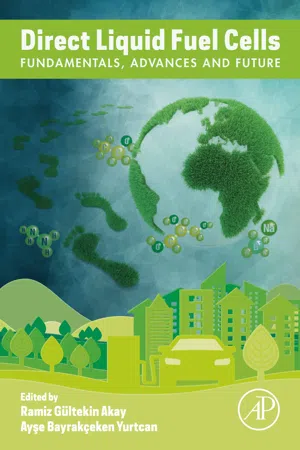
Direct Liquid Fuel Cells
Fundamentals, Advances and Future
- 328 pages
- English
- ePUB (mobile friendly)
- Available on iOS & Android
eBook - ePub
Direct Liquid Fuel Cells
Fundamentals, Advances and Future
About this book
Direct Liquid Fuel Cells is a comprehensive overview of the fundamentals and specificities of the use of methanol, ethanol, glycerol, formic acid and formate, dimethyl ether, borohydride, hydrazine and other promising liquid fuels in fuel cells. Each chapter covers a different liquid fuel-based fuel cell such as: Anode catalysts of direct methanol fuel cells (DMFCs), future system designs and future trends for direct ethanol fuel cells (DEFCs), development of catalysts for direct glycerol fuel cells (DGFCs), the mechanisms of the reactions taking place at the anode and cathode electrodes, and the reported anode catalysts for direct formic acid fuel cell (DFAFC) and direct formate fuel cell (DFFC), characteristics of direct dimethyl ether fuel cell (DDMEFC), including its electrochemical and operating systems and design, the developments in direct borohydride fuel cells, the development of catalysts for direct hydrazine fuel cells (DHFCs), and also the uncommonly used liquids that have a potential for fuel cell applications including 2-propanol, ethylene glycol, ascorbic acid and ascorbate studied in the literature as well as utilization of some blended fuels. In each part, the most recent literature is reviewed and the state of the art is presented. It also includes examples of practical problems with solutions and a summarized comparison of performance, advantages, and limitations of each type of fuel cell discussed. Direct Liquid Fuel Cells is not a typical textbook but rather designed as a reference book of which any level of students (undergraduate or graduate), instructors, field specialists, industry and general audience, who benefit from current and complete understanding of the many aspects involved in the development and operation of these types of fuel cells, could make use of any chapter when necessary.
- Presents information on different types of direct liquid fuel cells.
- Explores information under each section, for specific fuel-based fuel cells in more detail in terms of the materials used.
- Covers three main sections: direct alcohol, organic fuel-based and inorganic fuel-based fuel cells
Information
Topic
Physical SciencesSubtopic
EnergyChapter 1: Introduction to fuel cells
Ayşenur Öztürka; Ramiz Gültekin Akayb; Serdar Erkanc; Ayşe Bayrakçeken Yurtcana,d,⁎ a Faculty of Engineering, Department of Chemical Engineering, Atatürk University, Erzurum, Turkey
b Faculty of Engineering, Chemical Engineering Department, Kocaeli University, Kocaeli, Turkey
c Atombir Energy Technologies Laboratory Chemistry Informatics Software Automation Contact Electric Electronic Limited Company, Middle East Technical University Technocity, Ankara, Turkey
d Nanoscience and Nanoengineering Research and Application Center, Atatürk University, Erzurum, Turkey
* Corresponding author
b Faculty of Engineering, Chemical Engineering Department, Kocaeli University, Kocaeli, Turkey
c Atombir Energy Technologies Laboratory Chemistry Informatics Software Automation Contact Electric Electronic Limited Company, Middle East Technical University Technocity, Ankara, Turkey
d Nanoscience and Nanoengineering Research and Application Center, Atatürk University, Erzurum, Turkey
* Corresponding author
Abstract
Fuel cells (FCs) have been mentioned as an alternative energy technology in which the chemical energy of the fuel is directly converted into electrical energy. Fuel cell technology is progressing gradually with intense researches in the fields of material engineering, nanotechnology, transport phenomena, electrocatalysts engineering, etc., and it is now possible to use these systems in many stationary and portable applications. This chapter consists of four subsections. In the first part, a brief introduction to the history of fuel cells was given. Subsequently, the information on the development of fuel cell technology and the current state of these systems in recent years will be provided in the second part. The third part was dedicated to basic components of fuel cells (on the specialty of PEMFC). The last part was concerned about the basis of direct liquid fuel cells (DLFCs) in which the fuel (alcohols, acids, glycols) is in liquid form.
Keywords
Fuel cell history and technology; PEM fuel cell components; Membrane electrode assembly; Gas diffusion layer; Direct liquid fuel cells
1.1: A brief history of the development of fuel cell (FC) technology
Initial studies on fuel cell systems coincide with the end of the 18th century and the beginning of the 19th century. Although the importance given to fuel cells has increased in recent years, it has a history of approximately 150 years. Although the German chemist Christian Friedrich Schönbein and the Welsh chemical physicist Sir William Robert Grove both have a reputation for being the first researchers on the fuel cell, Sir William Robert Grove is mostly considered to be the inventor of the first fuel cell. But even before, the concept of a fuel cell was also attributed to Humphry Davy in the early 19th century (1802) for his observations and studies [1, 2]. Sir William Robert Grove created the “Grove Cell” and discovered that it could generate current flow from the electrochemical reaction between the oxygen and hydrogen gases by using platinum electrodes immersed in dilute sulfuric acid solution [1, 3]. Then by further developing the system, he connected the cells in series. In this integrated system, which he called the “gas battery” (1842), he observed a higher potential drop between the electrodes and discovered that more current was drawn through the cells connected in series [1, 2, 4]. This arrangement forms the basis of the fuel cell systems used today. The representative demonstration of the gas battery was given in Fig. 1.1[4].

Although the first fuel cell developed by Sir William Robert Grove was a major step forward for the introduction of this technology, much more had to be understood in order to implement fuel cells into practical applications. Grove stated the significance of the electrochemical active area in which three phases such as gas, electrolyte and electrode interact with each other. Friedrich Wilhelm Ostwald (1893), who is known as the founder of physical chemistry and a Nobel Prize Winner (1909), contributed a lot to the fuel cell field by theoretical explanations regarding the fuel cell operation principles. He explained the difference between the internal combustion engines and fuel cells in terms of energy efficiency. The first one has a lower capability comparatively to the second one regarding the energy conversion because of the Carnot Cycle limitations. In a fuel cell, direct conversion of the fuel chemical energy into elec...
Table of contents
- Cover image
- Title page
- Table of Contents
- Copyright
- Contributors
- Preface
- Chapter 1: Introduction to fuel cells
- Chapter 2: Introduction to direct alcohol fuel cells (DAFCs)
- Chapter 3: Direct methanol fuel cells (DMFCs)
- Chapter 4: Direct ethanol fuel cells (DEFCs)
- Chapter 5: Direct glycerol fuel cells (DGFCs)
- Chapter 6: Introduction to other organic fuel-based fuel cells
- Chapter 7: Direct formic acid and formate fuel cells (DF(A)FCs)
- Chapter 8: Direct dimethyl ether fuel cells (DDMEFCs)
- Chapter 9: Introduction to inorganic fuel-based direct liquid fuel cells
- Chapter 10: Direct borohydride fuel cells (DBFCs)
- Chapter 11: Direct hydrazine fuel cells (DHFCs)
- Chapter 12: Other possible fuels and possible use of blended fuels in fuel cells
- Chapter 13: Conclusions: Current state and future
- Index
Trusted by 375,005 students
Access to over 1.5 million titles for a fair monthly price.
Study more efficiently using our study tools.
Frequently asked questions
Yes, you can cancel anytime from the Subscription tab in your account settings on the Perlego website. Your subscription will stay active until the end of your current billing period. Learn how to cancel your subscription
No, books cannot be downloaded as external files, such as PDFs, for use outside of Perlego. However, you can download books within the Perlego app for offline reading on mobile or tablet. Learn how to download books offline
Perlego offers two plans: Essential and Complete
- Essential is ideal for learners and professionals who enjoy exploring a wide range of subjects. Access the Essential Library with 800,000+ trusted titles and best-sellers across business, personal growth, and the humanities. Includes unlimited reading time and Standard Read Aloud voice.
- Complete: Perfect for advanced learners and researchers needing full, unrestricted access. Unlock 1.5M+ books across hundreds of subjects, including academic and specialized titles. The Complete Plan also includes advanced features like Premium Read Aloud and Research Assistant.
We are an online textbook subscription service, where you can get access to an entire online library for less than the price of a single book per month. With over 1.5 million books across 990+ topics, we’ve got you covered! Learn about our mission
Look out for the read-aloud symbol on your next book to see if you can listen to it. The read-aloud tool reads text aloud for you, highlighting the text as it is being read. You can pause it, speed it up and slow it down. Learn more about Read Aloud
Yes! You can use the Perlego app on both iOS and Android devices to read anytime, anywhere — even offline. Perfect for commutes or when you’re on the go.
Please note we cannot support devices running on iOS 13 and Android 7 or earlier. Learn more about using the app
Please note we cannot support devices running on iOS 13 and Android 7 or earlier. Learn more about using the app
Yes, you can access Direct Liquid Fuel Cells by Ramiz Gültekin Akay,Ayşe Bayrakçeken Yurtcan in PDF and/or ePUB format, as well as other popular books in Physical Sciences & Energy. We have over 1.5 million books available in our catalogue for you to explore.