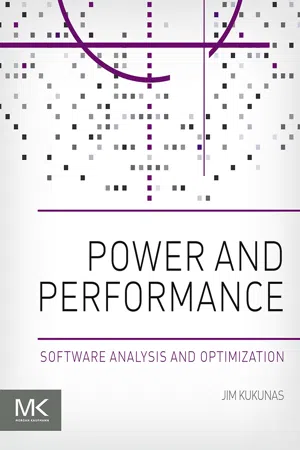
- 300 pages
- English
- ePUB (mobile friendly)
- Available on iOS & Android
eBook - ePub
About this book
Power and Performance: Software Analysis and Optimization is a guide to solving performance problems in modern Linux systems. Power-efficient chips are no help if the software those chips run on is inefficient. Starting with the necessary architectural background as a foundation, the book demonstrates the proper usage of performance analysis tools in order to pinpoint the cause of performance problems, and includes best practices for handling common performance issues those tools identify.
- Provides expert perspective from a key member of Intel's optimization team on how processorsand memory systems influence performance
- Presents ideas to improve architectures running mobile, desktop, or enterprise platforms
- Demonstrates best practices for designing experiments and benchmarking throughout the software lifecycle
- Explains the importance of profiling and measurement to determine the source of performance issues
Information
Part 1
Background Knowledge
Chapter 1
Early Intel® Architecture
Abstract
This chapter is the first of three that explores the Intel(R) Architecture, focusing on the fundamental design. The chapter begins with the Intel(R) 8086, the first x86 processor. Then the Intel(R) 8087 coprocessor is covered, along with the IEEE 754 floating point specification and the Intel(R) 80286. The chapter ends by looking at the Intel(R) 80386, the first 32-bit Intel(R) processor and the first processor to run Linux.
Keywords
8086
8087
80286
80386
x87 FPU
x86
The power button is pressed, causing the #RESET pin to be asserted, that is, the voltage is driven into the predefined threshold that represents the active state logic level. After a predefined number of clock cycles pass, the #RESET pin is then deasserted, invoking the hardware reset. The hardware reset is responsible for initializing the processor to a known state. This includes setting the registers, including the general purpose, control and status registers, to their documented initial values.
This first “breath” leaves the processor in an execution state significantly different from the one which most developers are familiar. The processor begins execution in 16-bit Real-Address mode. This journey between 16-bit Real-Address mode and 64-bit, or 32-bit, Protected Virtual-Address mode occurs every time the processor is powered on. In doing so, this process mirrors the historical evolution of the Intel® Architecture, from the 16-bit 8086 of 1978 to the 64-bit Intel® Core™ processor family of the twenty-first century. As the computer is booted, more than 40 years of advancements in processor technology unfold in the blink of an eye.
The author imagines that some readers are wondering what benefit could possibly come from the retention of all these relics of computing antiquity in modern processor design. Backwards compatibility, which by definition involves maintaining older designs, directly benefits the reader. As readers, hopefully, continue through this book, they will find references to many architectural features. Education on and usage of these features is an investment of the reader’s time. By strictly maintaining backward compatibility, Intel ensures that the investments made by the reader today continue to pay dividends for the foreseeable future. Consider that original bytecode compiled in the late 1970s will still run unmodified on a modern Intel® processor fabricated in 2014.
Other detractors argue that Intel Architecture is inelegant. Since elegance is in the eyes of the beholder, this claim is hard to refute. The author is not a hardware engineer; however, as a software engineer, the author sees an interesting parallel between hardware and software in this claim. Many software projects are architected to be elegant solutions to a well-defined problem. This elegance erodes over time as new features, which were unimaginable during the design phase, are requested and bug fixes and workarounds are introduced. After enduring these unavoidable harsh realities of the software lifecycle, a software’s worth comes not from elegance, but from whether that software still works, is still reliable, and can still be extended to meet future needs. The author submits that x86 still works, is still reliable, and can still be extended.
Covering every aspect of Intel Architecture would require an entire book, as opposed to a couple of chapters. The goal of the next three chapters is to introduce the fundamentals of the architecture, in order to provide just enough knowledge to enable the reader to understand the later content in this book, as well as begin to reason effectively about power consumption and performance.
Because Intel Architecture has been in a constant state of evolution for the last 40 years, and has been steadily increasing in complexity, the author has divided the introduction to Intel Architecture into three separate chronologically ordered chapters, sampling the general timeline of Intel products. Despite following the timeline, history is only being used as a convenient tool. Not all processors or architectural details will be covered in the sections that follow. Also, unless explicitly stated, not all technologies are discussed in the section corresponding to the processor that introduced them. Instead, each section will utilize the given processor as a vehicle for simplifying and explaining important concepts of the modern x86 architecture. This has the dual benefit of gradually introducing the concepts of the modern x86 architecture in a natural and logical progression, while also providing the context necessary to understand the reasoning behind the technical decisions made through the years.
This chapter examines some of the earliest members of the x86 family. The majority of these processors are 16-bit. The chapter ends with the first 32-bit x86 processor, and the first processor to run Linux, the Intel® 80386.
1.1 Intel® 8086
The 8086, introduced in 1978 and shown in Figure 1.1, was not the first processor developed by Intel, however it was the first processor to implement what would be known as the x86 architecture. In fact, the two digits in the name x86 correspond to the fact that the first x86 processor designations all ended with 86, such as 8086, 80186, 80286, 80386, and so on. This trend was continued by Intel until the Pentium® processor family. Despite being introduced in 1978, the 8086 was continually produced throughout the 1980s and 1990s. Famously, NASA had been using the 8086 in their shuttles until 2011.
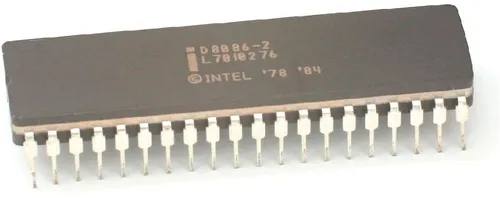
Figure 1.1 Intel® 8086 (Lanzet, 2009).
In stark contrast to the thousands of pages in the modern Intel® Software Developer Manual (SDM), the 8086 user manual, including a full reference on the system behavior, programming tools, hardware pinout, instructions and opcodes, and so on, fits within about two hundred pages. This simplified nature makes the 8086 an excellent introduction to the fundamental concepts of the x86 architecture. The rest of this book will build further on the concepts introduced here.
In the architecture of the 8086, there are three fundamental design principles (Intel Corporation, 1979). The first principle is the usage of specialized components to isolate and distribute functionality. In other words, rather than one large monolithic system architecture, building an 8086 system provided flexibility in the peripherals selected. This allowed system builders to customize the system to best accommodate the needs of the given situation. The second principle is the inherent support for parallelism within t...
Table of contents
- Cover image
- Title page
- Table of Contents
- Copyright
- Dedication
- Introduction
- Part 1: Background Knowledge
- Part 2: Monitors
- Part 3: Optimization Techniques
- Index
Trusted by 375,005 students
Access to over 1.5 million titles for a fair monthly price.
Study more efficiently using our study tools.
Frequently asked questions
Yes, you can cancel anytime from the Subscription tab in your account settings on the Perlego website. Your subscription will stay active until the end of your current billing period. Learn how to cancel your subscription
No, books cannot be downloaded as external files, such as PDFs, for use outside of Perlego. However, you can download books within the Perlego app for offline reading on mobile or tablet. Learn how to download books offline
Perlego offers two plans: Essential and Complete
- Essential is ideal for learners and professionals who enjoy exploring a wide range of subjects. Access the Essential Library with 800,000+ trusted titles and best-sellers across business, personal growth, and the humanities. Includes unlimited reading time and Standard Read Aloud voice.
- Complete: Perfect for advanced learners and researchers needing full, unrestricted access. Unlock 1.5M+ books across hundreds of subjects, including academic and specialized titles. The Complete Plan also includes advanced features like Premium Read Aloud and Research Assistant.
We are an online textbook subscription service, where you can get access to an entire online library for less than the price of a single book per month. With over 1.5 million books across 990+ topics, we’ve got you covered! Learn about our mission
Look out for the read-aloud symbol on your next book to see if you can listen to it. The read-aloud tool reads text aloud for you, highlighting the text as it is being read. You can pause it, speed it up and slow it down. Learn more about Read Aloud
Yes! You can use the Perlego app on both iOS and Android devices to read anytime, anywhere — even offline. Perfect for commutes or when you’re on the go.
Please note we cannot support devices running on iOS 13 and Android 7 or earlier. Learn more about using the app
Please note we cannot support devices running on iOS 13 and Android 7 or earlier. Learn more about using the app
Yes, you can access Power and Performance by Jim Kukunas in PDF and/or ePUB format, as well as other popular books in Computer Science & Software Development. We have over 1.5 million books available in our catalogue for you to explore.