
- 260 pages
- English
- ePUB (mobile friendly)
- Available on iOS & Android
eBook - ePub
Hacking and Penetration Testing with Low Power Devices
About this book
Hacking and Penetration Testing with Low Power Devices shows you how to perform penetration tests using small, low-powered devices that are easily hidden and may be battery-powered. It shows how to use an army of devices, costing less than you might spend on a laptop, from distances of a mile or more.
Hacking and Penetration Testing with Low Power Devices shows how to use devices running a version of The Deck, a full-featured penetration testing and forensics Linux distribution, and can run for days or weeks on batteries due to their low power consumption. Author Philip Polstra shows how to use various configurations, including a device the size of a deck of cards that can easily be attached to the back of a computer.
While each device running The Deck is a full-featured pen-testing platform, connecting systems together via 802.15.3 networking gives you even more power and flexibility. This reference teaches you how to construct and power these devices, install operating systems, and fill out your toolbox of small low-power devices with hundreds of tools and scripts from the book's companion website. Hacking and Pen Testing with Low Power Devices puts all these tools into your hands and will help keep you at the top of your game performing cutting-edge pen tests from anywhere in the world!
- Understand how to plan and execute an effective penetration test using an army of low-power devices
- Learn how to configure and use open-source tools and easy-to-construct low-power devices
- Leverage IEEE 802.15.4 networking to perform penetration tests from up to a mile away, or use 802.15.4 gateways to perform pen tests from anywhere in the world
- Access penetration testing operating systems with hundreds of tools and scripts on the book's companion web site
Information
Chapter 1
Meet the deck
Abstract
This chapter introduces The Deck, a Linux distribution based on Ubuntu 13.04 that runs on the BeagleBoard and BeagleBone family of ARM-based computer boards. The Deck includes many powerful tools used by penetration testers and forensics experts. Unlike desktop Linux systems that have been ported to ARM-based boards, The Deck is optimized for this platform.
The Deck is meant to operate in one of three modes: a traditional desktop, a dropbox to be planted, or a drone, which will use IEEE 802.15.4 networking to be controlled from distances of up to a mile away.
Keywords
Penetration testing
The Deck
IEEE 802.15.4
BeagleBone Black
BeagleBoard-xM
ARM
Information in This Chapter
• The Deck—a custom Linux distribution
• Small computer boards running Linux
• Standard penetration testing tools
• Penetration testing desktops
• Dropboxes—attacking from within
• Drones—attacking from a distance with multiple devices
Introduction
We live in an increasingly digital world. The number of interconnected devices in our world is constantly on the rise. Businesses worldwide rely on computers, tablets, smartphones, and other digital devices in order to compete in a global economy. Many businesses are necessarily connected to the Internet. Newly connected systems can come under attack by malicious persons and/or organizations in a matter of minutes. Because of this, the demand for information security (infosec) professionals is strong. Penetration testers (pentesters) are some of the most sought after infosec people.
Chances are that if you are reading this book, you already know what penetration testing entails. Penetration testing (pentesting) is authorized hacking performed at the request of a client in order to ascertain how easily their digital security may be penetrated and steps that should be taken to improve their security posture. The need for penetration testing has led to the creation of a number of specialized Linux distributions. Up until now, these custom Linux distributions have been created almost exclusively to be run by a single penetration tester using an Intel-based (or AMD-based) desktop or laptop computer.
Fear Not
Before getting started with the main topic of this chapter, I wanted to provide you with some assurances up front. This book is written under the assumption that you have an understanding of general penetration testing concepts and basic Linux usage. Everything else you need to know will be provided in this book. You need not be an elite hacker (but if you are, then good for you!) or advanced Linux user/administrator to get something out of this book. Most importantly, absolutely no hardware knowledge is assumed. While information will be provided for those wishing to create their own custom circuit boards and such, most of what is described in this book is also commercially available.
If you are new to the idea of hardware hacking, you can choose the level to which you want to push yourself. You can simply play it safe and buy commercially available BeagleBone capes (expansion boards that plug into the BeagleBone directly; see http://beagleboard.org/cape for more information). If you want to get your feet wet, you might solder four wires to a commercially available XBee adapter (such as this Adafruit adapter (http://www.adafruit.com/products/126)) to create a mini-cape as described later in this book. Information is provided for advanced users who want to etch their own custom circuit boards. You can do as little or as much hardware hacking as you wish without affecting your ability to perform powerful penetration tests as described in this book.
The Deck
The Deck, the custom Linux distribution described in this book, breaks the traditional model by providing penetration testers with an operating system that runs on low-power ARM-based systems developed by the nonprofit BeagleBoard.org Foundation (these will be described more fully in the next chapter, but see http://beagleboard.org/Getting%20Started if you just cannot wait till then). This permits devices running The Deck to be easily hidden and opens up the possibility of running off of battery power. At the time of this writing, The Deck contained over 1600 packages, making it extremely useful for penetration testing. The Deck is extremely flexible and is equally adept at being used as a traditional desktop, dropbox, or remote hacking drone.
Devices Running The Deck
All of the devices shown in Figure 1.1 are running The Deck. At the time of this writing, The Deck runs on three devices in the Beagle family: the BeagleBoard-xM, BeagleBone, and BeagleBone Black edition. These boards will be described more fully in the next chapter. You can also find out more about them at the BeagleBoard Web site (http://beagleboard.org). For now, we will describe them as low-power boards based on ARM Cortex-A8 processors running at up to 1 GHz. Despite providing desktop-like performance, these devices require a fraction of the power of an Intel-based or AMD-based system. Even when driving a 7 in. touchscreen (such as this one: http://elinux.org/Beagleboard:BeagleBone_LCD7) and external wireless adapter, a 10 W (2 A at 5 V) power adapter is more than sufficient. Compare this with triple- and quadruple-digit wattages found in laptop and desktop systems.
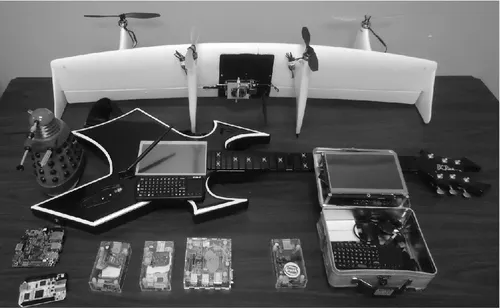
Figure 1.1 Collection of devices running The Deck.
Penetration Testing Tools
The Deck contains a large number of penetration testing tools. The intention is to have every tool you would likely need available without the trouble of downloading additional packages. Installing new packages to a hacking drone during a penetration test ranges from difficult to impossible. Some desktop-oriented penetration testing Linux distributions suffer from having many old packages that are no longer in common use. Each package included in The Deck was evaluated before inclusion. Anything deemed redundant to a new package was left out. Some of the more frequently used tools are introduced here.
Wireless networking has become extremely prevalent. As a result, many penetration tests start with the need to crack a wireless network. The aircrack-ng suite is included in The Deck for this purpose. The airodump-ng utility is used for basic packet captures and analysis. Captured packets can then be fed to aircrack-ng in order to crack network encryption. Screenshots of airodump-ng and aircrack-ng are provided in Figures 1.2 and 1.3, respectively. More details on using the aircrack-ng suite will be provided in future chapters.
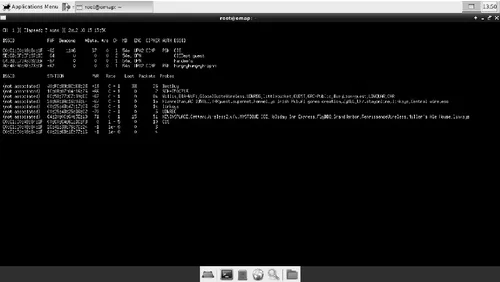
Figure 1.2 Using airodump-ng to capture and summarize wireless packets.
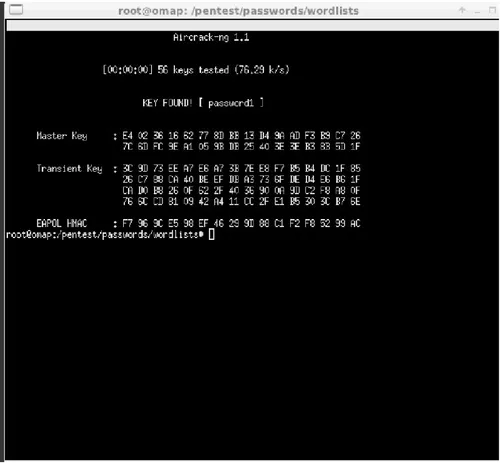
Figure 1.3 A successful crack with aircrack-ng.
Even in cases where a client is not using wireless networking, the aircrack-ng suite can be useful for detecting and possibly cracking any rogue access points on the client's network. A very easy to use point-and-click wireless cracking tool known as Fern WiFi Cracker is also included with The Deck. A screenshot showing a successful crack with Fern is shown in Figure 1.4. Those newer to penetration testing might find Fern easier to use. Due to their interactive nature, neither aircrack-ng nor Fern is suitable for use in a hacking drone. For this reason, the Scapy Python tool (http://www.secdev.org/projects/scapy/) is included in The Deck.
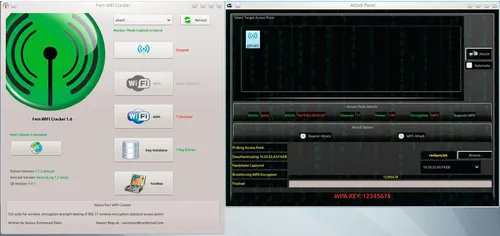
Figure 1.4 Fern WiFi Cracker.
Regardless of whether they are from wired or wireless networks, network packets are potentially interesting to the penetration tester. The Deck includes Wireshark (http://www.wireshark.org/) for capturing and analyzing captured packets. Nmap (http://nmap.org/), a standard network mapping tool, is also provided for identifying services and hosts on a target network. A collection of vulnerability scanners and a powerful exploitation framework known as Metasploit (http://www.metasploit.com/) are also bundled in the standard version of The Deck. Some of these tools are presented in Figure 1.5.
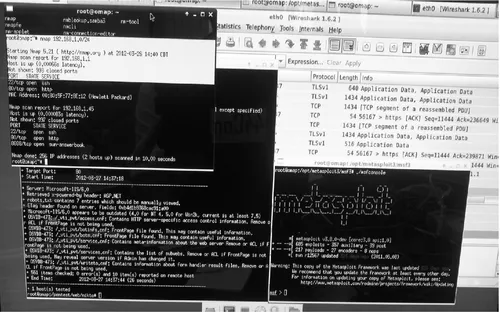
Figure 1.5 Wireshark, Nmap, Nikto, and Metasploit.
Metasploit is a very popular tool maintained by Rapid 7 (http://www.rapid7.com/). Numerous books, training classes, and videos covering Metasploit have been created. Offensive Security has published an online book Metasploit Unleash...
Table of contents
- Cover image
- Title page
- Table of Contents
- Copyright
- Dedication
- Foreword
- Author Biography
- Acknowledgments
- Chapter 1: Meet the deck
- Chapter 2: Meet the beagles
- Chapter 3: Installing a base operating system
- Chapter 4: Filling the toolbox
- Chapter 5: Powering The Deck
- Chapter 6: Input and output devices
- Chapter 7: Building an army of devices
- Chapter 8: Keeping your army secret
- Chapter 9: Adding air support
- Chapter 10: Future directions
- Index
Trusted by 375,005 students
Access to over 1.5 million titles for a fair monthly price.
Study more efficiently using our study tools.
Frequently asked questions
Yes, you can cancel anytime from the Subscription tab in your account settings on the Perlego website. Your subscription will stay active until the end of your current billing period. Learn how to cancel your subscription
No, books cannot be downloaded as external files, such as PDFs, for use outside of Perlego. However, you can download books within the Perlego app for offline reading on mobile or tablet. Learn how to download books offline
Perlego offers two plans: Essential and Complete
- Essential is ideal for learners and professionals who enjoy exploring a wide range of subjects. Access the Essential Library with 800,000+ trusted titles and best-sellers across business, personal growth, and the humanities. Includes unlimited reading time and Standard Read Aloud voice.
- Complete: Perfect for advanced learners and researchers needing full, unrestricted access. Unlock 1.5M+ books across hundreds of subjects, including academic and specialized titles. The Complete Plan also includes advanced features like Premium Read Aloud and Research Assistant.
We are an online textbook subscription service, where you can get access to an entire online library for less than the price of a single book per month. With over 1.5 million books across 990+ topics, we’ve got you covered! Learn about our mission
Look out for the read-aloud symbol on your next book to see if you can listen to it. The read-aloud tool reads text aloud for you, highlighting the text as it is being read. You can pause it, speed it up and slow it down. Learn more about Read Aloud
Yes! You can use the Perlego app on both iOS and Android devices to read anytime, anywhere — even offline. Perfect for commutes or when you’re on the go.
Please note we cannot support devices running on iOS 13 and Android 7 or earlier. Learn more about using the app
Please note we cannot support devices running on iOS 13 and Android 7 or earlier. Learn more about using the app
Yes, you can access Hacking and Penetration Testing with Low Power Devices by Philip Polstra in PDF and/or ePUB format, as well as other popular books in Computer Science & Computer Science General. We have over 1.5 million books available in our catalogue for you to explore.