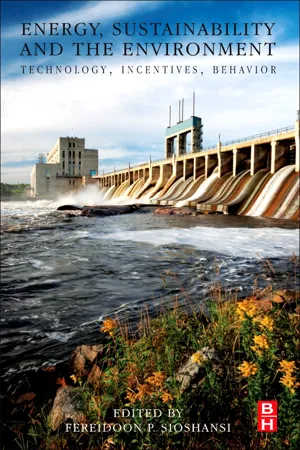
eBook - ePub
Energy, Sustainability and the Environment
Technology, Incentives, Behavior
- 640 pages
- English
- ePUB (mobile friendly)
- Available on iOS & Android
eBook - ePub
Energy, Sustainability and the Environment
Technology, Incentives, Behavior
About this book
The complexity of carbon reduction and economic sustainability is significantly complicated by competing aspects of socioeconomic practices as well as legislative, regulatory, and scientific requirements and protocols. An easy to read and understand guide, Sioshansi, along with an international group of contributors, moves through the maze of carbon reduction methods and technologies, providing steps and insights to meet carbon reduction requirements and maintaining the health and welfare of the firm.
The book's three part treatment is based on a clear and rigorous exposition of a wide range of options to reduce the carbon footprint Part 1 of the book, Challenge of Sustainability, examines the fundamental drivers of energy demand – economic growth, the need for basic energy services, and the interdependence of economic, political, environmental, social, equity, legacy and policy issues. Part 2 of the book, Technological Solutions, examines how energy can be used to support basic energy service needs of homes, commercial and industrial facilities and for other applications. Part 3 of the book, case studies, covers a number of innovative projects, initiatives, concepts or self-imposed targets in different parts of the world with the aim of significantly reducing energy use and carbon footprint of a company, a community, a city or an entire country.
There was a widespread recognition among environmental engineers and energy economist of the importance of carbon reduction while sustaining the firm's economic growth. The only book to bring together both subjects into one easy to understand reference, Carbon Reduction and Economic Sustainability not only clearly explains which option has the lowest energy/carbon footprint but also which option would better suit the business in question. This includes carbon reduction for residential, transport, industrial and public sectors.
- The only book to clearly explain the economic and environmental engineering aspects of carbon reduction.
- Case studies taken from a number of international projects.
- Carbon reduction options for all sectors of society.
- The role of the planning system in carbon reduction.
Information
Subtopic
Environmental ScienceTable of contents
- Cover Image
- Table of Contents
- Front Matter
- Copyright
- Foreword
- Preface
- Contributors
- Introduction. Can We Have Our Cake and Eat It Too?
- Chapter 1. Why Do We Use So Much Energy, and What For?
- Chapter 2. Which Energy Future?
- Chapter 3. Energy “Needs”, Desires, and Wishes
- Chapter 4. Equity, Economic Growth, and Lifestyle
- Chapter 5. We Can't Have Our Cake and Eat it Too
- Chapter 6. Sustainability
- Chapter 7. Is It Possible to Have It Both Ways?
- Chapter 8. Efficiency First
- Chapter 9. Getting to Zero
- Chapter 10. Beyond the Meter
- Chapter 11. How Organizations Can Drive Behavior-Based Energy Efficiency
- Chapter 12. Reinventing Industrial Energy Use in a Resource-Constrained World
- Chapter 13. Prospects for Renewable Energy
- Chapter 14. Heating Systems When Little Heating Is Needed
- Chapter 15. Why China Matters
- Chapter 16. Swiss 2000-Watt Society
- Chapter 17. Zeroing in on Zero Net Energy
- Chapter 18. Toward Carbon Neutrality: The Case of the City of Austin, TX
- Chapter 19. Rising to the Challenge of Sustainability: Three Cases of Climate and Energy Governance
- Epilogue: Can We Get There from Here?
- Index
Trusted by 375,005 students
Access to over 1.5 million titles for a fair monthly price.
Study more efficiently using our study tools.
Frequently asked questions
Yes, you can cancel anytime from the Subscription tab in your account settings on the Perlego website. Your subscription will stay active until the end of your current billing period. Learn how to cancel your subscription
No, books cannot be downloaded as external files, such as PDFs, for use outside of Perlego. However, you can download books within the Perlego app for offline reading on mobile or tablet. Learn how to download books offline
Perlego offers two plans: Essential and Complete
- Essential is ideal for learners and professionals who enjoy exploring a wide range of subjects. Access the Essential Library with 800,000+ trusted titles and best-sellers across business, personal growth, and the humanities. Includes unlimited reading time and Standard Read Aloud voice.
- Complete: Perfect for advanced learners and researchers needing full, unrestricted access. Unlock 1.5M+ books across hundreds of subjects, including academic and specialized titles. The Complete Plan also includes advanced features like Premium Read Aloud and Research Assistant.
We are an online textbook subscription service, where you can get access to an entire online library for less than the price of a single book per month. With over 1.5 million books across 990+ topics, we’ve got you covered! Learn about our mission
Look out for the read-aloud symbol on your next book to see if you can listen to it. The read-aloud tool reads text aloud for you, highlighting the text as it is being read. You can pause it, speed it up and slow it down. Learn more about Read Aloud
Yes! You can use the Perlego app on both iOS and Android devices to read anytime, anywhere — even offline. Perfect for commutes or when you’re on the go.
Please note we cannot support devices running on iOS 13 and Android 7 or earlier. Learn more about using the app
Please note we cannot support devices running on iOS 13 and Android 7 or earlier. Learn more about using the app
Yes, you can access Energy, Sustainability and the Environment by Fereidoon Sioshansi,Fereidoon P. Sioshansi in PDF and/or ePUB format, as well as other popular books in Technology & Engineering & Environmental Science. We have over 1.5 million books available in our catalogue for you to explore.