eBook - ePub
Time and Relational Theory
Temporal Databases in the Relational Model and SQL
- 560 pages
- English
- ePUB (mobile friendly)
- Available on iOS & Android
eBook - ePub
Time and Relational Theory
Temporal Databases in the Relational Model and SQL
About this book
Time and Relational Theory provides an in-depth description of temporal database systems, which provide special facilities for storing, querying, and updating historical and future data. Traditionally, database management systems provide little or no special support for temporal data at all. This situation is changing because:
- Cheap storage enables retention of large volumes of historical data in data warehouses
- Users are now faced with temporal data problems, and need solutions
- Temporal features have recently been incorporated into the SQL standard, and vendors have begun to add temporal support to their DBMS products
Based on the groundbreaking text Temporal Data & the Relational Model (Morgan Kaufmann, 2002) and new research led by the authors, Time and Relational Theory is the only book to offer a complete overview of the functionality of a temporal DBMS. Expert authors Nikos Lorentzos, Hugh Darwen, and Chris Date describe an approach to temporal database management that is firmly rooted in classical relational theory and will stand the test of time.
This book covers the SQL:2011 temporal extensions in depth and identifies and discusses the temporal functionality still missing from SQL.
- Understand how the relational model provides an ideal basis for taming the complexities of temporal databases
- Learn how to analyze and evaluate commercial temporal products with this timely and important information
- Be able to use sound principles in designing and using temporal databases
- Understand the temporal support recently added to SQL with coverage of the new SQL features in this unique, accurate, and authoritative reference
- Appreciate the benefits of a truly relational approach to the problem with this clear, user friendly presentation
Information
Part I
A Review of Relational Concepts
Outline
Part I A Review of Relational Concepts
This book assumes a basic familiarity with the relational model. Thus, this first part is intended merely as a quick refresher course on that model; in effect, it summarizes, and serves as a reference source for, material you’ll be expected to know when we get to the temporal discussions in Parts II, III, and IV. It consists of three chapters:
1. Types and Relations
2. Relational Algebra
3. Relation Variables
Of course, tutorials on the relational model and related matters can be found in many places (see, e.g., references [28], [42], and [45]); thus, if you’re familiar with any of those references, you probably don’t need to read this part of the book in detail. However, if your knowledge of the relational model derives from other sources—especially ones based on SQL—then you probably do need to read these chapters fairly carefully, because they emphasize numerous important topics that such sources typically don’t. Such topics include:
■ “Possible representations,” selectors, and THE_ operators
■ Relation types
■ Relation values vs. relation variables
■ Predicates and propositions
■ Relation valued attributes
■ Relational assignment
■ The fundamental role of constraints
■ Less well known but important operators such as EXTEND, MATCHING, and NOT MATCHING
and many others.
Note: Chapter 1 also introduces the suppliers-and-shipments database, which serves as the basis for almost all of the examples in later chapters. Even if you decide just to skim this part of the book, therefore, you should at least take a look at that sample database before moving on to Part II.
Chapter 1
Types and Relations
This chapter is the first of three devoted to reviewing the basics of relational theory. It explains relations as such, as well as the supporting notion of types (aka domains), in considerable depth. With regard to types; it discusses values, variables, operators, parameters, arguments, expressions, and polymorphism; equality and assignment; system defined vs. user defined types; scalar vs. nonscalar types; possible vs. physical representations; type generators and generated vs. nongenerated types; type constraints; and selectors, literals, and THE_ operators. With regard to relations, it discusses tuples, attributes, and relation headings and bodies; relation and tuple types; TABLE_DEE and TABLE_DUM; relation valued attributes; predicates and propositions; and The Closed World Assumption. The chapter also introduces the running example (i.e., the suppliers-and shipments-database).
Keywords
domain; relation; tuple; attribute; relation heading; relation body; type theory; relation predicate; The Closed World Assumption
What type of relation do you mean?
—Anon.:
Where Bugs Go
The relational model is, of course, defined in terms of relations, and relations in turn are defined in terms of types. This first chapter explains these two constructs in detail. First, however, it introduces the running example.
The Running Example
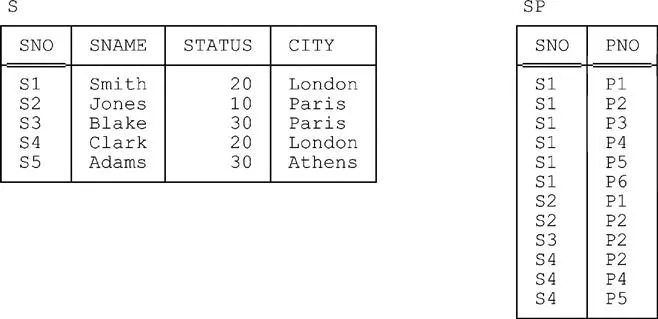
Most of the examples in this book are based on the well known suppliers-and-parts database—or, more precisely, on a simplified version of that database that we refer to as suppliers and shipments. Fig. 1.1 shows a set of sample values for that simplified database (and please note that we’ll be assuming those specific sample values in examples throughout this part of the book, barring explicit statements to the contrary). Note: In case you happen to be familiar with the more usual version of this database as discussed in, e.g., reference [45], we explain here briefly what the simplifications consist of:
■ First of all, we’ve dropped the parts relvar P entirely (hence the revised name “suppliers and shipments”). Note: The term relvar is short for relation variable. Relation variables are discussed in detail in Chapter 3.
■ Second, we’ve removed attribute QTY (“quantity”) from the shipments relvar SP, leaving just attributes SNO and PNO.
■ Third, we (re)interpret that revised SP relvar thus: “Supplier SNO is currently able to supply part PNO. ” In other words, instead of standing for actual shipments of parts by suppliers, as it did in, e.g., reference [45], relvar SP now stands for what might be called potential shipments—i.e., the ability of certain suppliers to supply certain parts.
Overall, then, the database is meant to be interpreted as follows:
■ Relvar S represents suppliers under contract. Each such supplier has a supplier number (SNO), unique to that supplier; a supplier name (SNAME), not necessarily unique (though the sample SNAME values shown in Fig. 1.1 do happen to be unique); a status or rating value (STATUS); and a location (CITY). Note: In the rest of this book we’ll refer to “suppliers under contract,” most of the time, as just suppliers for short.
■ Relvar SP represents potential shipments—it shows which suppliers are capable of supplying, or shipping, which parts. Obviously, the combination of SNO and PNO values for a given “potential shipment” is unique to that shipment. Note: In the rest of this book we’ll take the liberty of referring to “potential shipments”—somewhat inaccurately, but very conveniently—as just shipments for short. Also, we’ll assume it’s possible for a given supplier to be under contract at some time and yet not actually be able to supply any parts at that time (supplier S5 is a case in point, given the sample values of Fig. 1.1).
Here for purposes of reference are formal definitions for the example, expressed in a language called Tutorial D—or, rather, in a version of that language that’s been tailored slightly in order to suit the purposes of this book. Tutorial D is a computationally complete programming language with fully integrated database functionality and, we believe, more or less self-explanatory syntax. It was introduced in the first (1998) edition of reference [52] as a vehicle for teaching database concepts. All coding examples in this book are expressed in that language or certain specified extensions thereto (except, of course, for the SQL-specific examples in Part IV).
TYPE SNO … ;
TYPE PNO … ;
TYPE NAME … ;
VAR S BASE
RELATION
{ SNO SNO , SNAME NAME, STATUS INTEGER , CITY CHAR } KEY { SNO } ;VAR SP BASE
RELATION
{ SNO SNO , PNO PNO } KEY { SNO , PNO } FOREIGN KEY { SNO } REFERENCES S ;To elaborate briefly (note, however, that all of the technical issues illustrated by this example and discussed in outline below will be explained in more detail either later in this chapter or somewhere in the next two):
■ The first three lines are type definitions (shown here in outline only;...
Table of contents
- Cover image
- Title page
- Table of Contents
- Copyright
- Dedication
- About the Authors
- Preface
- Part I: A Review of Relational Concepts
- Part II: Laying the Foundations
- Part III: Building on the Foundations
- Part IV: SQL Support
- Appendixes
- Index
Trusted by 375,005 students
Access to over 1.5 million titles for a fair monthly price.
Study more efficiently using our study tools.
Frequently asked questions
Yes, you can cancel anytime from the Subscription tab in your account settings on the Perlego website. Your subscription will stay active until the end of your current billing period. Learn how to cancel your subscription
No, books cannot be downloaded as external files, such as PDFs, for use outside of Perlego. However, you can download books within the Perlego app for offline reading on mobile or tablet. Learn how to download books offline
Perlego offers two plans: Essential and Complete
- Essential is ideal for learners and professionals who enjoy exploring a wide range of subjects. Access the Essential Library with 800,000+ trusted titles and best-sellers across business, personal growth, and the humanities. Includes unlimited reading time and Standard Read Aloud voice.
- Complete: Perfect for advanced learners and researchers needing full, unrestricted access. Unlock 1.5M+ books across hundreds of subjects, including academic and specialized titles. The Complete Plan also includes advanced features like Premium Read Aloud and Research Assistant.
We are an online textbook subscription service, where you can get access to an entire online library for less than the price of a single book per month. With over 1.5 million books across 990+ topics, we’ve got you covered! Learn about our mission
Look out for the read-aloud symbol on your next book to see if you can listen to it. The read-aloud tool reads text aloud for you, highlighting the text as it is being read. You can pause it, speed it up and slow it down. Learn more about Read Aloud
Yes! You can use the Perlego app on both iOS and Android devices to read anytime, anywhere — even offline. Perfect for commutes or when you’re on the go.
Please note we cannot support devices running on iOS 13 and Android 7 or earlier. Learn more about using the app
Please note we cannot support devices running on iOS 13 and Android 7 or earlier. Learn more about using the app
Yes, you can access Time and Relational Theory by C.J. Date,Hugh Darwen,Nikos Lorentzos in PDF and/or ePUB format, as well as other popular books in Computer Science & Databases. We have over 1.5 million books available in our catalogue for you to explore.