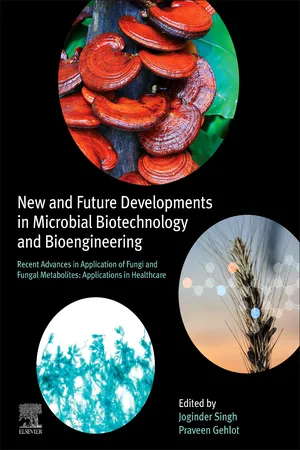
eBook - ePub
New and Future Developments in Microbial Biotechnology and Bioengineering
Recent Advances in Application of Fungi and Fungal Metabolites: Applications in Healthcare
- 232 pages
- English
- ePUB (mobile friendly)
- Available on iOS & Android
eBook - ePub
New and Future Developments in Microbial Biotechnology and Bioengineering
Recent Advances in Application of Fungi and Fungal Metabolites: Applications in Healthcare
About this book
New and Future Developments in Microbial Biotechnology and Bioengineering: Recent Advances in Application of Fungi and Fungal Metabolites: Applications in Healthcare presents an account of recent development and applied aspects of fungi and its metabolites in the healthcare sector. Chapters are written by eminent researchers, emphasizing the incredible role of fungi and its metabolites in the field of medicine. This book offers reference material to all mycologists working on the exploration and usage of medicinal aspects of fungi and fungal metabolites.
- Introduces the aspects and advances of fungi and fungal metabolites in healthcare
- Includes a description of traditional uses and modern practices on how to harness the potential of fungi and its metabolites in healthcare applications
- Provides details surrounding the use of fungi and its metabolites in medical purposes
- Describes potential manifold prospects of fungi and fungal metabolites
Information
Chapter 1: Prospective of macrofungal metabolites in human health
S.K. Singh*; K.S. Jadon; Rakesh Pathak ICAR-Central Arid Zone Research Institute, Jodhpur, India
* Corresponding author. E-mail: [email protected]
* Corresponding author. E-mail: [email protected]
Abstract
Mushrooms are an incredible factory for enzymes and biologically active polysaccharides and their complexes with proteins. The potential roles and mechanisms of medicinal mushrooms such as immunomodulators, antioxidants, antimicrobials, hepatoprotective, antiinflammatories, antiallergens, antidiabetics, antitumor, and in lowering blood pressure and rheumatoid arthritis have been reviewed. The importance of metallic nanoparticles of silver, gold, and selenium synthesized by edible mushrooms that are effective against certain cancer cell lines that have been used in pharmaceutical drugs to transform and modulate immunity during cancer progression and treatment is discussed.
Keywords
Metabolites; Functional food; Immunomodulators; Medicinal applications
1.1: Introduction
Camassola (2013) defined mushrooms as an incredible factory for the production of enzymes and metabolites. The mushroom is a functional food not only because of the human use of its extracts and compounds to fulfill nutritional requirements (low fat, high protein, and dietary fiber while also containing potassium, copper, and vitamins) but also for its biologically active metabolites with antitumor, antioxidant, antimicrobial, and antidiabetic effects (Cho et al., 2007; Reis et al., 2017; Cheung, 2010). The polysaccharides contained in the fruit bodies and mycelia of mushrooms possess incredible antitumor and immunostimulating properties (Wasser, 2010). Mushrooms possess biologically active compounds such as immunomodulators, antioxidants, and antimicrobials while also lowering glucose and lipidic levels and offering antitumor activities (Novaes et al., 2011; Petrova, 2012). The medicinal mushrooms are synonymous with immunoceuticals as they contain antitumor, antimicrobial, antidiabetic, antioxidant, cardiovascular, detoxification, hepatoprotective, and immunomodulating effects (Chang and Miles, 2004; Wasser, 2010). About 50 mushroom species possess prospective immunomodulatory and antitumor compounds such as lentinan, lectins, polysaccharides, and schizophyllan as well as bioactive compounds of Maitake for the treatment of human cancers.
1.2: Medicinal mushrooms
The major medicinal mushrooms are Agaricus blazei, Agaricus bisporus, Agaricus brasiliensis, Coriolus versicolor, Flammulina velutipes, Ganoderma tsugae, Ganoderma neo-japonicum, Ganoderma lucidum, Grifola frondosa, Lentinus edodes, Pleurotus pulmonarius, Pleurotus tuberregium, Pleurotus rhinoceros, Schizophyllum commune, Sparassis crispa, Trametes robiniophila, and Trametes versicolor (Wasser, 2002, 2010; Endo et al., 2010; Ayeka, 2018).
1.3: Mushroom metabolites
The potential role of the natural compounds of mushrooms with antitumor potential aimed at malignant tissues to modulate immunity in the treatment of human disease has been reviewed (Blagodatski et al., 2018; Borchers et al., 2008). The potential role of mushroom glucans in treating cancer patients was documented by Kidd (2000). β-glucans produced by several mushrooms are of vital importance in treating human diseases and a range of cancers such as leukemia, liver, lung, ovarian, urinary bladder, prostate, skin, breast, and stomach (Pelley and Strickland, 2000; Chen and Robert, 2007; Chen et al., 2014; Baldassano et al., 2017). Many other complexes of polysaccharides with proteins, agaritine, ergosterol, polyphenols, selenium, and terpenoids are capable of modulating the immune system by promoting apoptosis, suppressing the progression of tumor cells, and reducing the formation of new blood vessels (Gao and Zhou, 2002; Sarangi et al., 2006; Ayeka, 2018).
1.4: Mechanism of action
Mushroom compounds utilize a variety of mechanisms to transform and modulate immunity during cancer progression and treatment. For example, Coriolus versicolor works by the secretion of various types of interleukins and tumor necrosis factors (Wasser and Weis 1999); Schizophyllum commune by the synthesis of Schizophyllan with direct toxicity to tumor cells (Borchers et al., 1999); Trametes robiniophila by apoptosis, antimetastasis, and activation of the immune system (Li and Wang, 2006); Agaricus blazei by inducing the production of TNF-alpha, IL-8, and nitrous oxide (Sorimachi et al., 2001; Takaku et al., 2001; Niu et al., 2009; Endo et al., 2010), Ganoderma colossum with anti-HIV properties (El Dine et al., 2008); Ganoderma lucidum and Ganoderma tsugae extracts through cytotoxicity (Min et al., 2000; Hsu et al., 2008); Agaricus bisporus by stimulating TNF-α production (Endo et al., 2010); Pleurotus tuber-regium scloratia by stimulating the proliferation of NK cells, macrophages, and T cells (Zhang et al., 2004; Wong et al., 2011); and Agaricus brasiliensis by inducing cell death in mouth cancer cells defined by a monoclonal antibody (Fan et al., 2011).
1.5: Medicinal applications
The biologically active substances of mushrooms activate the immune response and inhibit tumor progression. The properties and medical applications of the biosynthesized nanoparticles of fungi and yeast have been reviewed (Moghaddam et al., 2015). The metallic nanoparticles (meta-NPs) of silver, gold, and selenium synthesized by edible mushrooms are effective against certain cancer cell lines. They have been used in pharmaceutical drugs and are an emerging field in the drug industry (Owaid and Ibraheem, 2017).
A number of researchers have reported the green synthesis of silver nanoparticles (AgNPs) with antimicrobial properties using Tricholoma crassum (Ray et al., 2011), Agaricus bisporus (Lillian et al., 2008; Mirunalini et al., 2012; Dhanasekaran et al., 2013; Sudhakar et al., 2014), Pleurotus ostreat...
Table of contents
- Cover image
- Title page
- Table of Contents
- Copyright
- Contributors
- Chapter 1: Prospective of macrofungal metabolites in human health
- Chapter 2: Toxins from Fusarium species and their role in animal and plant diseases
- Chapter 3: Keratinophilic fungi: Isolation, identification, pathogenicity, characterization, and treatment
- Chapter 4: Endophytic fungi: A new hope for drug discovery
- Chapter 5: Therapeutic potency of bioactive compounds from fungal endophytes
- Chapter 6: Role of fungi in neurodegenerative diseases
- Chapter 7: Fungal secondary metabolites: A potential source of anticancer compounds
- Chapter 8: A promising source of anticancer drug from fungal secondary metabolite
- Chapter 9: Neoteric research trends in marine fungi as promising and alternate sources of anticancer phytochemicals
- Chapter 10: Fungal enzyme inhibitors: Repository of novel cancer therapeutics
- Chapter 11: Biotechnological approaches for the enhancement of anticancer secondary metabolite production from endophytic fungi
- Chapter 12: Fungal metabolites—A potential source of antiviral compounds
- Chapter 13: Chitin: Promising biopolymer for biomedical application
- Chapter 14: Antipathogenic activity of fungal secondary metabolites with special reference to human pathogenic bacteria
- Chapter 15: Hypoglycemic potential of mushroom and their metabolites
- Chapter 16: Biomedical applications of 4-hydroxycoumarin as a fungal metabolite and its derivatives
- Chapter 17: Recombinant Pichia pastoris and its applications in healthcare industry
- Index
Trusted by 375,005 students
Access to over 1.5 million titles for a fair monthly price.
Study more efficiently using our study tools.
Frequently asked questions
Yes, you can cancel anytime from the Subscription tab in your account settings on the Perlego website. Your subscription will stay active until the end of your current billing period. Learn how to cancel your subscription
No, books cannot be downloaded as external files, such as PDFs, for use outside of Perlego. However, you can download books within the Perlego app for offline reading on mobile or tablet. Learn how to download books offline
Perlego offers two plans: Essential and Complete
- Essential is ideal for learners and professionals who enjoy exploring a wide range of subjects. Access the Essential Library with 800,000+ trusted titles and best-sellers across business, personal growth, and the humanities. Includes unlimited reading time and Standard Read Aloud voice.
- Complete: Perfect for advanced learners and researchers needing full, unrestricted access. Unlock 1.5M+ books across hundreds of subjects, including academic and specialized titles. The Complete Plan also includes advanced features like Premium Read Aloud and Research Assistant.
We are an online textbook subscription service, where you can get access to an entire online library for less than the price of a single book per month. With over 1.5 million books across 990+ topics, we’ve got you covered! Learn about our mission
Look out for the read-aloud symbol on your next book to see if you can listen to it. The read-aloud tool reads text aloud for you, highlighting the text as it is being read. You can pause it, speed it up and slow it down. Learn more about Read Aloud
Yes! You can use the Perlego app on both iOS and Android devices to read anytime, anywhere — even offline. Perfect for commutes or when you’re on the go.
Please note we cannot support devices running on iOS 13 and Android 7 or earlier. Learn more about using the app
Please note we cannot support devices running on iOS 13 and Android 7 or earlier. Learn more about using the app
Yes, you can access New and Future Developments in Microbial Biotechnology and Bioengineering by Joginder Singh Panwar,Praveen Gehlot,Joginder Singh in PDF and/or ePUB format, as well as other popular books in Technology & Engineering & Chemical & Biochemical Engineering. We have over 1.5 million books available in our catalogue for you to explore.