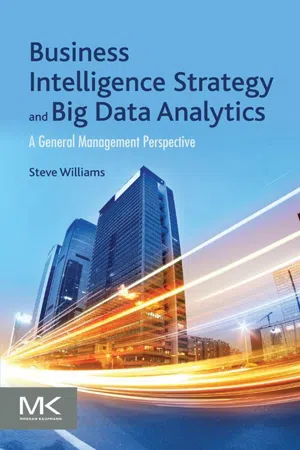
eBook - ePub
Business Intelligence Strategy and Big Data Analytics
A General Management Perspective
- 240 pages
- English
- ePUB (mobile friendly)
- Available on iOS & Android
eBook - ePub
Business Intelligence Strategy and Big Data Analytics
A General Management Perspective
About this book
Business Intelligence Strategy and Big Data Analytics is written for business leaders, managers, and analysts - people who are involved with advancing the use of BI at their companies or who need to better understand what BI is and how it can be used to improve profitability. It is written from a general management perspective, and it draws on observations at 12 companies whose annual revenues range between $500 million and $20 billion. Over the past 15 years, my company has formulated vendor-neutral business-focused BI strategies and program execution plans in collaboration with manufacturers, distributors, retailers, logistics companies, insurers, investment companies, credit unions, and utilities, among others. It is through these experiences that we have validated business-driven BI strategy formulation methods and identified common enterprise BI program execution challenges.
In recent years, terms like "big data and "big data analytics have been introduced into the business and technical lexicon. Upon close examination, the newer terminology is about the same thing that BI has always been about: analyzing the vast amounts of data that companies generate and/or purchase in the course of business as a means of improving profitability and competitiveness. Accordingly, we will use the terms BI and business intelligence throughout the book, and we will discuss the newer concepts like big data as appropriate. More broadly, the goal of this book is to share methods and observations that will help companies achieve BI success and thereby increase revenues, reduce costs, or both.
- Provides ideas for improving the business performance of one's company or business functions
- Emphasizes proven, practical, step-by-step methods that readers can readily apply in their companies
- Includes exercises and case studies with road-tested advice about formulating BI strategies and program plans
Information
Chapter 1
The Personal Face of Business Intelligence
Abstract
An excellent way to explain what business intelligence (BI) is and its importance in the business world is to look at what business people talk about when the subject is BI. By “getting into the heads” of key executives and managers and hearing their frustrations with the BI gaps they experience, we can learn what kinds of business information, business analyses, and decision support they feel would be most useful for driving profitability. By understanding how they see their world, what are they looking to accomplish, and how they want BI to help them, we can put together a business-driven BI strategy that resonates with business people based on their specific roles. To put a personal face on BI, this chapter will step through the business challenges and BI gaps identified by top executives in a very successful $3 billion company.
Keywords
Business intelligence strategy; BI case studies; BI for financial executives; BI for operations executives; BI for sales and marketing executives
One way to develop a useful perspective about what business intelligence (BI) is and its importance in the business world is to look at what business people talk about when the subject is BI. Developing a BI Strategy using the methods we’ll describe in this book is a people-intensive process—as it should be. We can leverage proven techniques, but the quality of the results depends to a significant degree on “getting into the heads” of key executives and managers. How do they see their world, what are they looking to accomplish, and how do they want BI to help them? We can build a business case that is “bullet-proof” from a logical, corporate perspective, but it also has to resonate with business people on a more intuitive level that squares with what they believe they would be able to achieve if they had better BI. So to put a human face on BI, this chapter will step through the business challenges and BI gaps identified by top executives in a manufacturing company we’ll call Big Brand Foods (BBF). We’ll then summarize the BI Vision and BI Portfolio that emerged from the strategy formulation process and offer some generalizations about BI opportunities (BIOs) for other manufacturing companies. While we’ve chosen a manufacturing company for this BI case study, the logic and process of identifying industry challenges, company strategies, functional challenges, and BIOs applies to any company in any industry. Further, the views of executives in the different business functions may be of value to executives in the same function but different industries.
1.1 BI Case Study Setting
1.1.1 Industry Setting
Food manufacturing is a large, complex industry that generates over $800 billion in annual sales. Typical food manufacturers produce hundreds or thousands of end products (called stock-keeping units, or SKUs) that are sold through a complex network of brokers, food distributors, and food service distributors to tens of thousands of retail outlets and restaurants. At the retail level, once the sole province of grocery stores and restaurants, food products are sold in many different places—by mass merchandizers, drug stores, convenience stores, and warehouse clubs, among others. Industry data suggest that less than half of food product sales are through traditional grocery stores. Other key industry trends are increased concentration of retail sales (Walmart alone accounts for over 50% of food sales), the rise of healthier products, and the diversity and increased quality of private label products that are now available. As a result of these and other trends, food manufacturers must cope with increased complexity and intense margin pressures, both of which impact profitability and customer service. Faced with these challenges, more and more food manufacturers are recognizing the strategic importance of BI.
1.1.2 Company Situation
BBF is a very successful manufacturer of widely known branded food products. Acquisition of known brands from competitors who were fine-tuning their brand portfolios allowed BBF to achieve $4 billion in revenue, and to be first or second in market share in most of the product categories in which it competed. With that growth came challenges. BBF was essentially a roll-up of acquired brands, plants, people, and systems, and it lacked the mature, well-synchronized business processes sometimes found in larger companies in the industry. BBF was addressing that challenge through an infusion of upper management talent from global competitors, such as Kraft, Unilever, Coca Cola, and Nestle. These seasoned professionals quickly figured out that BBF had substantial gaps in its ability to cope with industry complexity and manage its profitability in the face of industry dynamics. Further, they were aware that BBF was behind the times when it came to leveraging sophisticated BI and business analytics to improve profitability.
1.2 BBF BI Opportunities
Recognizing that BI advances were critical to future business success—and to his own career—BBF’s Chief Information Officer (CIO) launched an enterprise BI strategy project. His objective was to identify specific opportunities to leverage information and sophisticated analytics within BBF’s major business functions and processes, such as for demand forecasting, production planning, inventory optimization, customer service improvement, revenue management, category management, trade promotion planning and lift analysis, supply chain collaboration, and cost optimization, among others. A variety of business challenges and BIOs were identified via interviews with executives, managers, and analysts across all major functions within BBF.
1.2.1 The CEO’s View of Business Challenges and BIOs
After earning an MBA from a top-tier business school, John McCoy rose quickly through the ranks in sales and marketing for consumer packaged goods companies. When BBF was put together by a large private equity firm (LPE), it was with a view toward further acquisitions and eventually going public. The original CEO moved too slowly along this strategic path, and thus LPE brought in McCoy, who was known to a LPE director who had been CEO of a multibillion dollar food manufacturer.
Within less than a year, McCoy had grown frustrated. While acquisition plans were coming along nicely, BBF lacked the ability to actively manage revenues and costs. McCoy realized that execution is critical in the packaged food industry, and to get better at it he and his leadership team needed better visibility into all aspects of BBF’s operations. As an industry veteran, McCoy understood that the packaged food business is complex—getting hundreds of products to thousands of retail shelves and making a profit despite fluctuating purchasing patterns and growing retailer purchasing power due to increased concentration.
As he considered what it would take to conquer complexity and move BBF to a point where all levels of the company had the visibility needed to be successful, his thoughts turned to BI and the results of a 2009 survey within the packaged food manufacturing industry. The results were troubling:
• over 50% said they wanted better information for cost and financial analysis;
• over 60% reported gaps in fundamental information and analytics needed for customer service analysis, and a third of those reported major gaps;
• over 80% reported gaps in fundamental information and analytics needed for performance management, and a quarter of those reported major gaps;
• over 80% reported gaps in fundamental information needed for sales and operations planning; and
• over 70% said that a key obstacle to BI success was lack of organizational awareness of how to use business information and analytics to improve business results.
McCoy considered these results and wondered whether the results would be the same within BBF—or even worse. At the same time, he knew that BBF’s performance depended on execution, and he knew the old adage that “what gets measured gets managed.” He considered where to add a BI-related objective to the BBF’s overall strategic objectives, and decided that it fit under the objective “Leverage Information.” With that in mind he added the subobjective “Create Business Intelligence Scorecards.”
1.2.2 The Chief Operating Officer’s View of Business Challenges and BIOs
After graduating in the mid-1970s with a B.S. in Industrial Engineering from a leading engineering school in the US manufacturing belt, Fred Sutcliff went to work in operations for a leading beverage manufacturer. He spent over 20 years in various manufacturing and supply chain jobs, culminating in the role of Vice President—Supply Chain. In that capacity, he was responsible for movement of products that resulted in $6 billion in revenues annually. Intrigued by what he perceived to be entrepreneurial possibilities, Fred joined BBF as Chief Operating Officer (COO).
Once onboard, Sutcliff’s top priority was to put together a complete picture of the current state of operations. As an industrial engineer by training and an operations professional for over 20 years, Fred understood the importance of BI and analytics. So he hoped to quickly put his hands-on business information and analyses that would answer some of his most pressing questions:
• How are the 11 manufacturing plants performing in terms of cost, quality, safety, and customer service? What are the root causes of any unfavorable variances?
• How are plant assets performing in terms of equipment downtime and capacity utilization? What are the root causes of any unfavorable variances?
• Within the plants, which production lines are performing best? What are the root causes of any performance differences?
• Who are our strategic suppliers and how are they performing? Do we have supplier scorecards?
• How do our inbound logistics costs and service levels compare with others in our industry? With our targets? What are the root causes of any unfavorable variances?
• How are our distribution centers performing in terms of operating costs and customer service? What are the root causes of any unfavorable customer service variances?
• How is our customer service department performing against customer service metrics? What metrics are we using?
• How effective are we at demand forecasting, and at sales and operations planning process?
• What are our costs-of-goods and gross margins and trends for the last several years? Are we getting better?
What Fred found was a mixed-bag of fragmented information, mostly in the form of a monthly PowerPoint decks that contained 50+ pages of report-style information lifted from spreadsheets and traditional reports. Despite having two decades’ experience, he found it difficult to see the big picture based on the PowerPoints. In frustration, he asked the VP of Finance assigned to Operations whether there were plans underway to provide the operations function with the information and analyses needed to manage the key performance variables that would determine the success—or failure—of company efforts to achieve operational excellence and meet profit objectives. Fred knew that BBF was under heavy ...
Table of contents
- Cover image
- Title page
- Table of Contents
- Copyright
- About the Author
- Foreword
- Acknowledgments
- Introduction
- Chapter 1. The Personal Face of Business Intelligence
- Chapter 2. Business Intelligence in the Era of Big Data and Cognitive Business
- Chapter 3. The Strategic Importance of Business Intelligence
- Chapter 4. BI Opportunity Analysis
- Chapter 5. Prioritizing BI Opportunities (BIOs)
- Chapter 6. Leveraging BI for Performance Management, Process Improvement, and Decision Support
- Chapter 7. Meeting the Challenges of Enterprise BI
- Chapter 8. General Management Perspectives on Technical Topics
- Bibliography
- Index
Trusted by 375,005 students
Access to over 1.5 million titles for a fair monthly price.
Study more efficiently using our study tools.
Frequently asked questions
Yes, you can cancel anytime from the Subscription tab in your account settings on the Perlego website. Your subscription will stay active until the end of your current billing period. Learn how to cancel your subscription
No, books cannot be downloaded as external files, such as PDFs, for use outside of Perlego. However, you can download books within the Perlego app for offline reading on mobile or tablet. Learn how to download books offline
Perlego offers two plans: Essential and Complete
- Essential is ideal for learners and professionals who enjoy exploring a wide range of subjects. Access the Essential Library with 800,000+ trusted titles and best-sellers across business, personal growth, and the humanities. Includes unlimited reading time and Standard Read Aloud voice.
- Complete: Perfect for advanced learners and researchers needing full, unrestricted access. Unlock 1.5M+ books across hundreds of subjects, including academic and specialized titles. The Complete Plan also includes advanced features like Premium Read Aloud and Research Assistant.
We are an online textbook subscription service, where you can get access to an entire online library for less than the price of a single book per month. With over 1.5 million books across 990+ topics, we’ve got you covered! Learn about our mission
Look out for the read-aloud symbol on your next book to see if you can listen to it. The read-aloud tool reads text aloud for you, highlighting the text as it is being read. You can pause it, speed it up and slow it down. Learn more about Read Aloud
Yes! You can use the Perlego app on both iOS and Android devices to read anytime, anywhere — even offline. Perfect for commutes or when you’re on the go.
Please note we cannot support devices running on iOS 13 and Android 7 or earlier. Learn more about using the app
Please note we cannot support devices running on iOS 13 and Android 7 or earlier. Learn more about using the app
Yes, you can access Business Intelligence Strategy and Big Data Analytics by Steve Williams in PDF and/or ePUB format, as well as other popular books in Computer Science & Data Processing. We have over 1.5 million books available in our catalogue for you to explore.