eBook - ePub
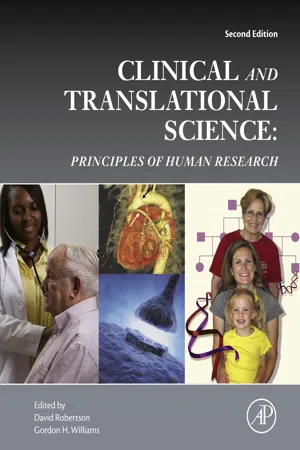
Clinical and Translational Science
Principles of Human Research
- 808 pages
- English
- ePUB (mobile friendly)
- Available on iOS & Android
eBook - ePub
About this book
Clinical and Translational Science: Principles of Human Research, Second Edition, is the most authoritative and timely resource for the broad range of investigators taking on the challenge of clinical and translational science, a field that is devoted to investigating human health and disease, interventions, and outcomes for the purposes of developing new treatment approaches, devices, and modalities to improve health.
This updated second edition has been prepared with an international perspective, beginning with fundamental principles, experimental design, epidemiology, traditional and new biostatistical approaches, and investigative tools. It presents complete instruction and guidance from fundamental principles, approaches, and infrastructure, especially for human genetics and genomics, human pharmacology, research in special populations, the societal context of human research, and the future of human research. The book moves on to discuss legal, social, and ethical issues, and concludes with a discussion of future prospects, providing readers with a comprehensive view of this rapidly developing area of science.
- Introduces novel physiological and therapeutic strategies for engaging the fastest growing scientific field in both the private sector and academic medicine
- Brings insights from international leaders into the discipline of clinical and translational science
- Addresses drug discovery, drug repurposing and development, innovative and improved approaches to go/no-go decisions in drug development, and traditional and innovative clinical trial designs
Information
Section II
Approaches
Chapter 8
Measurement of Biological Materials
Mark D. Kellogg Boston Children's Hospital, Boston, MA, United States
Abstract
This chapter summarizes various methods employed to characterize and quantify biological materials from human sources used in translational and clinical research. The measurement of biological compounds in body fluids and tissues is a critical component of clinical research and represents an objective endpoint for many trials, especially those involving therapeutic interventions. While there have been significant technological advances made to characterize and quantify biological compounds from in vivo sources, many of these are still immature technologies that may not be suitable for use in translational and clinical research. Much of what has been added in the past decade relates to using data from different biomolecules in a multiomics approach. The purpose of this chapter is to provide an overview, advantages, and disadvantages of select methods that are available to the clinical researcher to assess biological compounds from human material. The technologies that will be discussed are (1) immunochemical (2) mass spectrometry, and (3) nucleic acid sequencing.
Keywords
Immunoassay; Mass spectrometry; -Omics; Validation; Verification
Key Points
• Immunoassays represent the most frequently used and perhaps simplest approach to the analysis of biological materials for the translational researcher.
• Enzyme immunoassay (EIA) and enzyme linked immunoassay formats are the easiest to utilize and are widely commercially available. More sensitive methods of immunoassay (Electrochemiluminescence, RIA, fluorescence polarization immunoassay) require specialized instrumentation for use.
• The concept of buyer aware is very appropriate when selecting from the available commercial immunoassays. The “Research use only”–labeled kit requires the user to verify the performance of the assay before use with research samples. Numerous examples of commercially available immunoassays not measuring the stated molecule have been reported in the past few years.
• Mass spectrometry and the associated separation techniques of gas and liquid chromatography have become the de facto approach to the profiling and quantification of protein, lipids, carbohydrates, and even nucleic acids. Instrumentation and associated processes have resulted in the capability to generate significant amounts of data. This data deluge has created the need for informatics processes to change the data into useful information.
• Massively parallel sequencing of nucleic acids has been termed “next-generation sequencing” and has largely supplanted the use of microarray approaches to genomics. Similar to the mass spectrometric analysis of biological materials, this has resulted in huge amounts of data and the need for powerful informatics approaches to make these data useful.
• Multiomics is the combination of processes and data from the genomics, proteomics, lipidomics, transcriptomics, metabolomics, and other -omics areas. The concept is based on the recognition that the structure and function of the biological systems of interest to the translational research are interrelated and impacted by all of the -omics.
Introduction
This chapter summarizes various methods employed to characterize and quantify biological materials from human sources used in translational and clinical research. The measurement of biological compounds in body fluids and tissues is a critical component of clinical research and represents an objective endpoint for many trials, especially those involving therapeutic interventions. The purpose of this chapter is to provide an overview of select methods that are available to the clinical researcher to assess biological compounds from human material. The technologies that will be discussed are (1) immunochemical, including immunoassays and immunochemistry; (2) mass spectrometry (MS) as applied to small molecules, proteins, and metabolites; and (3) nucleic acid sequencing as applied to genomics. It should be noted that some of these methods, such as immunoassays, and some types of MS are significantly more mature technologies than are techniques used in genomics, proteomics, and metabolomics. Since the topics discussed herein provide an overview, the reader is referred to the references at the end of the chapter for a more detailed discussion of specific methodologies.
Immunoassays and Immunochemistry
Background
Immunoassay methodologies represent, perhaps, the most frequently used approach to measure biological compounds in translational and clinical research. Assays exist, from either commercial or research sources, for both the qualitative and quantitative measurement of a plethora of naturally occurring small molecules such as lipid mediators and hormones as well as larger peptides and proteins that are present in human body fluids and tissues (Davies, 1994). In addition, a number of therapeutic agents can be measured by immunoassays. It is important to note that immunoassays can not only measure antigens but antibodies as well. Many immunoassays are extremely sensitive and can detect as little as 0.1 pg of compound per milliliter of body fluid (Ashihara et al., 2001). This section will focus primarily on the most commonly used immunoassay approach—enzyme immunoassay (EIA). Mention will also be made about other immunoassay methods including radioimmunoassay (RIA), fluorescent and chemiluminescent immunoassays, precipitation immunoassays, and particle immunoassays.
Basic Principles
The first immunoassays resulted from the pioneering work of Yalow and Berson in the late 1950s and utilized antibodies labeled with a radioisotope like 125I. Regardless of the method used, all immunoassays rely upon the interaction of an antigen with an antibody (Davies, 1994). The extent to which this in...
Table of contents
- Cover
- Front Matter
- Table of Contents
- Copyright
- List of Contributors
- Acknowledgments
- List of Illustrations
- List of Tables
- Chapter 1 : Introduction to Clinical Research
- Chapter 2 : Patient-Oriented Research
- Chapter 3 : Clinical Trials
- Chapter 4 : Introduction to Epidemiology
- Chapter 5 : The Patient-Centered Outcomes Research Institute: Current Approach to Funding Clinical Research and Future Directions
- Chapter 6 : Health-Care Technology Assessment (HTA)
- Chapter 7 : Health Services Research: Translating Discovery and Research Into Practice and Policy
- Chapter 8 : Measurement of Biological Materials
- Chapter 9 : Imaging Tools in Clinical Research: Focus on Imaging Technologies
- Chapter 10 : Imaging Tools in Human Research: Focus on Image-Guided Intervention
- Chapter 11 : Nanotechnology in Clinical and Translational Research
- Chapter 12 : The Use of Questionnaires and Surveys
- Chapter 13 : Information Technology
- Chapter 14 : Principles of Biostatistics
- Chapter 15 : Good Clinical Practice and Good Laboratory Practice
- Chapter 16 : Introduction to Human Genetics∗
- Chapter 17 : Epidemiologic and Population Genetic Studies
- Chapter 18 : Pharmacogenetics of Drug Metabolism
- Chapter 19 : Statistical Techniques for Genetic Analysis
- Chapter 20 : Introduction to Clinical Pharmacology
- Chapter 21 : Adverse Drug Events
- Chapter 22 : Translating Science to the Bedside: The Innovation Pipeline
- Chapter 23 : Regulatory Environment
- Chapter 24 : Ethical Issues in Translational Research and Clinical Investigation
- Chapter 25 : Clinical Research in the Public Eye
- Chapter 26 : Research in Special Populations: Acute Illnesses; Critical Care; and Surgical Patients
- Chapter 27 : Research in the Emergency Care Environment
- Chapter 28 : Psychiatric Disorders
- Chapter 29 : Research in Special Populations: Geriatrics
- Chapter 30 : Clinical Research in Neurology
- Chapter 31 : Research in Pediatrics
- Chapter 32 : Cancer as a Paradigm for Translational and Clinical Biomedical Research
- Chapter 33 : Maintaining an Emphasis on Rare Diseases With Research Initiatives and Resources at the National Center for Advancing Translational Sciences
- Chapter 34 : Clinical and Translational Science Infrastructure
- Chapter 35 : Education, Training and Career Choices: Training Basic, Clinical, and Translational Investigators
- Chapter 36 : A Stepwise Approach to a Career in Translational Research
- Chapter 37 : Physician Careers in the Pharmaceutical Industry
- Chapter 38 : Industry-Sponsored Clinical Research in Academia
- Chapter 39 : Governmental Support of Research
- Chapter 40 : The Role of Nonprofit, Nongovernmental Funding in Support of Biomedical Research
- Chapter 41 : Modern Drug Discovery and Development
- Chapter 42 : Pharmaceutical and Biotechnology Sector Support of Research
- Chapter 43 : The Future of Clinical Research
- Index
- A
Trusted by 375,005 students
Access to over 1.5 million titles for a fair monthly price.
Study more efficiently using our study tools.
Frequently asked questions
Yes, you can cancel anytime from the Subscription tab in your account settings on the Perlego website. Your subscription will stay active until the end of your current billing period. Learn how to cancel your subscription
No, books cannot be downloaded as external files, such as PDFs, for use outside of Perlego. However, you can download books within the Perlego app for offline reading on mobile or tablet. Learn how to download books offline
Perlego offers two plans: Essential and Complete
- Essential is ideal for learners and professionals who enjoy exploring a wide range of subjects. Access the Essential Library with 800,000+ trusted titles and best-sellers across business, personal growth, and the humanities. Includes unlimited reading time and Standard Read Aloud voice.
- Complete: Perfect for advanced learners and researchers needing full, unrestricted access. Unlock 1.5M+ books across hundreds of subjects, including academic and specialized titles. The Complete Plan also includes advanced features like Premium Read Aloud and Research Assistant.
We are an online textbook subscription service, where you can get access to an entire online library for less than the price of a single book per month. With over 1.5 million books across 990+ topics, we’ve got you covered! Learn about our mission
Look out for the read-aloud symbol on your next book to see if you can listen to it. The read-aloud tool reads text aloud for you, highlighting the text as it is being read. You can pause it, speed it up and slow it down. Learn more about Read Aloud
Yes! You can use the Perlego app on both iOS and Android devices to read anytime, anywhere — even offline. Perfect for commutes or when you’re on the go.
Please note we cannot support devices running on iOS 13 and Android 7 or earlier. Learn more about using the app
Please note we cannot support devices running on iOS 13 and Android 7 or earlier. Learn more about using the app
Yes, you can access Clinical and Translational Science by David Robertson,Gordon H. Williams in PDF and/or ePUB format, as well as other popular books in Biological Sciences & Biology. We have over 1.5 million books available in our catalogue for you to explore.